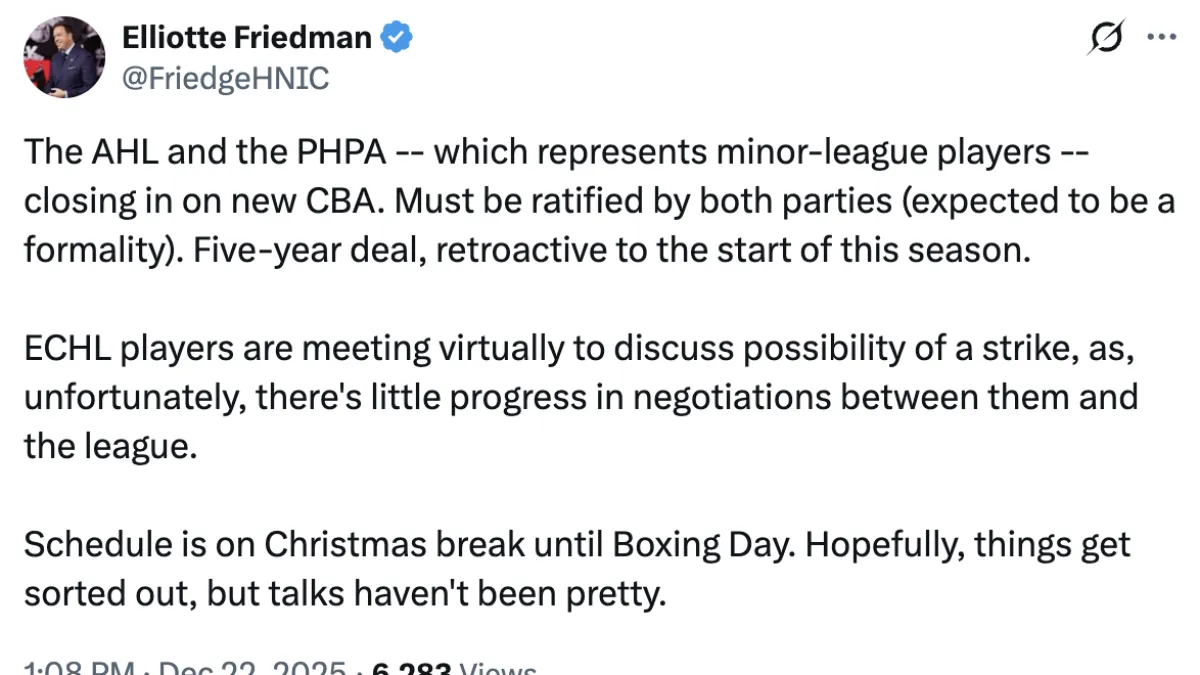
The American Hockey league (AHL) and the Professional Hockey Players’ Association (PHPA) have reached a tentative agreement on a new collective bargaining agreement (CBA). Announced on January 7, 2026, the deal aims to secure labor stability for the league, which serves as the primary developmental circuit for the NHL. This agreement still requires ratification by the AHL Board of Governors and PHPA membership across its U.S. and Canada-based teams.
Unlike recent turmoil in lower tiers, negotiations proceeded smoothly, avoiding any work stoppages. Players have been competing this season without a new CBA in place, but optimism had been building since late 2025.
Context of AHL labor relations
The AHL operates 31 teams and acts as a crucial pipeline to the NHL, with hundreds of players transitioning annually. The previous CBA expired before the 2025-26 season, prompting talks focused on compensation, benefits, and working conditions.
Negotiations gained momentum amid broader minor-league labor dynamics. Reports from November 2025 highlighted positive signals between the sides, contrasting with tensions elsewhere.
This tentative deal underscores proactive engagement. AHL Communications confirmed via social media: “The AHL and PHPA have reached a tentative deal on a new collective bargaining agreement. The agreement is subject to ratification by the AHL Board of Governors and by the PHPA’s AHL membership.”
The process reflects lessons from recent history. Stability ensures focus remains on development rather than disputes.
Key details emerging from the agreement
While full terms await official release, insiders have shared insights. Sportsnet’s Elliotte Friedman reported on X key improvements, including:
- Increases to minimum player salaries.
- Enhancements to the AHL playoff prize pool and per diem allowances.
- Expansion of veteran player spots per game, from five plus one emergency.
- Introduction of AHL-only, one-year entry-level contracts.
These changes address core player concerns like pay equity and roster security. Minimum salary hikes, in particular, could boost retention in a competitive market.
Veteran provisions aim to balance development with experience. Such adjustments mirror trends in NHL-affiliated leagues.
Ratification will clarify the deal’s duration and scope. Speculation points to a multi-year pact, potentially retroactive to stabilize the current campaign.
Lessons from the ECHL strike
The AHL agreement arrives weeks after drama in the ECHL, the tier below. Players there struck post-holiday break, postponing 41 games over pay, housing, and travel issues. Our coverage of the ECHL tentative CBA ending the strike detailed how a ratified five-year deal through 2030 brought peace.
Earlier reports on the ECHL strike threat amid 2025 CBA talks highlighted demands for better safety and rest provisions. The swift resolution there influenced higher leagues.
AHL teams avoided similar pitfalls by negotiating early. The ECHL’s official announcement emphasized ratification processes mirroring the AHL’s.
This contrast benefits the ecosystem. No disruptions mean uninterrupted player pathways to the NHL.
Next steps and ratification process
Ratification involves dual approvals: AHL governors and PHPA members. Expect votes soon, with implementation following promptly.
For context, The Athletic noted the league’s operation sans new CBA, underscoring urgency.
Player input remains vital. PHPA represents over 1,800 across AHL and ECHL, ensuring voices are heard.
Timeline suggests approval before playoffs. Delays could arise, but momentum favors quick passage.
Implications for players and the league
This deal fortifies the AHL’s role as NHL feeder. Better terms attract talent, enhancing competition.
Fans benefit from continuity. No stoppages preserve schedules and rivalries.
Development thrives under stability. Recent NHL call-ups trace AHL roots, a pipeline strengthened here.
Looking ahead, ratification paves way for focus on on-ice action. Expect refined rosters and sharper play as 2025-26 progresses toward playoffs.
The agreement signals maturing labor relations in minors. What it means for the NHL pipeline: sustained talent flow without interruptions.
Frequently Asked Questions

Par Mike Jonderson
Mike Jonderson is a passionate hockey analyst and expert in advanced NHL statistics. A former college player and mathematics graduate, he combines his understanding of the game with technical expertise to develop innovative predictive models and contribute to the evolution of modern hockey analytics.