
Alexander Zharovsky has emerged as one of the most intriguing stories leading up to the 2025 NHL draft. From relative obscurity to NHL Central Scouting’s fifth-ranked European skater, the Russian forward’s meteoric rise has captured the attention of scouts across the league. Playing for Tolpar Ufa in the MHL, Zharovsky showcased elite offensive creativity and skill that made him impossible to ignore, despite questions about competition level and consistency.
The 6-foot-1, 163-pound left-shot winger finished the 2024-25 MHL season with 24 goals and 50 points in 45 games, leading all U18 players in the league. What makes his emergence even more remarkable is that he was playing in Russia’s second-tier junior league just one year prior. His progression accelerated dramatically through the season, particularly in the second half where he accumulated 35 points in his final 22 games. Most impressively, after Tolpar’s early playoff exit, Zharovsky earned a call-up to Salavat Yulaev for their KHL playoff run, becoming the only U18 player to see action in the KHL postseason and recording an assist across seven appearances.
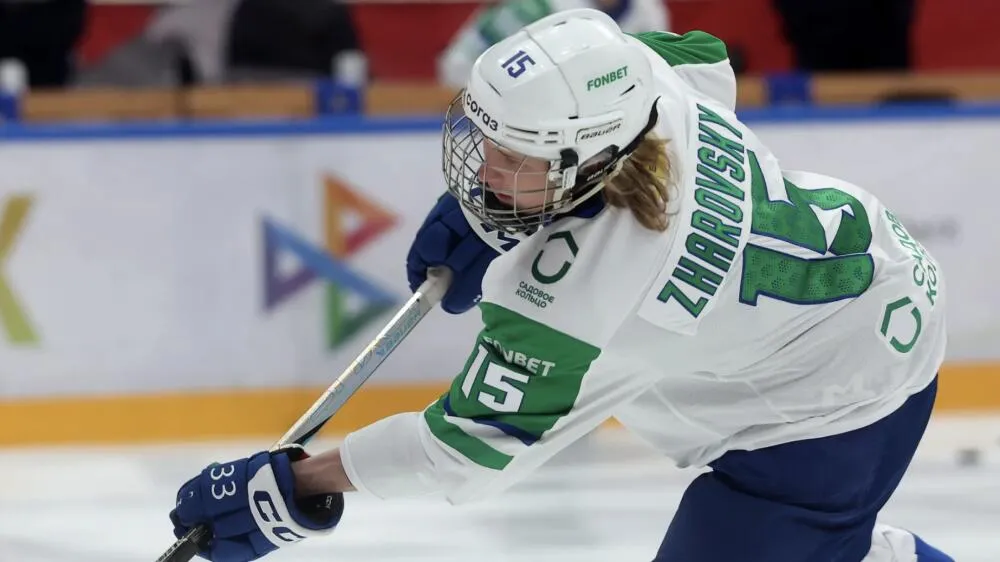
Elite offensive skills define the Alexander Zharovsky 2025 NHL draft prospect profile
Zharovsky’s game is built upon exceptional puck-handling ability that scouts consistently rank among the best in the entire 2025 draft class. His stickwork creates an almost hypnotic effect, allowing him to weave through defenders with an arsenal of dekes, fakes, and feints that leave opponents grasping at air. This elite control enables him to maintain possession in tight spaces and generate scoring chances from seemingly impossible situations.
The Russian winger demonstrates remarkable patience and deception in his offensive approach. Rather than forcing plays, he lulls defenders into false security before exploding with a quick burst of speed and dazzling puck manipulation. His ability to read defensive gaps and exploit them with precise timing separates him from typical junior prospects.
According to The Hockey Writers’ comprehensive breakdown, Zharovsky’s offensive creativity reached its peak during a dominant 12-game point streak from December 18 to February 15, during which he compiled 24 points. His production wasn’t merely accumulation—it reflected genuine game-breaking ability that forced opponents to adjust their entire defensive schemes around him.
SMAHT Scouting’s Gray Matter noted in their spring rankings: “He’s just so much fun, he’s dynamic and creative to a degree that I haven’t seen from many guys past this point in the draft. He brings quick-thinking and creative problem-solving under pressure, with a quick and fluid dynamic range of movement in his handling, impressive playmaking, and a dangerous shot release.”
His playmaking vision stands as another elite attribute. Zharovsky processes the game at an advanced level, identifying passing lanes that other prospects simply don’t see. His combination of handling skill and hockey IQ allows him to draw defenders toward him before delivering accurate, high-danger passes to open teammates. The pass-first mentality sometimes works against him, but when he’s firing on all cylinders, defenses struggle to account for both his individual skill and his ability to elevate linemates.
Skating and decision-making concerns in the Zharovsky scouting report
Despite his offensive wizardry, legitimate questions surround Zharovsky’s skating mechanics and overall speed. While his agility with the puck is impressive, his straight-line speed and explosiveness require significant development. The skating stride lacks power, and he often struggles to create separation from defenders when carrying the puck through the neutral zone. This deficiency becomes particularly concerning when projecting how his game will translate against faster, more athletic defenders in North American professional leagues.
His skating profile shows he’s more of an east-west player than a north-south attacker. The quick turns and changes of direction help him maintain possession, but without adding more explosiveness and top-end speed, he risks being caught between levels—too skilled for junior but not fast enough for the NHL pace. Improving his lower-body strength and refining his skating mechanics represent crucial development priorities.
Decision-making represents another area requiring refinement. Zharovsky occasionally tries to do too much himself, carrying the puck into crowds of defenders and attempting unnecessarily complex plays when simpler options exist. His shot selection also needs work—he tends to pass up catch-and-release opportunities in favor of carrying the puck closer, where his weaker shot becomes less of a liability.
The physicality component of his game remains underdeveloped. At 163 pounds, Zharovsky needs to add significant muscle mass to his 6-foot-1 frame. During his KHL playoff appearances, he frequently shied away from physical engagement, preferring to use his stick to disrupt plays rather than delivering body checks. Some of this hesitation likely stems from the intimidation factor of playing against professional men for the first time, but his reluctance to engage physically was evident in MHL games as well.
Dylan Griffing of Elite Prospects observed: “Is he out of control sometimes? Absolutely. However, when he’s composed, we see a player who manipulates with incredible handling skill and withstands pressure attempts with ease. He feasts on opponents barging towards him with simple, dynamic handles to send them the wrong way and take the space.”
Competition level questions cloud draft projection
The most significant caveat surrounding Zharovsky’s production involves the level of competition he faced. The MHL ranks below North American junior leagues and Swedish development circuits in overall quality, and Tolpar Ufa competed in the league’s weaker Eastern Conference. This reality creates substantial uncertainty about how his skills will translate against superior opponents.
The conference disparity became starkly apparent during the MHL playoffs. Despite finishing as the top seed in their conference, Tolpar was swept in the first round by the eighth seed from the stronger Western Conference. Zharovsky didn’t play a single game against teams from the better conference during the regular season, making it impossible to evaluate his production against elite MHL competition.
However, his KHL playoff performance provides crucial context. Playing depth minutes averaging just over six minutes per game, Zharovsky held his own against professional competition. The fact that Salavat Yulaev trusted him in their playoff run—and he responded with responsible, detail-oriented play—speaks volumes about his maturity and adaptability. He wasn’t called upon to be a game-breaker in those situations but rather to execute within a structured system, and he succeeded.
Following the KHL playoffs, Zharovsky dominated the Russian U18 playoffs with 12 goals in 10 games, further demonstrating his ability to elevate his performance when stakes increase. These experiences suggest his offensive skill is genuine, even if his MHL point totals require contextual asterisks.
Pension Plan Puppets’ in-depth analysis emphasized this dichotomy: “It’s great to see him weave through entire teams, fire ridiculous passes and deke the goalie out of his pants. But you likely saw at least a couple highlights and wondered what the hell the defenders around him were even doing. Can he replicate it against faster, better, stronger, more defensive players?”
Defensive growth and two-way potential emerge
One of the most encouraging developments in Zharovsky’s game has been his defensive improvement throughout the season. Early in the year, his off-puck engagement was inconsistent and his defensive zone coverage left much to be desired. By season’s end, particularly evident in his KHL stint, he demonstrated legitimate two-way awareness and commitment.
His defensive positioning improved markedly, with better anticipation of opponent movements and more active stick work to disrupt passing lanes. While he’ll never be confused with a shutdown defensive specialist, Zharovsky showed he can execute defensive responsibilities within a structured system. His hockey IQ translates to both ends of the ice—he reads plays developing, scans effectively, and positions himself appropriately.
The work rate and compete level also evolved considerably. Zharovsky began providing more consistent backchecks, battling through traffic more willingly, and engaging in board battles despite his lean frame. During KHL playoff action, coaches trusted him in defensive situations, a remarkable vote of confidence for a 17-year-old playing his first professional games.
Jason Bukala of Sportsnet noted: “Zharovsky is one of my sleepers in this draft class. He’s an elusive offensive winger who’s a consistent threat to score at even strength and the power play. His skating stride is solid, he now needs to add more strength, which will lead to better separation in open ice.”
His transition game represents another strength. Zharovsky effectively pushes pace up ice with controlled carries, generating momentum into the offensive zone with consistency. He also demonstrates the composure to slow the game down when appropriate, curling back to find trailers or attacking gaps that over-aggressive defenders create. This dual-speed ability suggests the hockey sense to adapt his approach based on what defenses provide.
Draft range and team fit for Zharovsky
NHL Central Scouting’s fifth-ranked European skater designation theoretically positions Zharovsky as a potential late first-round selection. However, most independent scouting services project him in the second round, with rankings ranging from the mid-30s to the low-50s. The Russian factor, competition concerns, and physical development needs create enough risk to push him outside the first round despite his elite skill set.
Bob McKenzie’s TSN ranking placed him 35th overall, while Elite Prospects had him 42nd in their final rankings. The consensus seems to be settling around the middle of the second round as his likely landing spot, though a team enamored with his offensive upside could reach earlier. Conversely, risk-averse organizations might wait until the third round if concerns about his skating and competition level outweigh the skill appeal.
The Montreal Canadiens ultimately selected Zharovsky 34th overall in the 2025 NHL Draft, using a pick acquired from the Carolina Hurricanes in a trade involving picks 41 and 49. The selection represents a bet on pure offensive skill and the belief that his physical development and skating improvements will come with professional training and maturation.
Henry Lawrence of McKeen’s Hockey offered an optimistic projection: “Zharovsky’s dominance this season has been impressive, to say the least. The most exciting element to his projection is the fact that it still looks like he has many more levels to his game that he can reach. If all goes well, Alex could easily become a smart and dangerous top-six playmaker who makes difficult plays look effortless against the world’s best defenders.”
For teams drafting in the second or third round, Zharovsky represents the rare opportunity to acquire genuine game-breaking skill—the type that’s typically reserved for first-round selections. His risk-reward profile skews toward high on both ends: significant developmental hurdles exist, but the ceiling of an offensively dynamic top-six winger makes the gamble worthwhile for organizations willing to invest in his growth and patient with his timeline.
The Russian development pathway adds another layer of complexity. Zharovsky will need time to adjust to North American ice surfaces, professional strength and conditioning programs, and the significantly higher pace of play. His lean frame requires at least another year or two of physical maturation before he can handle the rigors of professional hockey on smaller rinks. However, for a team selecting outside the first round, finding a prospect with his offensive ceiling represents excellent value, even accounting for the inherent uncertainties.
Zharovsky’s remarkable ascent from unranked prospect to second-round selection embodies the unpredictable nature of draft evaluation. His combination of elite puck skills, improving two-way awareness, and genuine offensive creativity offers NHL teams a compelling development project. While questions about competition level, skating mechanics, and physical readiness require honest assessment, the raw skill is undeniable. For the organization that drafted him, the hope is that his offensive wizardry continues translating up the competitive ladder, ultimately producing a dynamic scorer capable of impacting NHL games with the same creativity he displayed dominating the MHL.

Par Mike Jonderson
Mike Jonderson is a passionate hockey analyst and expert in advanced NHL statistics. A former college player and mathematics graduate, he combines his understanding of the game with technical expertise to develop innovative predictive models and contribute to the evolution of modern hockey analytics.