







The 2001 Alexei Yashin trade between the New York Islanders and Ottawa Senators stands as one of the most fascinating and lopsided transactions in modern NHL history. On June 23, 2001, during the NHL Entry Draft in Sunrise, Florida, the Senators dealt their disgruntled star center to the Islanders in exchange for defenseman Zdeno Chara, forward Bill Muckalt, and the second overall pick in the draft. What appeared on the surface to be a blockbuster acquisition for the Islanders would ultimately become a cautionary tale about overpaying for talent, while Ottawa’s haul would pay dividends for years to come.
The trade came at a pivotal moment for both franchises. The Senators were looking to move on from Yashin after a bitter contract dispute that saw him sit out the entire 1999-2000 season, while the Islanders, desperate to end their playoff drought that had stretched since 1993-94, believed they were acquiring the franchise center who could change their fortunes. General manager Mike Milbury’s gamble would prove costly, while Ottawa GM Marshall Johnston’s decision to “turn the page” would reshape the Senators’ roster for the better part of a decade.
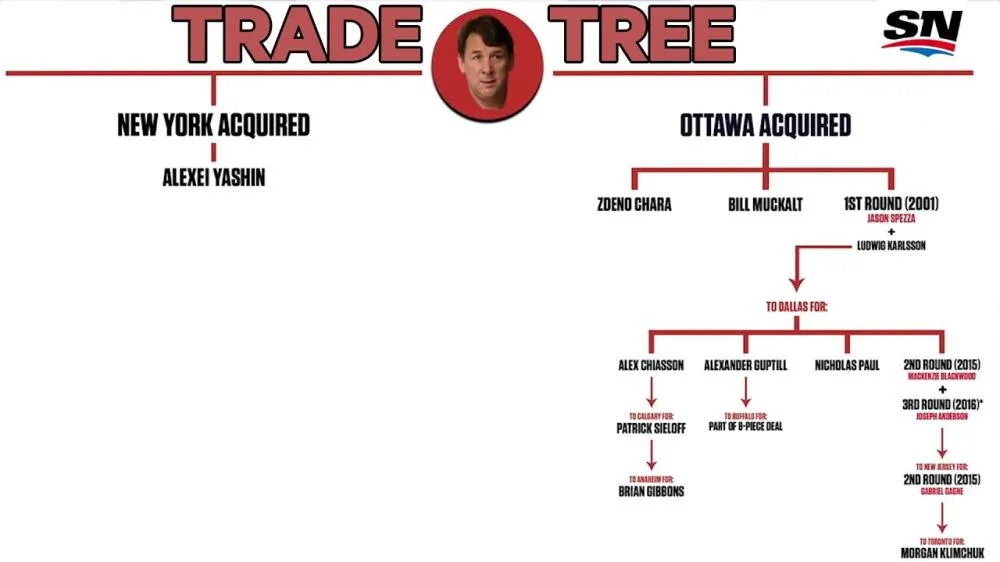
The backstory to the Alexei Yashin trade 2001 Islanders Senators deal
Alexei Yashin had established himself as one of the premier offensive centers in the NHL during his seven seasons with the Senators. He posted nearly a point-per-game average with 491 points in 504 regular season games, including a career-high 94 points in 1998-99 that earned him runner-up honors for the Hart Trophy as league MVP. His skill level and offensive creativity made him one of the franchise’s cornerstone players, ranking fourth all-time in Senators scoring history.
However, Yashin’s relationship with the organization deteriorated dramatically following a contract dispute. Despite making $3.6 million in the final year of his deal, Yashin believed he was significantly underpaid compared to his contributions. When the team refused to renegotiate, he made the bold decision to sit out the entire 1999-2000 season in protest. The standoff created a rift that would never fully heal, even after he returned to play the 2000-01 campaign.
That final season in Ottawa showcased both Yashin’s brilliance and the lingering tension. He led the team with 40 goals and 88 points during the regular season, but when the second-seeded Senators were swept by Toronto in the first round of the playoffs, Yashin managed just one assist in four games. The disappointing postseason performance only reinforced management’s belief that it was time to part ways. With Yashin set to become a restricted free agent on July 1 and seeking an $8 million annual contract, the Senators knew they couldn’t afford to keep him.
The trade market for Yashin was robust, but the Islanders emerged as the most aggressive suitor. Mike Milbury, known for his bold and sometimes reckless moves, saw an opportunity to land a legitimate first-line center who could transform his struggling franchise. “We’ve got so many draft picks in our stable of young players and it’s time for us to advance the cause,” Milbury said after completing the deal. “We’re thrilled he’s going to be part of our organization. A premium first-line center is hard to come by.”
What the Islanders received in the Alexei Yashin trade 2001 Islanders Senators transaction
The Islanders’ acquisition of Yashin represented their most significant move in years, a clear signal that the team was ready to compete. Upon securing his services, New York immediately locked him into a mammoth 10-year contract worth nearly $64 million, one of the largest deals in NHL history at the time. The commitment demonstrated just how much faith the organization placed in the Russian center’s ability to lead them back to relevance.
On the ice, Yashin produced respectable numbers for the Islanders, though never quite at the elite level the organization had hoped for. Over 346 regular season games spanning parts of six seasons, he tallied 119 goals and 290 points, maintaining a 0.84 point-per-game average. While solid production, it represented a noticeable decline from his 0.97 mark in Ottawa and failed to justify the enormous financial investment the team had made.
The contract quickly became an albatross around the franchise’s neck. As the NHL’s salary cap era arrived following the 2004-05 lockout, Yashin’s massive deal limited the team’s flexibility to add complementary pieces. His defensive shortcomings became more pronounced, and questions about his leadership and commitment in crucial moments echoed the same criticisms that had followed him from Ottawa. The situation became untenable, leading to the Islanders buying out the remainder of his contract on June 6, 2007.
The buyout proved financially crippling for years to come. The Islanders were forced to pay Yashin just over $2.2 million annually through the 2014-15 season, money that counted against their salary cap despite him no longer being on the roster. Yashin never played another NHL game after the buyout, instead returning to Russia to finish his career in the KHL with stops at Lokomotiv Yaroslavl, SKA St. Petersburg, and CSKA Moscow before retiring in 2012. For the Islanders, the Yashin era stood as one of the most expensive mistakes in franchise history, costing them not only the assets they surrendered but also years of cap flexibility.
The Ottawa Senators’ haul from the Alexei Yashin trade 2001 Islanders Senators swap
While the Islanders struggled with their acquisition, the Senators emerged as clear winners almost immediately. The three assets they received—Chara, Muckalt, and the draft pick—would have vastly different impacts, but the two significant pieces more than justified Marshall Johnston’s decision to move on from Yashin. As Johnston stated after the trade, “We’ve turned the page. Alexei was with our franchise, contributed to the early success of our franchise and we wish him the best.”
Bill Muckalt represented the minor piece of the return package. The 27-year-old forward served as a depth player during the 2001-02 season, appearing in 70 games while averaging about 10 minutes of ice time per contest. He contributed eight assists and added some physicality with 46 penalty minutes, providing exactly the type of fill-in role player teams need. After that single season in Ottawa, Muckalt signed with Minnesota but played just eight games before his NHL career came to an end.
Zdeno Chara, on the other hand, blossomed into one of the league’s premier defensemen during his four seasons with the Senators. The 6-foot-9 Slovak had shown glimpses of potential with the Islanders, posting modest offensive numbers while bringing intimidating physicality, but he truly came into his own in Ottawa. Between 2001 and 2006, Chara became a workhorse on the blue line, averaging nearly 25 minutes per game while recording 146 points in 299 regular season contests. According to The Hockey Writers’ analysis, he finished second and fourth in Norris Trophy voting in his final two seasons with the club, legitimizing himself as a true top-pairing defenseman.
When Chara’s contract expired in 2006, the Senators faced a difficult decision between re-signing him or Wade Redden. They chose Redden, allowing Chara to sign with the Boston Bruins as a free agent. That decision would prove regrettable as Chara went on to captain the Bruins to a Stanley Cup championship in 2011 and played another 14 seasons, cementing his legacy as one of the greatest defensemen of his generation. Despite leaving Ottawa relatively early in his prime, Chara still ranks fourth in franchise history for defensive scoring.
Jason Spezza and the long-term impact of the Alexei Yashin trade 2001 Islanders Senators deal
The crown jewel of Ottawa’s return was the second overall pick in the 2001 NHL Entry Draft, which they used to select Jason Spezza. The young center from the Ontario Hockey League had been touted as a potential first overall pick despite some questions about his skating. His offensive credentials were undeniable—116 points including 43 goals in just 56 games during his draft year at age 17. The Senators believed they were selecting a future franchise cornerstone, and they were proven absolutely correct.
Spezza made his NHL debut as a 19-year-old during the 2002-03 season, immediately showing promise with 21 points in 33 games. From there, his development accelerated rapidly. Over parts of 11 seasons in a Senators uniform, Spezza established himself as one of the most dynamic offensive centers in franchise history, notching four 80-point campaigns and twice surpassing the 90-point plateau. His playmaking ability and hockey IQ made him a constant threat, capable of threading passes through the smallest windows and creating offense seemingly at will.
By the time his tenure in Ottawa concluded, Spezza had accumulated 687 points in 686 regular season games, placing him second on the team’s all-time scoring list behind only Daniel Alfredsson. He also showed up in the playoffs, particularly during the Senators’ memorable 2006-07 postseason run when he contributed 22 points in 20 games as the team advanced to the Stanley Cup Final. Spezza’s consistency and production made him the exact type of number-one center the Senators needed after moving on from Yashin.
The relationship between Spezza and the franchise eventually soured toward the end of his time in Ottawa. In the final year of a seven-year contract extension he’d signed in 2007, the team traded him to the Dallas Stars in 2014 for a package of players who never made significant impacts. While that trade didn’t work out as well for Ottawa, it couldn’t diminish what Spezza had accomplished during his prime years—a direct result of the Yashin trade years earlier.
The contrasting fortunes of the two teams illuminate why the deal is remembered so differently in each city. For Ottawa, the trade represented both excellent asset management and good fortune. They turned a disgruntled star into a Hall of Fame defenseman and a franchise center, completely resetting their organizational trajectory. The Senators remained competitive throughout the mid-2000s, reaching the Stanley Cup Final in 2007 with a core that included both Chara and Spezza.
Why the Alexei Yashin trade 2001 Islanders Senators remains a cautionary tale
The Yashin trade serves as a masterclass in the dangers of overcommitting to a single player, particularly one with red flags already visible in their history. The Islanders’ desperation to end their playoff drought clouded their judgment, leading them to not only surrender significant assets but also lock themselves into a contract that would haunt them for over a decade. ESPN’s analysis at the time noted that the Senators received decent short-term value on a deal they had to make for financial reasons, though even that assessment proved conservative given how the assets developed.
Mike Milbury’s tenure as Islanders general manager is remembered for a series of questionable decisions, but the Yashin trade and subsequent contract extension stands out as perhaps his most damaging. The move exemplified the kind of win-now mentality that sacrifices long-term stability for immediate gratification. While Milbury’s quote about having “so many draft picks” and needing to “advance the cause” made sense in theory, the execution proved disastrous. The team failed to make the playoffs during Yashin’s tenure despite the massive investment, and the buyout penalties hamstrung the franchise well into the next decade.
From Ottawa’s perspective, the trade demonstrated the value of patience and asset accumulation. Rather than accepting a lesser return simply to move an unhappy player, the Senators held firm until they found a partner willing to overpay. The fact that both Chara and Spezza became elite players at their respective positions wasn’t entirely predictable, but Ottawa put themselves in position to benefit from their development. Even if those players had been merely good rather than great, the Senators still would have won the trade given Yashin’s ultimate trajectory with New York.
The salary cap era that began after the 2004-05 lockout further exposed the flaws in the Islanders’ approach. Yashin’s contract, signed in the pre-cap era, became even more burdensome under the new financial restrictions. Teams could no longer simply spend their way out of bad decisions, making the buyout penalty payments particularly painful. The Islanders’ inability to compete throughout the late 2000s and early 2010s can be traced in part to the financial constraints imposed by Milbury’s mistakes, with Yashin’s deal serving as the most prominent example.
For players in similar positions, the Yashin saga offers important lessons about reputation and perception. Despite putting up solid numbers in New York, Yashin could never shake the narrative that he was a selfish player who disappeared when it mattered most. His postseason performances rarely matched his regular season production, and the contract situation in Ottawa followed him throughout his career. Even years after his retirement, Yashin is remembered more for his controversies than his considerable on-ice accomplishments.
The ripple effects of the trade continued for years beyond the immediate exchange. Chara’s departure from Ottawa to Boston eventually influenced the Senators’ defensive structure for seasons to come, while his success with the Bruins raised questions about whether the team had made the right choice in letting him walk. Similarly, when Ottawa eventually traded Spezza to Dallas, they received far less in return than the value he had provided, struggling to replace his offensive production. The Stars benefited from having an elite center for several seasons, a direct descendant of the original Yashin trade tree.
Looking back more than two decades later, the Alexei Yashin trade between the Islanders and Senators stands as one of the most one-sided deals in NHL history. While Yashin himself was a talented player who contributed meaningfully during his years in New York, the combination of assets surrendered and the financial commitment made transformed what could have been a reasonable gamble into a franchise-altering mistake. The Senators, meanwhile, parlayed a difficult situation with a disgruntled star into years of competitive success, adding two foundational pieces who defined their golden era.
The trade remains required study material for NHL general managers, a reminder that championship-caliber teams are built through patience, smart asset management, and avoiding the temptation to mortgage the future for immediate results. Mike Milbury’s aggressive move to acquire Yashin demonstrated ambition but lacked the careful evaluation necessary for sustainable success. Marshall Johnston’s willingness to trade a star player and trust in his scouting staff’s evaluation of Chara and Spezza showed the kind of calculated risk-taking that separates good organizations from struggling ones. In the final analysis, the 2001 deal serves as both a warning and a blueprint—a testament to how a single transaction can reshape multiple franchises for years to come.

Par Mike Jonderson
Mike Jonderson is a passionate hockey analyst and expert in advanced NHL statistics. A former college player and mathematics graduate, he combines his understanding of the game with technical expertise to develop innovative predictive models and contribute to the evolution of modern hockey analytics.