


The first overall pick in the 2020 NHL Draft was supposed to be entering his prime years with the New York Rangers, but the 2024-25 season told a different story for Alexis Lafrenière. After a promising breakout campaign in 2023-24 where he posted career highs of 28 goals and 57 points, the young winger took a significant step backward at the worst possible time. His regression came immediately after signing a lucrative seven-year contract extension worth $52.15 million, raising questions about whether the Rangers locked in a future star or overpaid for potential that may never fully materialize.
The Alexis Lafrenière underperforming with New York Rangers 2024-25 season narrative became impossible to ignore as the campaign progressed. Finishing with just 17 goals and 45 points across 82 games, Lafrenière’s production dropped by 12 points and 11 goals compared to the previous year. His minus-13 rating highlighted his defensive struggles, and his 11.1% shooting percentage marked a concerning decline. For a player who was supposed to be taking another leap forward, the numbers painted a picture of stagnation and inconsistency at a critical juncture in his development.
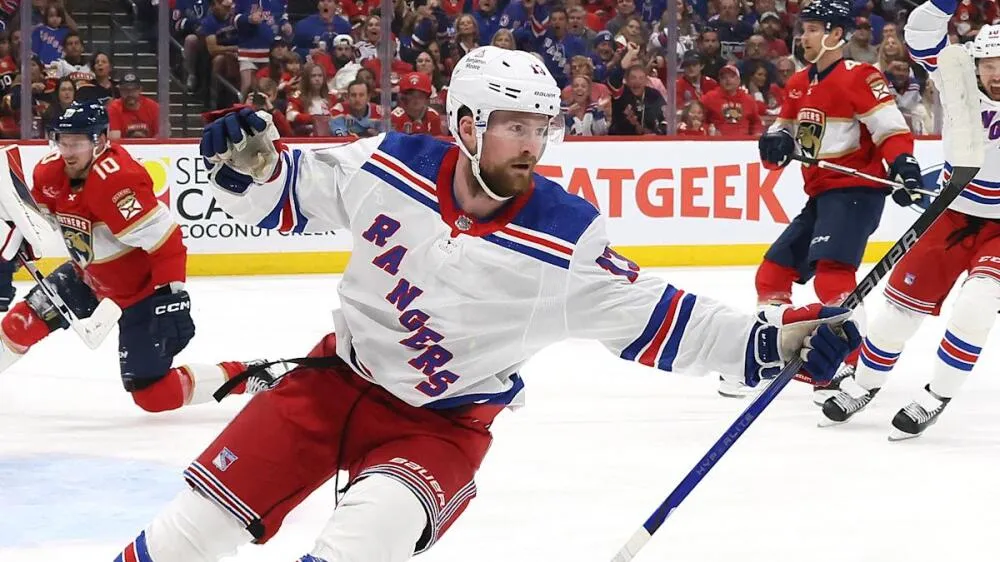
Understanding Alexis Lafrenière underperforming with New York Rangers 2024-25 season statistics
The raw statistics reveal a troubling trend for Lafreniéres’s second half of the season. While he started strong with seven points in his first seven games immediately following his contract announcement on October 25, 2024, the remainder of the campaign was marked by prolonged droughts and inconsistent production. Over the final 75 games, Lafrenière managed just 37 points, a pace that falls well short of expectations for a top-line winger earning nearly $8 million per season.
The most glaring issue was Lafrenière’s goal-scoring drought. According to detailed reports, he endured a 13-game goalless streak from December 9 to January 5, which was part of an even longer struggle where he scored just one goal in 21 games stretching from November 23 through January 5. These cold stretches became a recurring theme, as he later suffered another 14-game goalless drought from February 5 through March 13. During the crucial stretch run of February, March, and April combined, Lafrenière managed just four total goals.
Perhaps most concerning was the dramatic reduction in shot volume. Lafrenière registered 64 fewer shots on goal compared to his 2023-24 breakout season, indicating either decreased offensive opportunities or a reluctance to shoot when chances presented themselves. This decrease in shooting attempts, combined with his lower shooting percentage, created a perfect storm for offensive regression that the Rangers could ill afford during a tumultuous season.
However, context matters when evaluating the Alexis Lafrenière underperforming with New York Rangers 2024-25 season situation. The Rangers as an organization struggled mightily, with nearly every player experiencing statistical declines. The team’s power play ranked as its least effective in a decade, and Lafrenière’s limited power-play time—averaging just 1:34 per game and ranking seventh on the team—significantly impacted his raw point totals. With minimal special teams opportunities, Lafrenière’s offensive production relied almost entirely on even-strength play.
The contract extension and its immediate impact on performance
The timing of Lafrenière’s contract extension couldn’t have been more unfortunate. Signed on October 24, 2024, the seven-year deal worth $7.45 million annually immediately placed heightened expectations on the young forward’s shoulders. The Rangers’ commitment to their former first overall pick was supposed to signal confidence in his continued development and provide the security needed to play freely without the distraction of contract negotiations.
Instead, the opposite appeared to occur. While correlation doesn’t equal causation, Lafrenière’s sharp decline following his hot start raised questions about pressure and expectations. After those initial seven games where he looked every bit the player the Rangers believed they were investing in, something changed. Whether it was the weight of the contract, external pressure, or simply bad luck converging with a team-wide collapse, Lafrenière never regained that early-season form.
The contract also shifted the narrative around Lafrenière’s performance. Prior to the extension, he was viewed as a developing player still working toward his potential. Post-extension, every shift became scrutinized through the lens of value and production relative to his cap hit. In a salary cap era where every dollar matters, a $7.45 million player producing at a 45-point pace simply doesn’t provide adequate return on investment, regardless of age or potential.
Team insiders noted that the locker room dysfunction that plagued the Rangers throughout the season likely impacted Lafrenière more than established veterans. At just 23 years old and not part of the leadership core, Lafrenière found himself caught in the crossfire of organizational turmoil without the experience or standing to influence the situation positively. While he wasn’t identified as a cause of the chemistry issues, he also wasn’t positioned to be part of the solution.
Breaking down the even-strength production despite struggles
Despite the disappointing overall numbers, digging deeper into Lafrenière’s even-strength metrics reveals a more nuanced picture of his 2024-25 campaign. Of his 45 total points, 40 came at 5-on-5—second on the Rangers in that category. He ranked third on the team in both 5-on-5 goals (15) and 5-on-5 assists (25), demonstrating that his production issues weren’t entirely self-inflicted.
More impressively, Lafrenière led the Rangers with 18 primary assists at even strength, according to Natural Stat Trick data. Primary assists—the second-to-last player to touch the puck before a goal—often indicate direct involvement in offensive creation rather than secondary contributions. This statistic suggests Lafrenière continued to generate quality offensive chances and make plays that directly led to goals, even when his own goal-scoring touch abandoned him.
His possession metrics, while not matching the heights of his breakout 2023-24 season, remained positive throughout the campaign. Lafrenière maintained respectable Corsi For percentages, and in the two games played without linemate Artemi Panarin, he recorded a 53.1 CF% and 60 CF% respectively. While the Rangers lost both games, Lafrenière stood out as one of the few positive contributors, suggesting his ability to drive play wasn’t entirely dependent on skating alongside an elite playmaker.
The argument that Lafrenière was merely “riding Panarin’s coattails” during his previous success doesn’t hold up under scrutiny. His ability to contribute effectively both with and without star linemates demonstrates legitimate offensive skill. The decline in his overall possession metrics aligned with the team’s general drop in performance rather than indicating individual regression. In an environment where the entire roster struggled, Lafrenière’s ability to remain net-positive in possession deserves recognition, even if the counting stats disappointed.
Physical development and secondary contributions worth noting
One underappreciated aspect of the Alexis Lafrenière underperforming with New York Rangers 2024-25 season discussion is his improved physicality. Lafrenière registered 46 more documented hits compared to the previous season while incurring two fewer penalty minutes. This increased physical engagement came despite averaging 16 seconds less ice time per game—a difference that accumulates to over 21 fewer minutes across a full 82-game season.
This physical development represents important progress for a player whose work ethic and compete level have faced occasional criticism throughout his young career. Lafrenière has always possessed an edge to his game, but the 2024-25 season saw him embrace a more assertive, physical style of play. His reverse hit on Nic Dowd during a March 6, 2025 game against Washington became a minor social media sensation, highlighting his willingness to initiate contact and stand his ground in board battles.
The combination of increased physicality and defensive zone improvements shows Lafrenière working to become a more complete player. His zone exit numbers demonstrated solid improvement, suggesting better decision-making with the puck in defensive situations. These developments point toward a player actively working on the non-scoring aspects of his game, even as his offensive production faltered.
However, these secondary contributions don’t fully offset the primary concern: goal scoring. Lafrenière’s draft pedigree and contract demands offensive production. While rounding out his game with physicality and defensive reliability is valuable, the Rangers ultimately need him to put pucks in the net. A well-rounded 45-point player earning $7.45 million annually doesn’t help a team win championships, regardless of how many hits he delivers or how well he exits the defensive zone.
The power play puzzle and special teams absence
Perhaps no single factor better explains the Alexis Lafrenière underperforming with New York Rangers 2024-25 season than his limited power-play opportunities. Despite recording career-high power-play ice time at 1:34 per game, Lafrenière ranked just seventh on the team in that category, relegating him primarily to second-unit duty. This placement meant inconsistent opportunities and often resulted in him watching from the bench during crucial power plays.
The Rangers’ power play operated at historically low efficiency during 2024-25, marking their worst performance in a decade. When the team’s special teams struggle this dramatically, players on the fringes of power-play deployment suffer disproportionately. Lafrenière’s two power-play goals and two power-play assists represented a minuscule portion of his overall production, highlighting how little impact special teams had on his season.
Statistical projections suggest that even modest improvement in power-play deployment and efficiency could have significantly altered perception of Lafrenière’s season. If the Rangers’ power play had performed just a few percentage points better and Lafrenière had received more consistent first-unit time, he could have reasonably added 5-10 points to his total. That difference—transforming a 45-point season into a 50-55 point campaign—would have shifted the narrative from regression to stagnation, a meaningful psychological distinction.
The power-play situation raises questions about coaching decisions under former head coach Peter Laviolette. With Lafrenière demonstrating offensive capabilities and possessing one of the better shots on the team, his limited power-play deployment seemed counterintuitive. Whether this was due to Laviolette’s preference for established veterans or concerns about Lafrenière’s power-play awareness remains unclear, but the result was undeniable: a significant offensive talent was underutilized in prime scoring situations.
Looking ahead with coaching changes and organizational reset
The arrival of new head coach Mike Sullivan brings hope for a Alexis Lafrenière underperforming with New York Rangers 2024-25 season bounce-back in 2025-26. Sullivan’s reputation for player development and maximizing offensive talent suggests potential changes in deployment, usage, and opportunity that could benefit Lafrenière. A fresh voice, new systems, and reset expectations might be exactly what both Lafrenière and the Rangers need after a tumultuous campaign.
Sullivan’s track record with young offensive players in Pittsburgh, including his work with Jake Guentzel and Bryan Rust, demonstrates an ability to unlock production from talented wingers. His willingness to give opportunities based on merit rather than veteran status could result in increased power-play time for Lafrenière, addressing one of the most significant limiting factors of his 2024-25 season. If Sullivan can restore even league-average efficiency to the Rangers’ power play while giving Lafrenière consistent first-unit minutes, a return to 20-goal, 60-point production becomes realistic.
The organizational reset following the disappointing 2024-25 campaign also provides Lafrenière with a clean slate. The locker room dysfunction that plagued the team throughout the season has been addressed through roster moves and leadership changes. Without the distraction of internal conflict and with renewed focus on collective goals, Lafrenière can concentrate entirely on his on-ice performance rather than navigating political minefields in the dressing room.
At 23 years old entering the 2025-26 season, Lafrenière still possesses significant room for growth. While his development trajectory hasn’t followed the linear path many anticipated when he was drafted first overall, he’s shown flashes of the player he can become. The 28-goal, 57-point season of 2023-24 proves the ceiling exists. The challenge now is establishing that level as his floor rather than his peak, demonstrating the consistency befitting a top-line winger on a championship-caliber team.
The Rangers’ commitment to Lafrenière isn’t going anywhere—his contract runs through 2032. Whether that investment pays dividends or becomes an albatross depends largely on how Lafrenière responds to adversity. The 2024-25 season tested him in ways his breakout campaign didn’t, exposing weaknesses in consistency, mental resilience, and goal-scoring reliability. How he addresses those weaknesses will define his career trajectory and ultimately determine whether the Rangers’ faith in their former first overall pick was justified or premature. With a new coaching staff, renewed organizational focus, and the motivation that comes from a disappointing season, Lafrenière has every opportunity to prove the 2024-25 campaign was an aberration rather than a harbinger of things to come.

Par Mike Jonderson
Mike Jonderson is a passionate hockey analyst and expert in advanced NHL statistics. A former college player and mathematics graduate, he combines his understanding of the game with technical expertise to develop innovative predictive models and contribute to the evolution of modern hockey analytics.