









Now I have enough information to write a comprehensive article. Let me create the blog post.
When the Vancouver Canucks traded their captain Bo Horvat to the New York Islanders on January 30, 2023, the hockey world split into two camps. Some viewed it as a necessary reset for a struggling franchise, while others saw it as the end of an era that could haunt Vancouver for years. Two years removed from the blockbuster deal that sent Horvat to Long Island in exchange for Anthony Beauvillier, Aatu Räty, and a conditional 2023 first-round pick, the verdict is finally becoming clear. Both organizations have traveled divergent paths since that winter day, and the ripple effects of this transaction continue to shape their respective futures in ways few could have predicted.
The trade itself wasn’t just about hockey assets—it represented a philosophical shift for both franchises. For the Canucks, it meant choosing J.T. Miller over their homegrown captain. For the Islanders, it signaled an all-in approach to support Mat Barzal with legitimate offensive firepower. As we dissect this deal from every angle, one thing becomes abundantly clear: the Bo Horvat trade analysis reveals layers of complexity that extend far beyond simple box scores and point totals.
The trade details and immediate aftermath for the Canucks and Islanders
The blockbuster deal materialized during one of the most turbulent periods in recent Canucks history. General manager Patrik Allvin, facing his first major test with the organization, made the call to move on from Horvat despite the center being on pace for a career-defining season. With 31 goals in 49 games, Horvat was playing the best hockey of his life, making the timing of the trade particularly gutting for Vancouver fans who had watched him develop from a promising first-round pick into a dependable two-way center.
The return package centered on three key pieces. Beauvillier arrived as a proven top-six forward with playoff experience, having been part of the Islanders’ back-to-back conference finals appearances. Räty represented the long-term investment—a Finnish center prospect with first-round pedigree who had fallen to the second round in 2021. The conditional first-round pick, which would become unprotected if the Islanders reached the 2023 Eastern Conference Final, gave Vancouver flexibility for future moves.
For the Islanders, the acquisition addressed their most glaring weakness. Despite possessing one of the league’s best defensive systems under head coach Lane Lambert, the team struggled to generate consistent offense beyond Barzal. Lou Lamoriello, never one to shy away from bold moves, identified Horvat as the missing piece. Within days of the trade, the Islanders locked Horvat into an eight-year, $68 million contract with an $8.5 million annual cap hit, signaling their long-term commitment.
The immediate aftermath told contrasting stories. Horvat’s production dipped upon arrival in New York, managing just seven goals in 30 games to close out the 2022-23 season. Meanwhile, Beauvillier posted nine goals and 20 points in 31 games with Vancouver, providing a temporary offensive boost to a team limping toward the finish line. Neither team made the playoffs that spring, leaving both fanbases questioning whether the trade had accomplished its intended purpose.
Bo Horvat’s performance with the Islanders: a comprehensive statistical breakdown
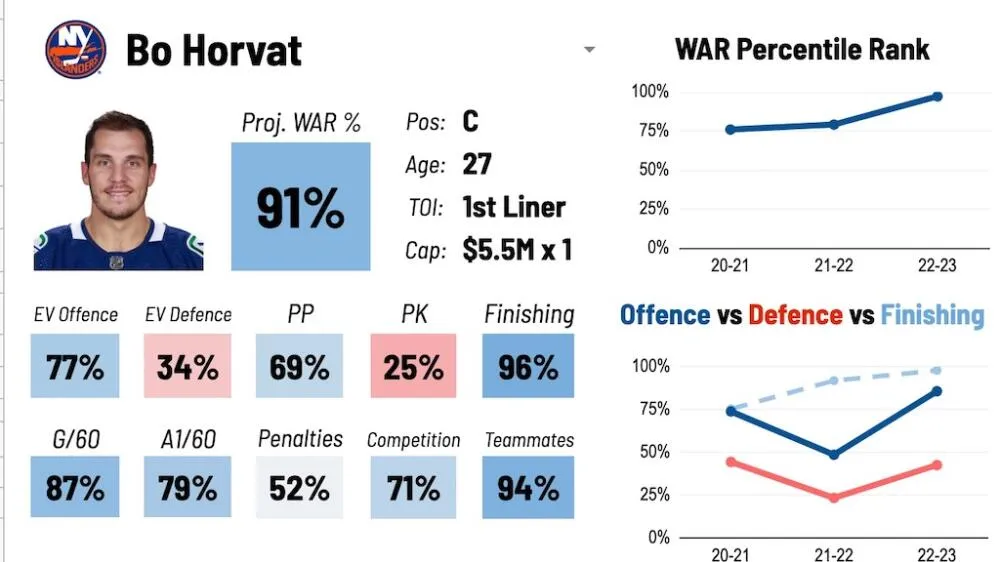
The true measure of Horvat’s impact on Long Island emerged in his first full season with the organization. The 2023-24 campaign showcased exactly what the Islanders had envisioned when they surrendered significant assets for his services. Playing primarily alongside Barzal and captain Anders Lee, Horvat recorded 33 goals and 68 points across 81 games, reestablishing himself as a legitimate top-line center capable of driving offensive production.
The chemistry between Horvat and Barzal developed into one of the league’s most effective partnerships. According to analytics data, their line together posted a 57.7% expected goals share, ranking fifth among all NHL forward combinations with a minimum of 450 minutes played. Horvat’s presence allowed Barzal to focus more on playmaking while relieving some of the defensive responsibilities that had previously fallen entirely on the former Calder Trophy winner’s shoulders.
Beyond raw point totals, Horvat’s value manifested in situational excellence. He became the Islanders’ most reliable faceoff man, consistently winning crucial draws in all three zones. His ability to play in all situations—power play, penalty kill, and critical late-game scenarios—justified the hefty contract extension. The versatility that made him valuable in Vancouver translated seamlessly to New York’s system-oriented approach.
The 2024-25 season saw some regression, as Horvat posted 28 goals and 57 points over 81 games. While the numbers dipped slightly, his underlying metrics remained solid, and the pairing with Barzal continued to generate quality scoring chances. Through 192 career games with the Islanders, Horvat has accumulated 68 goals and 141 points, representing consistent top-six production even if he hasn’t quite reached the superstar level some projected when the deal was finalized.
His $8.5 million cap hit looms large in discussions about the Islanders’ championship window. While Horvat provides reliable two-way play and offensive contributions, some question whether that salary could have been better allocated across multiple roster spots. Nevertheless, he remains a cornerstone piece of New York’s forward group and a player the organization built around for the foreseeable future.
What the Canucks received: analyzing Beauvillier, Räty, and the crucial first-round pick
The Vancouver side of this equation requires parsing into distinct components, as the assets acquired evolved significantly beyond their original form. Beauvillier’s tenure in a Canucks uniform proved fleeting and largely forgettable. After his initial 31-game stint in 2022-23, he managed just two goals and eight points in 22 appearances the following season before being flipped to the Chicago Blackhawks for a conditional fifth-round pick in November 2023. The player Vancouver hoped would provide veteran scoring depth simply never found his rhythm in the Pacific Northwest.
Räty’s development trajectory has followed a more patient timeline. The 6-foot-2 Finnish center spent the majority of his time with the AHL’s Abbotsford Canucks, working to refine the defensive aspects of his game while maintaining his offensive instincts. Through the 2024-25 season, Räty has received limited NHL opportunities, appearing in scattered games but not yet establishing himself as an everyday NHL player. At just 22 years old, he still possesses considerable upside, but his development hasn’t reached the accelerated pace Vancouver might have hoped for when acquiring him.
The conditional first-round pick transformed into the trade’s most valuable component—not for what it became directly, but for what it enabled. When the pick converted to unprotected status after the Islanders’ playoff run fell short, Vancouver possessed a valuable trade chip. Allvin capitalized on this flexibility by packaging the selection to the Detroit Red Wings in March 2023 as the centerpiece of a deal for defenseman Filip Hronek, fundamentally altering the calculus of the Horvat trade.
Hronek’s arrival in Vancouver cannot be overstated in importance. The right-handed defenseman immediately slotted alongside Quinn Hughes, forming what analytics suggest is one of the NHL’s most effective shutdown pairings. In 2023-24, Hronek averaged over 23 minutes per game, contributed to both special teams units, and helped anchor a defensive corps that had been the team’s Achilles heel. His chemistry with Hughes played a crucial role in Vancouver’s remarkable turnaround from lottery team to Pacific Division champions.
The Canucks recognized Hronek’s value by signing him to an eight-year, $58 million extension, locking in a top-pair defenseman through his prime years. When evaluating the Bo Horvat trade analysis from Vancouver’s perspective, Hronek’s emergence as a legitimate number-two defenseman represents the most tangible long-term benefit. In essence, the Canucks converted their captain into a cornerstone blueliner—a positional upgrade that addressed their most pressing organizational need.
The locker room dynamics and the Miller-Pettersson situation that changed everything
Beyond on-ice performance and asset management lies the human element that often determines a trade’s ultimate success or failure. In Vancouver’s case, the decision to trade Horvat was inextricably linked to internal dynamics that have continued to plague the organization. According to multiple reports and interviews, including comments from team president Jim Rutherford, tensions between J.T. Miller and Elias Pettersson had been simmering for years, creating factions within the locker room.
Horvat, as captain, found himself navigating these treacherous waters. Multiple sources suggested he and Miller would occasionally clash from a leadership perspective, adding another layer of complexity to an already fractured dressing room. When faced with the choice of which center to build around, management opted for Miller, who had signed a seven-year, $56 million extension in September 2022 that kicked in for the 2023-24 season. The decision to let Horvat walk rather than extend him represented a clear declaration of organizational priorities.
The gamble appeared to pay dividends initially. Vancouver’s 2023-24 season saw the team post 109 points and capture the Pacific Division title, with both Miller and Pettersson contributing significantly. The on-ice success seemed to validate management’s belief that removing Horvat would allow Miller and Pettersson to coexist more comfortably. The team’s Game 7 loss to the Edmonton Oilers in the second round represented progress for a franchise that had missed the playoffs entirely the previous year.
However, the 2024-25 season exposed the fragility of that peace. Reports of renewed tension between Miller and Pettersson surfaced publicly, with the situation deteriorating to the point where trade speculation surrounded both players. The very issues management hoped to resolve by moving Horvat had resurfaced, calling into question whether the trade had actually addressed the root causes of Vancouver’s locker room dysfunction or merely postponed the inevitable reckoning.
This context adds a sobering dimension to any retrospective analysis. While Vancouver may have acquired valuable assets and built a temporary contender, the organizational stability that should accompany such moves remains elusive. The decision to trade a beloved, homegrown captain in favor of a player who would later become part of the very drama management sought to avoid represents a miscalculation that extends beyond hockey operations into the realm of organizational culture.
Comparing team trajectories since the trade: wins, losses, and playoff implications
The two-year sample size provides meaningful data for assessing how each organization has fared in the post-trade landscape. Vancouver’s 2023-24 campaign represented a stunning reversal of fortune, as the team that finished sixth in the Pacific Division with 83 points transformed into division champions with 109 points. The addition of Hronek stabilized the blue line, while coaching changes and improved goaltending from Thatcher Demko propelled the Canucks back into legitimate contention.
The Islanders experienced a different trajectory. Their 2023-24 season saw them finish third in the Metropolitan Division with 94 points, qualifying for the playoffs but falling in the first round to the Carolina Hurricanes. While Horvat’s contributions were valuable, the team’s overall performance suggested that acquiring a top-six center alone couldn’t overcome deeper systemic issues with aging depth pieces and inconsistent goaltending. The 2024-25 season has proven even more challenging, with the Islanders struggling to maintain their playoff positioning.
Looking at head-to-head roster construction, Vancouver currently appears better positioned for sustained success. The Canucks’ best and worst trades throughout franchise history include several that shaped their competitive windows, and the Horvat deal’s ultimate impact continues to unfold. The Hronek acquisition addressed a positional weakness that had hampered the team for years.
The Islanders, conversely, face an uncertain future with an aging roster and limited cap flexibility. Horvat’s $8.5 million cap hit through 2031 represents both stability and constraint, as it limits the team’s ability to make significant additions elsewhere in the lineup. While he provides value commensurate with his salary in most seasons, the contract’s length could become problematic as the center enters his early thirties and the team seeks to retool around its core.
Playoff success—or lack thereof—colors any trade evaluation. Neither team has captured a Stanley Cup or even reached a conference final since the deal, making it difficult to declare either organization a definitive winner from a championship perspective. Vancouver’s second-round appearance in 2024 represents the deepest playoff run by either franchise in this window, but that alone doesn’t settle the debate about asset allocation and long-term planning.
The verdict two years later: who won the Bo Horvat trade between Canucks and Islanders?
Reaching a definitive conclusion requires weighing multiple factors against each organization’s stated objectives when executing the trade. For the Islanders, the goal was clear: acquire a proven center to complement Barzal and provide the offensive depth necessary for a playoff run. By that metric, the trade succeeded partially. Horvat has been everything advertised as a player—reliable, productive, and professional. However, team’s success has remained elusive, with the Islanders failing to advance deep into the playoffs despite the significant investment.
The financial commitment to Horvat through 2031 represents both security and risk. If the Islanders can construct a championship-caliber roster around him over the next several years, the trade will be remembered as the move that finally gave Barzal the support he needed. If the team continues to struggle and ages out of contention while Horvat’s cap hit prevents necessary roster moves, the deal could be viewed as an overpay for temporary improvement. The eight-year extension signed immediately after the trade locked the Islanders into this path, for better or worse.
Vancouver’s evaluation centers on asset maximization and roster construction. Converting Horvat into Hronek via the conditional first-round pick represents shrewd asset management that addressed the team’s most glaring deficiency. Hronek’s partnership with Hughes has proven invaluable, and his eight-year extension provides long-term stability on the blue line. From this perspective, the Canucks succeeded in transforming a departing forward into a cornerstone defenseman—a positional upgrade that fundamentally improved the roster.
However, the locker room implications cannot be ignored. The decision to prioritize Miller over Horvat was predicated on the belief that removing Horvat would resolve internal tensions. Two years later, those tensions have resurfaced, calling into question whether management correctly identified the root causes of their dysfunction. If Vancouver ultimately feels compelled to trade either Miller or Pettersson, the Horvat deal becomes part of a larger pattern of failed personnel management rather than a clean solution to organizational problems.
The most balanced assessment suggests this trade deserves matching “A” grades for both teams, as recent analysis has concluded. The Islanders got a player who fit their system perfectly and provided exactly what they paid for in terms of on-ice production. The Canucks maneuvered the return package into a transformative defenseman while also acquiring a prospect who could still develop into a valuable NHL center. Both organizations accomplished their stated objectives, even if neither has yet parlayed those moves into championship contention.
Looking ahead, the Horvat trade will continue to be evaluated through the lens of what comes next. If the Islanders build a contender around Horvat and Barzal over the next three to four years, the aggressive timeline and financial commitment will be vindicated. If Vancouver can resolve its locker room issues and leverage Hronek’s presence alongside Hughes into a sustained competitive window, trading their captain will be remembered as a necessary step in the team’s evolution. The final judgment on this deal may not arrive for several more years, when the long-term implications of both the personnel decisions and the contractual commitments become fully apparent. For now, it stands as a fascinating case study in different organizational philosophies, asset management strategies, and the unpredictable human elements that so often determine success in professional sports.

Par Mike Jonderson
Mike Jonderson is a passionate hockey analyst and expert in advanced NHL statistics. A former college player and mathematics graduate, he combines his understanding of the game with technical expertise to develop innovative predictive models and contribute to the evolution of modern hockey analytics.