









Now I have enough information to write a comprehensive article about the Canucks’ best and worst trades of all time. Let me create the blog post.
The Canucks best and worst trades of all time: a franchise shaped by dealmaking
Through 54 years of NHL history, the Vancouver Canucks have built a reputation as one of the league’s most active franchises when it comes to making trades. From blockbuster deals that defined championship windows to transactions that haunt the organization to this day, the Canucks’ trade history is a rollercoaster of triumph and regret. Some moves brought franchise legends to Vancouver, while others sent future Hall of Famers packing before their prime. These deals have shaped not just rosters, but entire eras of Canucks hockey, creating memories both cherished and painful for fans in British Columbia.
Understanding the best and worst trades in Canucks history provides crucial context for the team’s journey from expansion franchise to perennial contender. Each transaction tells a story about the decision-making, the circumstances, and sometimes the desperation that drove management to pull the trigger. These aren’t just moves that impacted a season or two—they’re the deals that altered the course of franchise history, for better or worse.
The greatest steals in Canucks best and worst trades of all time history
The Markus Naslund heist that redefined lopsided trades
When examining the Canucks best and worst trades of all time, one deal stands head and shoulders above the rest as the greatest coup in franchise history. In 1996, the Canucks acquired Markus Naslund from the Pittsburgh Penguins for Alek Stojanov, a trade so one-sided that it’s regularly cited as one of the most lopsided deals in NHL history.
Playing behind superstars like Mario Lemieux, Jaromir Jagr, and Ron Francis in Pittsburgh, Naslund was viewed as expendable. The Penguins wanted muscle to protect their talented forwards, and Stojanov fit that mold. What happened next became the stuff of legend in Vancouver.
Naslund exploded into stardom with the Canucks, scoring 346 goals and 756 points in a Vancouver uniform. He became team captain in 2000, won the Lester B. Pearson Trophy in 2003, and led the feared “West Coast Express” line that terrorized opposing defenses. Meanwhile, Stojanov managed just two goals and six points in 45 games with Pittsburgh before washing out of the league entirely within two years.
The impact of this transaction extended far beyond statistics. Naslund became the face of the franchise during one of its darker periods, helping rebuild the team’s identity and setting the foundation for future success. His leadership and scoring prowess lifted the Canucks from mediocrity to relevance, making this the undisputed champion among the best Canucks trades ever made.
The masterclass in draft maneuvering to land the Sedins
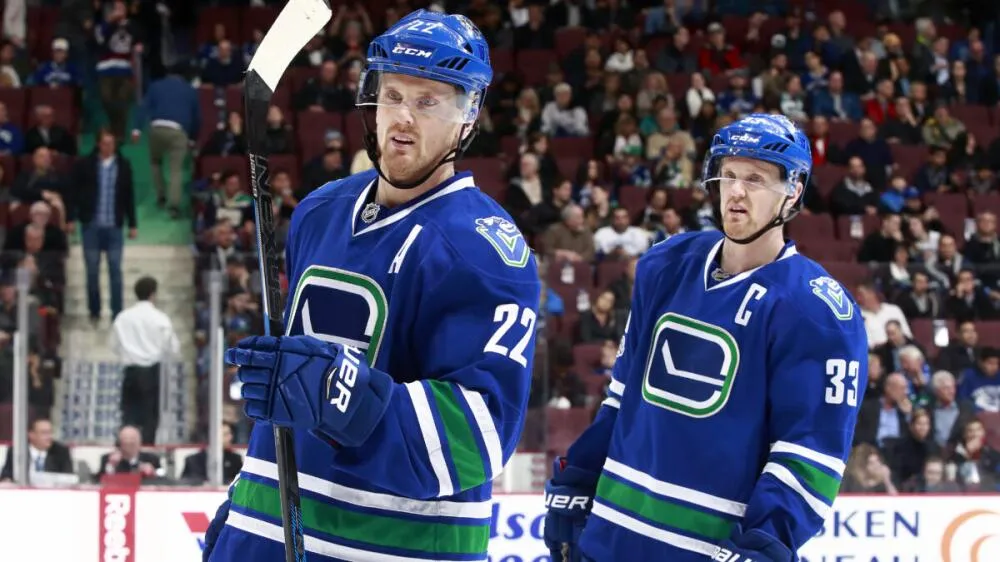
Perhaps no series of trades better demonstrates shrewd management than Brian Burke’s orchestrated plan to draft Daniel and Henrik Sedin in 1999. This complex sequence of transactions ranks among the most impressive dealmaking in NHL history and stands as a defining moment in the Canucks best and worst trades of all time narrative.
Burke’s vision required multiple moves. First, he traded Bryan McCabe and a future first-round pick to Chicago for the fourth-overall selection. He then flipped that pick, along with two third-rounders, to Tampa Bay for the first-overall pick. In a final move, he traded that top selection to Atlanta for the second-overall pick and a conditional third-rounder, with Atlanta agreeing to select Patrik Stefan first overall.
The result? The Canucks secured both Sedin twins, who became the franchise’s all-time leading scorers. Over their remarkable careers, both brothers accumulated multiple individual awards, with Henrik serving as team captain. Their synchronized on-ice chemistry and consistent excellence through the 2000s and 2010s anchored the most successful era in franchise history, including the 2011 Stanley Cup Final appearance.
According to The Hockey Writers, Burke described the intricate dealmaking as one of his proudest accomplishments. The trade sequence not only secured two future Hall of Famers but demonstrated that creative thinking and bold action could reshape a franchise’s destiny.
Roberto Luongo and the foundation of a championship contender
When discussing the Canucks best and worst trades of all time, the acquisition of Roberto Luongo in 2006 represents a franchise-defining moment. The Canucks sent Todd Bertuzzi, Bryan Allen, Alex Auld, and a conditional pick to Florida for Luongo, Lukas Krajicek, and a sixth-round pick that became Sergei Shirokov.
At the time, the trade shocked the hockey world. Bertuzzi needed a fresh start after the Steve Moore incident, but giving up that much for a goaltender seemed risky. Canucks Army noted that none of the pieces going to Florida contributed significantly to that organization, while Luongo transformed Vancouver’s fortunes.
Luongo became the best goaltender in franchise history, setting records for wins (252) and shutouts (38) over eight-and-a-half seasons. He won the William M. Jennings Trophy in 2011, led Vancouver to the Stanley Cup Final, and even served as team captain. His consistency and excellence provided the foundation for the Canucks’ most dominant period, when they became annual championship contenders.
The Florida return was minimal. Bertuzzi played just seven games as a Panther due to injury before being traded. Auld struggled through one disappointing season, and while Allen spent five years in Florida, his contributions paled compared to Luongo’s impact. This trade exemplifies how acquiring elite goaltending can elevate an entire franchise.
The deals that haunt Canucks history forever
The Cam Neely disaster that still stings decades later
No discussion of the Canucks best and worst trades of all time is complete without examining the Cam Neely catastrophe of 1986. This trade is universally regarded as the worst in franchise history and ranks among the NHL’s most regrettable deals ever made.
Vancouver sent Neely and a first-round pick (third overall, which became Glen Wesley) to Boston for Barry Pederson. At the time, Pederson was considered an elite young center who would anchor the Canucks’ offense for years. The reality proved devastatingly different.
Neely became a Boston legend, scoring 344 goals and 590 points in just 525 games with the Bruins. His combination of physicality and skill revolutionized the power forward position, and he remains beloved in Boston to this day. Wesley, selected with Vancouver’s pick, played 1,457 NHL games and added 537 points as a reliable two-way defenseman over his lengthy career.
Meanwhile, Pederson’s body betrayed him in Vancouver. Previous surgeries caught up with him, and he managed just 60 goals and 137 assists in four seasons before retiring in 1992. The Canucks gave up a future Hall of Fame player and a thousand-game defenseman for minimal return, fundamentally altering both franchises’ trajectories for over a decade.
The trade haunted Vancouver for years, serving as a cautionary tale about giving up on young players too early and failing to properly evaluate a player’s physical condition. According to Canucks Daily, 81.5% of fans in a recent poll identified this as the franchise’s worst trade ever.
Trading away elite talent for role players
The pattern of the Canucks best and worst trades of all time includes several painful examples of the franchise trading young, talented players before they reached their potential. The 1980 deal that sent Rick Vaive and Bill Derlago to Toronto for Tiger Williams and Jerry Butler exemplifies this troubling trend.
Williams provided entertainment value with his physical play and 1,325 penalty minutes in 312 games, and he contributed to the 1982 Stanley Cup Final run. Butler, however, was a complete bust with just 19 goals in 128 games. Meanwhile, Vancouver had given up two future stars.
Vaive went on to score 441 goals and 788 points over his 876-game career, becoming one of the NHL’s elite scorers of the 1980s. Derlago, after recovering from a major knee injury suffered as a Canuck rookie, scored 189 goals and 416 points in 555 games. Both players enjoyed their best years in Toronto, while Vancouver received minimal lasting value.
This trade represented a franchise philosophy problem that plagued the Canucks for decades: giving up on young players too quickly in pursuit of immediate results. The organization’s impatience cost them dearly, as both Vaive and Derlago could have formed the core of a competitive team through the 1980s.
The Oliver Ekman-Larsson albatross that keeps on costing
When examining recent entries in the Canucks best and worst trades of all time discussion, the 2021 Oliver Ekman-Larsson acquisition stands as Jim Benning’s final catastrophic move. Vancouver received Ekman-Larsson and Conor Garland from Arizona for Antoine Roussel, Loui Eriksson, Jay Beagle, and three draft picks including a 2021 first-rounder that became Dylan Guenther.
This trade was designed to rid Vancouver of bad contracts, but it replaced them with an even worse situation. Ekman-Larsson arrived with six years remaining on an eight-year, $66 million deal paying him $8.25 million annually. His play had clearly declined in Arizona, but Benning jumped at the opportunity because the Canucks were one of only two teams Ekman-Larsson would accept a trade to.
The Swedish defenseman struggled through two disappointing seasons in Vancouver, scoring just seven goals and 51 points in 133 games before being bought out. The buyout penalty haunts the franchise to this day. Vancouver owes Ekman-Larsson $4.76 million per season through 2027, then $2.13 million annually through 2031—dead cap space that limits roster flexibility during a crucial competitive window.
According to Canucks Army, the worst part is that the contracts Vancouver shed—Roussel, Eriksson, and Beagle—all had just one year remaining. Waiting one season would have cleared $12 million in cap space without the long-term consequences. Additionally, Dylan Guenther has emerged as a star for Utah, making the trade even more painful to revisit.
The Ryan Kesler return that defined mismanagement
The 2014 Ryan Kesler trade to Anaheim showcases how restricted options can lead to terrible outcomes in the Canucks best and worst trades of all time ledger. Vancouver received Nick Bonino, Luca Sbisa, and draft picks for Kesler and a third-round selection. While the Canucks’ hands were tied—Kesler requested a trade to a limited list of teams—the return value proved disastrous.
Bonino played one solid season before being traded to Pittsburgh for Brandon Sutter, who became one of the team’s most criticized players due to his contract. Sbisa emerged as perhaps the worst regular defenseman on a struggling team, given far too many minutes despite replacement-level play. The first-round pick became Jared McCann, who was quickly dealt for Erik Gudbranson, another player who failed to meet expectations.
What makes this trade particularly painful is the cascade of poor decisions that followed. Each asset acquired was mismanaged or flipped for inferior returns, exemplifying the organizational dysfunction that defined this era. The lone bright spot—Derek Dorsett, acquired using one of the picks—couldn’t salvage a deal that set the franchise back years.
This trade sequence demonstrated how one bad deal can compound into multiple disasters when poor management continues making flawed decisions. The Kesler trade wasn’t just about losing a star center; it was about fumbling every piece of the return package.
Recent mistakes and missed opportunities in Canucks trading history
The Gustav Forsling giveaway that built a champion
Among recent entries in the Canucks best and worst trades of all time catalog, few sting quite like the 2014 Gustav Forsling trade. Vancouver dealt the Swedish defenseman prospect to Chicago for Adam Clendening, a depth swap that seemed inconsequential at the time. Forsling never played a game for the Canucks, and neither did Clendening after managing just two assists in 17 games.
Forsling developed into an elite NHL defenseman. After stints with Chicago and Carolina, he found his home in Florida following a 2021 waiver claim. There, Forsling blossomed into a top-pairing defender, scoring 44 goals and 151 points in 320 games with the Panthers. He played a crucial role on Florida’s 2023 Stanley Cup-winning team, providing reliable defense and offensive contributions from the blue line.
This trade represents the Canucks’ historical tendency to give up on young prospects prematurely. Had Vancouver shown patience with Forsling, they might have developed a cost-controlled, high-quality defenseman during their competitive window. Instead, they watched him become a championship-caliber player elsewhere while getting nothing of value in return.
The Sven Baertschi gamble that produced Rasmus Andersson elsewhere
The 2015 trade that brought Sven Baertschi to Vancouver for a second-round pick initially seemed reasonable—taking a chance on a former first-rounder for a mid-round selection. But this deal belongs firmly on the wrong side of the Canucks best and worst trades of all time divide.
Baertschi had his moments in Vancouver, scoring 48 goals and 100 points in 225 games alongside Bo Horvat. Injuries derailed his career, leading to retirement at age 30 in 2023. Meanwhile, Calgary used Vancouver’s pick to select Rasmus Andersson, who has become one of the Flames’ cornerstone defensemen.
Andersson has spent nine seasons in Calgary, recording 42 goals and 218 points while averaging over 21 minutes per game. Since Mark Giordano’s departure, Andersson has logged over 23 minutes nightly, manning the top power-play unit and serving as a legitimate number-one defenseman. The irony? The Canucks have shown heavy interest in acquiring Andersson in recent years, essentially hoping to re-acquire the player they could have had all along.
This trade highlights the risk of banking on reclamation projects over developing draft picks. While Baertschi provided value, surrendering a pick that yielded a top-pairing defenseman proved costly for a franchise perpetually searching for blue-line stability.
The Elias Lindholm rental that mortgaged the future
As one of the most recent additions to the Canucks best and worst trades of all time discussion, the 2024 Elias Lindholm acquisition cost Vancouver dearly. The Canucks sent Andrei Kuzmenko, Hunter Brzustewicz, Joni Jurmo, and two draft picks to Calgary for Lindholm, hoping to add a top-center for their playoff push.
Lindholm’s regular-season impact disappointed significantly. Originally acquired to play alongside Elias Pettersson, he managed just six goals and 12 points before sliding to third-line center duties. While he performed better in the playoffs with 10 points, that production came in a third-line role that didn’t justify the acquisition cost.
The assets departing Vancouver represented significant value. Brzustewicz emerged as an elite OHL defenseman, posting 92 points and ranking second in defensive scoring. The first-round pick became Matvei Gridin, who’s dominating the QMJHL with nearly point-per-game production. Calgary also acquired additional draft picks that yielded Luke Misa and Eric Jamieson, both developing nicely.
According to reports from Canucks Army, paying such a steep price for 26 regular-season games and a third-line playoff role demonstrates poor asset management. While Lindholm’s faceoff prowess (58.7% in the regular season) provided value, the cost exceeded the return by a substantial margin.
As the franchise navigates its current competitive window, the lessons from both triumph and tragedy in trade history remain vitally relevant. The Canucks best and worst trades of all time remind us that smart, patient management builds dynasties, while impatience and poor evaluation destroy them. Vancouver’s challenge moving forward is learning from past mistakes while replicating the shrewd dealmaking that brought legends like Naslund, the Sedins, and Luongo to British Columbia. Every trade carries franchise-altering potential—the key is ensuring more deals land on the right side of history.

Par Mike Jonderson
Mike Jonderson is a passionate hockey analyst and expert in advanced NHL statistics. A former college player and mathematics graduate, he combines his understanding of the game with technical expertise to develop innovative predictive models and contribute to the evolution of modern hockey analytics.