










Bobby Orr’s revolutionary 1969-70 season stands as one of the most dominant individual campaigns in professional hockey history. The 21-year-old defenseman didn’t just break records—he obliterated them, rewriting what was possible for a player at his position. Playing 76 games for the Boston Bruins, Orr tallied 33 goals and 87 assists for 120 points, becoming the first defenseman ever to lead the NHL in scoring and claim the Art Ross Trophy.
This wasn’t merely an outstanding season; it was a paradigm shift in how hockey would be played. Orr’s offensive explosion came while maintaining his defensive responsibilities, proving that a blue-liner could dominate both ends of the ice simultaneously. His point total nearly doubled the previous record for defensemen, a feat of athleticism unprecedented in professional sports at the time.
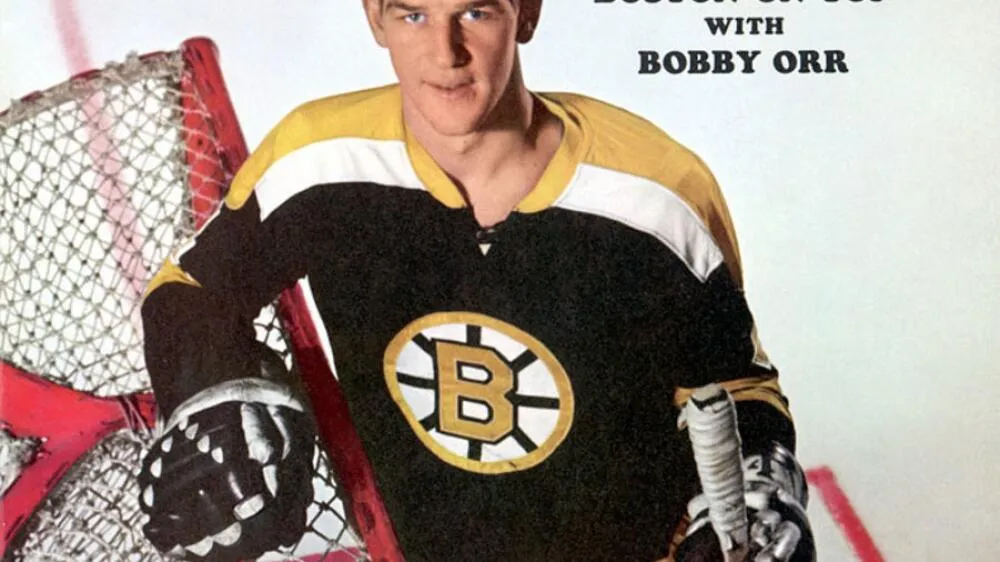
Breaking down Bobby Orr’s 1969-70 season statistics
The raw numbers from Orr’s 1969-70 campaign remain staggering more than five decades later. In 76 regular season games, he recorded 33 goals, 87 assists, and 120 points—each figure representing a new single-season record for NHL defensemen. His plus-54 rating and 125 penalty minutes demonstrated his physical, two-way game, while his 11 power-play goals and 40 power-play assists showcased his special teams dominance.
Perhaps most remarkable was Orr’s consistency throughout the season. He maintained an average of 1.58 points per game, a pace that would have been impressive for elite forwards of the era, let alone a defenseman. His 413 shots on goal led all Bruins players and reflected his aggressive offensive mindset every time he stepped on the ice.
The scoring title wasn’t a close race either. Orr finished 21 points ahead of second-place finisher Phil Esposito—his own teammate—demonstrating just how far ahead of the pack he truly was. No other defenseman in the league came remotely close to matching his production, with most top blue-liners of the era posting fewer than 50 points.
His plus-minus rating of +54 told the story of a player who dominated play in both directions. The Bruins scored goals at will when Orr was on the ice, and opposing teams found it nearly impossible to generate consistent offense against him. He was, quite simply, the best player in the world at his peak.
How Bobby Orr’s 1969-70 season statistics changed hockey history
When a panel of hockey historians and experts ranked the most significant single-season contributions in NHL history at the turn of the century, they placed Orr’s 1969-70 campaign at number one—ahead of any of Wayne Gretzky’s record-breaking seasons, ahead of everyone else. The reason was clear: Orr fundamentally transformed how the game was played.
Before Orr, defensemen were expected to stay back, protect their zone, and make the occasional safe pass up the ice. Orr turned that convention on its head, functioning as a fourth forward whenever the Bruins had possession. He would carry the puck through the neutral zone with blazing speed, quarterback the power play with precision, and create scoring chances seemingly at will.
His 87 assists in 1969-70 set a new NHL record for any position at the time, not just for defensemen. This meant Orr was setting up his teammates more effectively than any center or winger in the league. He made everyone around him better—Phil Esposito, John McKenzie, Ken Hodge, and Johnny Bucyk all benefited from Orr’s extraordinary playmaking ability.
The 33 goals he scored shattered his own previous record of 21 from the 1968-69 season by more than 50 percent. Coaches and general managers across the league watched in amazement as this 21-year-old redefined what was possible. Former Kings coach Hal Laycoe, upon witnessing Orr for the first time that season, remarked that “everything I read about him was underwritten.”
Memorable moments from Bobby Orr’s 1969-70 season statistics march
The season began with promise as Orr registered his first points on opening night, October 12, 1969, with two assists in a 2-1 victory over the New York Rangers. His ability to impact winning from the opening faceoff set the tone for everything that would follow over the next six months.
By November, Orr was already leading the league in scoring—a position no defenseman had held in a quarter-century. After picking up four assists in a game against the Los Angeles Kings on November 16, he had accumulated 29 points through just 16 games. Veterans across the league shook their heads in disbelief.
His five-assist performance against the Pittsburgh Penguins on December 20 showcased his playmaking wizardry at its finest. Orr had become the engine that powered the Bruins’ offense, setting up teammates with passes that seemed to defy the laws of physics.
The mid-season milestone moments came in rapid succession. On January 15, 1970, Orr broke the record for most assists by a defenseman with his 51st helper. Just three nights later, he shattered his own total points record by recording his 65th point. The season was barely half over, yet he was already rewriting the record books with regularity.
March 15, 1970 marked perhaps the most significant regular-season achievement. In a 5-5 tie against the Detroit Red Wings, Orr collected two goals and two assists to become the first defenseman in NHL history to reach 100 points in a season. Hockey fans struggled to comprehend the magnitude of what they were witnessing—this wasn’t supposed to be possible.
The playoff dominance that capped Bobby Orr’s 1969-70 season statistics
Orr’s regular season heroics were merely the prelude to a playoff run that would cement his legend forever. In 14 playoff games, he added 9 goals and 11 assists for 20 points, obliterating previous playoff records for defensemen. His offensive production remained at an elite level when the stakes were highest.
Against the New York Rangers in the opening round, Orr scored twice in the series-clinching Game 6 victory, propelling Boston past their longtime rivals. In the second round sweep of the Chicago Black Hawks, Orr and linemate Phil Esposito proved unstoppable, combining for devastating offensive output that left the league’s first-place team bewildered.
The Stanley Cup Final against the St. Louis Blues was never in doubt, with the Bruins dominating the overmatched Western Division champions. But it was Game 4, on May 10, 1970, that provided the perfect ending to Orr’s dream season. At 40 seconds into overtime, Orr took a pass from Derek Sanderson and rifled the puck past Blues goaltender Glenn Hall for the championship-winning goal.
The iconic photograph of Orr flying through the air in celebration, having been tripped immediately after scoring, became one of the most recognizable images in sports history. In that moment, captured forever in black and white, hockey changed. The goal wasn’t just a Cup winner—it was validation of everything Orr had accomplished throughout the season.
Awards and recognition for Bobby Orr’s 1969-70 season statistics
The hardware accumulated throughout the spring of 1970 reflected Orr’s total dominance. He captured the Art Ross Trophy as the NHL’s leading scorer—the first defenseman ever to win it. The Norris Trophy as the league’s best defenseman was practically a formality at that point, marking his third consecutive year winning the award.
The Hart Memorial Trophy as league MVP recognized what everyone already knew: Orr was the most valuable player in hockey, regardless of position. His impact on winning went far beyond statistics, though the numbers themselves told a compelling story.
Finally, the Conn Smythe Trophy as playoff MVP completed an unprecedented haul of four major individual awards in a single season—something no player had ever accomplished before. Orr’s excellence wasn’t limited to one aspect of the game; he dominated in every measurable category.
When combined with the Stanley Cup championship, Orr’s 1969-70 season represented the pinnacle of individual and team achievement. He had proven himself the greatest player of his era while lifting his team to hockey’s ultimate prize. The Bruins’ first championship in 29 years belonged to Bobby Orr as much as to any player who ever lifted the Cup.
Bobby Orr’s 1969-70 season statistics remain a monument to individual excellence and transformative impact. His 120 points in 76 games, combined with 33 goals and 87 assists, didn’t just break records—they redefined what was possible for a defenseman in professional hockey. The fact that historians and experts continue to rank this season as the single most significant individual campaign in NHL history speaks to its enduring importance.
More than half a century later, no defenseman has come close to matching Orr’s offensive dominance from that magical season. His point total from 1969-70 would still lead all NHL defensemen in most modern seasons, a testament to just how far ahead of his time he truly was. The game evolved because Bobby Orr showed everyone a new way to play it, and the sport has never been the same since.

Par Mike Jonderson
Mike Jonderson is a passionate hockey analyst and expert in advanced NHL statistics. A former college player and mathematics graduate, he combines his understanding of the game with technical expertise to develop innovative predictive models and contribute to the evolution of modern hockey analytics.