






The Boston Bruins are facing a significant challenge after Elias Lindholm was forced to leave their overtime victory against the Buffalo Sabres with a lower-body injury. Head coach Marco Sturm confirmed on Friday that Lindholm will miss “at least a few weeks,” dealing a major blow to a team that was just beginning to find its footing. The 30-year-old center was helped off the ice following a collision with Buffalo’s Jordan Greenway in the second period, and an MRI revealed the severity of the setback.
Lindholm had been one of Boston’s most consistent performers through the first 13 games, recording nine points (four goals, five assists) while excelling in the faceoff circle with a 57.5% success rate. More importantly, he had been instrumental on the power play, contributing seven of his nine points with the man advantage. His absence leaves a gaping hole at the top of the lineup that won’t be easy to fill, forcing the Bruins to evaluate both internal and external solutions to maintain their competitiveness.
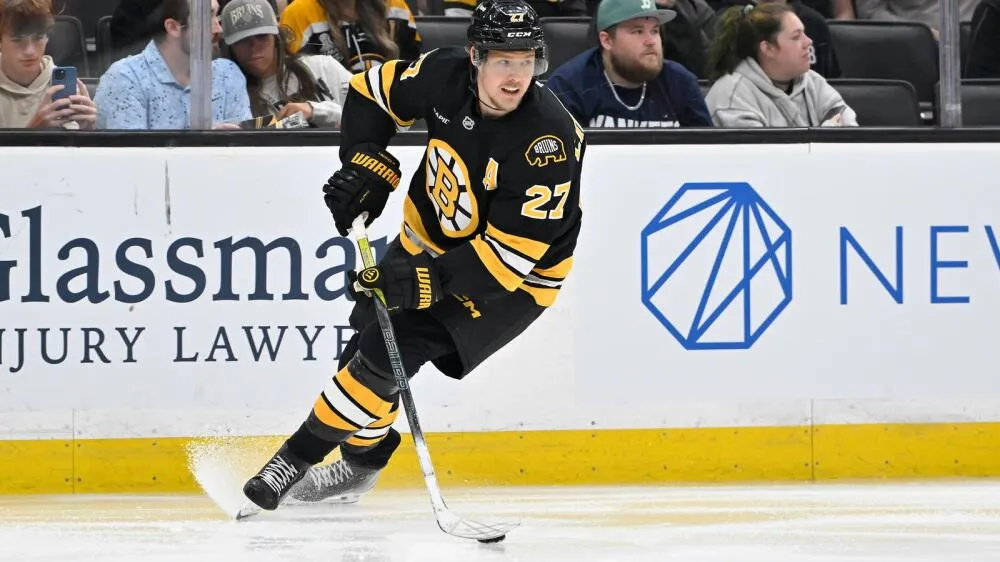
Internal Bruins replacement options after Elias Lindholm injury: Pavel Zacha steps up
The most logical immediate solution among the Bruins replacement options after Elias Lindholm injury involves shifting Pavel Zacha back to center. The Czech forward has proven chemistry with David Pastrnak, having played alongside his countryman extensively. According to advanced metrics from the 2024-25 season, Zacha and Pastrnak outscored opponents 94-66 when on the ice together, while posting a respectable 50.70% Corsi for percentage and 50.33% expected goals percentage.
Zacha possesses the defensive responsibility and two-way awareness necessary to handle top-line center duties. He’s comfortable in high-leverage situations and has experience taking crucial faceoffs, though his 48% success rate in the dot doesn’t quite match Lindholm’s elite numbers. The 27-year-old brings versatility to the lineup, capable of playing both wing and center positions depending on the matchup.
Moving Zacha to center would create a domino effect throughout the lineup, but it allows Boston to keep their most talented players together. Reuniting him with Pastrnak could spark offensive production for both players while maintaining some continuity during this difficult stretch. The familiarity between the two Czech natives cannot be overstated – they communicate effortlessly on the ice and understand each other’s tendencies.
However, deploying Zacha at center full-time removes him from a wing position where he’s been effective this season. The Bruins would need to shuffle their forward lines considerably to accommodate this move, potentially disrupting chemistry that has been building elsewhere in the lineup. It’s a calculated risk that could pay immediate dividends but requires careful consideration of the downstream effects.
Marat Khusnutdinov emerges as surprising candidate among Bruins replacement options after Elias Lindholm injury
Perhaps the most intriguing option among the Bruins replacement options after Elias Lindholm injury is Marat Khusnutdinov, who delivered a dramatic overtime winner against the Sabres in the very game Lindholm was injured. The 22-year-old Russian center had already been elevated to play alongside Pastrnak and Lindholm before the injury occurred, and he impressed with his speed, creativity, and hockey sense.
According to ESPN, Khusnutdinov is set to center Boston’s top line against Carolina, giving him an immediate opportunity to prove he can handle the responsibility. In his first full NHL season, he’s shown flashes of brilliance that suggest he might be ready for an expanded role. His performance against Buffalo was particularly encouraging – he won four of five faceoffs and continued generating offense even after being thrust into Lindholm’s vacated center position.
Khusnutdinov brings an element this Bruins team desperately needs: speed. His ability to create offense through the neutral zone with his skating has been evident in limited ice time. He’s shown he can hang with top-line talent and isn’t intimidated by elevated expectations. The overtime heroics against Buffalo demonstrated his clutch gene and ability to perform under pressure.
The biggest question surrounding Khusnutdinov is whether he’s ready for this level of responsibility so early in his NHL career. With just one goal and one assist in eight games before the Buffalo contest, his production hasn’t been overwhelming. Similar to how the Bruins have shuffled their defensive pairs in search of the right combinations, deploying a young, relatively unproven center in a top-line role represents both an opportunity and a significant gamble. But sometimes necessity forces teams to accelerate development timelines, and Khusnutdinov may benefit from being thrown into the deep end.
Providence pipeline presents intriguing Bruins replacement options after Elias Lindholm injury
The Providence Bruins have started the AHL season with a perfect 7-0-0 record, and their success has many observers wondering if reinforcements from the farm system could help offset Lindholm’s absence. Two names consistently surface in discussions about potential call-ups: Matthew Poitras and Fabian Lysell.
Poitras made the NHL roster as a 19-year-old during the 2023-24 season and showed promise before a shoulder injury ended his campaign. After a strong training camp this year, he was assigned to Providence for further development. Through the first several games, he’s contributed six assists and demonstrated the playmaking ability that made him a second-round pick in 2022. His hockey IQ and vision are NHL-ready, even if his physical strength continues to develop.
Lysell represents another intriguing option, though his skill set differs from Poitras. The Swedish winger has tantalizing offensive tools and has been productive in Providence. However, inserting Lysell into the lineup would only make sense if the Bruins opt to shift Zacha to center, creating a wing vacancy. Lysell’s speed and shot could provide a spark, but his defensive game remains a work in progress.
Boston Hockey Now reports that the coaching staff faces difficult decisions about whether to disrupt Providence’s chemistry by calling up a key contributor. The P-Bruins’ hot start suggests the young players are benefiting from playing big minutes in winning situations. Sometimes the best development path isn’t the fastest route to the NHL, but rather allowing players to dominate at the AHL level before making the jump.
John Beecher also factors into the equation as an internal option already on the roster. Sturm confirmed Beecher will draw into the lineup against Carolina, likely centering the fourth line. While he doesn’t possess the offensive upside of Poitras or Lysell, Beecher brings speed, defensive responsibility, and penalty-killing ability that could prove valuable in Lindholm’s absence.
Trade market and long-term Bruins replacement options after Elias Lindholm injury
While Lindholm’s injury is expected to last only “a few weeks,” it exposes a broader concern about Boston’s center ice depth. The Bruins entered the season thin down the middle, and this injury magnifies that vulnerability. General Manager Don Sweeney may need to explore external options if the internal solutions prove inadequate or if Lindholm’s absence extends beyond the initial timeline.
The trade market before American Thanksgiving typically remains quiet, but teams with center depth might be willing to discuss rentals or depth additions. Boston’s salary cap situation complicates matters, limiting their ability to acquire high-priced talent without moving money out. Any significant trade would likely require the Bruins to include a roster player or prospect, raising the stakes considerably.
Some analysts have speculated about potential trade scenarios involving current Bruins forwards, though those discussions preceded Lindholm’s injury. The current situation makes it less likely Boston moves a center like Zacha, who has emerged as a critical piece of the puzzle during this crisis. Instead, the focus shifts to whether the organization can weather this storm with existing personnel.
According to The Hockey Writers, Sturm emphasized the “next man up” mentality that must take hold. This represents the first real adversity test of the 2025-26 season for Boston. The team already lost defenseman Hampus Lindholm earlier, but losing Elias Lindholm creates a more pressing concern given the lack of proven center depth.
The silver lining is that this injury provides an opportunity for younger players to prove themselves. If Khusnutdinov can handle the increased responsibility, it gives the Bruins a valuable building block moving forward. If Poitras earns a call-up and excels, it accelerates his development timeline and provides another center option for the future. Sometimes injuries, while never welcome, create opportunities that wouldn’t otherwise exist.
The loss of Elias Lindholm for multiple weeks forces the Boston Bruins to confront depth issues they hoped wouldn’t surface so early in the season. Whether through internal shuffling, call-ups from Providence, or potential external additions, the organization must find a way to remain competitive during this critical stretch. The next few weeks will reveal much about the character and adaptability of this group.
How Marco Sturm deploys his roster and which Bruins replacement options after Elias Lindholm injury prove most effective could shape the trajectory of Boston’s season. The good news is that Lindholm’s injury isn’t considered long-term, but the bad news is that even a few weeks without a top-line center could significantly impact the standings in a competitive Eastern Conference. The Bruins’ response to this adversity will define whether they’re genuine contenders or a team still searching for its identity.

Par Mike Jonderson
Mike Jonderson is a passionate hockey analyst and expert in advanced NHL statistics. A former college player and mathematics graduate, he combines his understanding of the game with technical expertise to develop innovative predictive models and contribute to the evolution of modern hockey analytics.