






The Buffalo Sabres once stood as a proud franchise with legitimate championship aspirations, anchored by one of the NHL’s premier goaltenders. But on February 28, 2014, everything changed. The decision to trade Ryan Miller to the St. Louis Blues didn’t just mark the end of an era—it triggered a catastrophic chain of events that would plunge the organization into the longest playoff drought in NHL history. What was intended to be a strategic rebuild quickly devolved into a decade of dysfunction, mismanagement, and heartbreak that fans in Western New York are still recovering from today.
The Miller trade represents more than just a transaction on paper. It symbolizes the moment when the Sabres lost their way, setting off a domino effect of poor decisions that would keep them out of postseason contention for an unprecedented 14 consecutive seasons. Understanding how this single move catalyzed such a prolonged collapse requires examining not just the trade itself, but the organizational chaos that followed in its wake.
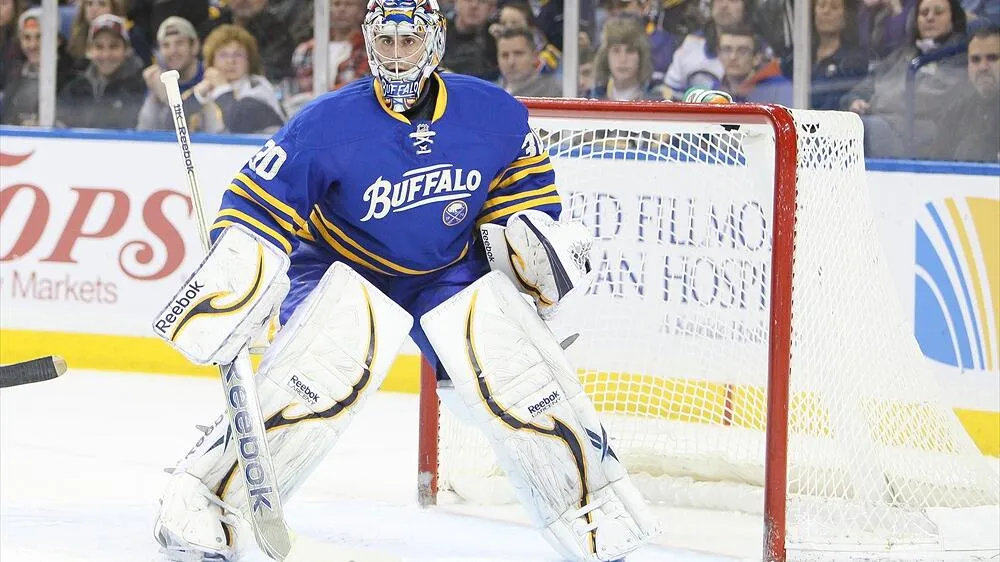
How the Buffalo Sabres Ryan Miller trade impact decade-long decline began with broken leadership
The warning signs were already flashing red before Miller ever packed his bags for St. Louis. By 2013, the Sabres had already begun their descent into mediocrity, and the franchise’s leadership recognized that change was necessary. Longtime head coach Lindy Ruff was dismissed in February 2013, followed by general manager Darcy Regier’s firing in November of that same year. These moves signaled that Buffalo’s front office understood the team needed a new direction, but they severely underestimated just how difficult that transition would become.
When Tim Murray was hired as general manager in January 2014 from the Ottawa Senators organization, he inherited a team in free fall. The 2013-14 Sabres were historically bad, posting a 21-51-10 record and finishing dead last in the NHL standings. Under Ron Rolston’s brief coaching tenure, the team started 4-15-1 in their first 20 games, with only one regulation win. The offensive struggles were particularly alarming—Buffalo averaged just 1.83 goals per game, the fewest in league history since the mid-1930s.
Miller stood as the last vestige of the team’s glory days, having developed from a fifth-round draft pick into one of the NHL’s elite goaltenders. With a .923 save percentage in 40 games during that disastrous 2013-14 campaign, he was essentially keeping the Sabres competitive by himself. But with his contract expiring and the team clearly not contending, Murray faced a critical decision: extend Miller and try to build around him, or trade him for assets and commit to a full rebuild.
The debate split the organization down the middle. Pat LaFontaine, the beloved Sabres legend who had been named President of Hockey Operations in November 2013, reportedly favored extending Miller and building around the proven veteran. Murray, on the other hand, wanted to maximize the return for Miller while he still had trade value and accumulate the draft picks and prospects necessary for a comprehensive rebuild. This fundamental disagreement would have consequences that extended far beyond the trade itself.
The blockbuster deal that sparked the Buffalo Sabres Ryan Miller trade impact decade-long decline
Five days before the March 5, 2014 trade deadline, Murray pulled the trigger. The Sabres sent Miller and captain Steve Ott to St. Louis in exchange for goaltender Jaroslav Halak, forward Chris Stewart, prospect William Carrier, a 2015 first-round pick, and a 2016 third-round pick. On paper, it looked like a substantial haul—a starting goaltender, a proven scorer, a prospect, and valuable draft capital.
Miller’s departure was emotionally devastating for Buffalo. The Michigan native fought back tears during his farewell press conference, struggling to compose himself as he said goodbye to the city where he had spent his entire professional career. He had given everything to the Sabres organization, including an Olympic silver medal performance in 2010 that remains one of the greatest goaltending displays in hockey history. His charitable work in Western New York had made him a beloved figure beyond the rink, and the team would eventually retire his No. 30 jersey in 2023 as recognition of his contributions.
But the immediate aftermath of the trade revealed deeper problems. Just one day after Miller was dealt, Pat LaFontaine shocked the hockey world by voluntarily resigning from his position. The timing wasn’t coincidental. It was later confirmed that LaFontaine and Murray had clashed over the Miller decision, with the Hall of Famer fundamentally disagreeing with the direction Murray wanted to take. The irony was staggering—LaFontaine had been instrumental in hiring Murray just two months earlier, yet their relationship had deteriorated so quickly that he felt compelled to walk away.
LaFontaine’s abrupt departure left the organization’s leadership structure in shambles. With no one above Murray to provide oversight or restraint, the rookie general manager was given complete autonomy to execute his vision. This lack of checks and balances would prove costly, as Murray embarked on a series of transactions that squandered the very assets he had acquired through the Miller trade and others like it.
Why the Buffalo Sabres Ryan Miller trade impact decade-long decline accelerated under Tim Murray
Murray’s fundamental strategy wasn’t necessarily flawed in concept. He correctly identified that the Sabres needed to accumulate assets and rebuild from the ground up. Throughout the 2013-14 season and into the following year, he systematically dismantled the roster, trading away veterans like Thomas Vanek and acquiring additional draft picks. The culmination of this strategy gave Buffalo three first-round selections in the loaded 2015 NHL Draft, positioning them to select multiple potential franchise cornerstones.
However, Murray’s execution proved disastrous. Rather than allowing those draft picks and prospects to develop organically into a competitive team over time, he became impatient. In a series of blockbuster trades before and during the 2015 draft, Murray dealt away most of those carefully accumulated assets in an attempt to accelerate the rebuild. He acquired talented players like Ryan O’Reilly, Evander Kane, and Jack Eichel (who was drafted second overall), but the cost was astronomical.
The trades were lopsided to an almost comical degree. To acquire O’Reilly from Colorado, Murray gave up forwards Nikita Zadorov and Mikhail Grigorenko, plus a 2015 second-round pick and prospect J.T. Compher. For Kane, he surrendered top prospect Joel Armia, Tyler Myers, Drew Stafford, and a first-round pick. The package sent to acquire other pieces included numerous additional picks and prospects that could have formed the foundation of sustained success.
Beyond the poor asset management, Murray failed to consider team chemistry and culture. He operated like the New York Yankees, attempting to buy success rather than build it. The Sabres ended up with a roster full of talented but mismatched players who lacked cohesion. Despite all the additions, Buffalo posted a 38-37-7 record in 2015-16 and missed the playoffs. The following year, they regressed to 33-37-12, extending their playoff drought to six seasons.
Murray’s abrasive personality also created friction throughout the organization. His “my way or the highway” management style alienated staff members and made it difficult to maintain productive working relationships. By April 2017, owner Terry Pegula had seen enough. Murray was fired after just three years, leaving behind a roster that was somehow less promising than the one he had inherited despite all his maneuvering.
The Buffalo Sabres Ryan Miller trade impact decade-long decline continued through ownership interference
Murray’s dismissal might have been an opportunity for course correction, but instead, it led to a different set of problems. Terry and Kim Pegula, who had been largely hands-off during Murray’s tenure, swung dramatically in the opposite direction. Rather than simply being more vigilant in their oversight, the owners began inserting themselves into hockey operations decisions at every level.
Jason Botterill was hired as general manager in May 2017, inheriting a mess of mismatched pieces and limited flexibility. While Botterill had his own shortcomings as a GM, his ability to execute any coherent strategy was constantly undermined by ownership interference. The Pegulas reportedly weighed in on personnel decisions, coaching changes, and roster construction, creating an environment where long-term planning became nearly impossible.
The revolving door of coaches exemplified the instability. Ron Rolston, Ted Nolan, Dan Bylsma, Phil Housley, and Ralph Krueger all came and went in rapid succession, with none lasting more than two seasons. Each coaching change brought a new system and philosophy, preventing players from developing consistency or building sustainable habits. The constant turnover was reflected on the ice, where the team continued to flounder despite occasional flashes of talent.
Botterill was fired in June 2020 after three seasons, reportedly due to disagreements with ownership over the team’s direction. His replacement, former Sabres player Kevyn Adams, inherited a franchise that had completely lost its way. The 2020-21 season proved to be rock bottom—Buffalo’s 15-34-7 record during the COVID-shortened campaign represented the nadir of the organization’s decade-long collapse.
The consistent thread throughout this period was instability. From the Miller trade through the end of the 2020s, the Sabres cycled through general managers and coaches at an alarming rate, never allowing any vision to fully materialize. Each new regime attempted to put their stamp on the organization, but the constant changes prevented any real progress. Players arrived with promise but left frustrated, their development stunted by the organizational chaos surrounding them.
Understanding the full scope of the Buffalo Sabres Ryan Miller trade impact decade-long decline
The numbers tell a stark story. Since Miller’s departure in February 2014, the Sabres have missed the playoffs for 14 consecutive seasons through 2024-25, establishing the longest playoff drought in NHL history. This surpassed the previous record held by the Florida Panthers and represents a level of sustained failure that’s difficult to comprehend in a salary cap era designed to promote parity.
The drought has outlasted entire player careers. Jack Eichel, drafted second overall in 2015 with the expectation that he would lead Buffalo back to contention, never played a single playoff game as a Sabre. After six frustrating seasons, he forced his way out via trade to the Vegas Golden Knights in 2021—and promptly won a Stanley Cup in 2023. His departure was symbolic of the organization’s inability to capitalize on elite talent or create a winning culture.
Other assets acquired in the Miller trade or subsequent deals also found success elsewhere. William Carrier, one of the pieces received from St. Louis, was later included in the Vegas expansion draft and also won a Cup with the Golden Knights in 2023. The draft picks that Murray accumulated were either traded away for minimal return or used on players who never developed into impact NHLers. The entire strategy of “tanking for assets” proved fruitless because the assets were consistently mismanaged.
The failure extended beyond just hockey operations. The constant losing eroded fan support and damaged the franchise’s reputation around the league. Buffalo became a destination to avoid in free agency, with players reportedly using their no-trade clauses to block moves to the Sabres. Young players viewed the organization as a career graveyard where development went to die. This perception made it even harder to attract the talent necessary to turn things around, creating a vicious cycle of futility.
The financial impact was also significant. While the Pegulas remained committed to spending to the salary cap, the lack of playoff revenue and declining attendance hurt the bottom line. Season ticket renewals dropped, corporate sponsorships became harder to secure, and the overall value proposition of supporting the team diminished with each passing non-playoff season.
Recent signs of recovery from the Buffalo Sabres Ryan Miller trade impact decade-long decline
There are finally legitimate reasons for optimism in Buffalo, though fans remain understandably skeptical after so many false dawns. The current regime of general manager Kevyn Adams and head coach Lindy Ruff (who returned for his second stint with the organization) has brought a measure of stability that’s been absent for over a decade. Crucially, the Pegulas appear to have learned from their mistakes and stepped back from day-to-day operations, allowing the hockey people to do their jobs.
The roster has been rebuilt with a focus on sustainable success rather than quick fixes. Young players like Rasmus Dahlin, Owen Power, and Tage Thompson have developed into legitimate building blocks, while the prospect pipeline is deeper than it has been in years. The team culture appears healthier, with players expressing genuine belief in the organization’s direction. While the playoff drought continued through 2024-25, the foundation for future success appears more solid than at any point since Miller’s departure.
The turnaround hasn’t been without setbacks. The 2023-24 season saw Buffalo miss the playoffs despite expectations they would finally break through, leading to renewed frustration among the fan base. However, the organization has maintained its course rather than panicking and making shortsighted moves—a sign of organizational maturity that was sorely lacking during the Murray and Botterill eras.
The lessons learned from the Miller trade and its aftermath are clear: sustainable success in the NHL requires patience, coherent planning, and organizational stability. Quick fixes and constant changes create chaos that undermines even the most talented rosters. The Sabres paid an enormous price to learn these lessons, enduring a historic stretch of futility that tested the loyalty of even the most dedicated fans.
Looking back, the Ryan Miller trade didn’t have to be the catastrophic mistake it became. In isolation, it was a reasonable move for a team clearly not contending to maximize return on a departing asset. The real damage came from everything that followed—the leadership vacuum created by LaFontaine’s resignation, Murray’s reckless squandering of assets, the ownership interference that prevented any coherent vision from taking root, and the constant coaching changes that made sustainable improvement impossible.
The Buffalo Sabres’ 14-year playoff drought stands as a cautionary tale about how quickly an NHL franchise can spiral when organizational dysfunction takes hold. A single trade didn’t doom the Sabres to a decade of failure, but it set in motion a cascade of poor decisions that did. As the franchise finally appears to be finding its footing, the hope is that the painful lessons learned during this dark period will prevent history from repeating itself. Western New York deserves better, and after more than a decade of suffering, there are finally signs that better days may be ahead.

Par Mike Jonderson
Mike Jonderson is a passionate hockey analyst and expert in advanced NHL statistics. A former college player and mathematics graduate, he combines his understanding of the game with technical expertise to develop innovative predictive models and contribute to the evolution of modern hockey analytics.