












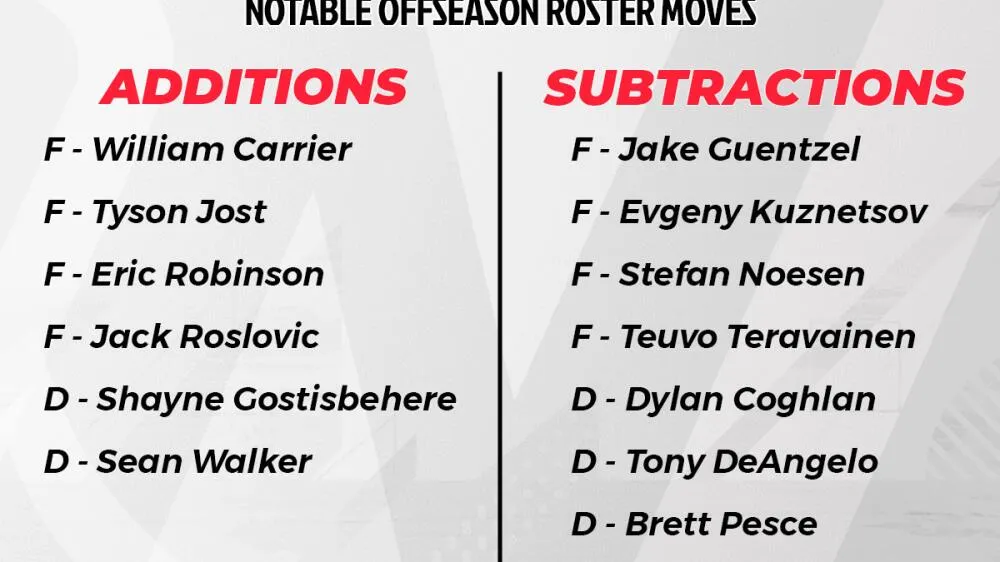
The Carolina Hurricanes made seismic moves during the 2025 offseason, transforming their roster with two marquee additions that could finally push them past the championship threshold they they’ve been knocking on for years. After acquiring defenseman K’Andre Miller via trade with the New York Rangers and signing former Winnipeg Jets star Nikolaj Ehlers to a lucrative six-year contract, the Hurricanes have addressed their most glaring needs while maintaining the defensive identity that has made them perennial contenders. These signings represent general manager Eric Tulsky’s aggressive approach to building a complete team capable of competing for the Stanley Cup.
The additions of Miller and Ehlers have already paid immediate dividends, as evidenced by Carolina’s blistering 5-1-0 start to the 2025-26 season. With their forward depth now rivaling the league’s best and a retooled blue line featuring both experience and youth, the Hurricanes have constructed a roster that balances offensive firepower with their trademark defensive structure. These moves signal a franchise ready to capitalize on their championship window before it closes.
How K’Andre Miller transforms the Carolina Hurricanes defense
The acquisition of K’Andre Miller from the New York Rangers came with a significant price tag—both in terms of assets and financial commitment. Carolina parted with defenseman Scott Morrow, a first-round pick, and a second-round pick before signing Miller to an eight-year, $60 million extension worth $7.5 million annually. This substantial investment reflects the organization’s belief that the 25-year-old can anchor their blue line for the foreseeable future.
Miller fills the void left by Dmitry Orlov’s departure, slotting into the top-four alongside elite defensive partner Jaccob Slavin or Sean Walker. Standing 6-foot-5 and weighing 210 pounds, Miller brings a physical presence and mobility combination that few defensemen possess. His ability to skate fluidly despite his imposing frame makes him particularly effective in Carolina’s transition-heavy system.
The Minnesota native showed his versatility during his time with the Rangers, demonstrating competence in all three zones while logging heavy minutes against top competition. His left-handed shot provides balance to Carolina’s defensive pairings, and his experience in high-pressure situations—including multiple playoff appearances—aligns perfectly with the Hurricanes’ championship aspirations.
Miller’s impact was immediately felt in Carolina’s season-opening win against the New Jersey Devils, where he played over 22 minutes and contributed both defensively and in the transition game. According to ESPN’s coverage of the game, the Hurricanes looked to Miller as part of their next steps toward competing for the Cup.
His presence allows Carolina to deploy their defensive pairs more strategically, reducing the burden on Slavin while providing coach Rod Brind’Amour with multiple reliable options in crucial game situations. The eight-year term ensures that Miller will be a cornerstone piece as younger players like Alexander Nikishin develop into larger roles.
The financial commitment also demonstrates Carolina’s willingness to spend to the salary cap ceiling, a shift from their historically conservative approach. With Miller locked in through his prime years, the Hurricanes have secured a defenseman who can grow alongside their young core while providing leadership and stability.
Nikolaj Ehlers brings elite scoring to the Carolina Hurricanes offseason signings
Signing Nikolaj Ehlers represented the boldest stroke of Carolina’s offseason, addressing their most persistent weakness: elite scoring depth. The six-year, $51 million contract ($8.5 million annually) made Ehlers the highest-paid free agent addition in franchise history. After years of searching for a dynamic top-six winger to complement Sebastian Aho and Andrei Svechnikov, the Hurricanes finally found their man.
Ehlers brings a proven track record of consistent production, having scored at least 20 goals in eight of his 10 NHL seasons with the Winnipeg Jets. Last season, he notched 24 goals and 63 points in 69 games before adding five goals and seven points in eight playoff contests. His 0.91 points-per-game career average demonstrates sustained excellence over nearly a decade at hockey’s highest level.
The 29-year-old Danish winger chose Carolina over other suitors because of their championship pedigree and the opportunity to play alongside elite talent. As reported by Pucks and Palms’ offseason review, Ehlers gives coach Rod Brind’Amour a talented forward to play alongside Sebastian Aho, forming what could become one of the league’s most dangerous top lines.
His versatility allows Carolina to deploy him in multiple roles—whether as a pure goal scorer, playmaker, or two-way forward. Ehlers’ speed and puck-handling ability complement Aho’s elite playmaking vision, while his willingness to engage defensively fits perfectly with Brind’Amour’s demanding system. This combination of offensive skill and defensive responsibility made him an ideal target for a Hurricanes team that never sacrifices structure for offense.
The early returns have been exceptional. Through Carolina’s first six games, Ehlers has seamlessly integrated into the top line with Aho and Seth Jarvis, contributing both goals and assists while maintaining a positive plus-minus rating. His chemistry with Aho has developed faster than many anticipated, suggesting the partnership could evolve into one of the league’s premier duos.
Ehlers’ contract takes him through his age-35 season, covering his prime years while providing reasonable term length that shouldn’t become burdensome in the latter stages. For a team that has consistently fallen short in the playoffs despite regular-season dominance, adding a proven scorer with extensive postseason experience addresses a critical gap in their championship pursuit.
The immediate impact of Carolina Hurricanes offseason signings K’Andre Miller Nikolaj Ehlers
The Hurricanes wasted no time validating their offseason investments, bursting out to a franchise-best 5-0-0 start before suffering their first loss to the Vegas Golden Knights. Both Miller and Ehlers have been instrumental in this early success, contributing in ways that extend beyond basic statistics. Their presence has elevated the entire roster’s confidence and provided Brind’Amour with lineup flexibility he’s never previously enjoyed.
Sebastian Aho praised both newcomers in a recent podcast appearance, noting how seamlessly they’ve integrated into Carolina’s culture and playing style. The chemistry between Ehlers and Aho has been particularly noteworthy, with the two developing an almost telepathic on-ice connection that has opposing defenses scrambling. Their ability to interchange between playmaking and finishing roles makes them exceptionally difficult to defend.
Miller’s defensive presence has allowed Carolina to take more calculated offensive risks, knowing they have a mobile, physical defenseman capable of recovering when transitions break down. His skating ability enables the aggressive forecheck that defines Carolina’s identity, while his size provides a deterrent against opponents’ top forwards. The partnership with various defensive partners has been seamless, suggesting Miller possesses the hockey IQ to adapt to different playing styles.
The supporting cast has also benefited from these additions. Logan Stankoven, acquired in last season’s Mikko Rantanen trade and subsequently signed to an eight-year extension, has thrived playing alongside players of Miller and Ehlers’ caliber. The depth created by these signings allows Carolina to roll four competitive lines, wearing down opponents through relentless waves of pressure.
Carolina’s power play has shown marked improvement with Ehlers’ addition, providing another lethal shooting option alongside Svechnikov and Aho. His ability to operate effectively from multiple positions on the ice gives the Hurricanes’ coaching staff numerous setup options, making their man-advantage opportunities more unpredictable and dangerous.
Defensively, Miller’s presence has allowed Alexander Nikishin to develop in a reduced role rather than being thrust immediately into top-four responsibilities. This patient approach to integrating their prized Russian prospect demonstrates how the Miller acquisition provides both immediate and long-term benefits to Carolina’s defensive structure.
Analyzing the contract structures for K’Andre Miller and Nikolaj Ehlers
The financial implications of Carolina’s offseason moves reveal an organization committed to maximizing their championship window regardless of salary cap constraints. Miller’s eight-year, $60 million deal carries a $7.5 million annual cap hit, while Ehlers’ six-year, $51 million contract represents an $8.5 million yearly commitment. Combined with existing contracts, these signings push Carolina to within $10.6 million of the salary cap ceiling.
Miller’s contract structure reflects Carolina’s belief in his ability to develop into a true number-one defenseman. The eight-year term buys out multiple unrestricted free agent years, potentially providing surplus value if Miller continues developing. At $7.5 million annually, the contract falls below market value for elite defensemen, representing a calculated bet that his best hockey remains ahead of him. The deal also contains considerable risk—Miller’s production and consistency have fluctuated throughout his Rangers tenure, and defensemen of his size sometimes struggle with injury management.
Ehlers’ contract offers less term but a higher annual cap hit, reflecting his established track record of production. The six-year commitment takes him through age 35, which presents manageable decline-year risk compared to contracts extending deeper into a player’s thirties. At $8.5 million annually, Ehlers commands a premium price, though comparable wingers with his scoring pedigree typically earn similar or higher amounts. The front-loaded structure provides Carolina with flexibility to manage their cap situation as younger players require extensions.
Both contracts contain no-movement clauses in their early years, standard for players of their caliber but potentially limiting Carolina’s flexibility if roster changes become necessary. The guaranteed money reflects the competitive free agent market and the premium required to attract elite talent to a non-traditional hockey market.
These investments forced difficult decisions elsewhere on the roster. The departures of Brent Burns and Dmitry Orlov saved considerable cap space, though both veterans contributed significantly to Carolina’s defensive success in recent years. Jack Roslovic’s exit via free agency created the financial room necessary to sign Ehlers, though some former players questioned whether letting Roslovic walk was the correct decision.
The cap management becomes tighter moving forward, with young stars like Seth Jarvis and Pyotr Kochetkov requiring extensions in the coming years. However, Eric Tulsky’s aggressive approach suggests the Hurricanes are willing to navigate these constraints to maintain their championship window. The organization clearly believes that the time to win is now, and these contracts reflect that urgency.
What the Carolina Hurricanes offseason signings mean for their championship window
The additions of K’Andre Miller and Nikolaj Ehlers fundamentally alter Carolina’s championship equation, transforming them from perennial contenders into legitimate Stanley Cup favorites. These signings address the two primary weaknesses that have repeatedly stymied their playoff progress: elite scoring depth and top-pairing defensive depth. By resolving both issues simultaneously, the Hurricanes have constructed arguably the most complete roster in franchise history.
The Metropolitan Division’s competitive landscape makes Carolina’s improvements even more significant. With the New York Rangers, New Jersey Devils, and Pittsburgh Penguins all retooling or rebuilding, the Hurricanes enter the season as divisional favorites. Their balanced roster construction—elite goaltending, deep defensive corps, and now legitimate scoring threats—provides multiple pathways to victory in different game situations.
However, championship windows rarely remain open indefinitely, and Carolina’s core players are aging. Sebastian Aho turns 28 this season, while Andrei Svechnikov enters his prime years. The time to capitalize on this roster is within the next three seasons, when all key pieces remain in their peak performance years. These offseason moves signal the organization understands this urgency and is willing to mortgage future assets for present-day success.
The pressure now falls squarely on Rod Brind’Amour and his coaching staff to extract maximum performance from this roster. With no more excuses about roster deficiencies, the Hurricanes must prove capable of winning four playoff rounds—something they’ve failed to accomplish during their current competitive window. The additions of proven playoff performers like Miller and Ehlers provide the experience necessary to navigate the postseason’s unique challenges.
The early-season success validates the front office’s aggressive approach, though meaningful evaluation must wait until the playoffs. Carolina has consistently dominated regular seasons only to falter when games matter most. Whether Miller’s defensive presence and Ehlers’ scoring touch prove sufficient to overcome this pattern remains the defining question of their 2025-26 campaign. If these signings deliver the expected results, the Hurricanes could finally achieve the championship success that has eluded them for over two decades.

Par Mike Jonderson
Mike Jonderson is a passionate hockey analyst and expert in advanced NHL statistics. A former college player and mathematics graduate, he combines his understanding of the game with technical expertise to develop innovative predictive models and contribute to the evolution of modern hockey analytics.