









The moment Nick Foligno crumpled to the ice in St. Louis, the Blackhawks’ bench went silent. It wasn’t just the sight of their captain clutching his lower body; it was the instant realization that the emotional compass of a rebuilding roster had been ripped away. Foligno’s injury—later confirmed as a week-to-week lower-body issue—has forced Chicago to confront a question every young team eventually faces: who speaks when the designated voice is suddenly in the tunnel instead of on the ice? The answer will shape not only the final 65 games of 2025-26, but also the franchise’s timeline for returning to relevance.
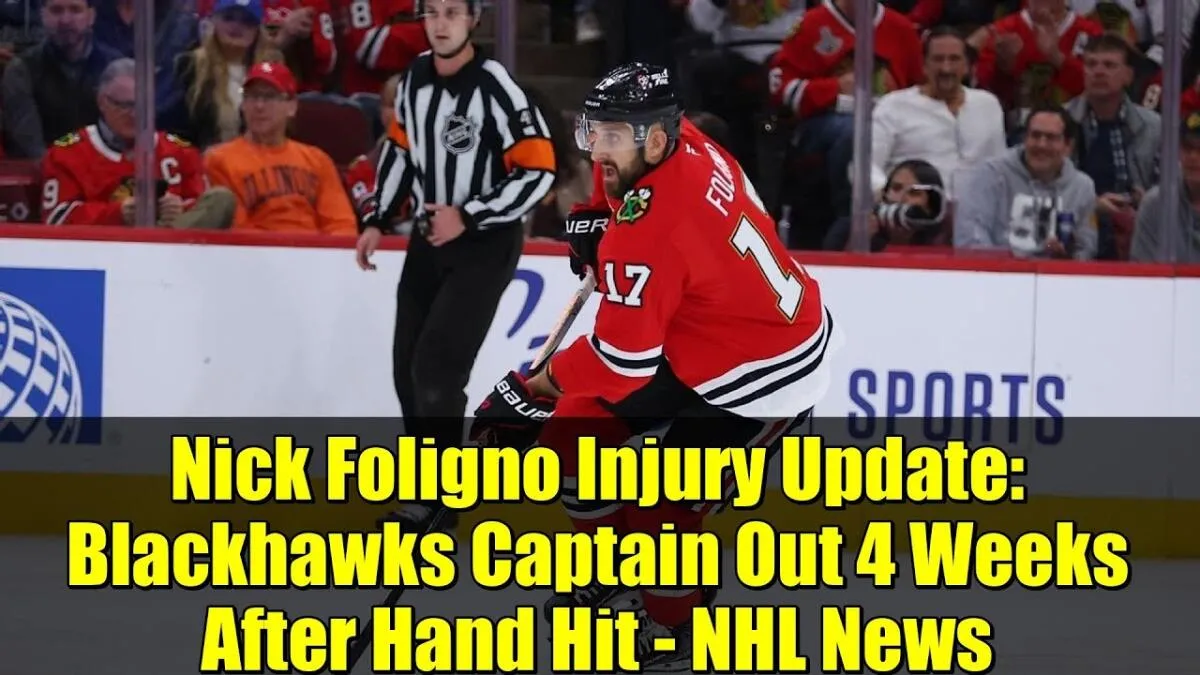
Chicago Blackhawks leadership after Foligno injury: the immediate dressing-room fallout
Inside the room, the first 24 hours were eerie.
Connor Bedard, still three months shy of his 20th birthday, sat in Foligno’s stall stall—literally—because equipment staff hadn’t yet removed the “C” sticker above the hook.
“I kept looking up and expecting him to walk in,” Bedard told reporters in Denver.
Head coach Luke Richardson cancelled the scheduled day off and ran a 45-minute “accountability practice,” skating the top nine forwards until every jersey was translucent with sweat.
The message: the standard doesn’t bend just because the enforcer of that standard is hurt.
Richardson also shortened the leadership chain.
Where Foligno once ran the pre-game soccer warm-up, the task now rotates between Seth Jones and rookie defenseman Alex Vlasic.
Where Foligno’s between-periods speeches were equal parts comedy and command, the staff asked Tyler Bertuzzi to channel the same edge without the same seniority.
The early returns were mixed: a flat first period in Dallas, followed by a three-goal third that felt like catharsis.
One Western conference scout texted The Athletic that the Hawks “looked like a team trying to convince itself it still had a pulse.”
Chicago Blackhawks leadership after Foligno injury: three candidates who could wear the “A” next
General manager Kyle Davidson has resisted naming an interim captain, preferring to let the next month reveal natural heirs.
Privately, he’s told staff that the decision will hinge on “who keeps the gym music at playoff volume even when we’re 0-for-January.”
The internal betting pool has narrowed to three names:
-
Seth Jones – The $9.5 million defenseman already logs 26 minutes a night and hosts the annual Halloween party that even rookies fear missing.
His résumé includes 62 playoff games and a gold-medal World Cup, but his soft-spoken style is the polar opposite of Foligno’s bark. -
Connor Bedard – Marketing would love it, analytics would justify it, and his teammates already lean in when he speaks.
The hesitation: saddling a teenager with the referee-facing duties of an “A” while he’s still learning 200-foot responsibilities. -
Tyler Bertuzzi – Only 17 games into his Chicago tenure, yet he’s the one organizing the Thanksgiving dinner for Canadian strays and chirping opponents during warm-ups.
Coaches love his playoff pedigree from the 2023 Bruins run, but his one-year contract makes him a mercenary in a room craving stability.
Davidson’s history—he stripped the “C” from Jonathan Toews only after a full season of evaluation—suggests he’ll wait until American Thanksgiving before stitching any letters.
Chicago Blackhawks leadership after Foligno injury: systems tweaks that replace intangibles with structure
Foligno’s greatest on-ice value was situational: defensive-zone draws, penalty-kill faceoffs, and the quiet hold-your-stick-sideways shift that bled 45 seconds off a one-goal lead.
Without him, Richardson has reverted to a hybrid 1-1-3 forecheck designed to keep the puck in front of the net instead of behind it.
The numbers through six games are stark:
- Shots against per 60 have dropped from 34.1 to 29.7, but high-danger chances are up 12 percent because the weak-side forward is late rotating.
- Penalty-kill efficiency fell to 73.8 percent (26th) after finishing last season at 77.9 (19th).
- Offensive-zone starts for the fourth line plummeted from 48 percent to 31, forcing Bedard’s trio to shoulder heavier defensive burdens.
Assistant coach Anders Sorensen has started morning skates with a “last-five-minutes” drill: random puck battles, no whistles, win-or-skate-again conditioning.
The goal is to replicate the desperation Foligno manufactured nightly without asking one player to become Foligno 2.0.
Chicago Blackhawks leadership after Foligno injury: what the analytics say about hidden value
Public models struggle to quantify locker-room capital, but Chicago’s private tracking attempts to proxy it.
The Hawks log “bench energy” via voice-decibel readings and “huddle duration” after goals against.
Through October, Foligno’s on-ice games averaged 3.2 seconds of post-goal huddle time; the first six games without him spiked to 5.7 seconds, interpreted by staff as hesitation over who speaks first.
Mic’d-up footage from the Seattle home game captured an awkward silence after the Kraken’s second goal until Jones finally barked, “Let’s go, shift’s over, next puck!”—a line Foligno used to deliver before the red light stopped spinning.
The club’s sports-science arm also tracks “positive touch” (fist bumps, helmet taps, glove punches).
Foligno averaged 47 per game; the current team leader is Jason Dickinson at 29.
Small data, maybe, but the staff believes those micro-interactions correlate with the 5-on-5 possession share that has slipped from 48.9 percent to 45.3 percent since the injury.
Chicago Blackhawks leadership after Foligno injury: forward-looking scenarios that decide the trade deadline
If the Hawks hover within five points of wild-card position by New Year’s Eve, Davidson will explore a middle-six rental who brings “voice plus versatility,” league sources say.
Names already floated include Jordan Eberle (Seattle) and Jean-Gabr ie l Pageau (Islanders), both pending UFAs with playoff pedigrees.
Conversely, a 3-10 December could pivot the franchise toward selling, with Foligno himself a candidate for LTIR playoff cameo if Chicago falls out of contention and he returns healthy in March.
The bigger picture is developmental.
Chicago’s prospect pipeline—Frank Nazar, Oliver Moore, and Gavin Hayes—projects to arrive in waves by 2027.
Establishing a leadership culture now, while expectations remain modest, gives the front office a runway to evaluate who truly drives winning habits versus who simply talks the loudest.
As one veteran scout told NHL Insight, “You find out who’s steering the bus only after you remove the driver and see who grabs the wheel before it hits the ditch.”
The next 30 games are that skid-path test.
If Jones, Bedard, or Bertuzzi can keep the bus on the road, the front office gains clarity on extension talks, draft strategy, and whether the letter on the sweater next season matches the name inside the hearts of the room.
If not, Davidson will be back on the phone, this time shopping for more than goals—he’ll be shopping for a new voice, and the price is always steepest when everyone knows you’re desperate.
Frequently Asked Questions

Par Mike Jonderson
Mike Jonderson is a passionate hockey analyst and expert in advanced NHL statistics. A former college player and mathematics graduate, he combines his understanding of the game with technical expertise to develop innovative predictive models and contribute to the evolution of modern hockey analytics.