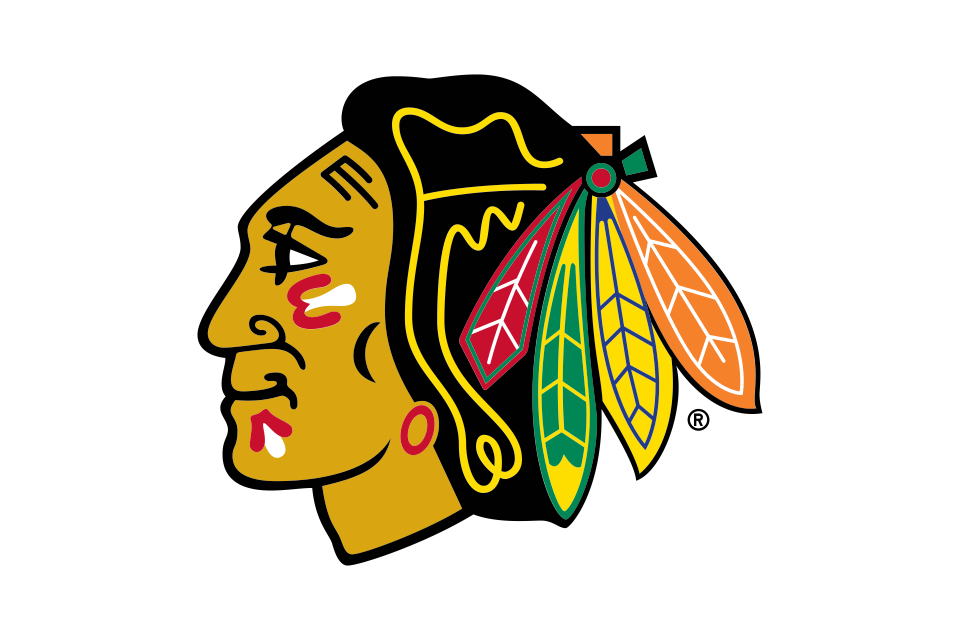
The Chicago Blackhawks logo history began in 1926 when Major Frederic McLaughlin founded the franchise and named it after the 86th Infantry Division, known as the “Black Hawk Division,” in which he served during World War I. The military unit itself was named after Black Hawk, a prominent Sauk warrior and leader who fought in the Black Hawk War of 1832. This historical connection gave the team’s visual identity a foundation rooted in American military history rather than simply adopting generic Native American imagery.
Irene Castle, McLaughlin’s wife, receives credit for designing the original logo that debuted during the team’s inaugural season. The first iteration featured a stark, minimalist approach with a Native American profile drawn in thin white lines against a black circular background. The image was enclosed in a double-ring frame with “BLACK HAWKS” arched along the top and “CHICAGO” positioned along the bottom, all rendered in a clean sans-serif typeface.
What made this original design particularly striking was its artistic use of negative space and sparse linework. The profile conveyed a sense of gravity and contemplation, creating an image that felt both respectful and powerful. The simplicity of the black-and-white color scheme enhanced the logo’s mysterious quality, though the overall execution appeared somewhat crude by modern standards.
This initial version remained unchanged for nearly a decade, setting the template for all future iterations. The circular format, the left-facing profile, and the framing text established design elements that would persist through multiple redesigns. Even as the franchise experimented with colors, details, and artistic styles over subsequent decades, these fundamental components remained central to the Chicago Blackhawks logo history.
The Chicago Blackhawks logo history took a dramatic turn in 1935 when the franchise introduced color for the first time. This redesign coincided with the addition of color to the team’s uniforms, moving away from the stark monochrome aesthetic that had defined the early years. The new version maintained the circular format and Native American profile but added burgundy and beige tones to depict skin color and features, along with the existing black and white elements.
This colorization attempt, while representing a significant shift, drew criticism for its execution. The addition of reddish skin tones approached stereotypical depictions of Native Americans that many today consider problematic. The artistic merit of the original design seemed compromised by the heavy-handed application of color, losing much of the mystique and contemplative quality that made the black-and-white version compelling.
Just two years later, in 1937, the team made another adjustment to the Chicago Blackhawks logo history by changing the background of the inner circle from black to white. This modification made the overall design appear lighter and more open, though it retained the same problematic color palette for the portrait itself. The white background created a starker contrast that some found more visually appealing, even as the fundamental issues with the colored depiction remained.
The experimentation with color during this period reflected the broader trends in sports branding of the era. Teams across professional sports were discovering the marketing potential of colorful, eye-catching logos that could be more easily reproduced on merchandise and promotional materials. However, these early color experiments in the Chicago Blackhawks logo history often prioritized visual impact over cultural sensitivity or artistic sophistication.
The Chicago Blackhawks logo history underwent its most dramatic transformation in 1941 when the team completely overhauled the Native American portrait. The new design featured a much more detailed and realistic depiction, with the profile rendered in yellow, green, and black, and adorned with white and red feathers. The facial features became more pronounced and the overall composition more complex, representing a significant departure from the minimalist approach of earlier versions.
This 1941-1955 version introduced several elements that would become permanent fixtures in the Chicago Blackhawks logo history. The addition of multiple colored feathers in the headdress created visual interest and made the logo more dynamic. The lettering on the circular frame became bolder and more condensed, improving legibility and creating a stronger visual presence. However, the expression on the face appeared somewhat startled or wide-eyed, lacking the dignity and gravitas that later versions would achieve.
In 1955, another significant redesign refined the portrait further, making the profile more realistic and adding additional feathers in red, green, and yellow. Red and yellow ornamental face paint appeared for the first time, an element that remains in the current logo. The typeface on the circular frame was modernized with a more geometric sans-serif style, though the white outline was removed, creating a cleaner overall appearance.
The most pivotal moment in Chicago Blackhawks logo history came in 1957 when the team removed the circular frame and text altogether, allowing the Native American head to stand alone as the primary logo. This bold decision meant the portrait itself needed to carry the entire weight of the team’s visual identity. The initial frameless version featured somewhat bulbous proportions and Egyptian-style eyes that didn’t quite work aesthetically, but it established the template that would eventually become iconic.
The Chicago Blackhawks logo history reached a critical turning point in 1959 when the team introduced a refined version of the standalone head that would remain essentially unchanged for three decades. This iteration featured bolder, simpler lines, more natural proportions, and a neutral expression that conveyed dignity and strength. The profile became instantly recognizable, and the team won the Stanley Cup in 1961, perhaps cementing the logo’s status as a lucky charm.
This 1959-1989 version demonstrated remarkable staying power during an era when many sports teams frequently tinkered with their visual identities. The cleaner lines and simplified details made the logo easier to reproduce across various media, from jerseys to merchandise to television broadcasts. The neutral expression replaced earlier attempts at conveying specific emotions, allowing fans and observers to project their own interpretations onto the image.
In 1989, the Blackhawks initiated another redesign that, while maintaining the essential character of the 1959 version, cleaned up various elements through improved outlines and shading. The facial features became softer and more harmonious, and the feather details were standardized. This refinement process continued through the 1990s with subtle adjustments to colors and proportions, ultimately producing the version that remains in use today.
The Chicago Blackhawks logo history extends beyond the primary crest to include several important secondary logos, most notably the crossed tomahawks design. Introduced in 1955-56, this shoulder patch featured two crossed tomahawks overlaid on a stylized “C,” with color variations depending on whether it appeared on red or white jerseys. The design provided a perfect complement to the primary logo without competing for attention.
On red jerseys, the tomahawk cross featured a yellow “C” with green-handled tomahawks and white heads. The white jersey version presented a yellow “C” with red-handled tomahawks and green heads. These color choices seemed unusual for a team whose official colors were red, black, and white, but the splashes of yellow and green actually enhanced the overall uniform design, preventing the shoulder area from looking washed out or bland.
The tomahawk cross evolved through several iterations throughout Chicago Blackhawks logo history, primarily involving adjustments to color shades rather than fundamental design changes. The basic concept established in 1959-60 has remained remarkably consistent, demonstrating the same longevity as the primary logo. This consistency has helped make both logos instantly recognizable elements of hockey’s visual landscape.
From 2009 to 2011, the team wore Winter Classic-inspired alternate jerseys featuring a throwback version of the tomahawk cross that harkened back to one of the earliest iterations, with tan substituted for white on the tomahawk shafts. These periodic nods to earlier designs in the Chicago Blackhawks logo history demonstrate the franchise’s awareness of its visual heritage and willingness to celebrate its past while maintaining its modern identity.
The Chicago Blackhawks logo history cannot be fully understood without addressing the ongoing debate about Native American imagery in sports. Unlike some other teams that use generic or clearly stereotypical Native American mascots, the Blackhawks’ logo specifically depicts Black Hawk, a historical figure who led his people in resistance against American government encroachment on Native lands. This distinction matters in evaluating the logo’s cultural impact.
The franchise has consistently maintained that its name and logo honor Black Hawk and the 86th Infantry Division rather than exploiting Native American culture more broadly. The current logo, refined over decades, presents a dignified portrait with traditional face paint and feathers rather than the caricatured or demeaning imagery seen in some other sports branding. This nuanced approach has allowed the Blackhawks to maintain their identity while many other teams face increasing pressure to change.
Throughout the Chicago Blackhawks logo history, the franchise has worked with Native American organizations and artists to ensure respectful representation. In 2010, the team’s commitment to education and outreach received endorsement from several Native American groups who distinguished the Blackhawks’ approach from teams they considered genuinely offensive. However, this doesn’t mean the logo escapes all criticism, as some activists argue any use of Native American imagery by sports teams constitutes appropriation.
The debate over the Chicago Blackhawks logo history reflects larger conversations about how society acknowledges and honors indigenous peoples. One reasonable suggestion has been returning to the original two-word spelling “Black Hawks” rather than the single-word “Blackhawks” adopted in 1986, which would more clearly emphasize the team’s connection to the historical figure and military unit. Such a change would acknowledge concerns while preserving the essential elements of the franchise’s visual and cultural identity.
The Chicago Blackhawks logo history represents one of sports’ most successful long-term branding efforts. From the minimalist black-and-white design of 1926 to today’s vibrant multi-colored portrait, the logo has evolved while maintaining remarkable consistency in its core elements. The left-facing profile, the traditional headdress, and the dignified expression have become synonymous not just with the franchise but with hockey excellence itself.
Modern hockey fans can trace the lineage of the current logo through nearly a century of refinements and adjustments. Each iteration responded to the aesthetic sensibilities and production capabilities of its era while respecting the foundation laid by Irene Castle’s original design. This evolutionary approach, rather than revolutionary overhauls, allowed the franchise to build cumulative brand equity that few sports teams can match.
The logo’s success extends beyond mere recognition to genuine affection among fans and respect within the design community. The Blackhawks’ jerseys consistently rank among the best in professional sports, with the logo serving as the centerpiece that ties together the red, black, and white color scheme. The strategic use of yellow, green, and orange in the feathers provides visual pop without overwhelming the classic palette.
The Hockey Writers’ comprehensive analysis of the various iterations demonstrates how each version reflected not just design trends but also the franchise’s evolving understanding of its responsibilities as a steward of imagery connected to Native American heritage. The Chicago Blackhawks logo history shows that thoughtful, respectful evolution can produce an enduring symbol that honors its origins while remaining relevant across generations. As the franchise moves forward, the lessons learned from nearly a century of logo refinement provide a roadmap for balancing tradition, artistic excellence, and cultural sensitivity in sports branding.

Par Mike Jonderson
Mike Jonderson is a passionate hockey analyst and expert in advanced NHL statistics. A former college player and mathematics graduate, he combines his understanding of the game with technical expertise to develop innovative predictive models and contribute to the evolution of modern hockey analytics.