






Two days after burying his father, Utah Mammoth captain Clayton Keller stood at center ice in the arena he grew up dreaming about and fought back tears. The St. Louis Blues had just honored his late father, Bryan Keller, with a moment of silence and a photo tribute on the Enterprise Center scoreboard. It was a gesture that encapsulated everything Keller loves about hockey culture and his hometown.
The 27-year-old forward, born in Chesterfield, Missouri and raised in nearby Swansea, Illinois, had just played through unimaginable grief. His father passed away unexpectedly in his sleep on Thanksgiving Day, yet Keller chose to honor his family’s wishes and continue playing. The Blues’ tribute represented the hockey community at its finest—lifting up one of its own when he needed it most.
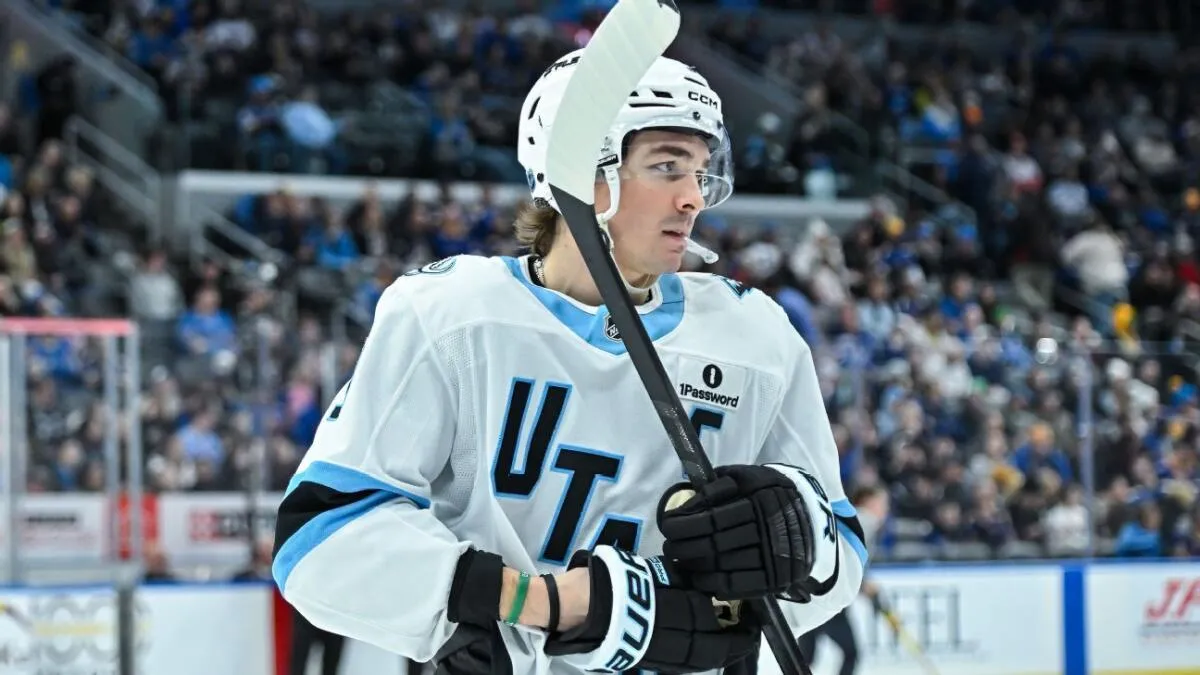
Thanksgiving tragedy strikes the Keller family
The news broke on Thanksgiving night when reports confirmed Bryan Keller, 64, had died suddenly in his sleep. The unexpected loss sent shockwaves through the hockey world, particularly in St. Louis where the Keller name had become synonymous with youth hockey excellence. Clayton Keller, in his first season as captain of the Utah Mammoth after the franchise relocated from Arizona, was on the road with his team when he received the devastating news.
What happened next demonstrated the remarkable character that has defined Keller’s career. Rather than immediately return home, Keller chose to play the following night in Dallas against the Stars. It was a decision that spoke volumes about his dedication to his teammates and his understanding of the healing power of hockey. The loss to Dallas ended 4-3, but the final score became secondary to the show of support from the opposing team, who named Keller the first star of the game in a touching gesture of sportsmanship.
The decision to play so quickly after such profound loss wasn’t made lightly. Keller consulted with his family, including his mother Kelley and younger brother Jake, who understood that hockey had always been the family’s sanctuary. Bryan Keller had been a constant presence in his son’s career, from basement hockey games with walls painted like a rink to traveling across the country for tournaments. Stepping onto the ice was Clayton’s way of honoring the man who had made it all possible.
A St. Louis homecoming filled with emotion
Saturday night’s matchup against the Blues was already circled on Keller’s calendar as a homecoming game. What none of the 18,000 fans knew was that it would become something far more meaningful. As the teams prepared for warm-ups, the Blues organization had been quietly planning a tribute that would leave few dry eyes in the building.
Before puck drop, the jumbotron illuminated with a photograph of a young Clayton Keller and his father, both beaming with pride. The arena fell silent as the public address announcer explained the significance of the moment. For thirty seconds, the only sound was the faint hum of the ice resurfacer in the distance and the sniffles of fans remembering their own loved ones. A simple gesture, perhaps, but one that carried profound weight for a grieving family.
Keller’s mother and grandmother were in attendance, sitting in seats they had occupied countless times before when Clayton was just a boy watching his heroes play. The moment of silence gave them space to feel the love of an entire community that had watched Clayton grow from a promising youth player into an NHL captain and four-time All-Star.
The Blues organization didn’t have to do anything. NHL teams aren’t obligated to honor opposing players’ family members, especially when those players now skate for different franchises. Yet the Blues chose to show up for one of their own, recognizing that Clayton Keller’s St. Louis roots run deeper than the current jersey on his back.
A career built on St. Louis hockey foundations
Clayton Keller’s journey to NHL stardom began in the very building where he now played through his grief. Growing up in Swansea, Illinois, he spent countless nights at what was then called the Scottrade Center, now Enterprise Center, sitting on his father’s lap and dreaming of playing where his idols performed. The basement of the Keller family home became a shrine to hockey, with walls painted to look like a rink and decorated with posters of Sidney Crosby, Patrick Kane, Pavel Datsyuk, Alexander Ovechkin, and Evgeni Malkin.
Keller’s path followed that of other St. Louis-area hockey prodigies, including Matthew Tkachuk and Luke Kunin. He played in the Quebec International Pee-Wee Hockey Tournament representing the St. Louis Blues minor affiliate, attended Shattuck-Saint Mary’s in Minnesota, and eventually joined the USA Hockey National Team Development Program. The St. Louis hockey community had always claimed Keller as one of their own, even when the Arizona Coyotes drafted him seventh overall in 2016.
His NHL debut on March 27, 2017, fittingly came against the Blues at their home arena. Bryan Keller was in the stands that night, watching his son record his first NHL point. The journey had come full circle, with father and son sharing a moment neither would ever forget. That memory made Saturday’s tribute all the more poignant.
The 2025 season had already been significant for Keller, who became the first captain in Utah Mammoth history after the franchise relocated from Arizona. He had established himself as one of the league’s most consistent scorers, reaching the 30-goal plateau in each of the past three seasons and registering career highs of 60 assists and 90 points in his final season with the Coyotes.
Teammates and opponents demonstrate hockey’s heart
The response from across the NHL community revealed the tight-knit nature of professional hockey. After the Dallas game, Utah Mammoth coach Andre Tourigny spoke about what makes the sport special. “That’s what is unbelievable about hockey,” he said. “There’s unbelievable people in this game. It comes from the right place, from the heart.”
Tourigny and the Mammoth organization gave Keller the space to make his own decision about playing, supporting him regardless of the choice. The coaching staff and management had been “unbelievable” in Keller’s words, providing resources and emotional support while also respecting his need to compete.
The Blues’ tribute represented something larger than a single game. It acknowledged the human element that exists beneath the fierce competition of professional sports. Players change teams, rivalries intensify, but the bonds forged through shared geography and mutual respect endure. St. Louis native Craig Berube, the Blues’ current general manager, understood the significance of honoring a local hockey product whose father had been part of the community fabric for decades.
The gesture also highlighted the difference between the NHL and other professional sports leagues. Where marketing often drives decisions, hockey culture remains rooted in traditions of respect and community. The Blues gained no competitive advantage from their tribute; if anything, they risked emotional momentum swinging toward the visiting team. Yet they chose humanity over gamesmanship.
What this means for Keller’s season and beyond
The Mammoth lost to the Blues 1-0 on Saturday night, but the result felt secondary to everything else that had transpired. Keller played meaningful minutes, recording several scoring chances and demonstrating the leadership that earned him the captain’s “C” on his jersey. His presence alone served as inspiration for teammates navigating their own emotions about their friend’s loss.
Keller’s resilience throughout this ordeal has been remarkable. In three games over four days following his father’s death, he never missed a shift. The decision to continue playing speaks to his character and his understanding of how hockey can serve as both distraction and tribute. Each time he steps onto the ice, he carries his father’s memory with him.
The coming weeks will test Keller’s emotional endurance. The NHL schedule shows no mercy, with games every other night and travel across multiple time zones. Grief has no timeline, and the reality of his loss will continue to surface in quiet moments away from the arena. But Keller now knows he has the full support of the hockey world behind him.
Utah Mammoth management has indicated they will continue to support Keller however he needs, whether that means additional time off or simply maintaining routines that provide comfort. The team’s performance will be measured not just in wins and losses, but in how they rally around their grieving captain.
A lasting legacy of love and hockey
Clayton Keller’s story is ultimately about the bonds between fathers and sons, the communities that raise athletes, and the sports that become family traditions. Bryan Keller wasn’t just a hockey dad; he was the man who painted his basement walls to look like a rink, who drove thousands of miles to tournaments, who sat in the stands for his son’s first NHL game. That legacy lives on every time Clayton steps onto the ice.
The Blues’ tribute ensures that legacy is recognized by an entire city. In St. Louis, where the Keller name has been part of the hockey landscape for decades, the moment of silence became a shared experience for fans who had watched Clayton grow up. For other NHL cities, it served as a reminder that behind every player is a family, a story, and a community that shaped them.
As Keller continues his season with Utah, he does so knowing that hockey has his back. The sport’s culture, often characterized by its physicality and intensity, revealed its softer side in his moment of need. From Dallas naming him first star to the Blues’ beautiful tribute, the message was clear: in hockey, you’re never alone.
For fans watching at home, the moment provided perspective on what really matters. The wins and losses, the playoff races, the statistical achievements—all fade in significance compared to family, community, and the human connections that make sports meaningful. Clayton Keller thanked the Blues, but an entire sport should thank him for reminding us why we fell in love with hockey in the first place.
Sources:
- ESPN: Mammoth’s Keller thanks Blues for tribute to late father
- Clayton Keller Wikipedia - Career and Personal Background
- NHL Insight: Clayton Keller plays after father’s death
- NHL Insight: Clayton Keller thanks St. Louis Blues for tribute to his late father/
Frequently Asked Questions

Par Mike Jonderson
Mike Jonderson is a passionate hockey analyst and expert in advanced NHL statistics. A former college player and mathematics graduate, he combines his understanding of the game with technical expertise to develop innovative predictive models and contribute to the evolution of modern hockey analytics.