







The Columbus Blue Jackets have entered the 2025-26 season with a renewed sense of purpose and genuine playoff aspirations. After falling just two points short of postseason hockey last spring, the organization has returned with largely the same roster that captured hearts and turned heads across the league. Through their first 10 games, Columbus has validated those expectations with a 6-4-0 record that projects to a 98-point pace, well above the 91 points needed for playoff contention in the Eastern Conference last season.
This isn’t the same franchise that stumbled through back-to-back last-place finishes in the Eastern Conference. The Blue Jackets demonstrated significant growth under first-year head coach Dean Evason last season, jumping 23 points in the standings and establishing themselves as a rising force in the Metropolitan Division. Now, with continuity as their foundation and lessons learned from near-misses, Columbus is proving that their late-season surge wasn’t a fluke but rather a preview of what’s to come.
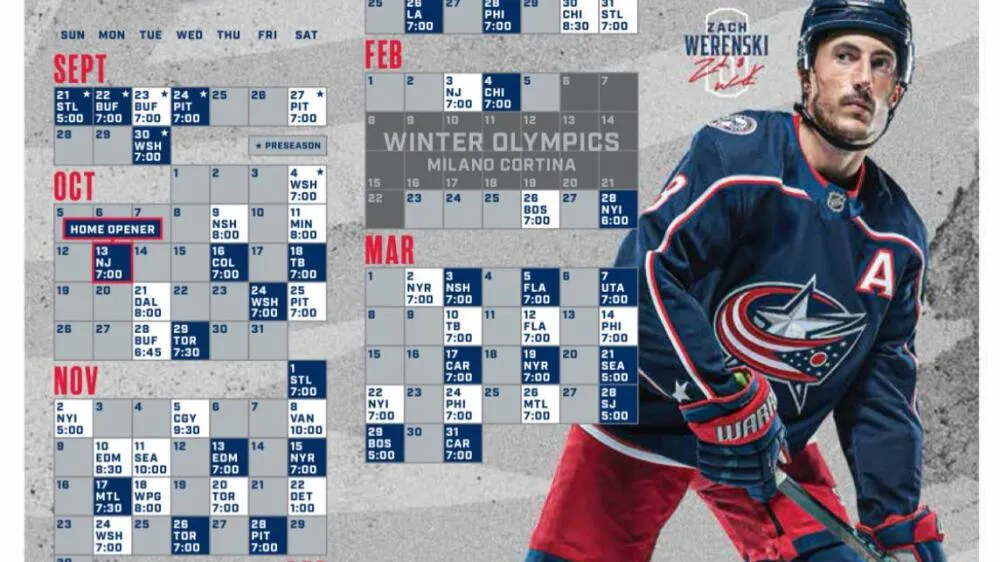
How the Columbus Blue Jackets early season progress 2025-26 demonstrates improved road performance
One of the most glaring weaknesses from the previous campaign has transformed into an early-season strength. Last year, the Blue Jackets managed just 14 victories in 41 road contests, a performance that ultimately doomed their playoff chances. This season tells a dramatically different story, with Columbus opening 4-1-0 away from Nationwide Arena, including a crucial overtime victory in Buffalo that showcased their newfound resilience.
The transformation stems from two critical improvements. Offensively, the Blue Jackets are averaging over four goals per game on the road, a remarkable uptick that has allowed them to play with leads rather than constantly chasing the scoreboard. Their power play has been particularly lethal away from home, clicking at an impressive 44.4% success rate that ranks among the league’s elite. This offensive explosion has provided Columbus with the cushion needed to weather the inevitable momentum shifts that occur during hostile road environments.
Perhaps more importantly, the goaltending has stabilized dramatically. The Blue Jackets are allowing just 2.80 goals against per game on the road, a defensive foundation that gives the team confidence no matter the venue. Elvis Merzlikins has been perfect through his first three road starts, including victories in challenging buildings like Dallas and Pittsburgh, while Jet Greaves earned his road debut with a 35-save performance in Buffalo.
The psychological impact of winning away from home cannot be overstated. Last season’s road struggles created a vicious cycle where players pressed to compensate, leading to mistakes and further losses. This year’s early success has flipped that script entirely. Players now believe they can win anywhere, and that confidence permeates through the lineup in crucial moments. While an .800 road winning percentage will inevitably regress toward league averages, the foundational improvements in goal scoring and goaltending suggest this team has genuinely evolved in this critical area.
The Columbus Blue Jackets early season progress 2025-26 showcases crucial depth scoring
The addition of veteran forwards Charlie Coyle and Miles Wood through trades, combined with the signing of Isac Lundestrom, has given Columbus a dimension they lacked in previous seasons. Different lines are winning games on different nights, spreading the offensive burden and making the Blue Jackets far more difficult to defend against. The Columbus Blue Jackets early season tests vs Capitals and Penguins demonstrated how this depth would be tested against divisional rivals early in the campaign.
Against Buffalo, the fourth line dominated proceedings with Yegor Chinakhov breaking through for his first goal of the season. Miles Wood then delivered twice, tying the game late in regulation before winning it in overtime during a rare fourth-line shift. The very next night against Toronto, it was the third line’s turn to shine as Cole Sillinger, Charlie Coyle, and Mathieu Olivier combined for 11 points and swept the Three Stars selections, a rare feat that illustrated their complete takeover of the game.
This depth extends beyond just the bottom six. The top line of Dmitri Voronkov, Sean Monahan, and Kirill Marchenko continues to produce despite Monahan’s early-season goal drought. Voronkov and Marchenko have each posted 5-5-10 lines through the first 10 games, leading the team in scoring and proving they can carry offensive responsibility. Voronkov, in particular, is beginning to realize his potential as a physical force who combines size with skill in ways that make him nearly impossible to defend.
The second line, featuring Adam Fantilli, may not have the point totals expected through the opening stretch, but the underlying talent and work ethic suggest a breakout is imminent. Having four lines capable of scoring gives coach Dean Evason tactical flexibility and allows him to roll his bench confidently in all situations. Coyle’s impact has been particularly noticeable beyond the scoresheet, bringing veteran playoff experience and hockey IQ that has helped stabilize situations throughout games. As one scout noted, there’s a reason Coyle has never missed the playoffs in his 13-year career, and that winning mentality is infectious.
Goaltending rotation benefiting Columbus Blue Jackets early season progress 2025-26
The decision to implement a true goaltending rotation between Merzlikins and Greaves has paid immediate dividends. Rather than riding one netminder until fatigue sets in, Evason and his staff have kept both goalies sharp by alternating starts and ensuring fresh legs at the most critical position on the ice. This approach addresses one of last season’s persistent issues: Merzlikins’ inconsistency, where he would post sub-two goals against performances one night and surrender five-plus the next.
Merzlikins has responded to the shared workload with renewed focus and energy. His perfect 3-0-0 road record demonstrates the benefits of playing with high energy levels rather than grinding through fatigue. At 31 years old and entering his seventh season with the organization, Merzlikins understands this may be his final opportunity to prove he can be a playoff-caliber starting goaltender. The structured rotation removes pressure while maintaining his engagement throughout the season.
Greaves, meanwhile, has seized his opportunity to establish himself as a legitimate NHL option. After years of spot starts and emergency duty, the 24-year-old enters his first campaign on an opening-night roster with something to prove. His .938 save percentage in limited NHL action last season combined with a .920 mark in the AHL demonstrated he was ready for this moment. The overtime win in Buffalo, where he turned aside 35 shots, showed he can handle the pressure of starting assignments.
The tandem approach also provides insurance against injury and allows the coaching staff to strategically deploy their goalies based on matchups and rest. As the season progresses and the schedule compresses with back-to-backs and three-games-in-four-nights stretches, having two capable netminders becomes increasingly valuable. The early returns suggest general manager Don Waddell made the right call trusting Greaves rather than seeking external goaltending help, and both netminders are feeding off the healthy competition.
Defensive improvements mark Columbus Blue Jackets early season progress 2025-26
The Blue Jackets’ commitment to defensive continuity is beginning to bear fruit. By returning all seven of their top defensemen from last season, Columbus has allowed chemistry and system familiarity to develop rather than starting from scratch with new personnel. The pairing of Zach Werenski and Dante Fabbro has continued its strong play from late last season, while Denton Mateychuk’s ascension to the top pair on the offside has been a revelation.
Mateychuk and Werenski have developed remarkable chemistry despite being deployed on their opposite sides. In over 108 minutes of five-on-five play together, they’ve outscored opponents 5-3 while posting expected goals percentages just under 56%. For a young defenseman like Mateychuk to perform at that level alongside a Norris Trophy runner-up speaks volumes about his hockey IQ and adaptability. The 20-year-old’s ability to move pucks efficiently and join the rush has given Columbus an offensive dimension from the back end that complements Werenski’s elite playmaking.
Ivan Provorov and Damon Severson have continued skating as a reliable second pair, providing veteran stability and strong puck-moving capabilities. Both defenders understand positioning and can transition the puck effectively, skills that become increasingly important in Evason’s up-tempo system. Alternate captain Erik Gudbranson’s return from injury has added the physical presence and leadership that was sorely missed during his absence last season.
The statistical improvements tell the story. While Columbus finished 25th in team defense last season, they showed marked improvement over the final 41 games, allowing just 2.90 goals per game from January onward, 14th in the NHL during that stretch. If the Blue Jackets can maintain or improve upon that second-half defensive performance for a full 82-game schedule, they’ll position themselves firmly in the playoff picture. As discussed regarding their Metropolitan Division title contention, defensive consistency will be paramount to any championship aspirations.
Special teams evolution in Columbus Blue Jackets early season progress 2025-26
The power play has shown flashes of elite potential, particularly on the road where it’s clicking at 44.4%. However, an interesting anomaly has emerged: Columbus has yet to score a power-play goal at Nationwide Arena through the early going. This home-ice struggle presents both a concern and an opportunity. The underlying talent on the top unit suggests regression to the mean will favor the Blue Jackets as the season progresses.
The personnel available for man-advantage situations reads like a who’s who of offensive talent. Werenski’s ability to quarterback from the point, directing traffic and unleashing his lethal shot, makes him a constant threat. Sean Monahan’s playmaking and net-front positioning give the unit a cerebral element, while Marchenko’s one-timer from the left circle provides a go-to finishing option. Kent Johnson’s creativity and Boone Jenner’s netfront presence round out a unit that should be scoring at will.
Last season’s 22nd-ranked power play (19.5%) was hampered by injuries to key personnel, particularly Jenner and Monahan at various points. With a healthy roster and more time to develop chemistry in Evason’s system, the pieces are in place for significant improvement. The early road success suggests the systems and execution are sound; home-ice results should follow as confidence builds.
The penalty kill presents a more pressing concern. Last year’s 77.0% success rate ranked 22nd in the NHL, and early season numbers haven’t shown dramatic improvement. The additions of Coyle, Wood, and Lundestrom were partially motivated by their penalty-killing experience and effectiveness. Coyle, in particular, has been one of the league’s most reliable defensive forwards throughout his career, while Wood’s speed creates shorthanded scoring chances that force opposing power plays to be more conservative in their approach.
Young core driving Columbus Blue Jackets early season progress 2025-26
The continued development of Columbus’s young core remains central to any sustainable success. Adam Fantilli’s 31 goals as the NHL’s youngest 30-goal scorer last season established him as a future star, and he’s shouldered even greater expectations this year. Kent Johnson followed his breakout campaign with career highs in both goals and assists, demonstrating he’s ready to take another step forward. Voronkov’s physical dominance combined with his skill set makes him one of the most unique talents in the league.
Marchenko has blossomed into a legitimate top-line winger whose 31 goals and 74 points tied for sixth in franchise history. His combination of shot and vision makes him a dual threat who can beat defenders multiple ways. Cole Sillinger enters his fifth NHL season at just 22 years old, a veteran presence whose experience belies his youth. These players have progressed from prospects to core pieces, and their continued growth will determine how high this team’s ceiling reaches.
The challenge facing young players often comes in year two or three, when opponents have scouting reports and adjust their game plans accordingly. Sophomore slumps and third-year plateaus are common throughout the NHL as the league’s coaching staffs identify and exploit weaknesses. The Blue Jackets’ young core has collectively spoken about accepting greater leadership responsibility and working tirelessly throughout the offseason to expand their games rather than rest on their accomplishments.
What separates good young players from great ones is their ability to adapt when the league adjusts to them. Marchenko and Fantilli proved last season they could handle increased defensive attention; now they must show they can thrive against it consistently. Johnson must demonstrate he can produce even when opponents take away his preferred options. Voronkov is only beginning to understand the havoc he can create with his unique combination of size, skill, and determination. If these players continue their upward trajectory, the Blue Jackets will exceed their modest preseason playoff aspirations.
Leadership and accountability fuel Columbus Blue Jackets early season progress 2025-26
Perhaps the most significant development for Columbus hasn’t been captured in box scores or advanced statistics. The leadership structure within the locker room has matured to the point where players hold each other accountable without requiring constant coaching intervention. Dean Evason has noticed he speaks far less during practices and games than he did during his first training camp, a testament to the team’s ownership of their systems and standards.
The captaincy trio of Boone Jenner, Zach Werenski, and Erik Gudbranson has established a culture of accountability that permeates through the roster. When mistakes happen or effort wanes, peers deliver the message rather than waiting for coaching staff intervention. This player-driven standard represents a crucial evolution for a young team that had struggled with consistency during previous campaigns. The standing ovation they received following their final game last season, despite missing the playoffs, demonstrated the connection between team and fanbase that comes from playing the right way every night.
Werenski’s emergence as a vocal leader complements his on-ice excellence. As Evason noted, having the team’s best player teaching and coaching during practices and games carries far more weight than any speech from the bench. Werenski understands what it takes to compete at an elite level, and his willingness to share that knowledge while demanding excellence from teammates elevates everyone around him. Jenner, one goal shy of becoming just the third Blue Jacket to reach 200 career goals, brings the experience of weathering the franchise’s darkest days and understanding the work required to build something sustainable.
The additions of Coyle and Wood brought more than just skill and speed. Both veterans carry extensive playoff experience and winning pedigrees that younger players can learn from daily. Coyle’s spotless 13-year playoff streak stands as the only active such streak in the NHL, a remarkable achievement that speaks to his consistency and professionalism. That mentality influences practice habits, preparation routines, and in-game decision-making in ways that don’t appear in traditional statistics but prove crucial in tight games and pressure situations.
The Columbus Blue Jackets have turned their early season opportunity into tangible results through their first 10 games of the 2025-26 campaign. The 6-4-0 record represents more than just wins and losses; it validates the organizational belief that last season’s late push wasn’t an aberration but rather a foundation for sustained success. From dramatic improvements in road performance to the depth scoring that has delivered victories in different ways, Columbus has demonstrated they’ve learned from past shortcomings and evolved as a team.
As the season progresses through November and beyond, the Blue Jackets face the challenge of maintaining this standard while navigating the inevitable adversity that comes with an 82-game schedule. The continuity in their lineup provides an advantage, as chemistry continues developing and players grow more comfortable in Evason’s system. With playoff expectations firmly established both internally and externally, according to their season preview via NHL.com, this team has embraced the pressure and shown early that they’re ready to compete for a postseason berth. The Hockey Writers’ analysis of their first 10 games](https://thehockeywriters.com/blue-jackets-first-10-games-show-real-progress-2025-26/) confirms what the standings already suggest: this team has made real progress and shows no signs of slowing down.

Par Mike Jonderson
Mike Jonderson is a passionate hockey analyst and expert in advanced NHL statistics. A former college player and mathematics graduate, he combines his understanding of the game with technical expertise to develop innovative predictive models and contribute to the evolution of modern hockey analytics.