





Chicago Blackhawks superstar Connor Bedard will miss Saturday’s matchup against the Detroit Red Wings after sustaining a shoulder injury during a last-second faceoff in Friday night’s 3-2 loss to the St. Louis Blues. The incident occurred with just 0.8 seconds remaining in regulation, turning what should have been a routine late-game play into a moment that could significantly impact Chicago’s immediate future.
Bedard, who ranks fifth in the NHL in points, was attempting to win the final draw to give his team one last scoring chance when Blues center Brayden Schenn knocked him down. The young forward immediately grasped at his right shoulder and left the ice accompanied by a trainer, leaving his teammates on the bench to process the sudden turn of events. Coach Jeff Blashill confirmed the absence shortly after the game, though he remained cautious about speculating on the severity of the injury.
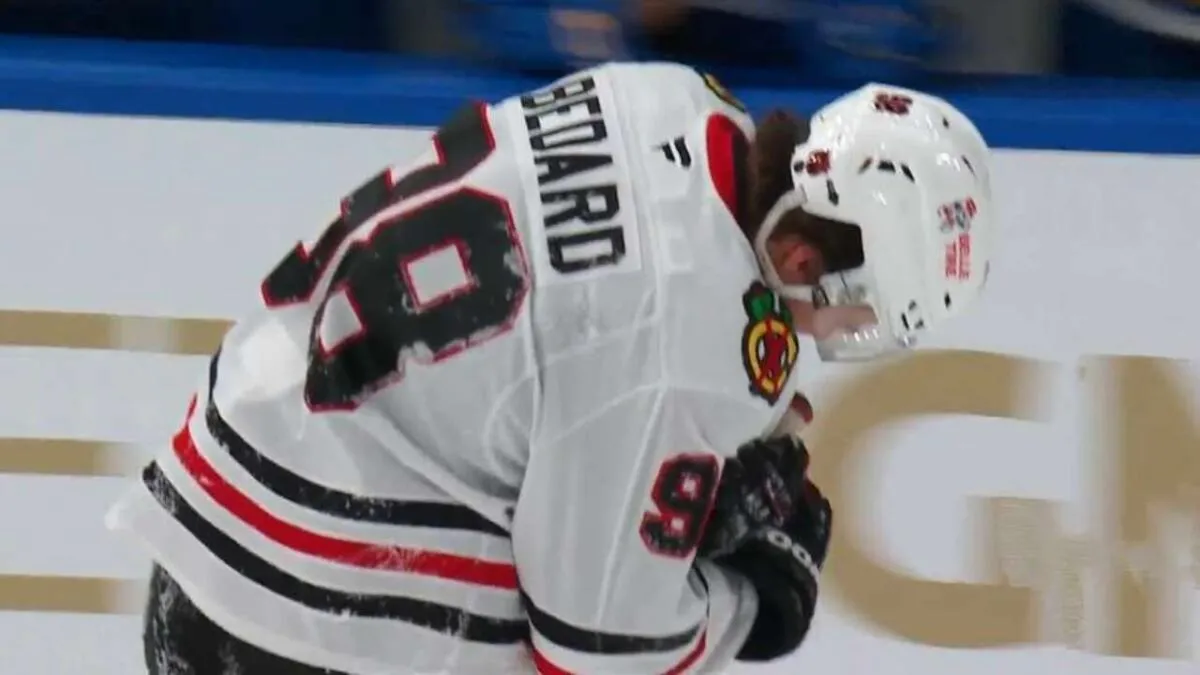
How the injury happened during the final faceoff
The sequence began when St. Louis iced the puck with less than a second remaining, giving Chicago a final opportunity in the offensive zone. Officials added 0.8 seconds back to the clock, creating a scenario where a clean faceoff win could theoretically lead to a desperation shot on goal. Bedard lined up against veteran Brayden Schenn, who engaged physically as the puck dropped. The contact sent Bedard to the ice awkwardly, with his right shoulder absorbing the impact.
Medical staff attended to Bedard immediately, and he made his way to the locker room without returning to the bench area. The concerning visual of Chicago’s franchise player clutching his shoulder cast a pall over what had already been a disappointing loss to a division rival. Teammates remained on the ice and bench, processing the sequence while medical personnel evaluated the injury.
The play itself drew little controversy from the coaching staff. Initial reviews suggested standard faceoff jostling rather than any malicious intent, though the timing and stakes made the outcome particularly cruel for a Chicago team fighting to stay competitive in a tough Central Division race.
Coach Blashill calls it a “freak accident”
Jeff Blashill minced no words when addressing reporters after the game, characterizing the incident as an unfortunate fluke rather than a dirty play. “Honestly, I think it’s a freak accident,” Blashill told assembled media. “To be honest with you.” The coach’s assessment reflects the random nature of hockey injuries, where routine plays can suddenly become dangerous.
Blashill’s tone remained measured but concerned throughout the postgame press conference. He acknowledged the obvious disappointment while refusing to place blame on Schenn or the Blues organization. The veteran coach has seen his share of hockey-related injuries during his tenure, but losing a generational talent in such innocuous circumstances adds another layer of frustration to an already challenging season.
The Blackhawks organization will conduct further evaluation before releasing additional details. Modern NHL teams typically employ extensive medical imaging and specialist consultations for injuries involving high-value players, meaning Bedard could undergo MRIs and other tests before any definitive diagnosis emerges.
Impact on Blackhawks lineup against Detroit
Bedard’s absence creates a massive void in Chicago’s offensive structure. Before leaving the game, he assisted on both Blackhawks goals, extending his season totals to 12 goals and 25 assists through roughly half the campaign. His 37 points place him among the league’s elite producers, trailing only a handful of superstars in the overall scoring race.
The timing couldn’t be worse for a Chicago squad preparing to host Detroit on Saturday night. The Red Wings enter with a respectable 16-11-3 record and have demonstrated clear competence on the road throughout the season. Chicago, now sitting at 12-11-6, faces an uphill battle against a division foe without their most dynamic offensive weapon.
Lineup adjustments will require significant creativity from the coaching staff. Secondary scoring options like Taylor Hall and Andreas Athanasiou must elevate their production, while the power play unit loses its primary quarterback. The Blackhawks have struggled with depth scoring issues all season, and Bedard’s injury exposes those weaknesses further.
Blackhawks vs Red Wings matchup challenges
Detroit’s defensive structure focuses on neutralizing speed and skill through the neutral zone, which becomes significantly easier without Bedard in the lineup. The Red Wings’ coaching staff can now concentrate their best checking forwards and defensemen against Chicago’s remaining threats, rather than dedicating special attention to the young superstar.
Special teams represent another area of concern. Bedard leads Chicago in power-play points and serves as the primary catalyst with the man advantage. The Blackhawks’ power play operates at a middle-of-the-pack efficiency, but removing its most dangerous element could send those numbers tumbling. Penalty kill effectiveness may also suffer, as Bedard’s absence removes a potential shorthanded threat that forces opponents to play more conservatively.
The rivalry aspect adds extra motivation for Detroit to capitalize on Chicago’s misfortune. Central Division games carry additional weight in playoff seeding, and the Red Wings have an opportunity to gain valuable points against a weakened opponent.
Uncertainty surrounds the timeline for recovery
Coach Blashill remained deliberately vague when pressed about potential recovery timelines. “He won’t play tomorrow,” Blashill stated definitively about the Detroit game. “I won’t know more info tomorrow, so don’t ask me tomorrow. At some point through the weekend, I’ll know more, so I’d probably have more info come Monday.”
When asked specifically whether the injury might only require a short-term absence, Blashill refused to speculate. “I’d hate to say that without knowing the information,” he explained. “Until we get the information, again, he’s not going to play tomorrow.” The cautious approach reflects both the uncertainty of the injury and the organization’s desire to protect their most valuable asset.
Medical evaluation protocols typically require 24-48 hours for comprehensive assessment, meaning Chicago fans likely won’t receive clarity until early next week. The team must balance transparency with proper medical caution, especially when dealing with a player who represents the franchise’s future.
The shoulder’s complexity as a joint creates additional anxiety. Hockey players subject their shoulders to constant stress from shooting, checking, and faceoff mechanics. Even minor injuries can require significant rest and rehabilitation to prevent recurrence or more serious damage.
The controversial context of the final play
The incident stemmed directly from a referee’s decision to add time back to the clock after an icing call. With 0.8 seconds showing, a clean faceoff win and immediate release could theoretically create a scoring chance, though the odds remain microscopic. Coaching staffs debate the wisdom of even contesting such plays, given the injury risk versus minimal reward.
Bedard’s competitive nature likely drove his decision to line up for the draw. The 19-year-old phenom has demonstrated relentless competitiveness throughout his young career, rarely taking plays off regardless of the situation. That drive has made him a fan favorite but occasionally puts him in vulnerable positions during seemingly meaningless moments.
Teammates and coaches must now grapple with whether encouraging maximum effort until the final buzzer represents sound strategy. While hockey culture prizes complete dedication, the calculus changes when franchise-altering injuries enter the equation. Future late-game situations may see star players exercise more caution, potentially saving their bodies for more meaningful possessions.
What Bedard’s absence means for Chicago’s season
The Blackhawks entered this season with tempered expectations, focusing on development rather than immediate contention. Bedard’s spectacular play had accelerated that timeline in many minds, with the team competing for a potential wild card spot despite its youth. This injury serves as a stark reminder of how quickly fortunes can change in professional sports.
Chicago’s management faces difficult decisions if the injury proves significant. The trade deadline approaches in March, and the team must determine whether to add veteran support or continue building for the future. A prolonged Bedard absence could shift the organization’s approach from competitive to developmental overnight.
Fantasy hockey managers across North America also watch nervously, as Bedard represents a first-round draft pick in most formats. His combination of goals, assists, and power-play production makes him irreplaceable in roster construction. The coming days will determine whether those investments require contingency planning.
The psychological impact on the locker room shouldn’t be underestimated. Young teams often rely on their star player for identity and confidence. Watching him leave the ice injured creates uncertainty that extends beyond X’s and O’s, potentially affecting performance until the team adjusts to life without its centerpiece.
Connor Bedard’s injury on a last-second faceoff serves as a cautionary tale about the unpredictable nature of hockey. The Blackhawks now face Detroit without their most important player, with further evaluation needed before anyone can definitively state how long he’ll be sidelined. Chicago’s response to this adversity will reveal much about the team’s character and depth, even as fans hope for positive medical news early next week. For now, the organization holds its collective breath, praying that a freak accident doesn’t become a season-defining catastrophe.
Frequently Asked Questions

Par Mike Jonderson
Mike Jonderson is a passionate hockey analyst and expert in advanced NHL statistics. A former college player and mathematics graduate, he combines his understanding of the game with technical expertise to develop innovative predictive models and contribute to the evolution of modern hockey analytics.