






The New Jersey Devils saw their impressive seven-game home winning streak come to a screeching halt on Monday night at Prudential Center, falling 3-2 to the New York Islanders in overtime. Mathew Barzal’s goal just 1:17 into the extra frame spoiled what appeared to be a miraculous comeback after Simon Nemec tied the contest with only 4.7 seconds remaining in regulation. While the Devils salvaged a point to maintain their perfect home record with at least one point (7-0-1), the loss stings as they came within one shot of tying the franchise record for the best home start to a season.
The Metropolitan Division rivals delivered a tightly contested affair that showcased both teams’ resilience and determination. Despite generating early offense with Timo Meier’s power-play tally, the Devils struggled to find consistent offensive rhythm throughout the night, turning the puck over in critical moments while trying to force plays off the rush. The loss serves as a reminder that even during a strong homestand, execution under pressure remains paramount, especially against divisional opponents fighting for crucial points in the standings.
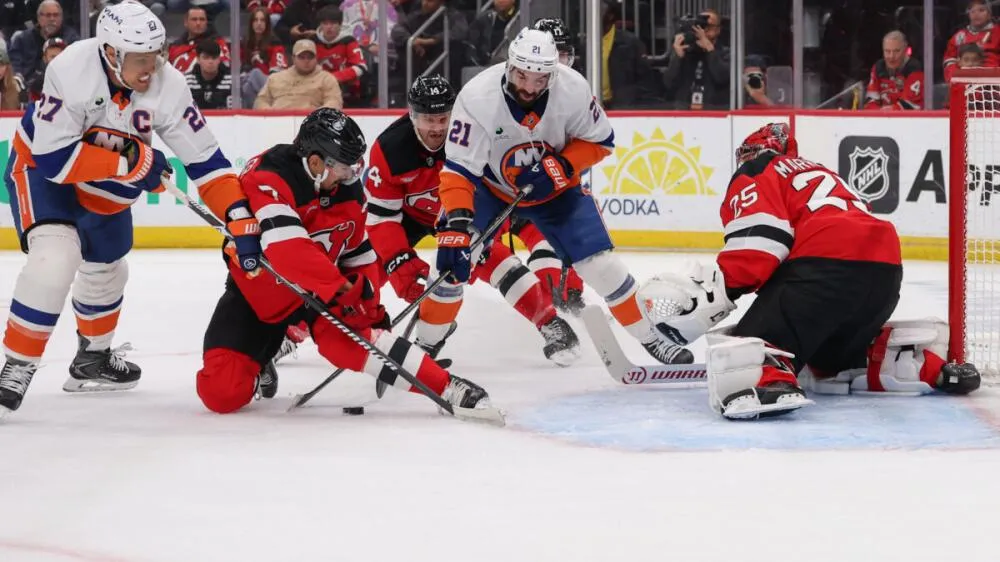
Nemec’s heroics force overtime in dramatic fashion
Simon Nemec provided the most crucial moment of the evening for New Jersey, delivering his first goal of the season at the most opportune time imaginable. With the Devils trailing 2-1 and time expiring, Nemec fired a shot from the point that deflected off an Islanders player between the circles and found its way past goaltender Ilya Sorokin with just 4.7 seconds on the clock.
The young defenseman’s clutch play salvaged a critical point for the Devils and demonstrated his ability to rise to the occasion when given increased opportunity. Head coach Sheldon Keefe praised Nemec’s performance after the game, noting, “Nemec has shown that when guys are hurt and an opportunity arises, he can step up and rise to the occasion. For him to shoot one in and get that big point, that’ll be big for him.”
Nemec himself acknowledged the desperation of the moment, admitting after the game: “I closed my eyes and tried to shoot. There’s not much you can do in the last five seconds.” The goal not only extended the Devils’ home point streak but also provided a massive confidence boost for the 23-year-old defenseman who has been working to establish himself as a consistent contributor on the blueline.
The timing of Nemec’s breakthrough couldn’t have been better for his personal development. With injuries creating opportunities for increased ice time, his ability to deliver in high-pressure situations bodes well for both his future and the team’s defensive depth. This moment could serve as a springboard for a more consistent offensive contribution from the backend throughout the remainder of the season.
Meier opens scoring but Devils offense sputters
Timo Meier got the Devils off to a perfect start, opening the scoring just 2:12 into the game with a power-play goal that was struck with such velocity that even the goal light and horn operators were delayed in their response. Positioned in the bumper spot above the crease, Meier received a perfect feed from Jesper Bratt and rifled a shot far side past Sorokin’s outstretched pad.
The goal marked Meier’s second in three games and demonstrated the kind of offensive firepower the Devils envisioned when they acquired the Swiss forward. His ability to find dangerous positions in the offensive zone and convert with a lethal shot makes him a constant threat when the Devils’ power play is clicking. The early goal seemed to set the tone for what could have been a dominant offensive performance at home.
However, the Devils couldn’t build on that early momentum, managing just one more goal in regulation outside of Nemec’s desperation shot. Meier himself acknowledged the team’s struggles to generate sustained pressure, explaining, “They did a good job of not giving up much off the rush and we played into that trap. We turned too many pucks over trying to force things off the rush instead of putting pucks behind them.”
The offensive difficulties highlighted a concerning trend for New Jersey in this matchup. Rather than maintaining their typically patient offensive approach, they attempted to force plays through the neutral zone, resulting in turnovers and stalled attacks. The Islanders’ defensive structure frustrated the Devils’ skilled forwards, limiting time and space for Jack Hughes, Bratt, and their teammates to create dangerous scoring chances.
Despite the team’s struggles, Meier’s goal showcased why the Devils invested heavily in his services. When given quality opportunities, particularly on the power play, he possesses the finishing ability to change games. The challenge moving forward will be finding ways to generate more consistent five-on-five production to complement the special teams success.
Defensive desperation keeps Devils in the game
While Jacob Markstrom provided solid goaltending throughout the contest, two remarkable saves from unlikely sources kept the Devils’ hopes alive during critical third-period moments. Jonas Siegenthaler delivered perhaps the most spectacular defensive play of the night when he dove into the crease and punched away what appeared to be a certain goal for Jonathan Drouin.
After Markstrom made an initial save but couldn’t control the rebound, the puck slid dangerously toward an open net. Siegenthaler, displaying pure desperation and selfless commitment, threw his body along the goal line and used his gloves to punch Drouin’s shot away from the empty cage. The play exemplified the kind of sacrifice required to win tight games against divisional opponents and prevented what would have been a crushing blow to New Jersey’s comeback hopes.
Just moments later, Jesper Bratt provided his own highlight-reel defensive stop. When Markstrom ventured out to poke a loose puck away above the circles, the puck popped into the air and began floating toward the net. Bratt, reading the play perfectly, swung his stick in a baseball-style motion and swatted the puck away before it could cross the goal line, drawing roars from the Prudential Center crowd.
These defensive heroics underscored how razor-thin the margins were in this contest. Both plays could have easily resulted in goals that would have ended the Devils’ chances, but instead, the desperation and awareness from two players primarily known for their offensive contributions kept New Jersey within striking distance.
The willingness of skill players like Bratt and Siegenthaler to sacrifice their bodies defensively speaks to the team’s commitment and character. While the Devils ultimately fell short in overtime, these moments demonstrated the competitive fire and resilience that has fueled their strong start to the season, particularly at home where they’ve remained a formidable opponent.
Palmieri haunts former team with crucial power-play goal in the New Jersey Devils 3-2 overtime loss to New York Islanders takeaways
Former Devil Kyle Palmieri continued his habit of making an impact against his old team, scoring the go-ahead power-play goal with just 2:53 remaining in regulation. Palmieri’s tally gave the Islanders a 2-1 lead and appeared to have ended New Jersey’s home winning streak before Nemec’s late heroics forced overtime.
The goal came at a particularly inopportune time for the Devils, who had been defending well for most of the third period. The penalty that led to Palmieri’s goal proved costly, as New York’s power play capitalized on the opportunity to swing momentum in their favor during the game’s critical final minutes. Palmieri’s familiarity with Prudential Center and his history with the organization made the goal especially painful for Devils fans.
Palmieri has consistently performed well against New Jersey since departing for Long Island. His understanding of the Devils’ systems and personnel gives him an edge in these Metropolitan Division matchups, and he once again demonstrated why he remains a dangerous offensive weapon for the Islanders. The veteran forward’s ability to produce in clutch situations makes him exactly the type of player who can influence tight divisional games.
Beyond Palmieri’s goal, Bo Horvat also delivered a strong performance with a goal and career assist No. 300, showcasing the Islanders’ depth throughout their lineup. The two-point night for Horvat highlighted how multiple New York players stepped up to contribute offensively, making it difficult for the Devils to focus their defensive attention on any single threat.
Barzal delivers the decisive blow in overtime
Mathew Barzal wasted little time ending the contest in overtime, scoring just 1:17 into the extra period to give the Islanders the victory and snap the Devils’ seven-game home winning streak. Barzal’s speed and skill in three-on-three overtime situations make him one of the league’s most dangerous players in the extra frame, and he once again demonstrated why.
The overtime loss marks another frustrating ending for the Devils in these tightly contested divisional matchups. While securing a point keeps their home record unblemished in terms of earning standings points, the inability to convert the momentum from Nemec’s late goal into a complete victory will sting as both teams battle for playoff positioning throughout the season.
This defeat represents a valuable learning opportunity for New Jersey as they prepare to embark on a challenging five-game road trip. The Devils must find ways to generate more consistent offensive pressure against structured defensive teams like the Islanders, who successfully limited rush chances and forced turnovers in the neutral zone throughout the night.
Coach Sheldon Keefe made adjustments during the game, breaking up the successful trio of Stefan Noesen, Jack Hughes, and Bratt in the third period by elevating Arseny Gritsyuk in place of Noesen. These lineup changes signal Keefe’s willingness to experiment when searching for offensive production, though the Devils ultimately couldn’t find the tying goal during five-on-five play in regulation.
Looking ahead after the New Jersey Devils 3-2 overtime loss to New York Islanders takeaways
The Devils now face an immediate test of their resilience as they head out on a five-game road trip beginning in Chicago. How they respond to this overtime disappointment will reveal much about their character and championship aspirations. The team has shown an ability to bounce back from adversity throughout the early season, but sustaining success away from the friendly confines of Prudential Center presents a different challenge entirely.
This loss, while disappointing, doesn’t diminish the impressive home start the Devils have compiled. Earning at least one point in all eight home games (7-0-1) demonstrates the fortress they’ve built in Newark. However, turning one-point games into two-point victories will be crucial as the season progresses and divisional races tighten. The difference between overtime losses and overtime wins often determines playoff seeding and home-ice advantage come spring.
The special teams battle proved decisive in this contest, with both teams scoring power-play goals at critical moments. The Devils’ ability to generate early offense with the man advantage while the Islanders struck late highlights how special teams can swing close games. Moving forward, maintaining discipline to avoid late-game penalties while continuing to convert power-play opportunities will be essential.
Individual performances from players like Nemec, Siegenthaler, and Bratt showed the Devils have the talent and determination to compete with anyone. The defensive desperation displayed by multiple players keeping pucks out of the net speaks to a team-first mentality that will serve them well throughout a grueling season. As they hit the road for an extended trip, these character moments may prove more valuable than the final score suggests.

Par Mike Jonderson
Mike Jonderson is a passionate hockey analyst and expert in advanced NHL statistics. A former college player and mathematics graduate, he combines his understanding of the game with technical expertise to develop innovative predictive models and contribute to the evolution of modern hockey analytics.