






The return of Josh Doan and Michael Kesselring to Delta Center carried emotional weight that transcended the usual narrative of players facing their former teams. The Buffalo Sabres duo spent just one season in Utah, but it was the inaugural campaign for the Mammoth franchise, creating bonds that made their November 12, 2025 homecoming particularly poignant. The trade that sent both players to Buffalo in exchange for JJ Peterka had shocked the organization last summer, but on this night, hockey took precedence over sentiment as the two sides battled for crucial points in a competitive Western Conference.
The atmosphere at Delta Center reflected the bittersweet nature of the occasion. Fans who had embraced Doan and Kesselring during Utah’s first NHL season welcomed them back warmly during pregame introductions, even as they hoped to see their current Mammoth squad emerge victorious. For the two players, the emotions were complex—gratitude for their time in Utah mixed with determination to prove the trade was a mistake. As Kesselring candidly admitted before the game, “I’d be lying if I said I didn’t want to score a few and stick it to them a little bit.”
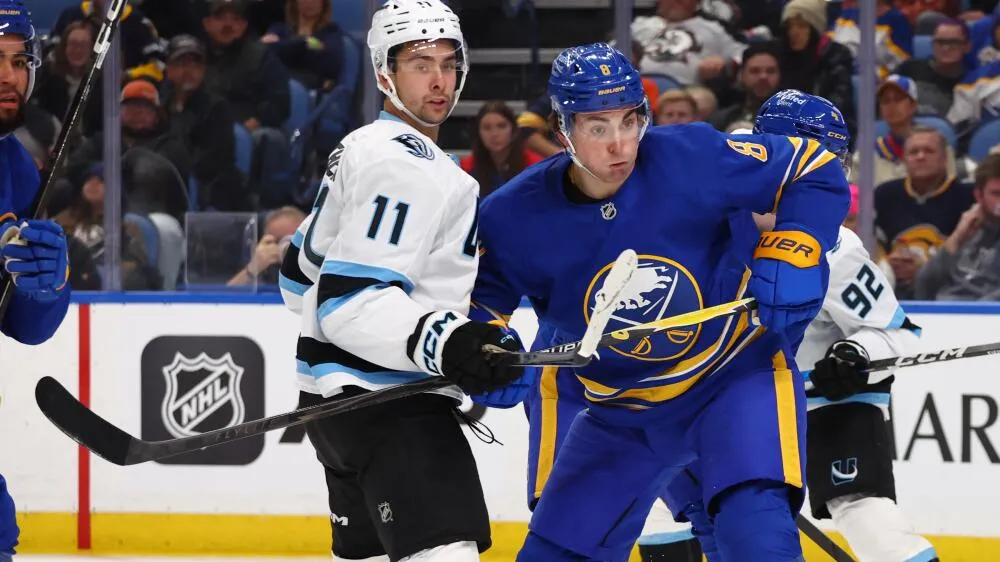
Josh Doan and Michael Kesselring return to Delta Center as Buffalo Sabres against Utah Mammoth with familiar faces everywhere
The pregame conversations between Doan, Kesselring, and their former teammates revealed the depth of relationships forged during Utah’s inaugural season. Logan Cooley, who had planned to live with both players before the trade disrupted those arrangements, picked them up for dinner at Clayton Keller’s house on Tuesday night. These weren’t just colleagues reuniting—they were close friends who had shared the unique experience of launching a new franchise together.
Kesselring spoke fondly of facing players like Cooley, Keller, Dylan Guenther, and others during their first meeting in Buffalo the previous week. “I think Cools is always going to be someone that’s fun to play against,” Doan noted, while also mentioning his strong connections with the team’s more physical players. The defensive setup they’d see from Buffalo Sabres vs Utah Mammoth projected lineups and storylines featured many familiar faces on both sides.
The rooming situation told its own story about the transition both players faced. Doan and Kesselring had lived together in Utah during the 2024-25 season, and they maintained that arrangement after being traded to Buffalo. The continuity provided some stability as they adjusted to a new organization, new systems, and the demanding expectations of an established hockey market.
For Kesselring, the return held special significance beyond just the hockey aspects. “Playing in Buffalo was cool, but I think tomorrow in Delta will be really special,” he said before the game. “Obviously, as you said, it’s (only) one year, but, I mean, we were in the first year of an organization. It’s pretty special, pretty cool.” That first-year bond created connections that a longer tenure with an established team might not have replicated.
The emotional weight of facing the team that gave them their chance
Both players carried deep gratitude toward Bill Armstrong, André Tourigny, and the Utah organization for providing them with NHL opportunities. Kesselring’s path to the league had taken him through the USHL and AHL before finally breaking through in Utah, while Doan—son of former NHL star Shane Doan—carved out his own identity in the Mammoth’s inaugural campaign.
The defensive adjustments Kesselring faced in Buffalo highlighted how different his role had become. In Utah, he averaged significant power-play time but minimal penalty-kill duties. With the Sabres, those roles reversed as he joined a team already loaded with power-play specialists. “I want to be a guy that penalty kills,” Kesselring explained. “Power play is great, but penalty kill is going to be more of my role.”
The transition period proved challenging for Kesselring, who started the Buffalo season on injured reserve with a lower-body injury sustained during the preseason. By the time he returned to face Utah, he was still working to find his rhythm. “I have to get going still a little bit from my injury, so I haven’t played too well yet, to be honest,” he admitted. “But I can see that the opportunity’s there and once I get going and get my feet moving a little bit more and start feeling better, I think it’s going to be a great fit.”
Doan, meanwhile, had embraced Buffalo’s blue-collar identity immediately. The city’s lunchpail mentality matched his playing style perfectly, making him an instant fan favorite. Through 15 games, he’d already accumulated half the point total from his entire rookie season in Utah, demonstrating growth that validated Buffalo’s faith in the trade.
The stark contrast between Utah’s embrace and Buffalo’s scrutiny
One of Kesselring’s most revealing comments concerned the difference between hockey markets. In Utah, he experienced something unusual for a professional athlete—unconditional fan support during an expansion season. “The fans were unbelievable to me and Doaner last year,” he reflected. “That was honestly probably one of the hardest parts, too, other than (leaving) the guys. We had such a good fan base here. It was so nice just seeing all the positive things all the time. I could do no wrong.”
The contrast with Buffalo couldn’t have been starker. “You see the other side of it now in a hockey market. They’re pretty critical,” Kesselring noted. The adjustment required developing thicker skin and learning to block out negative commentary while maintaining confidence in his abilities. Buffalo fans demanded excellence, not participation trophies, and every mistake drew scrutiny that would have been forgiven or overlooked in Utah’s inaugural season.
A touching moment from the previous week’s game in Buffalo illustrated the lasting impact both players made in Utah. Kesselring spotted a young fan wearing a custom split jersey—half Utah, half Buffalo—featuring his name and number for both teams. “That just makes my day,” he said. “I remember being a little kid and getting signatures from (Steven) Stamkos and (Victor) Hedman, guys like that, how much it meant to me. It’s cool that I can impact someone like that, even though I don’t think of myself like that at all. It’s really special.”
The memory resonated with Kesselring precisely because it demonstrated how his one season in Utah had created meaningful connections with fans. Despite spending only one year with the franchise, he’d left an impression strong enough that families traveled across the country to watch him play. That kind of devotion couldn’t be manufactured—it spoke to the authentic relationships built during Utah’s first NHL campaign.
How Josh Doan and Michael Kesselling return to Delta Center as Buffalo Sabres against Utah Mammoth unfolded on the ice
When the puck dropped, both teams came out with intensity befitting the occasion. Buffalo struck first, with Isak Rosen opening the scoring just 5:33 into the game on a beautiful back-door feed from Jack Quinn. The Sabres’ young forward doubled the lead in the second period, giving Buffalo a 2-0 advantage that seemed to validate their road trip strategy.
Colten Ellis, making just his second NHL appearance, stood strong in the Buffalo net through the first two periods. His 12-save opening frame included spectacular stops on Clayton Keller, Guenther, and Cooley, denying Utah despite the home team generating six high-danger chances. Ellis continued his stellar play into the second period, though Nick DeSimone finally solved him with a well-screened slap shot to cut Buffalo’s lead to 2-1.
The third period, however, belonged entirely to Utah. The Mammoth scored five unanswered goals—four in the final frame—to storm back and secure a 5-2 victory that snapped their three-game losing streak. JJ Peterka, the player acquired in the trade that sent Doan and Kesselring to Buffalo, scored the go-ahead goal early in the period, adding a layer of narrative symmetry to the evening.
Neither Doan nor Kesselring registered points in the game, though Kesselring played significant minutes and Doan contributed the physical, forechecking effort that had become his trademark. The “bragging rights” Doan mentioned before the game went decisively to Utah, as the Mammoth dominated the final 20 minutes with a 14-3 shot advantage.
The broader implications of the trade and what it means moving forward
The JJ Peterka-for-Doan-and-Kesselring trade represented a significant gamble for both organizations. Utah bet that adding an established offensive weapon like Peterka would accelerate their development into a playoff contender. Buffalo, meanwhile, saw value in acquiring two younger players with upside who fit their rebuilding timeline and salary structure.
Through the early portion of the 2025-26 season, Peterka’s impact in Utah had been substantial. His goal-scoring ability and offensive creativity gave the Mammoth another dimension that complemented their core of Keller, Cooley, and Guenther. The victory over Buffalo, with Peterka scoring a crucial third-period goal, seemed to validate Armstrong’s decision to make the trade.
For Buffalo, the evaluation remained ongoing. Doan’s immediate integration into the team’s culture suggested long-term potential as a complementary forward who could contribute in various situations. Kesselring’s adjustment period, complicated by injury, made his trajectory less clear. The Sabres needed him to develop into a reliable two-way defenseman who could handle 18-20 minutes per night in all situations.
The emotional elements of the Delta Center return would fade with time, but the hockey implications would persist for years. Both organizations made calculated decisions based on their respective timelines and needs. Whether the trade ultimately proved beneficial for one side, both sides, or neither would take seasons to fully determine.
The reunion between Josh Doan, Michael Kesselring, and their former Utah teammates offered a reminder that behind every transaction sits real people with genuine relationships and complex emotions. While the Mammoth emerged victorious on this particular night, the longer-term success of all parties involved remains unwritten. Doan and Kesselring will continue building their careers in Buffalo, carrying memories of their Utah experience while forging new paths with the Sabres. The bonds formed during that inaugural season in Salt Lake City won’t diminish, but they’ll inevitably become part of each player’s history rather than their present reality.
As both teams navigate the challenges of a demanding NHL season, the November 12 meeting at Delta Center will stand as a moment when past and present intersected meaningfully. For fans who witnessed Utah’s first season, seeing Doan and Kesselring in different uniforms provided a bittersweet reminder of how quickly circumstances change in professional sports. For the players themselves, the experience reinforced that while trades are part of the business, the relationships and experiences gained along the way leave lasting impressions that transcend team logos and jersey colors.
Frequently Asked Questions

Par Mike Jonderson
Mike Jonderson is a passionate hockey analyst and expert in advanced NHL statistics. A former college player and mathematics graduate, he combines his understanding of the game with technical expertise to develop innovative predictive models and contribute to the evolution of modern hockey analytics.