





The Edmonton Oilers have built their recent success on the foundation of a reliable defensive core, and no pairing has been more critical to that blueprint than the combination of Evan Bouchard and Mattias Ekholm. After reaching back-to-back Stanley Cup Finals and establishing themselves as legitimate championship contenders, the Oilers entered the 2025-26 season with elevated expectations. Both defensemen signed substantial contract extensions during the offseason, cementing their roles as cornerstones of the franchise’s blue line for years to come. However, the early returns have been mixed, with the duo facing scrutiny despite controlling possession and generating chances at an elite level.
The narrative surrounding this top pairing has been complicated by some unlucky bounces and unfortunate timing, but recent performances suggest that Bouchard and Ekholm are beginning to rediscover the form that made them one of the NHL’s most effective defensive tandems. As the season progresses and the chemistry solidifies, their ability to step up will determine whether the Oilers can return to championship contention or fall short of their lofty ambitions.
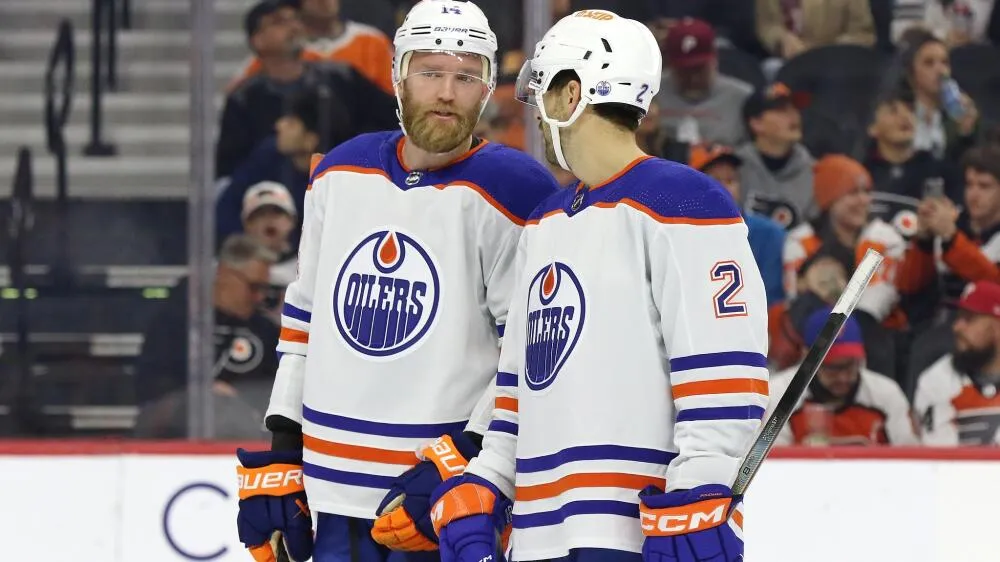
Early season struggles mask underlying excellence for Edmonton Oilers top defense pairing Bouchard Ekholm stepping up
The statistical profile of the Bouchard-Ekholm pairing reveals a fascinating contradiction between process and results. Through the first portion of the 2025-26 season, the duo has controlled an impressive 61 percent of shots and 55 percent of high-danger scoring chances when on the ice together at five-on-five. These possession metrics align closely with their performance from the previous season, suggesting their fundamental game remains intact.
Yet the actual goal differential tells a drastically different story. Early in the campaign, Bouchard and Ekholm were on ice for just one goal for while surrendering eight against, translating to an abysmal 11 percent actual goal share. This disconnect between expected results and reality has led to considerable criticism, particularly directed at Bouchard, whose occasional defensive lapses have been magnified by the unfavorable results.
The underlying numbers provide crucial context that raw plus-minus statistics fail to capture. Bouchard has been on ice for 80 scoring chances at five-on-five but has seen only a 2.1 percent on-ice shooting percentage, meaning just two of those chances have found the back of the net. Similarly, goaltending has been unkind to both defensemen, with Bouchard posting an 0.885 on-ice save percentage and Ekholm suffering through an even worse 0.817 mark.
This pattern of poor percentages drowning out strong underlying play is not unprecedented for Bouchard. During October 2023, he faced similar criticism when his 58 percent expected goal share was undermined by a terrible 36 percent actual goal share. His goaltenders managed just an 0.855 save percentage with him on ice that month, making every mistake seem catastrophic. Bouchard responded by finishing that season with a 62 percent goal share, 82 points, and a fifth-place finish in Norris Trophy voting.
The Edmonton Oilers practice tense exchange between McDavid and Bouchard demonstrated the accountability and leadership present within the locker room. When Connor McDavid challenged Bouchard during a practice session, it reflected the captain’s commitment to maintaining championship standards. Rather than being viewed as divisive, the exchange highlighted how seriously the organization takes defensive responsibility, especially from its highest-paid blue liners.
Statistical regression favors the Bouchard-Ekholm partnership going forward
Advanced hockey analytics strongly suggest that extreme shooting and save percentages tend to regress toward league averages over time. The law of large numbers dictates that the severe disparities between the Bouchard-Ekholm pairing’s expected results and actual outcomes will normalize as the sample size increases. This regression to the mean represents perhaps the strongest evidence that their performance will improve substantially.
Ekholm leads all Edmonton defensemen with a 56 percent expected goals percentage, yet has been outscored 4-11 in actual goals when on the ice. For a player of his caliber and experience, such a disparity cannot persist indefinitely. His defensive positioning and gap control remain sound, and his ability to make the smart first pass out of the defensive zone continues to facilitate the Oilers’ transition game.
The shooting percentage drought affecting both defensemen extends beyond just their own shot production. The forwards playing alongside them have been unable to convert quality chances at anything approaching a normal rate. This team-wide slump in finishing when Bouchard and Ekholm are on ice has created a distorted picture of their effectiveness. As different forward combinations rotate through shifts and the sample size grows, probability suggests scoring rates will increase.
Bouchard’s offensive contributions have historically been a massive differentiator for Edmonton’s blue line. His exceptional outlet passing and ability to quarterback the power play generated 82 points during the 2023-24 season. While he must clean up some defensive errors, his capacity to create offense from the back end remains elite. The challenge lies in balancing that offensive creativity with the defensive responsibility expected of a top-pairing defenseman earning $10.5 million annually.
The Mattias Ekholm struggles highlight Edmonton Oilers 2025-26 season challenges from an individual perspective, but the veteran Swede’s track record suggests resilience. His defensive acumen and veteran savvy have been instrumental in Edmonton’s deep playoff runs, and he has consistently elevated his game when the stakes are highest. The early season turbulence appears more like an aberration than a permanent decline for a player who averaged over 22 minutes per game during the team’s Stanley Cup Final appearances.
Defensive depth provides support as top pairing finds rhythm
The Edmonton Oilers’ defensive structure extends beyond just their top pairing, and the performance of depth defensemen has provided crucial support during the adjustment period. Brett Kulak and Ty Emberson have formed a reliable third pairing, outscoring opponents 6-3 while controlling over 50 percent of shots and expected goals. Emberson’s solid underlying metrics in sheltered minutes represent an encouraging development for a young player learning the NHL game.
The second pairing has undergone significant rotation through the early portion of the season, creating some inconsistency in the overall defensive structure. Darnell Nurse began alongside Alec Regula before an injury disrupted that combination. Troy Stecher filled in for four games before Jake Walman returned from his own injury absence to reclaim the second-pairing spot alongside Nurse.
Walman’s return has sparked noticeable improvement in Nurse’s overall numbers. The pairing has posted a 52 percent expected goals percentage and outscored opponents 2-1 in limited action together. Last season, Nurse and Walman demonstrated excellent chemistry across 105 minutes, recording a 61 percent expected goal share while outscoring opponents 8-2. While that sample remains small, the stylistic fit appears genuine, with Walman’s puck-moving ability complementing Nurse’s physical presence and defensive zone coverage.
This improved second-pairing performance creates a ripple effect throughout the lineup. When Nurse and Walman handle tougher matchups effectively, it allows Bouchard and Ekholm to face slightly more favorable deployment. The depth and versatility of Edmonton’s defensive corps provide head coach Kris Knoblauch with options for managing ice time and matchups strategically throughout games.
The presence of young defensemen like Emberson and the injured Regula creates internal competition that should elevate everyone’s performance. These developing players are watching how established veterans like Bouchard and Ekholm handle adversity and scrutiny. The leadership and professionalism displayed by the top pairing during this challenging stretch will influence the team’s culture and the development trajectory of younger blue liners for years to come.
Playoff experience provides blueprint for redemption and success
The postseason performances of Bouchard and Ekholm provide the most compelling evidence of their capability under pressure. Bouchard averaged over 26 minutes of ice time per game during the 2025 Stanley Cup Playoffs, demonstrating the coaching staff’s trust in his ability to handle enormous workloads against elite competition. The season before, he logged over 25 minutes per game in the playoffs while Ekholm averaged approximately 22 minutes of high-leverage ice time.
During those playoff runs, both defensemen elevated their games significantly. Bouchard’s offensive production in the postseason has been particularly impressive, with his ability to create scoring chances from the point proving crucial to Edmonton’s success. His poise with the puck under forechecking pressure and his vision to find teammates through seams in defensive coverage separate him from most NHL defensemen.
Ekholm’s playoff reliability has been equally valuable, though expressed differently than Bouchard’s flashier contributions. His ability to defend the rush, break up odd-man situations, and make smart decisions under duress has allowed the Oilers to weather storms against top offensive teams. The 34-year-old’s experience and leadership become even more pronounced in tight games where every shift carries magnified importance.
The consistency both players demonstrated during extended playoff runs contrasts sharply with the early regular-season volatility they have experienced. According to detailed analysis from Oilers Nation, the underlying metrics suggest this inconsistency stems more from variance in percentages than any fundamental decline in play. The combination of poor shooting luck and below-average goaltending when they are on ice has created results that don’t reflect the quality of their actual performance.
Finding that playoff confidence and consistency again represents the key challenge for both defensemen. The mental approach required for 82-game regular seasons differs from the focused intensity of playoff hockey. Translating their postseason excellence into regular-season dependability will determine whether Edmonton can secure home-ice advantage and favorable matchups when the games truly matter in the spring.
Leadership expectations accompany substantial contract commitments
Both Bouchard and Ekholm signed significant contract extensions during the offseason, with financial commitments that reflect their status as foundational pieces of the franchise. These deals came with elevated expectations not just for on-ice performance but also for leadership and accountability within the locker room. As the highest-paid defensemen on the roster, they understand that scrutiny comes with the territory.
The leadership void must be filled not through vocal exhortation but through consistent, reliable play that allows teammates to trust their presence in critical situations. Younger defensemen like Emberson and the 25-year-old Regula are watching and learning from how veterans navigate adversity. The example set by Bouchard and Ekholm during this challenging stretch will influence team culture and the development of the next generation of Oilers blue liners.
Ekholm ranks 14th in the NHL with 28 giveaways through the early portion of the season, while Bouchard has recorded 23. The pair has combined for 29 defensive zone giveaways, according to advanced tracking data. While some turnovers result from attempting ambitious plays that could generate offense, the frequency in dangerous areas has been concerning. Both players possess the skill to reduce these errors through more conservative decision-making in high-risk areas of the ice.
The plus-minus statistics paint an unflattering picture, with Bouchard sitting at minus-10 and Ekholm at minus-9. However, plus-minus remains one of the most context-dependent statistics in hockey, heavily influenced by goaltending, shooting percentages, and deployment. The fact that both players are posting strong expected goals percentages while suffering poor actual goal differentials suggests that luck has been a significant factor in those numbers.
Veterans throughout the NHL understand that reputations are built over seasons and careers, not over nine-game stretches. Both Bouchard and Ekholm have earned the benefit of the doubt through their previous body of work. The organization has shown confidence in their long-term value through substantial contract commitments. Now the players must validate that faith by rediscovering the form that made them such effective partners.
Tactical adjustments and system refinement support defensive improvement
Head coach Kris Knoblauch and his staff have made subtle adjustments to support the defensive corps as the season has progressed. These tweaks in deployment, line matching, and zone exit strategies aim to maximize the strengths of each pairing while minimizing exposure to unfavorable matchups. The flexibility within Edmonton’s forward group allows for different combinations that can provide better support in the defensive zone.
The Oilers’ transition game relies heavily on Bouchard’s ability to make accurate outlet passes under pressure. His vision and passing range allow Edmonton to bypass the neutral zone and create controlled entries with speed. When this system functions properly, it generates odd-man rushes and creates offensive zone time that limits the opposition’s ability to generate sustained pressure. The key lies in protecting the puck in the defensive zone long enough for those passing lanes to develop.
Ekholm’s role in this system centers on defending the rush and making simple, effective plays to move pucks to more dynamic offensive players. His gap control and stick positioning force opposing forwards to make plays at higher speeds than they would prefer, leading to turnovers and broken plays. When paired with Bouchard’s offensive creativity, the combination creates a balanced top pairing capable of handling all situations.
Special teams deployment also factors into the overall workload management for both defensemen. Bouchard’s power play responsibilities add significant ice time and create fatigue that can affect five-on-five play later in games. Managing those minutes carefully while maintaining the effectiveness of the man advantage represents an ongoing balancing act for the coaching staff.
The penalty kill has also required attention, with Ekholm logging heavy shorthanded minutes due to his defensive reliability. His ability to read plays and position himself to block shooting lanes makes him invaluable in four-on-five situations. However, the cumulative effect of power play and penalty kill responsibilities on top of even-strength deployment can approach 25-28 minutes per game, creating physical demands that require careful monitoring across an 82-game season.
The Edmonton Oilers’ championship aspirations depend heavily on the performance of Evan Bouchard and Mattias Ekholm. While the early season results have been frustrating, the underlying metrics suggest that improvement is not just possible but probable as shooting and save percentages normalize. Both players have demonstrated the ability to perform at elite levels during the most pressure-packed moments of recent playoff runs, validating the organization’s financial commitment to keeping them in Edmonton long-term.
The combination of Bouchard’s offensive creativity and Ekholm’s defensive reliability creates a complementary top pairing that can drive possession and control games when functioning optimally. As the season progresses and the sample size grows, the law of averages suggests their results will more closely align with their strong underlying numbers. For the Oilers to return to the Stanley Cup Final and complete unfinished business, they will need their top defense pairing to recapture the form that has made them one of the league’s most effective tandems. The foundation remains solid, and the pathway to redemption runs through consistent, championship-caliber play from their highest-paid blue liners.

Par Mike Jonderson
Mike Jonderson is a passionate hockey analyst and expert in advanced NHL statistics. A former college player and mathematics graduate, he combines his understanding of the game with technical expertise to develop innovative predictive models and contribute to the evolution of modern hockey analytics.