






The Edmonton Oilers entered the 2025-26 campaign with championship aspirations following consecutive Stanley Cup Final appearances. Yet through the first quarter of the season, a troubling pattern has emerged that threatens to derail those lofty goals. With a middling 9-8-4 record after 21 games, the team sits in an uncomfortable position—far too close to the playoff cut line for a roster boasting Connor McDavid and Leon Draisaitl in their primes. The root cause isn’t mysterious: a catastrophic lack of forward depth has transformed what should be a juggernaut into a one-line team that’s getting exposed on a nightly basis.
This slow start represents more than just typical early-season growing pains. When McDavid and Draisaitl leave the ice, the Oilers don’t just struggle—they become one of the worst teams in modern NHL history. The bottom six forwards have combined for historically low production, creating a scenario where two superstars must play near-perfect hockey simply to keep their team afloat. The situation has grown so dire that head coach Kris Knoblauch has publicly pleaded for secondary scoring, a rare admission that the roster construction simply isn’t working.
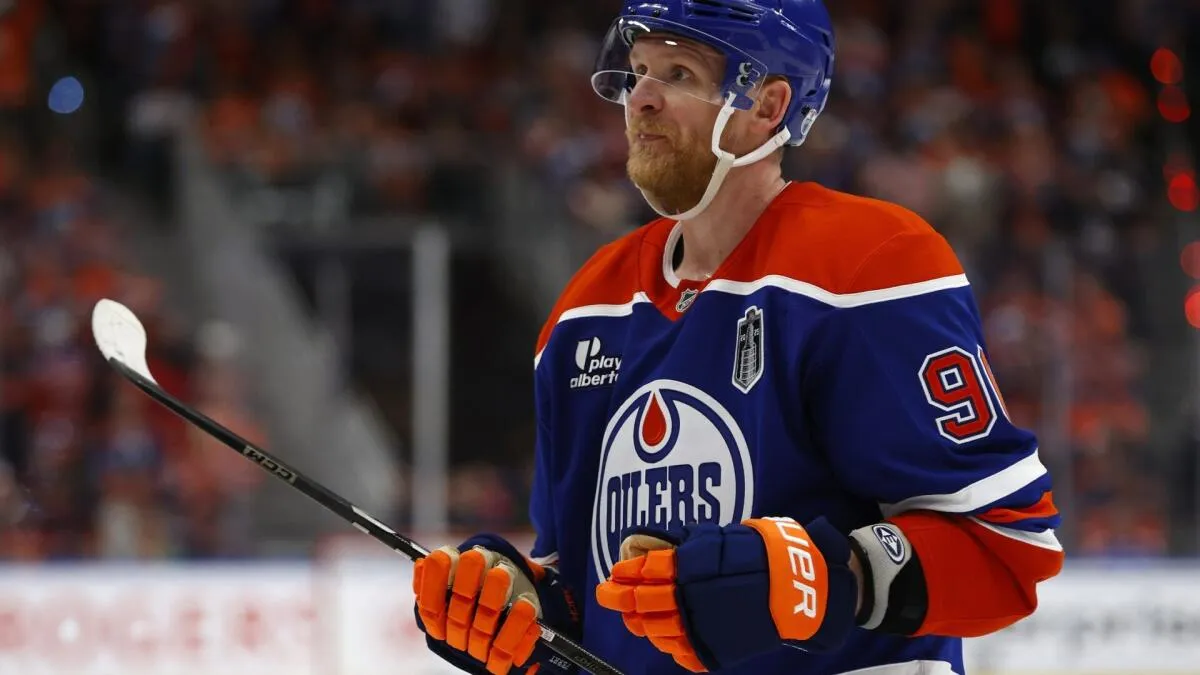
The exodus of veteran forwards and its immediate impact
Over the summer, Edmonton underwent a quiet transformation that has suddenly become deafening. The organization bid farewell to five veteran forwards who, despite their age and diminishing skills, brought irreplaceable qualities to a championship locker room. Corey Perry departed for Los Angeles after providing 95 career playoff goals and an unrelenting net-front presence. Evander Kane’s physicality and ability to change a game”s momentum left when his contract expired. Connor Brown, the team’s penalty-killing heartbeat, signed in Vancouver. Viktor Arvidsson and Jeff Skinner, two middle-six finishers who could reliably move up the lineup in emergencies, also found new homes.
The combined void left by these players stretches far beyond point totals. Their departure stripped the roster of 28 percent of its playoff hits and 42 percent of “high-danger screens” according to Sportlogiq data. More importantly, they took with them every ounce of battle-tested experience that defined the team’s run to two straight finals. The current roster now relies on Ryan Nugent-Hopkins and the recovering Zach Hyman as its only proven veteran forwards, and both have spent significant time in suits rather than sweaters this season.
General manager Stan Bowman’s replacement plan hinged on youthful exuberance. Matthew Savoie, Isaac Howard, and 29-year-old SHL import David Tomasek earned roster spots out of training camp, but the transition has been brutal. Savoie has managed just 5 points in 21 games with a 43 percent expected-goals share, while Howard recorded only 2 points in 11 games before finding himself watching from the press box. Tomasek’s team-worst minus-7 rating illustrates the harsh reality of converting European success to North American ice.
Numbers tell a grim story about the Oilers 2025-26 slow start
The statistical evidence supporting Edmonton’s struggles is overwhelming and impossible to ignore. While the power play continues clicking at an elite 31 percent rate, the even-strength results paint a picture of a lottery team rather than a contender. The Oilers rank 25th in the NHL in goals per 60 minutes at 5-on-5 and 26th in expected goals, a stunning collapse from last spring when they consistently ranked in the top five in these same categories.
Perhaps the most damning metric involves what happens when the superstars take a breather. Natural Stat Trick data reveals that when neither McDavid nor Draisaitl is on the ice during even-strength play, the Oilers have been outscored by a staggering 30-9 margin while controlling just 42.4 percent of expected goals. These aren’t merely bad numbers— they’re historically terrible, representing production levels lower than any previous year in the McDavid-Draisaitl era.
Screening the goaltender has become a lost art in Edmonton. The team’s “screens per game” metric has plummeted from 7.4 to 4.1, while high-danger shots have dropped by 18 percent. No forward outside the top line consistently wins rebound battles or establishes position in the slot. The result is a one-dimensional attack that opposing defenses can easily neutralize by focusing their attention on a single line and waiting for the inevitable scoring drought.
The McDavid-Draisaitl dependency crisis
The superstar duo continues performing at an absurd level, with McDavid flirting with a 130-point pace and Draisaitl maintaining his reputation as one of hockey’s most lethal shooters. Yet their individual brilliance has become a double-edged sword. The organization has built a roster that requires perfection from its best players just to remain competitive, placing unsustainable pressure on two individuals to carry an entire franchise.
Coach Knoblauch recently addressed this imbalance with uncharacteristic bluntness. “We need to have secondary scoring,” he told reporters. “We can’t rely on Connor and Leon or whoever’s playing with them. We need some bottom-six contributions.” His frustration became evident after a recent loss when he noted, “We’re trying to find our identity… again.” That search for identity used to be led by veterans who understood playoff hockey’s nuances, but those voices now wear different uniforms.
The physical and mental toll is beginning to show. McDavid and Draisaitl are logging heavier minutes than ever, with their ice time increasing as the desperation grows. This overreliance creates a vicious cycle: the stars play more to compensate for weak depth, which leaves them exhausted and prone to mistakes, which then requires even more heroics to overcome. It’s a blueprint for playoff failure, especially against disciplined teams built to suffocate one-line offenses.
Young players thrown into the deep end
Edmonton’s rookie class arrived with considerable hype but has been swallowed by the NHL’s unforgiving nature. Matthew Savoie’s elite edges and quick-release shot generated excitement during training camp, yet he’s found the transition to professional defense overwhelming. His 5 points in 21 games reflect a player struggling to find space against bigger, smarter opponents who target him physically every shift.
Isaac Howard’s situation has been even more discouraging. The Hobey Baker winner from Michigan lasted just 11 games before the coaching staff concluded he needed more seasoning. His two points came in flashes rather than sustained production, and his defensive positioning raised concerns about his readiness for NHL pace. The decision to send him down suggests the organization overestimated its prospects’ immediate impact.
David Tomasek’s journey from SHL MVP to NHL rookie has proven particularly rocky. The 29-year-old’s signing was celebrated as a low-risk, high-reward gamble, but his minus-7 rating and 3 points in 14 games indicate the North American game moves too quickly for his current adjustment level. His contract’s flexibility allows for AHL assignment, which might become necessary if his struggles continue.
The lack of veteran mentorship has exacerbated these struggles. Without Corey Perry barking at rookies to get to the net or Connor Brown demonstrating penalty-killing techniques in real-time, the young forwards have been left to learn through trial and error. In a win-now environment, those errors have proven costly, contributing to several one-goal losses that might have been victories with more experienced depth.
The structural problems in 5-on-5 play
Edmonton’s systemic issues extend beyond individual player performance to fundamental flaws in their even-strength structure. The team’s inability to generate consistent offensive pressure without its stars stems from two critical missing elements: net-front presence and slot penetration.
Last season’s playoff run featured forwards who made living in the crease their mission. Corey Perry’s 95 career playoff goals weren’t accidents—they resulted from decades of learning how to occupy the goalie’s vision while deflecting pucks through traffic. Without that archetype, the Oilers’ perimeter-oriented attack becomes predictable. Defensemen can focus on blocking shots from the point while ignoring the space directly in front of the crease.
The ripple effects show throughout the lineup. High-danger chances have decreased by 18 percent because no forward consistently wins puck battles in tight spaces. The power play remains effective through individual skill, but 5-on-5 hockey demands structure and grit—qualities currently missing from the bottom nine forwards. This deficiency becomes especially apparent in third periods when holding leads requires defensive awareness and cycle play that grinds down opponents.
Coach Knoblauch’s systems haven’t changed dramatically from last year’s successful formula, but the personnel executing those systems has been overhauled. A scheme that relied on veteran savvy and positional discipline now asks teenagers to make split-second reads they’ve never faced before. The result is a team that looks lost during extended defensive zone sequences, unable to execute simple breakouts without turning pucks over.
Can the Oilers fix their forward depth before it’s too late?
Stan Bowman faces mounting pressure to address these issues before the season slips away. The organization entered the summer with $8.4 million in cap space after bonus overages—more than enough to retain Corey Perry at $1.1 million or Connor Brown at $1.05 million. Instead, Bowman chose an eight-year, $32 million commitment to Trent Frederic, who has one assist through 21 games and looks miscast as a top-six solution.
That financial flexibility still exists. The Oilers maintain $3.7 million in deadline space they elected not to use in October, and they own all their draft capital through 2027. Trade options are emerging across the league, with three names specifically linked to Edmonton. Tyler Bertuzzi in Chicago offers positional versatility and cup-final experience, while Anaheim’s Adam Henrique provides faceoff prowess and penalty-killing reliability. Jordan Eberle represents a sentimental choice who still drives play at a 55-point pace.
The cost for any of these veterans likely involves a second-round pick plus a B-level prospect—a reasonable price for a team whose championship window remains open. The greater risk lies in waiting too long. The Pacific Division has tightened considerably, with traditional bottom-feeders showing unexpected competitiveness. Edmonton’s loser-point cushion from previous seasons has vanished, leaving little margin for error as Christmas approaches.
Internal solutions appear limited. The AHL pipeline contains intriguing names like Quinn Hutson and Viljami Marjala, but both are smaller skill players who would face the same NHL adjustment challenges as Savoie and Howard. Noah Philp’s size and right-shot center profile make him perhaps the most NHL-ready option, yet asking an unproven player to stabilize a sinking ship represents wishful thinking rather than strategic planning.
What this means for Edmonton’s playoff hopes
History suggests McDavid and Draisaitl will eventually drag this roster into the postseason—Edmonton hasn’t missed the playoffs during a full season since 2017. However, seeding has never mattered more. A wild-card finish likely means a first-round matchup against Vegas or Dallas, two organizations constructed specifically to neutralize one-line offenses. Last year’s championship formula included depth contributions from veterans who understood playoff hockey’s physical and mental demands; this year’s roster lacks those same voices.
The next 20 games will define the season’s trajectory. If the Oilers can hover around .500 until the trade deadline, Bowman might acquire the missing pieces needed for a deep run. But if the current trend continues, Edmonton could find itself in a desperate scramble just to qualify, burning out its stars in the process and entering the playoffs as a damaged, exhausted version of its potential self.
Edmonton’s front office faces a choice: trust that rookies will develop overnight or acknowledge that veterans win championships. The early returns suggest internal growth won’t suffice. The question is whether management recognizes the urgency before the standings make the decision for them.
The Oilers’ slow start reflects deeper rot within the roster construction. Two superstars can mask many flaws, but they cannot win alone—not in the NHL of 2025, and certainly not in the unforgiving playoff environment where depth determines champions. Edmonton must find reliable bottom-six contributors before the math becomes insurmountable and another year of generational talent disappears into what-could-have-been territory.
Frequently Asked Questions

Par Mike Jonderson
Mike Jonderson is a passionate hockey analyst and expert in advanced NHL statistics. A former college player and mathematics graduate, he combines his understanding of the game with technical expertise to develop innovative predictive models and contribute to the evolution of modern hockey analytics.