





The Edmonton Oilers entered the 2025-26 season with Stanley Cup aspirations after their Finals appearance last spring, but through the opening weeks, a troubling pattern has emerged. While much of the spotlight has fallen on inconsistent goaltending, the real crisis brewing in Alberta runs deeper than netminding woes. The Oilers are experiencing a dramatic collapse in their five-on-five offense, transforming from one of the league’s most dangerous even-strength teams into a squad that struggles to generate quality chances when the game is played at full strength. With Connor McDavid and Leon Draisaitl still anchoring the lineup, this offensive drought represents an alarming regression that threatens to undermine the team’s championship window.
The statistics paint a sobering picture for a franchise built around elite offensive firepower. According to Natural Stat Trick data, Edmonton ranks 29th in expected goals per 60 minutes, 27th in scoring chances per 60 minutes, and a staggering 31st in high-danger chances per 60 minutes at five-on-five. These numbers represent a precipitous fall from last season, when they ranked second, third, and second respectively in those same categories. The transformation from elite to league-bottom in offensive generation over a single offseason isn’t just concerning—it’s unprecedented for a team with this much talent.
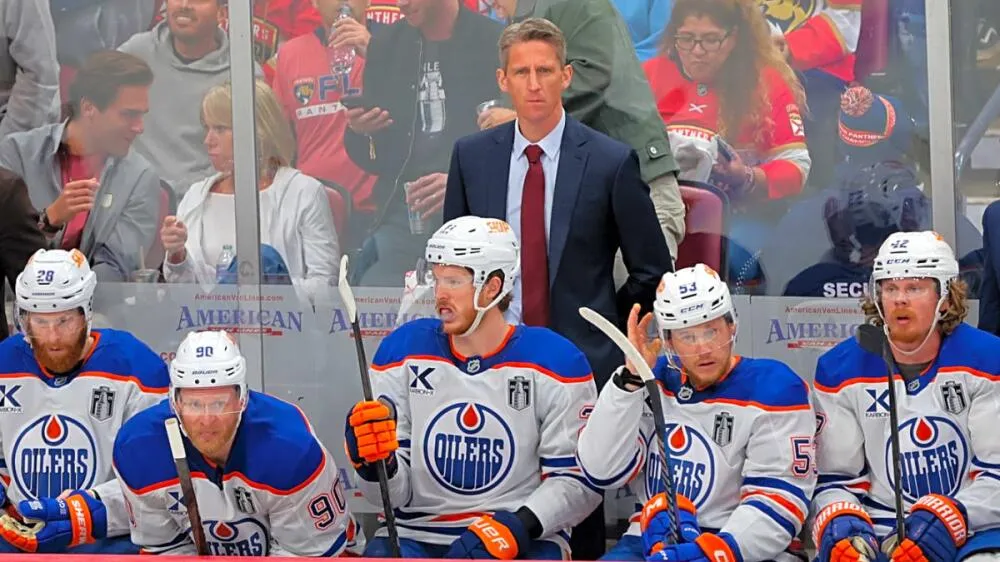
Why the Edmonton Oilers five on five offense struggles have reached crisis levels
The Oilers’ even-strength production has cratered to historically poor levels for a contending team. With just 2.31 expected goals per 60 minutes at five-on-five, Edmonton is generating fewer quality opportunities than rebuilding franchises. They’ve managed only 8.82 high-danger chances per 60 minutes, placing them near the bottom of the league in the most critical offensive metric. Through their first 14 games, the team produced just 23 goals in 332 minutes of tied, five-on-five situations—a conversion rate that would embarrass most bottom-feeding clubs, let alone a team employing two of the game’s premier offensive weapons.
The eye test confirms what the analytics reveal. Edmonton’s offensive approach has become predictable and toothless, relying heavily on perimeter cycling without generating meaningful traffic in the scoring areas. Opponents have adjusted their defensive schemes, forcing the Oilers to the outside and limiting second-chance opportunities. The result is an abundance of low-percentage shots from the point and boards, with little presence to capitalize on rebounds or create deflections. Recent analysis of their opening 10 games highlighted how offensive droughts have become a defining characteristic of this season’s early struggles.
Perhaps most troubling is the team’s inability to create offense independently of their power play. Edmonton currently boasts a power play clicking at over 33%, which masks just how anemic their even-strength attack has become. While special teams excellence keeps them competitive on the scoreboard—they’re averaging 3.07 goals per game overall, 17th in the league—this dependency creates a fragile foundation. One poor night on the power play, and the Oilers risk being shut out entirely. Championship teams need sustained five-on-five pressure to weather playoff hockey, where special teams opportunities diminish and physical play intensifies.
The roster construction issues compound these problems. Beyond McDavid and Draisaitl, Edmonton lacks players capable of driving offensive play independently. When the two superstars leave the ice, the attack stalls completely. Depth forwards prove capable in complementary roles but cannot generate dangerous chances on their own, forcing the top duo to carry an unsustainable burden. McDavid’s five-on-five scoring rate sits at 1.37 points per 60 minutes this season, a number that would satisfy most players but represents a decline for hockey’s best player. More tellingly, the Oilers score only 2.11 goals per 60 minutes at five-on-five with McDavid on the ice—evidence that even his presence cannot overcome systemic offensive dysfunction.
The absence of Zach Hyman, who spent time out of the lineup, exposed how thin Edmonton’s forward depth truly runs. Without a reliable finisher alongside McDavid, the team’s top line struggled to convert possession into goals. The month-long audition for various wingers beside number 97 yielded few answers, with journeyman forwards unable to replicate Hyman’s net-front presence and timing. This lack of complementary skill forces the Oilers to overwork their stars, creating predictable matchups that opposing coaches exploit ruthlessly.
The structural breakdown behind Edmonton Oilers five on five offense struggles
Beyond personnel issues, Edmonton’s five-on-five offense struggles stem from fundamental breakdowns in system execution. The team has abandoned the aggressive forechecking and quick transition game that defined their success last season. Instead, they’ve settled into a passive cycle game that allows opponents to establish defensive structure and eliminate dangerous scoring lanes. This conservative approach generates possession metrics but fails to produce quality chances—a hollow victory in the standings.
Head coach Kris Knoblauch has acknowledged the team’s identity crisis. “We’re not playing our best hockey, and we knew at the beginning of the season that it was going to take a while to build this and get our identity,” he explained after a deflating loss to St. Louis. “Some of it, we’ve solved things.” However, the evidence suggests few solutions have materialized. The same systemic issues recur game after game: predictable offensive zone entries, failure to establish net-front presence, reluctance to shoot from dangerous areas, and an over-reliance on the cycle instead of driving the net.
The coaching staff’s adjustments have proven insufficient to address these deficiencies. Edmonton continues to play the same style regardless of game situation, failing to adapt when holding leads or trailing late. They don’t simplify their game in crucial moments, instead attempting complex passing plays that result in turnovers and odd-man rushes against. This one-dimensional approach allows opponents to game-plan effectively, knowing the Oilers will persist with their preferred style even when it’s clearly not working.
Video analysis reveals Edmonton’s forwards consistently making poor decisions in the offensive zone. Players circle away from the net instead of attacking open ice. Passes bypass teammates in scoring position for safer options on the perimeter. Shooting opportunities get passed up in favor of one more pretty play. These individual mistakes accumulate into systemic offensive failure, as the entire forward group seems infected with the same conservative mindset. The pattern continued in their stumble against Seattle, where defensive lapses coincided with limited five-on-five production in another disappointing performance.
The defensive consequences of offensive struggles cannot be ignored either. When Edmonton fails to generate sustained offensive zone time, they spend more shifts defending in their own end. This defensive-zone time compounds with the team’s turnover issues—they rank among the league leaders in costly giveaways that lead directly to high-danger chances against. Poor puck management in neutral and offensive zones creates odd-man rushes and quality scoring opportunities for opponents, putting additional pressure on already-shaky goaltending.
Connor McDavid’s excellence cannot mask Edmonton Oilers five on five offense struggles
McDavid reached the 1,100-point milestone on November 5th, becoming the fourth-fastest player in NHL history to achieve the feat behind only Wayne Gretzky, Mario Lemieux, and Mike Bossy. The accomplishment is historic, cementing his status among hockey’s all-time greats. Yet individual brilliance cannot overcome collective dysfunction. McDavid’s excellence has kept Edmonton competitive, but even the game’s best player cannot single-handedly solve systemic offensive failures that permeate the entire roster.
The burden placed on McDavid has increased exponentially as surrounding players struggle to contribute. He’s averaging more ice time, facing tougher matchups, and receiving less support from linemates than in previous seasons. While his assist totals remain respectable, his goal-scoring has dipped, partially because opponents can focus defensive attention on him knowing depth players won’t punish them. The result is a vicious cycle: McDavid works harder for fewer results, while teammates become more passive waiting for him to create magic.
Draisaitl’s production has also declined at five-on-five, though his power-play dominance maintains his overall point totals. Like McDavid, he’s finding scoring chances harder to generate against opponents who’ve adjusted their defensive strategies. Teams now employ aggressive box-plus-one schemes that shadow McDavid while positioning extra defenders to eliminate passing lanes to Draisaitl. Without secondary scorers to punish these tactics, Edmonton’s offense becomes predictable and easier to neutralize.
The psychological impact of offensive struggles extends throughout the lineup. When goals don’t come easily, players tighten up and make conservative decisions. Confidence erodes, replaced by hesitation and second-guessing. This mentality infects power plays and special teams situations, as players who should be relaxed and creative instead play tentatively. The Oilers’ exceptional power-play percentage masks how even those opportunities often require multiple chances before conversions occur.
Path forward for addressing Edmonton Oilers five on five offense struggles
Correcting Edmonton’s five-on-five offensive collapse requires both personnel adjustments and systemic changes. Management must consider external additions at the trade deadline if internal solutions don’t emerge. The team lacks the depth scoring necessary to sustain offensive pressure without McDavid and Draisaitl, making acquisitions of proven middle-six forwards essential. Players who can win board battles, drive the net, and finish rebounds would provide the complementary skills currently absent from the roster.
Internally, lineup adjustments could help spark offensive production. Experimenting with different line combinations might uncover chemistry that’s been missing. Breaking up the McDavid-Draisaitl partnership, while counterintuitive, could create two dangerous lines instead of one elite unit and three pedestrian groups. Younger players like Dylan Holloway and Connor Brown need more ice time in offensive situations to develop confidence and timing. The current bottom-six configuration generates almost nothing offensively, making changes essentially risk-free.
Tactical adjustments from the coaching staff are equally crucial. Edmonton must rediscover the aggressive, north-south style that made them dangerous last season. This means emphasizing quick transitions, challenging defenders with speed, and shooting from dangerous areas instead of looking for perfect plays. Net-front presence needs to become non-negotiable—every offensive zone shift should feature a forward battling for position in the blue paint. Simplifying the offensive approach, especially in crucial situations, would reduce turnovers and generate more quality chances.
Practice habits and preparation require examination as well. If offensive execution is breaking down in games, the team isn’t drilling these situations adequately in practice. More time spent on offensive zone drills, shooting practice, and situational work would build the muscle memory necessary for instinctive play during games. Video sessions should focus on identifying and correcting the specific errors that lead to offensive stagnation—poor zone entries, premature cycles away from the net, and reluctance to shoot.
The mental aspect cannot be overlooked. Sports psychology support might help players overcome the tentative mindset that’s infected the offense. Building confidence through positive reinforcement and small victories could gradually restore the aggressive, creative play that’s disappeared. Leadership from McDavid, Draisaitl, and veteran players needs to emphasize patience and persistence—offensive droughts happen, but only teams that continue attacking with purpose break through them.
The Edmonton Oilers’ five-on-five offensive struggles represent the most significant obstacle between them and championship contention. While goaltending issues grab headlines, the systematic inability to generate quality chances at even strength poses a far greater existential threat. No team has won the Stanley Cup in the modern era without a functional five-on-five attack, regardless of special teams excellence or individual star power. For detailed analysis on how these struggles compare to historical patterns, The Hockey Writers provides context on why goaltending isn’t the primary concern.
The season is young enough for corrections, but time is not unlimited. Every point lost to preventable losses compounds the difficulty of making the playoffs in a competitive Pacific Division. Management, coaching staff, and players all bear responsibility for identifying and implementing solutions before this offensive drought becomes an entrenched pattern. The talent exists on this roster—McDavid and Draisaitl alone represent more offensive firepower than most franchises possess. Unlocking that potential at five-on-five will determine whether the Oilers fulfill their championship aspirations or watch another season slip away despite historic individual performances. For further context on these systemic issues, Yahoo Sports examines why Edmonton’s problems aren’t mysterious—they’re simply not being addressed with the urgency required.

Par Mike Jonderson
Mike Jonderson is a passionate hockey analyst and expert in advanced NHL statistics. A former college player and mathematics graduate, he combines his understanding of the game with technical expertise to develop innovative predictive models and contribute to the evolution of modern hockey analytics.