









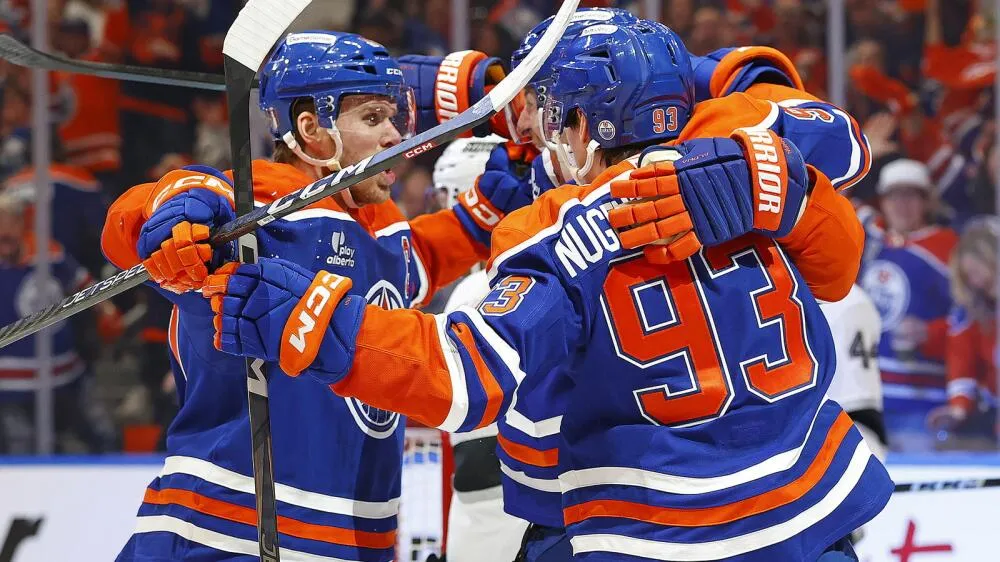
The Edmonton Oilers entered the 2025-26 season with championship aspirations after consecutive Stanley Cup Finals appearances. Instead, they’ve stumbled through their opening 10 games with a 4-4-2 record, collecting just 10 points and leaving fans and analysts wondering what’s gone wrong. While the numbers look concerning on paper—projecting to roughly 82 points over a full season, historically not enough to reach the playoffs—there’s more nuance beneath the surface than a simple win-loss column suggests.
This early-season stretch has been marked by inconsistency, injury absences, and underlying metrics that tell a more complex story than the standings indicate. From Connor McDavid’s unusual goal-scoring drought to defensive pairings struggling to find chemistry, the Oilers have faced challenges across the board. Yet amid the struggles, there are reasons to believe this team can turn things around.
The offensive drought that defines the Edmonton Oilers 2025-26 season first 10 games takeaways
Perhaps the most alarming aspect of Edmonton’s early struggles has been their inability to generate consistent offense at five-on-five. The Oilers rank 29th in the league in goals scored per 60 minutes at even strength, a shocking statistic for a team boasting two of the game’s premier offensive talents. This isn’t just about finishing either—they’re struggling to create quality chances.
Advanced metrics paint a troubling picture. Edmonton sits 23rd in Corsi for per 60, 21st in Fenwick for per 60, and 24th in expected goals for per 60. These numbers indicate the Oilers aren’t just snake-bitten; they’re fundamentally failing to control play and generate dangerous opportunities in the offensive zone. The possession game that defined their playoff runs has largely disappeared.
Connor McDavid, remarkably, has just one goal through 10 games—a power play marker. Despite accumulating 12 points thanks to 11 assists, observers have noted his reluctance to shoot when opportunities present themselves. In a game against Seattle, McDavid failed to register a single shot on net, an almost incomprehensible stat line for arguably the world’s best player. The good news? He’s creating chances. McDavid ranks in the 88th percentile in high-danger shots and 92nd percentile overall, with 2.13 individual expected goals suggesting the puck will eventually find the net.
Leon Draisaitl has fared better with seven goals and four assists for 11 points, but even that pace of 90 points over a full season would represent a significant decline from his typical production. The German superstar has carried more of the goal-scoring burden while McDavid facilitates, but the dynamic duo hasn’t found their usual lethal rhythm. When they’ve played together, they’ve been paired with a revolving door of linemates—Trent Frederic, Andrew Mangiapane, Vasily Podkolzin, and Adam Henrique among others—preventing any sustained chemistry from developing.
The absence of Zach Hyman looms large over these offensive struggles. The natural winger, who scored 54 goals in 2023-24, has been sidelined with a dislocated wrist sustained during the preseason. His net-front presence and ability to finish plays created by McDavid and Draisaitl is irreplaceable, and the Oilers have desperately missed his contributions on both the power play and at even strength. His potential return could provide the spark Edmonton desperately needs.
Defensive performance belies the Edmonton Oilers 2025-26 season first 10 games takeaways
While the offense has sputtered, Edmonton’s defensive structure has actually been quite sound—at least in terms of suppression. The Oilers rank sixth in Corsi against per 60, third in Fenwick against per 60, and ninth in expected goals against per 60. They’re limiting both the quantity and quality of chances opponents generate, which represents a significant improvement from previous seasons when their defensive zone coverage was consistently criticized.
This disconnect between defensive play and results on the scoreboard points to two potential culprits: poor luck or inadequate goaltending. Likely, it’s a combination of both. Despite controlling play in their own end, the Oilers are allowing goals at a rate that doesn’t match their underlying metrics, suggesting opposing shooters are capitalizing on their chances at an unsustainably high rate.
The blue line has undergone significant change with the addition of Jake Walman, who missed the first six games of the season with an injury. The group’s best five defensemen played together in just four regular-season games after Walman’s acquisition in March, then got only seven playoff games together in the Western Conference Final and Stanley Cup Final, with Mattias Ekholm operating at less than full strength due to his torn abductor injury.
Evan Bouchard has been a particular source of concern. The offensive-minded defenseman has just four points through 10 games, putting him on pace for a career-low 33 points—a total he hasn’t approached since his rookie season. Ryan Nugent-Hopkins has started strong for the Oilers, providing veteran leadership even as other key players struggle, but Bouchard’s regression creates a significant hole in the lineup. His decision-making with the puck has been uncharacteristically poor, leading to dangerous turnovers.
The pairing of Bouchard and Ekholm, which had been among the league’s best since Ekholm arrived in February 2023, has been disastrous to start this season. The duo has been outscored 8-1 at five-on-five, with five of those goals against coming in a brutal two-game stretch against Montreal and Seattle. This prompted coach Kris Knoblauch to split them up, pairing Bouchard with Darnell Nurse, where the young blueliner showed immediate improvement. Ekholm, meanwhile, continues to look a step slow as he recovers from his significant injury, struggling next to Walman against Vancouver.
The addition of assistant coach Mark Stuart to run the defense after Paul Coffey’s departure adds another variable to the adjustment period. With new systems, new personnel, and key players working back from injury, the expectation within the organization is that this group will improve significantly as the season progresses.
Goaltending concerns shape the Edmonton Oilers 2025-26 season first 10 games takeaways
Goaltending was identified as the Oilers’ biggest question mark entering the season, and through 10 games, those concerns haven’t been fully alleviated. Stuart Skinner, the presumed starter, has posted a .903 save percentage—acceptable but hardly stellar. He’s delivered some excellent performances, including a shutout at Madison Square Garden against the Rangers and a strong effort in his 100th NHL win against Ottawa, but he’s also allowed soft goals at inopportune moments.
At five-on-five, Skinner ranks 21st among NHL goaltenders in goals saved above expected, according to evolving-hockey.com. While this represents an improvement over his 2024-25 struggles, it’s still not the level of play the Oilers need to contend for a championship. For a team with Stanley Cup aspirations, having below-average goaltending puts enormous pressure on the offense to outscore their mistakes—something Edmonton clearly hasn’t managed early this season.
Calvin Pickard has been even worse as the backup. After getting gifted a win in his first start when the Oilers dominated Vancouver, Pickard has posted save percentages of .818, .815, and .852 in his subsequent appearances. He ranks 32nd in goals saved above expected at five-on-five. These numbers are concerning, especially considering Pickard was brought in to provide reliable insurance behind Skinner.
The acquisition of Connor Ingram from Utah generated significant buzz among Oilers fans desperate for goaltending help. However, Edmonton’s approach to their roster reflects a longer-term view. Ingram hadn’t played since February before entering the NHL/NHLPA Player Assistance Program to deal with his mother’s death from breast cancer. He’s only recently returned to game action with the AHL’s Bakersfield Condors, where he stopped 22 of 23 shots in his first appearance but allowed five goals on 29 shots in his second.
The organization isn’t rushing Ingram to the NHL. Barring injury or a complete collapse from Skinner and Pickard, he’ll get more seasoning in the minors. Still, his presence in the system provides an option should the goaltending situation deteriorate further. The Oilers may also explore the trade market for an upgrade if their playoff position becomes precarious.
Line shuffling and chemistry issues among the Edmonton Oilers 2025-26 season first 10 games takeaways
Coach Kris Knoblauch has approached the early season like a chef frantically experimenting with recipes before a dinner party. Through just 10 games, the Oilers have deployed 27 different forward line combinations—a staggering number that doesn’t even account for the constant in-game adjustments. This endless tinkering may be actively hurting the team’s ability to develop chemistry and consistent patterns of play.
The constant shuffling has affected every forward on the roster. Trent Frederic started the season alongside McDavid and Draisaitl but lasted just two games there before being relegated to bottom-six duty. Noah Philp had an outstanding performance against Vancouver on October 11, even scoring his first NHL goal, only to be scratched for the next three games. Rookie Ike Howard has been moved up and down the lineup seemingly at random.
While players haven’t explicitly blamed the line combinations for their struggles, they’ve been quick to point out how out of sync the team looks. The constant changes prevent linemates from learning each other’s tendencies, from knowing where their teammates will be in various situations, and from building the intuitive understanding that separates good lines from great ones. Chemistry matters in hockey, perhaps more than any other team sport, and Edmonton has had precious little time to develop it.
Knoblauch’s aggressive approach stems from the team’s poor five-on-five results, but it may be creating a self-fulfilling prophecy. When players don’t produce, he changes lines. When lines change, players can’t develop chemistry. Without chemistry, production suffers. The cycle continues. At some point, the coach may need to show more patience and allow combinations to work through their struggles rather than hitting the panic button at the first sign of trouble.
The only potential justification for this strategy is that Knoblauch is actively searching for combinations that will work when Zach Hyman returns. With Hyman’s impending activation requiring someone to come out of the lineup, perhaps the coach is auditioning players for different roles. Still, the constant upheaval has clearly taken a toll on the team’s offensive flow and rhythm.
The role of luck in the Edmonton Oilers 2025-26 season first 10 games takeaways
For all the legitimate concerns about Edmonton’s play, they’ve also been significantly unlucky. Their PDO—a metric that combines on-ice shooting percentage and save percentage, with 100 representing league average—sits at just 96.4. This indicates the Oilers are experiencing a notable run of bad fortune that should regress toward the mean as the season progresses.
Edmonton’s on-ice shooting percentage ranks 29th in the NHL, while their save percentage sits 26th. Given the offensive talent on their roster, it’s reasonable to expect their shooting percentage to climb as players like McDavid convert more of their chances. Similarly, with better defensive metrics than their goals-against numbers suggest, the save percentage should improve whether through better goaltending or simply opposing shooters cooling off.
The underlying numbers suggest the Oilers are better than their record. They’re controlling nearly 52% of the expected goals at five-on-five, indicating they’re creating better chances than they’re allowing. The problem is that opponents are scoring on their chances at a higher rate while Edmonton isn’t finishing their own opportunities. This combination is unsustainable over a full season.
Historical data on PDO shows that extreme values tend to regress toward 100 over time. Teams with very low PDO early in the season typically improve their record in the second half, not because they start playing better necessarily, but because the shooting and save percentages normalize. The Oilers should benefit from this regression, assuming they maintain their underlying metrics.
That said, luck can’t be used as an excuse for everything. Edmonton’s poor chance generation metrics indicate real problems that won’t be solved by variance correction alone. They need to get better at creating quality opportunities, not just hope that they start converting a higher percentage of marginal chances. The combination of improved play and better fortune should lift their results, but both elements need to be present.
Looking ahead: reasons for optimism despite the Edmonton Oilers 2025-26 season first 10 games takeaways
Despite the disappointing start, there are legitimate reasons to believe the Oilers will turn their season around. The return of Zach Hyman represents a significant upgrade to the forward group, providing a proven finisher who can play in all situations. His presence will improve not just his line but the entire depth chart as players shift into more appropriate roles.
The team’s underlying metrics, particularly on defense, suggest they’re playing better than their record indicates. As the blue line continues to build chemistry with more games together, and as Ekholm works his way back to full strength, the defensive performance should become even stronger. The organizational belief that this is the best defensive group Edmonton has iced in recent memory isn’t unfounded.
Connor McDavid’s struggles appear more statistical anomaly than genuine decline. His high-danger chances and shot volume indicate the goals will come, and when they do, they’ll likely come in bunches. Leon Draisaitl has shown he can carry the offensive load, and players like Ryan Nugent-Hopkins have provided steady veteran production. This forward group has too much talent to remain dormant for long.
According to reports from multiple NHL sources, the Oilers are actively targeting a top-nine winger ahead of the trade deadline. This addition, combined with a healthy Hyman, should provide the depth scoring that’s been absent. General manager Stan Bowman has proven willing to make aggressive moves to improve his roster, and he’ll have the flexibility to do so given the team’s cap situation.
The schedule also provides opportunities for the Oilers to build momentum. While every NHL game is difficult, Edmonton’s upcoming slate includes several matchups against teams they should beat. Stringing together a few wins could provide the confidence boost needed to recapture their form from previous seasons.
The Edmonton Oilers’ first 10 games of the 2025-26 season have revealed a team searching for its identity. With a 4-4-2 record, they’ve combined flashes of excellence with extended periods of mediocrity, leaving fans anxious about their championship aspirations. The offensive struggles at five-on-five, particularly from their star players, remain concerning, while goaltending continues to be a question mark rather than an answer.
Yet beneath the disappointing results lie encouraging signs. The defensive structure is solid, limiting high-quality chances against. The advanced metrics suggest bad luck has played a significant role in their poor record. Key players like Connor McDavid are creating chances that should soon convert into goals. The imminent return of Zach Hyman and potential deadline additions offer pathways to improvement. For a team that’s reached consecutive Stanley Cup Finals, writing them off after just 10 games would be premature. The Oilers have the talent, the underlying numbers, and the time to turn this season around—they just need to start doing it before they dig themselves a hole too deep to escape.

Par Mike Jonderson
Mike Jonderson is a passionate hockey analyst and expert in advanced NHL statistics. A former college player and mathematics graduate, he combines his understanding of the game with technical expertise to develop innovative predictive models and contribute to the evolution of modern hockey analytics.