







The Edmonton Oilers Ike Howard trade buzz that started as a late-night social-media ripple has become the daily soundtrack around Rogers Place. General manager Ken Holland has not confirmed anything, but every beat reporter in town now carries a fresh notebook just in case the story explodes before puck-drop. Howard, the 23-year-old winger who was supposed to round out the middle six, has seen his name bounce from TSN’s Insider Trading to The Athletic’s player cards in less than a week, and the timing is no accident: Edmonton needs cap space, a right-shot defender, and a jolt of desperation after last spring’s second-round exit.
What makes the chatter feel different this time is the convergence of need and asset value. Howard’s entry-level deal expires in July, he is arbitration-eligible, and he just finished a 17-goal season despite averaging barely twelve minutes a night. In other words, he is cheap, promising, exactly the kind of chip that contending teams love to flip for immediate help. The Oilers, meanwhile, have only $1.3 million of projected deadline space if they place Dylan Holloway on LTIR, and that is not enough to land a top-four blue-liner without sending money out. Put those two realities together and you get the perfect Petri dish for trade speculation.
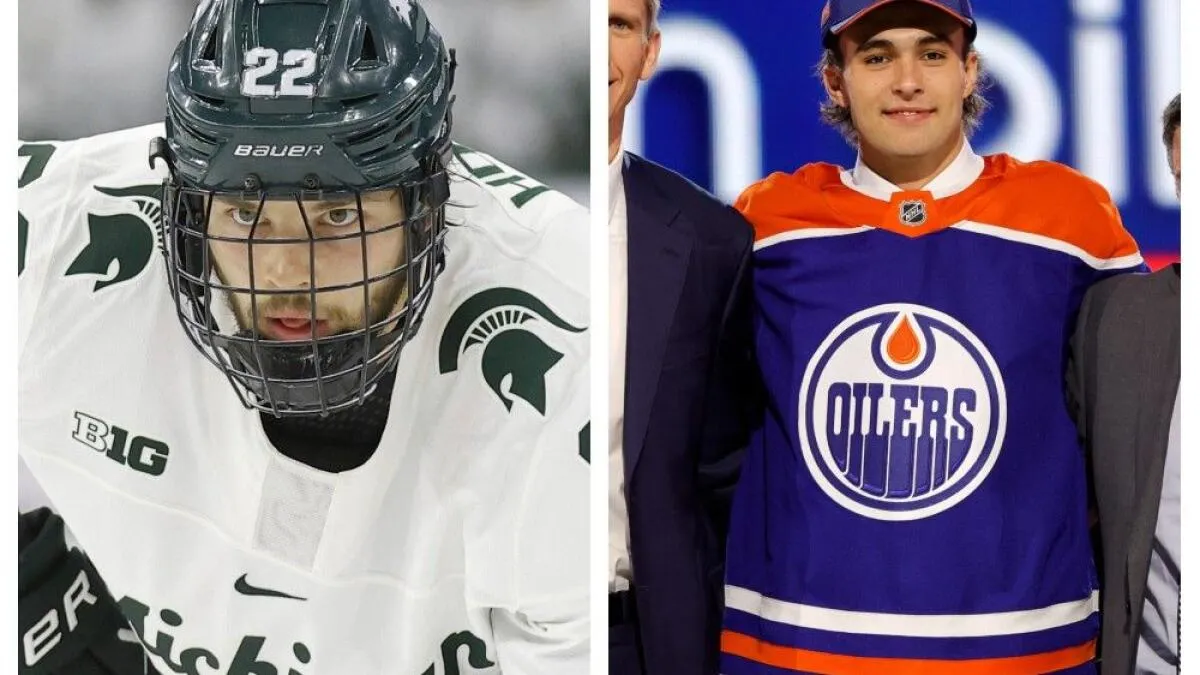
Edmonton Oilers Ike Howard trade buzz: the numbers behind the noise
Howard’s underlying profile is the engine driving the conversation. Among forwards with 750-plus minutes at 5-on-5, he ranked in the 88th percentile for expected goals above replacement (xGAR) according to Evolving-Hockey. His 1.83 points-per-60 was third on the club behind only Connor McDavid and Zach Hyman, and he did it while starting barely 38 % of his shifts in the offensive zone. Those are the kind of sheltered-yet-productive splits that playoff-bound scouts scribble in capital letters.
The eye test backs the spreadsheet. Watch any third-period shift from the early-season homestand and you will see Howard winning foot-races against tired pairs, then immediately turning up-ice. Coach Kris Knoblauch recently called him “our safety valve” because the staff trusts him to dump the puck in, change, and still create a chance on the next wave. That utility is exactly why rival GMs believe Edmonton could move him for a second-round pick plus a prospect; the bet is that a bottom-feeder will pay for 25-goal upside rather than the 12-minute role he currently fills.
Contract geometry is the final accelerant. Because Howard’s qualifying offer sits at only $874 125, any acquiring team controls him for 2025-26 at a negligible number, then retains RFA rights for a full arbitration walk-year. That flexibility is catnip for budget clubs such as Anaheim or Chicago, both of whom have oodles of space and a willingness to flip future assets at the deadline. Edmonton, conversely, needs every dollar it can claw back if it wants to chase someone like Calgary’s Rasmus Andersson or Buffalo’s Henri Jokiharju.
Edmonton Oilers Ike Howard trade buzz: three logical landing spots
-
Anaheim Ducks
The Ducks are quietly stockpiling mid-tier forwards who can protect their rookie centers. Howard’s forechecking resume fits the Pat Verbeek blueprint, and Anaheim owns two second-round picks in 2025. A package built around the better of those selections plus defensive prospect Tyson Hinds would give the Oilers an affordable right-shot defender with NHL feet. -
Chicago Blackhawks
Chicago has the cap room and the motivation to surround Connor Bedard with competent wingers. General manager Kyle Davidson has already moved two fourth-rounders for rental depth; flipping a third-rounder and defensive prospect Gavin Hayes would land a cost-controlled scorer who is younger than every forward on the Hawks’ roster not named Bedard. -
Utah Hockey Club
The league’s newest franchise needs buzz as much as points. Utah owns five picks in the first three rounds of the next two drafts and has only $51 million committed to next season’s cap. Sending a 2026 second plus defensive prospect Maveric Lamoureux would give the Oilers a 6-foot-7 righty who is one season away from NHL duty, while Howard would slide into Utah’s top-nine immediately.
Edmonton Oilers Ike Howard trade buzz: what the insiders are actually saying
Ryan Rishaug told 630 CHED last Thursday that Holland has “taken more calls on Howard than he’s made,” a semantic difference that still signals interest. The phrasing matters because it suggests Edmonton is not shopping the winger so much as listening, the classic posture of a team that knows it may be forced to choose between today’s Cup window and tomorrow’s depth chart. Frank Seravalli added on Daily Faceoff that at least four clubs have requested medicals, the procedural step that usually precedes a firm offer.
Inside the room, the message has been predictably diplomatic. Howard, approached after practice, said only, “I love this group, but you learn this is a business.” Captain Connor McDavid offered the standard vote of confidence—“We want Ike here, full stop”—yet even that statement carried an implicit qualifier: if the return upgrades the blue line enough to move the needle in June, the captain will understand. The most telling quote came from assistant GM Keith Gretzky, who told TSN’s Dustin Nielson that the organization is “comfortable keeping him, comfortable moving him,” the verbal equivalent of a green light.
Edmonton Oilers Ike Howard trade buzz: how a deal could reshape the Pacific race
Moving Howard for defensive help would shorten Edmonton’s forward group but lengthen its ability to handle the league’s elite transitions. Right now the Oilers are one Evan Bouchard sprain away from running a third pair of Philip Broberg and Cody Ceci against the Nathan MacKinnons of the world. Adding a legitimate top-four righty pushes Darnell Nurse back to the left side he prefers, allows Bouchard to keep feasting on second-pair matchups, and gives Knoblauch the option of loading up a shutdown pair against the Vegas powerhouse lines come April.
The ripple effects reach special teams as well. Howard averages 1:44 per night on the second power-play unit, a role that could be absorbed by Dylan Holloway or even the recently recalled Raphael Lavoie. The club’s man-advantage efficiency might dip a percentage point, yet the penalty kill—currently 24th in goals against per-60—would gain a proven top-four defender, the more urgent weakness. In a conference where three points separate second place from ninth, one extra shorthanded stop per week could decide home-ice advantage.
Finally, there is the intangible jolt that often accompanies a deadline sacrifice. The 2016 Penguins moved a popular young winger in David Perron and watched the room respond with a 16-4 finish; the 2019 Blues traded a 23-year-old prospect in Sammy Blais and rode the resulting depth to a parade. Holland, who witnessed both scenarios during his Detroit tenure, understands the psychological leverage of telling a core, “We believe in you so much we’re mortgaging tomorrow.” If the return is the right defenseman, the Oilers could replicate that galvanizing effect.
Edmonton Oilers Ike Howard trade buzz: the case for standing pat
Yet there is a coherent counter-argument, one that begins with Edmonton’s recent track record of developing middle-six talent. Since 2019 the club has graduated Kailer Yamamoto, Warren Foegele, and now Howard from the 15-goal wilderness to legitimate playoff rotation. Each player cost the organization nothing but patience and AHL bus rides; flipping such an asset for a rental risks repeating the 2018 Petry-for-Detroit second mistake, a deal that still haunts the analytics department. If Holloway’s injury lingers, the Oilers could wake up in May with no Howard, no replacement scorer, and a blue-line upgrade that played only 22 regular-season games.
The salary-cap picture also looks less dire once you factor in performance bonuses. Stuart Skinner’s Schedule A bonuses are tracking at $850 000, but they count against the cap only if Edmonton ends the season with space. By waiting until the final weekend to accrue a cushion, Holland could add a prorated $4 million contract without subtracting a roster player, the same sleight-of-hand Tampa used for David Savard in 2021. In that scenario Howard stays, the prospect pipeline remains intact, and the club still lands its defensive piece.
Finally, there is the question of ceiling. Scouts inside the organization believe Howard’s toolkit—elite first three steps, NHL release, willingness to hunt pucks—projects as a consistent 25-30 goal man once he reaches 16-17 minutes a night. Trading him now, before that breakout, would violate the cardinal rule of selling low. If the Oilers genuinely view themselves as contenders for the next three seasons, the smarter calculus may be to keep the affordable scorer and instead move a 2026 first-round pick whose value depreciates the later McDavid and Leon Draisaitl drag the team into the postseason.
Edmonton Oilers Ike Howard trade buzz: what happens next
All signs point to a quiet resolution one way or another before the March 7 deadline. Holland has never been a general manager who enjoys multi-player fireworks; his M.O. is single-piece surgery, usually in the final 72 hours. If Anaheim or Chicago ups the ante to a first-round pick—unlikely but not impossible—expect the Oilers to pounce, introduce the new defenseman at a Saturday morning skate, and slot Howard’s replacement into the top-nine by Sunday. If the market remains stuck at second-rounders and B-level prospects, the likelier outcome is no trade at all, followed by a summer qualifying offer and another season of cost-controlled production.
For fans tracking every Twitter refresh, the takeaway is simple: the Edmonton Oilers Ike Howard trade buzz is real, but it is not yet inevitable. The next two weeks will determine whether the winger’s next goal is scored in Oilers colours or in someone else’s, and whether the franchise’s latest swing for a championship requires sacrificing one of its own home-grown pieces. Until the phone finally rings or the clock finally hits 3 p.m. ET on deadline day, the only certainty is that the echoes inside Rogers Place will keep getting louder.
Frequently Asked Questions

Par Mike Jonderson
Mike Jonderson is a passionate hockey analyst and expert in advanced NHL statistics. A former college player and mathematics graduate, he combines his understanding of the game with technical expertise to develop innovative predictive models and contribute to the evolution of modern hockey analytics.