













The Edmonton Oilers have found themselves at a crossroads heading into the middle portion of the 2025-26 season. Despite reaching back-to-back Stanley Cup Finals, the franchise’s goaltending situation remains a persistent question mark. Now, multiple insiders are reporting that the organization is genuinely open to trading Stuart Skinner if the right opportunity presents itself—a significant shift in philosophy for a team that has invested considerable faith in the 27-year-old Edmonton native. This willingness to explore all options reflects the growing urgency surrounding the Oilers’ championship window with Connor McDavid and Leon Draisaitl in their prime years.
The question is no longer whether the Oilers should consider moving on from Skinner, but rather when and how such a move might materialize. With the goaltender posting a .900 save percentage through the season’s opening stretch and consistency issues continuing to plague his game, management appears ready to pull the trigger if an upgrade becomes available. The stakes have never been higher for a franchise that has come agonizingly close to hockey’s ultimate prize but hasn’t been able to seal the deal between the pipes.
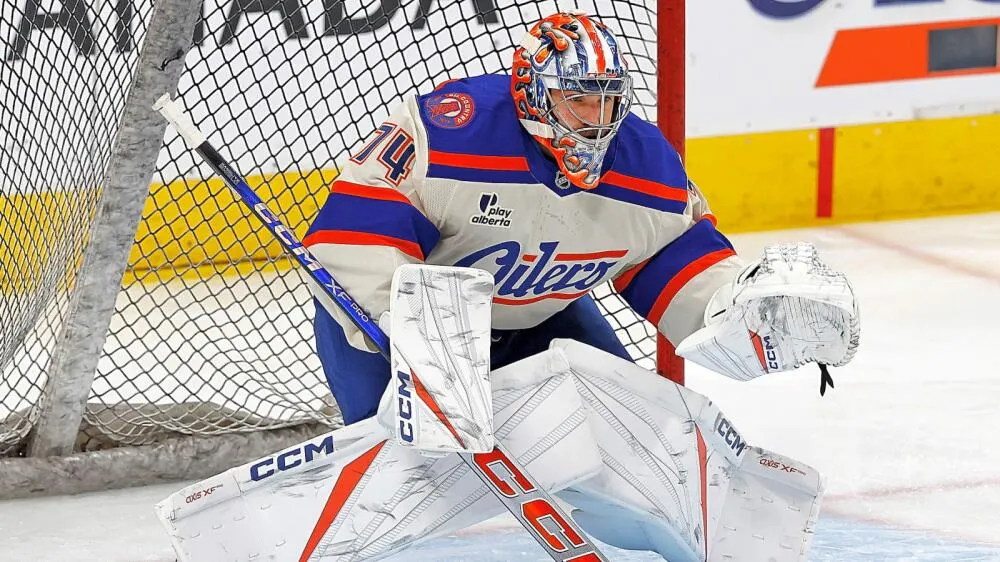
What insiders are saying about the Edmonton Oilers open to trading Stuart Skinner
TSN’s Ryan Rishaug made waves recently when he appeared on 880 CHED and stated unequivocally that general manager Stan Bowman would not hesitate to move Skinner if a clear upgrade materialized. “If a deal comes up that allows Stan Bowman to make a trade tomorrow that he knows in his gut is an upgrade in net and it involves moving on from Stuart Skinner, it’s done. No question,” Rishaug explained during the broadcast.
This represents a notable evolution in the organization’s thinking. For the past two seasons, Skinner has been treated as the franchise goaltender, the homegrown solution to a position that has vexed the Oilers for years. He earned that opportunity by backstopping the team deep into the playoffs, but his inability to deliver consistent performances—particularly in crucial moments—has forced management to reconsider their long-term plans.
Rishaug further emphasized that while the Oilers are open to trading Skinner, the challenge lies in finding a suitable replacement. The insider noted that Bowman wouldn’t hesitate for “a second” if he could improve the position, but acknowledged that such a deal may not currently exist in the marketplace. This creates a delicate balancing act for the Oilers’ front office as they evaluate whether to stand pat or aggressively pursue an alternative.
The timeline for potential action appears to be crystallizing around the December-January window. If Skinner hasn’t demonstrated clear improvement by that point, and if Connor Ingram—currently working his way back in the AHL—doesn’t emerge as a viable option, Bowman may have no choice but to make a significant move. The Oilers’ championship aspirations simply cannot afford another season of goaltending uncertainty.
Stuart Skinner’s performance and the consistency conundrum for the Edmonton Oilers open to trading Stuart Skinner
Through nine games this season, Skinner has posted a 4-5 record with a 2.52 goals-against average, a .900 save percentage, and one shutout. On paper, these numbers aren’t catastrophic, but they tell only part of the story. The advanced metrics paint a slightly more favorable picture, with Skinner recording a 2.1 goals saved above expected, suggesting he’s making some quality saves even if the overall body of work remains inconsistent.
The real issue continues to be reliability on a game-to-game basis. Skinner has demonstrated the ability to deliver strong performances, but those outings are frequently followed by games where he allows soft goals or fails to make a critical save at a pivotal moment. This pattern has become all too familiar for Oilers fans who have watched their team dominate possession and offensive chances only to see their goaltender let in a backbreaking goal against the run of play.
Recent discussions around Edmonton Oilers trade rumors have intensified as the team navigates early-season challenges while trying to maximize their championship window. The organization hired new goaltending coach Peter Aubry over the summer specifically to address Skinner’s inconsistencies, but the results have been mixed at best. Every step forward seems to be accompanied by two steps back, a frustrating reality for a coaching staff and management group desperate for stability in net.
What makes Skinner’s situation particularly complex is his track record of playoff success. He did help guide the Oilers to consecutive Stanley Cup Finals appearances, demonstrating poise and capability on hockey’s biggest stage. However, he also routinely lost the starting job during those playoff runs, creating doubt about his ability to be the last line of defense when the stakes are highest. For a team with McDavid and Draisaitl leading the charge, that uncertainty in goal is simply too risky to ignore.
Potential trade destinations with the Edmonton Oilers open to trading Stuart Skinner
If the Oilers do decide to move Skinner, identifying a suitable trade partner will require creative thinking and likely some package dealing. Skinner’s $2.6 million cap hit for this season and next makes him affordable, but his performance hasn’t been elite enough to command significant return value on his own. Most realistic scenarios would involve the Oilers packaging additional assets to facilitate a goaltending upgrade.
The Columbus Blue Jackets present one of the more logical landing spots for Skinner, particularly if Elvis Merzlikins could be pried loose. Merzlikins has had his own consistency issues in Columbus, but he’s capable of elite stretches and might benefit from a fresh start with a contending team. The challenge is that Columbus’s goaltending has actually been a strength early this season, potentially making them reluctant to shake things up. Any deal would likely require the Blue Jackets to retain salary and would need to include additional pieces from Edmonton’s perspective.
The Pittsburgh Penguins represent another possibility, albeit a risky one. Tristan Jarry has struggled mightily and finds himself in the crosshairs of criticism in Steel City. A change of scenery swap could theoretically benefit both goaltenders, though Jarry’s $5.375 million cap hit through 2027-28 would create significant complications. The Penguins would need to retain substantial salary, and the Oilers would be gambling that Jarry could rediscover the form that made him a quality NHL starter just a few seasons ago.
Long-shot options like Ilya Sorokin from the New York Islanders or Juuse Saros from the Nashville Predators would represent clear upgrades, but the cost would be astronomical. Both goaltenders have trade protection, and their respective teams would demand a king’s ransom in prospects and picks. For a team already strapped against the salary cap and depleted of draft capital from previous moves, acquiring either would require financial gymnastics that might not be feasible. Some fans have floated the Buffalo Sabres’ tandem of Devon Levi and Ukko-Pekka Luukkonen as potential targets, but neither has established themselves as a guaranteed upgrade over Skinner, making such a move lateral at best.
The Connor Ingram factor and internal solutions for the Edmonton Oilers open to trading Stuart Skinner
One reason the Oilers may feel comfortable exploring a Skinner trade is the presence of Connor Ingram in the organization. The team acquired Ingram from Utah as organizational depth, and he’s currently working his way back to NHL readiness after taking time away from hockey. While Ingram isn’t expected to be an immediate solution, he represents a potential plan B if the Oilers need to move on from their current tandem.
Ingram’s story is one of perseverance and resilience. He’s bounced around the league and dealt with personal challenges, but when healthy and confident, he’s shown flashes of being a capable NHL netminder. The Oilers are giving him time to find his game in the AHL with the Bakersfield Condors, monitoring his progress closely as they evaluate their options for the NHL roster.
If Ingram can demonstrate consistent performance at the AHL level over the coming weeks, it would give management another card to play. A scenario where the Oilers trade Skinner for an upgrade and promote Ingram to serve as the backup becomes more realistic if he’s playing well. This would allow the organization to address their goaltending concerns without necessarily having to make multiple moves or give up excessive assets in a desperation trade.
The timeline Rishaug mentioned—December to January—aligns perfectly with Ingram’s development path. By that point, the organization will have a much clearer picture of whether he can contribute at the NHL level this season. If the answer is yes, it removes one significant obstacle to trading Skinner. If Ingram isn’t ready, the Oilers may need to be more cautious about dismantling their current tandem without a clear replacement plan in place.
What the Edmonton Oilers open to trading Stuart Skinner means for the championship window
The Oilers’ willingness to consider trading Skinner reflects the urgent reality of their championship window. McDavid is now in his age-28 season, and while he remains the game’s most dominant player, the franchise knows it cannot afford to waste any more opportunities. The past two seasons saw the Oilers come heartbreakingly close to winning the Stanley Cup, only to fall short when their goaltending proved insufficient in the most critical moments.
General manager Stan Bowman inherited a team built to win now, and he’s shown a willingness to make bold moves to address weaknesses. The acquisition of Ingram, while modest, demonstrates proactive thinking about the goaltending position. The reported openness to moving Skinner takes that thinking to another level entirely, signaling that no options are off the table when it comes to improving the roster.
Calvin Pickard’s struggles this season have only intensified the scrutiny on the goaltending position. Through 14 team games, only four have seen an Oilers goaltender post a save percentage above .900—a staggering statistic for a team with championship aspirations. This situation has created additional urgency around the possibility of trading Stuart Skinner as the organization seeks stability between the pipes.
The challenge for Bowman and his staff is navigating a relatively thin trade market for goaltending. Most contending teams are set in net, while rebuilding teams have little incentive to trade away their goaltenders mid-season unless they’re getting significant value in return. The trade deadline typically sees more activity, but waiting until March could mean squandering valuable regular season points if the goaltending situation continues to cost the team games.
The risk-reward calculation facing Edmonton’s front office
Trading a goaltender who has helped backstop your team to consecutive Stanley Cup Finals is not a decision to be made lightly, even if that goaltender’s performance has been inconsistent. Skinner knows the organization, understands the pressure of playing in a hockey-mad market, and has shown he can handle the bright lights of the playoffs. Those intangibles have value, particularly when the alternative might be an unproven option or a reclamation project.
However, the Oilers’ front office must also weigh the cost of inaction. If Skinner’s inconsistency continues and the team finds itself struggling to secure home-ice advantage in the playoffs, the organization will have missed an opportunity to address a known weakness. The Pacific Division remains competitive, and every point matters in the race for playoff positioning. Goaltending that costs your team even a handful of games could be the difference between a first-round matchup you can win and a treacherous series against a dangerous opponent.
The financial considerations also factor into this equation. Skinner is signed through next season at a reasonable cap hit, but he’ll be due for a new contract in the summer of 2026. If the Oilers aren’t confident he’s their long-term answer, trading him now allows them to avoid potentially overpaying in free agency or arbitration. It also prevents the awkward situation of letting him walk for nothing if they decide not to re-sign him.
From Skinner’s perspective, a fresh start might not be the worst outcome either. The pressure and scrutiny in Edmonton have been immense, and every mistake is magnified under the microscope of a fanbase desperate for a championship. Playing for a team with lower expectations could allow him to rebuild his confidence and potentially salvage his NHL career. Whether he would waive any trade protection and where he’d be willing to go are questions that would need to be addressed before any deal could be finalized.
The Edmonton Oilers’ reported openness to trading Stuart Skinner represents a significant shift in organizational philosophy and underscores the urgency surrounding their championship aspirations. While no move appears imminent, the December-January window looms as a potential inflection point where management will need to make critical decisions about the future of their goaltending. With Connor McDavid and Leon Draisaitl in their prime, the franchise cannot afford another season derailed by inconsistency between the pipes.
Whether Stan Bowman ultimately pulls the trigger on a Skinner trade will depend on several factors: the continued development of Connor Ingram, the emergence of realistic trade options on the market, and Skinner’s own performance over the next several weeks. For now, the message is clear—the Oilers are willing to explore all options to upgrade their goaltending, even if it means parting ways with a homegrown player who has been part of their recent playoff success. The stakes have never been higher, and the organization’s championship window demands decisive action if the current approach isn’t delivering results.

Par Mike Jonderson
Mike Jonderson is a passionate hockey analyst and expert in advanced NHL statistics. A former college player and mathematics graduate, he combines his understanding of the game with technical expertise to develop innovative predictive models and contribute to the evolution of modern hockey analytics.