










The Edmonton Oilers’ goaltending struggles have once again become the focal point of the hockey world’s attention. As the team continues to search for stability between the pipes, one name keeps surfacing in trade discussions: Nashville Predators netminder Juuse Saros. With Stuart Skinner and Calvin Pickard failing to provide consistent performances early in the 2025-26 season, speculation about a blockbuster move has intensified. However, the reality of acquiring the Finnish goaltender is far more complicated than it appears on the surface, with multiple factors working against such a transaction.
The Saros situation represents a fascinating case study in NHL trade dynamics. While the 30-year-old has established himself as one of the league’s premier goaltenders over recent years, his current circumstances and contract details have created a complex puzzle for teams like Edmonton to solve. As GM Stan Bowman navigates the organization’s goaltending crisis, the question isn’t just whether Saros would improve the team, but whether the cost of acquisition makes sense for a franchise already operating with limited cap flexibility and depleted trade assets.
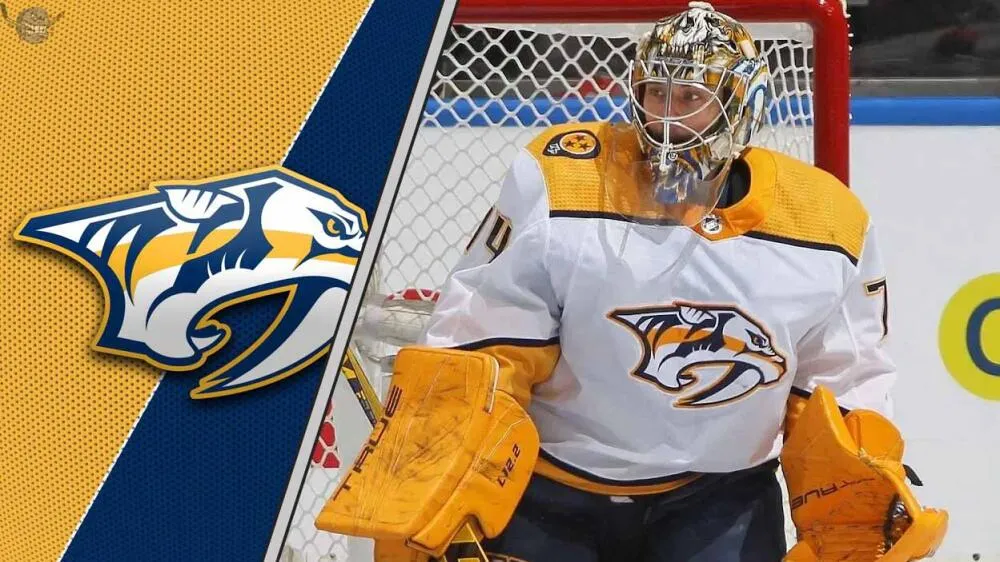
Why Juuse Saros trade rumors continue to swirl around Edmonton
The connection between the Oilers and Saros isn’t entirely fabricated. Multiple league sources have confirmed that Edmonton is among several teams monitoring the Nashville goaltender’s situation. With the Predators stumbling to another disappointing start, speculation about a potential fire sale has gained momentum. In that scenario, Saros would undoubtedly be the centerpiece of any significant roster overhaul.
Saros brings credentials that would appeal to any contending team. Just four years ago, he was a Vezina Trophy finalist, recognized as one of the NHL’s elite goaltenders. His track record of consistency and durability made him a cornerstone for Nashville’s franchise. However, the 2024-25 season marked a significant departure from that standard, representing the worst campaign of his career. Through 14 games this season, he’s posted a 5-6-3 record with an .892 save percentage and a -0.9 goals saved above expected rating.
The advanced metrics paint a concerning picture, but context matters. Saros has been performing behind a Predators team’s that’s completely fallen apart defensively. His struggles mirror those of other talented goaltenders who’ve found themselves on struggling teams. For the Oilers, the gamble would be whether a change of scenery and playing behind a more talented roster could restore Saros to his previous form.
The timing of these rumors also coincides with growing frustration in Edmonton. The Oilers rank among the NHL’s worst teams in save percentage through the season’s first quarter. Both Skinner and Pickard have posted mediocre individual results, leaving the team’s defensive zone stability in constant question. When you’re a championship contender dealing with subpar goaltending for the third consecutive season, drastic measures start to look increasingly attractive.
Jeff Marek has been among the prominent voices suggesting Edmonton as a logical destination for Saros. The hockey insider pointed to the obvious fit: a contending team desperate for goaltending meeting a quality goaltender potentially available due to his team’s struggles. On paper, it makes perfect sense. In practice, executing such a trade presents enormous challenges.
The persistent goaltending trade rumors surrounding the Oilers reflect a deeper organizational concern about their championship window. With Connor McDavid and Leon Draisaitl in their primes, the franchise cannot afford to waste another season hoping their current netminders suddenly figure things out.
The financial complications of acquiring Juuse Saros
The most significant obstacle to any Saros trade is his contract situation. While he carries a manageable $5 million cap hit for the remainder of this season, an eight-year extension kicks in next summer that will pay him $7.74 million annually through 2032-33. That deal takes him through age 39, representing a massive commitment for any acquiring team.
For a team like Edmonton, already operating near the salary cap ceiling, absorbing even the current $5 million hit requires creative maneuvering. Looking ahead to next season, when the larger number kicks in, the financial gymnastics become even more challenging. The Oilers would need to move significant salary in any deal, and Nashville would need to be willing to take back contracts they might not want.
Insider Frank Seravalli has been particularly vocal about why this trade doesn’t make sense for Edmonton. In a recent appearance, he argued that Saros’ hefty contract, declining performance numbers, and questionable playoff track record make him a poor investment for the Oilers. Seravalli went so far as to suggest the only scenario where Edmonton should pursue Saros is if Nashville is willing to attach assets to move the contract—essentially paying the Oilers to take on the long-term commitment.
That perspective gained traction when Jason Gregor of Sports 1440 added that the Predators aren’t going to retain 50 percent of Saros’ contract. While Nashville might be willing to trade their goaltender, doing so at maximum retention seems unlikely unless the situation deteriorates further. The franchise committed significant money to Saros because they believed in him as a long-term solution. Eating half that contract would represent a spectacular miscalculation by management.
The financial realities extend beyond just fitting the contract under the cap. Edmonton would need to consider what they’re giving up to acquire Saros. The Oilers don’t have an abundance of high-end prospects or draft picks to offer. Any package would likely need to include roster players, potentially creating new holes while trying to fill the one in goal. Trading Adam Henrique or other veterans might help with cap matching, but it would also diminish the team’s depth at a time when they’re trying to make a championship push.
To make the money work in any realistic scenario, Nashville would need to take on contracts like Henrique’s and possibly Skinner’s, while still retaining some salary. That’s asking a lot from a team that may be rebuilding but still has to reach the salary cap floor and manage their own financial structure.
Alternative goaltending options for the Oilers
While Saros dominates the headlines, he’s far from the only goaltender potentially available to Edmonton. The trade market features several other options that might be more financially feasible, even if they don’t carry the same upside.
Ukko-Pekka Luukkonen of the Buffalo Sabres represents an intriguing target. The 26-year-old Finnish netminder carries a $4.75 million cap hit through 2029 and seems to need a fresh start. Buffalo’s goaltending logjam—featuring Luukkonen, Colton Ellis, Alex Lyon, and Devon Levi—suggests someone will be moved. While his numbers have declined over the past two seasons behind a struggling Sabres squad, a change of scenery could unlock his potential. The risk is lower than Saros, but so is the ceiling.
Elvis Merzlikins has been on the trade block for years, it seems. The Columbus Blue Jackets goaltender has been difficult to evaluate, showing flashes of brilliance mixed with extended struggles. After averaging an .888 save percentage over the past three seasons, he’s started this year more strongly. At $5.4 million through 2027, with Columbus potentially willing to retain salary, Merzlikins could be had for a reasonable price. The question is whether his recent improvement is sustainable or merely a small sample size mirage.
For those seeking a safer, short-term solution, Cam Talbot presents an interesting reunion opportunity. The 38-year-old veteran won’t solve Edmonton’s long-term goaltending question, but he’s been consistently reliable throughout his career. At $2.5 million through the end of the season, he represents a Band-Aid approach—not ideal for a team needing stability, but potentially the most cost-effective option available. Detroit already has John Gibson and Sebastian Cossa pushing for NHL time, making Talbot expendable.
Tristan Jarry’s career appeared to be in freefall last season when the Pittsburgh Penguins placed him on waivers and sent him to the AHL. However, the former Edmonton Oil Kings goaltender has started this season surprisingly well, posting a .911 save percentage through seven games. At $5.37 million through 2028, his contract is problematic, but if Pittsburgh retains salary, he could represent a low-cost, high-upside gamble. His connection to Bowman from junior hockey adds an interesting wrinkle to any potential discussion.
The question of whether the Oilers should consider trading Stuart Skinner complicates matters further. If Edmonton moves their current starter, they’re signaling a complete reset of their goaltending philosophy, which may require a more significant acquisition than a rental or reclamation project.
What Stan Bowman and the Oilers are really thinking
Following the recent NHL GM meetings, Stan Bowman provided insight into the organization’s thinking regarding their goaltending situation. His message was clear: while the team acknowledges their goaltending hasn’t been elite, they don’t believe it’s entirely to blame for their inconsistent performance. Bowman described the current tandem as “average” and emphasized that defensive breakdowns and inconsistent forward play share responsibility for the team’s struggles.
This measured approach suggests Edmonton isn’t panicking into making a desperation move. The Oilers’ brass recognizes that trading for a goaltender isn’t a magic solution if the team in front of him continues to make critical mistakes. The analytics support this perspective to some degree—while save percentage numbers are poor, the quality of scoring chances against has also been problematic.
However, Bowman’s public statements may also serve as a negotiating tactic. By downplaying the urgency of their situation, the GM potentially strengthens his position in trade discussions. If other teams believe Edmonton is desperate, the price for any goaltender increases significantly. Projecting patience and measured evaluation could help keep acquisition costs reasonable.
The reality is that the Oilers are walking a tightrope. They can’t afford to write off another season due to goaltending issues, but they also can’t mortgage their future on an expensive solution that might not pan out. With Connor McDavid and Leon Draisaitl’s championship window wide open, every decision carries enormous weight. Making the wrong move could set the franchise back years; doing nothing could waste a precious year of their superstars’ primes.
League sources suggest that while Edmonton is monitoring Saros and other goaltenders, they’re unlikely to make a move unless their current situation becomes completely untenable. The organization wants to see if Skinner and Pickard can find better form as the season progresses. There’s also hope that improved team defense will naturally boost their goaltenders’ numbers.
The other consideration is timing. Trade deadline deals often come with premium prices. If the Oilers can survive until the deadline without completely falling out of playoff contention, more options may become available. Teams that consider themselves sellers by February often make goaltenders available who weren’t on the market in November. Patience might expand Edmonton’s options and reduce the cost of acquisition.
The broader implications for Edmonton’s championship window
The Saros trade rumors, whether they materialize or not, highlight a fundamental challenge facing the Oilers. This franchise has two of the best players in hockey and a roster built to compete for championships right now. Yet for three consecutive seasons, goaltending has been their Achilles heel. At some point, hoping for internal improvement stops being a strategy and becomes wishful thinking.
The stakes couldn’t be higher. McDavid is 28 years old. Draisaitl is 30. Their peak years won’t last forever, and the team has already made significant investments in the supporting cast. Darnell Nurse, Zach Hyman, and others are locked into long-term deals. The roster’s construction assumes competitive windows are now, not later.
Failing to address goaltending adequately could haunt this organization for years. Imagine looking back in five years and realizing Edmonton wasted McDavid’s prime because they wouldn’t take the necessary risks to acquire legitimate starting goaltending. That’s the nightmare scenario keeping Oilers management awake at night.
Conversely, overpaying for the wrong goaltender could be equally damaging. If Edmonton trades valuable assets and takes on a problematic long-term contract for a goaltender who doesn’t solve their problems, they’ve made their situation worse. The Saros contract is particularly risky in this regard—committing nearly $8 million annually through his age-39 season is a massive gamble, even for a goaltender who was recently elite.
The Oilers find themselves in this predicament partly due to previous miscalculations. The organization believed Stuart Skinner could develop into a legitimate number-one goaltender after his strong playoff performance. That hasn’t materialized as hoped. They also invested in Calvin Pickard as a steady backup, but he hasn’t provided the reliable support they expected. These evaluation errors have created the current crisis.
Looking ahead, the Oilers need to balance multiple competing priorities. They must win now while McDavid and Draisaitl are in their primes. They need to maintain some flexibility for future moves and contract extensions. They can’t completely empty the prospect cupboard, as organizational depth matters. Threading this needle while addressing goaltending requires exceptional management.
The Juuse Saros trade rumors represent more than just speculation about one potential transaction. They symbolize the Edmonton Oilers’ ongoing struggle to find the final piece of their championship puzzle. While Saros would theoretically provide an upgrade over the current situation, the practical realities of his contract, declining performance, and acquisition cost make this move far less straightforward than it appears.
As the season progresses, Stan Bowman and the Oilers’ management team face difficult decisions with franchise-altering implications. Whether they ultimately pursue Saros, target an alternative like Luukkonen or Merzlikins, or stick with their current tandem while hoping for improvement, the margin for error is razor-thin. The championship window is open, but it won’t stay that way forever. How Edmonton addresses their goaltending situation in the coming months may well determine whether this era of Oilers hockey is remembered for what could have been or for what they achieved when it mattered most. For now, the Saros rumors will continue to swirl, but as insiders like Frank Seravalli have noted, the path from speculation to reality remains fraught with complications that may prove insurmountable.
Frequently Asked Questions

Par Mike Jonderson
Mike Jonderson is a passionate hockey analyst and expert in advanced NHL statistics. A former college player and mathematics graduate, he combines his understanding of the game with technical expertise to develop innovative predictive models and contribute to the evolution of modern hockey analytics.