








The Edmonton Oilers’ bold move to solve their goaltending instability has hit a major snag. Less than two weeks after acquiring Tristan Jarry from the Pittsburgh Penguins in a blockbuster trade, the Oilers placed their new netminder on injured reserve with a lower-body injury suffered during Thursday’s 3-1 victory over the Boston Bruins. The announcement came just one day after Jarry appeared to suffer a non-contact injury midway through the second period, leaving the team scrambling to address their crease situation once again.
The timing couldn’t be worse for an Oilers organization that had pinned its hopes on Jarry providing stability between the pipes for a team with legitimate Stanley Cup aspirations. Jarry had played just three games for his new club, stopping 58 of 65 shots, before the injury forced him from the lineup. Head coach Kris Knoblauch offered little clarity immediately after the game, telling reporters, “Not sure how serious it is. No updates,” a quote that now seems ominous given the subsequent IR placement.
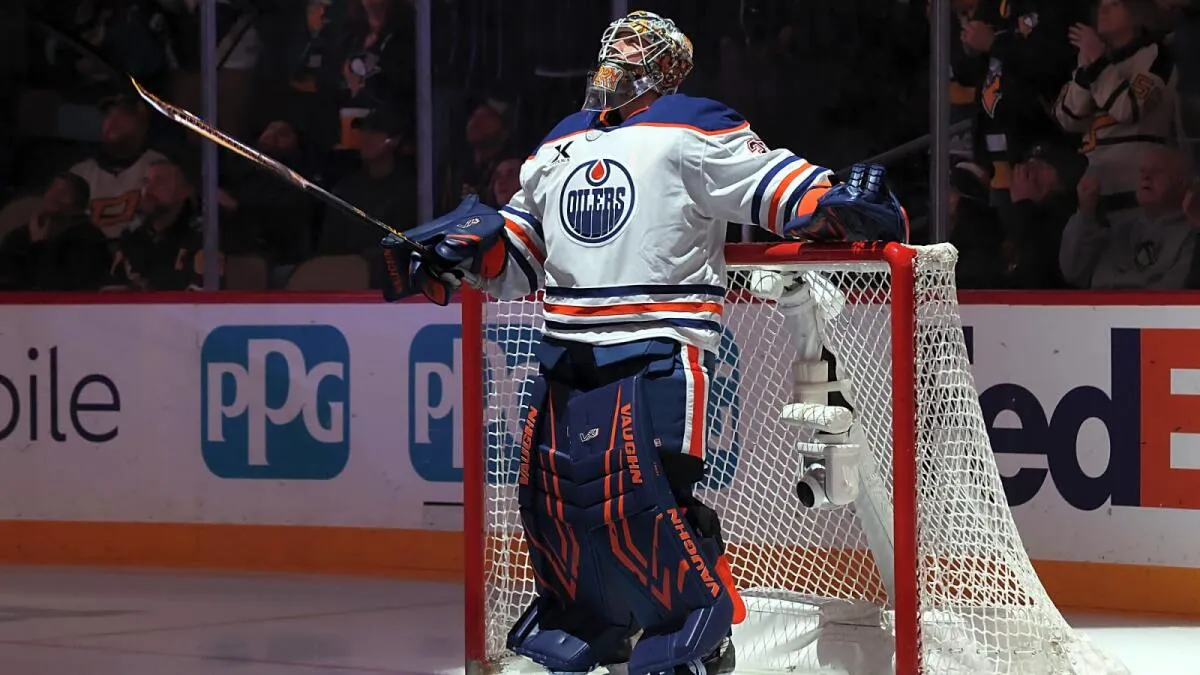
How Tristan Jarry’s lower-body ailment unfolded against Boston
The injury occurred during what appeared to be an innocuous sequence. With just under four minutes remaining in the second period, Jarry pushed across his crease from left to right to track the play. The movement itself seemed routine, but the veteran goaltender came up slowly and appeared to be favoring his leg. At the next whistle, he headed straight for the dressing room, replaced by backup Calvin Pickard with the Oilers clinging to a 2-1 lead.
What’s particularly concerning for Edmonton is the non-contact nature of the injury. As hockey medical experts know, injuries that occur without external contact often suggest structural issues like tears or significant strains. Jarry had already missed three weeks earlier this season with a lower-body injury while still with Pittsburgh, raising questions about his durability. The Oilers’ medical staff will conduct further evaluation to determine the severity and timeline, but the immediate move to injured reserve suggests this won’t be a day-to-day situation.
Jarry stopped 12 of 13 shots before exiting, performing reasonably well despite the eventual outcome. His season statistics remained solid: 12-3-1 record with a .906 save percentage and 2.73 goals-against average across 14 games with Pittsburgh and Edmonton. However, those numbers now seem secondary to his ability to stay healthy when his team needs him most.
Oilers goaltending depth tested after Jarry IR placement
With Tristan Jarry on injured reserve, the Oilers face an all-too-familiar problem. The team has recalled Connor Ingram from the AHL’s Bakersfield Condors to serve as Calvin Pickard’s backup, but the depth chart looks concerning. Pickard, who performed admirably in relief against Boston by stopping all 12 shots he faced, now inherits the starter’s role. His season numbers tell a different story: 3-4-2 record with a .857 save percentage and 3.91 GAA in limited action.
The situation becomes more troubling when examining Ingram’s performance this season. The 27-year-old has struggled with the Condors, posting a 4-5-2 record with an .856 save percentage and 4.04 GAA. Those statistics don’t inspire confidence for a team currently fighting for playoff positioning in the competitive Pacific Division. The Oilers have three games remaining before the holiday break, including Saturday’s matchup against the Minnesota Wild, giving little time for adjustments.
Edmonton’s front office may need to explore external options if Jarry’s absence extends beyond a few weeks. The trade market for goaltenders is notoriously thin in-season, and the Oilers already depleted some assets to acquire Jarry. General manager Ken Holland faces a difficult balancing act between addressing immediate needs and preserving future flexibility for what the organization hopes will be a deep playoff run.
The blockbuster trade that brought Jarry to Edmonton
Understanding the full impact of Edmonton Oilers placing Tristan Jarry on injured reserve requires revisiting the Dec. 12 trade that reshaped the team’s goaltending landscape. In a deal that signaled win-now urgency, Holland sent Stuart Skinner, Brett Kulak, and a 2029 second-round draft pick to Pittsburgh for Jarry and forward Sam Poulin. At the time, the move addressed Edmonton’s inconsistent goaltending while giving them a proven starter with playoff experience.
The trade analysis at the time highlighted the risk-reward proposition. Jarry brought a track record of regular-season success but came with injury concerns that have materialized faster than anyone anticipated. Skinner, while inconsistent, had been durable and was locked into a team-friendly contract. Kulak provided defensive depth the Oilers now lack. The second-round pick represented valuable future capital for an organization with limited draft resources.
For a deeper examination of the trade’s implications, our analysis of the Edmonton Oilers’ acquisition of Tristan Jarry explored how the move was designed to provide stability. The article noted that Jarry’s health would be the determining factor in whether the trade proved successful. That assessment now looks prophetic, as the Oilers find themselves without their new starter before he could truly establish himself in the Edmonton crease.
What Jarry’s IR placement means for Oilers’ playoff push
The immediate schedule doesn’t offer Edmonton any favors. After Saturday’s game in Minnesota, the Oilers face the Winnipeg Jets on Monday and the Los Angeles Kings on Tuesday before the holiday break. Those are three critical Western Conference matchups where points will be at a premium. With Pickard and Ingram as the goaltending tandem, Edmonton must rely on its high-powered offense led by Connor McDavid and Leon Draisaitl to outscore opponents.
Long-term implications depend entirely on the severity of Jarry’s lower-body ailment. If this becomes a multi-week or month-long absence, Holland may need to get creative. The Oilers have roughly $2 million in cap space, limiting their ability to absorb significant contracts. A trade for a rental goaltender or claiming someone off waivers could be necessary, but options are limited this late in the season.
The injury also raises questions about roster construction philosophy. Edmonton has now placed multiple key players on injured reserve this season, following Ryan Nugent-Hopkins’ recent stint. The team’s medical staff and training protocols may face scrutiny if injuries continue to mount. For context on how the Oilers have managed previous injury crises, our coverage of Edmonton placing Nugent-Hopkins on IR shows the pattern developing.
Potential solutions and next steps for Edmonton
The Oilers have several paths forward, none perfect. They could ride with Pickard and Ingram, hoping their offensive firepower can compensate for goaltending deficiencies. This approach carries enormous risk in a conference where every point matters. Alternatively, they could pursue external help through trade or waiver claims, though the market is thin and cap space limited.
Another consideration involves the AHL pipeline. Beyond Ingram, the Oilers’ goaltending prospects include 23-year-old Olivier Rodrigue, who has shown promise with the Condors. While throwing an inexperienced goaltender into the NHL fire isn’t ideal, desperate times may call for desperate measures. The organization’s development staff will be evaluating all options in the coming days.
The front office must also consider the mental toll on the team. Players see management invest heavily in a goaltender who immediately gets hurt, potentially shaking confidence in the decision-making process. Leadership from McDavid, Draisaitl, and other veterans becomes crucial in maintaining focus during this challenging stretch.
Edmonton’s situation underscores the razor-thin margins in today’s NHL. A team can look like a Stanley Cup contender one moment and find itself in crisis the next. How the Oilers navigate this goaltending storm may define not just their season, but potentially the job security of those who built this roster.
The Oilers’ championship window remains open, but it’s narrowing. Every decision from this point forward carries heightened stakes, and the organization’s ability to adapt to this latest setback will test the mettle of everyone involved. For a team that has endured so much goaltending instability, the hope was that Jarry would be the solution, not another question mark.
Frequently Asked Questions

Par Mike Jonderson
Mike Jonderson is a passionate hockey analyst and expert in advanced NHL statistics. A former college player and mathematics graduate, he combines his understanding of the game with technical expertise to develop innovative predictive models and contribute to the evolution of modern hockey analytics.