



















The 2025-26 NHL season has reached its quarter mark, and ESPN’s panel of hockey experts continues to see the Colorado Avalanche reign supreme atop the weekly power rankings. With Thanksgiving approaching—a traditional milestone that often predicts playoff positioning—teams are revealing their true identities. From championship contenders in Denver to rebuilding projects finding their footing, each franchise carries unique reasons for optimism despite the inevitable ups and downs of an 82-game journey.
This comprehensive breakdown examines all 32 teams through ESPN’s latest polling, drawing insights from the quarter-season grades analysis that evaluated everything from superstar performances to systemic improvements. Whether your team sits in the penthouse or the basement, there’s a compelling narrative worth following as we head toward the holiday season.
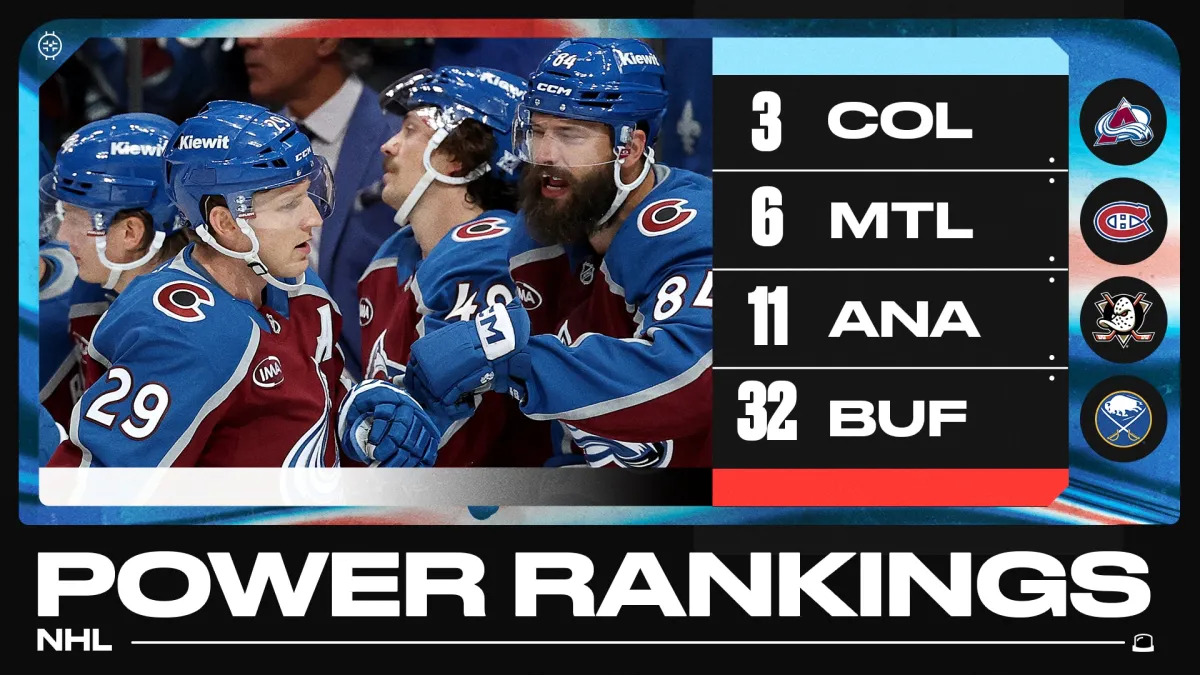
Colorado Avalanche maintain dominance at no. 1 in ESPN NHL power rankings 2025-26
The Colorado Avalanche aren’t just winning—they’re threatening history. With an 84.8% points percentage and a blistering pace that projects to 137.9 regular-season points, the Avs might challenge the Bruins’ record of 135 points set in 2022-23. What makes this particularly impressive is their two-way dominance: they lead the NHL in goals per game while surrendering the fewest.
Superstar tandem drives success
Nathan MacKinnon isn’t merely playing at an MVP level; he’s positioned to capture his second Hart Trophy. Meanwhile, Cale Makar could claim his third Norris Trophy and potentially challenge MacKinnon for the Hart itself. This dynamic duo has elevated a supporting cast that finally provides consistent contributions across all four lines. As coach Jared Bednar noted after their latest victory, “When your best players are your hardest workers, everyone falls in line.”
Special teams remain the Achilles’ heel
The only blemish on Colorado’s report card is a power play converting just 15.7% of opportunities, placing them in the bottom ten. For a team generating the most scoring chances per 60 minutes and dominating shot metrics at even strength, this represents a curious anomaly. The coaching staff has dedicated recent practices to power-play adjustments, recognizing that postseason success often hinges on these crucial moments.
Upcoming schedule presents challenges
The next seven days feature tests against Minnesota, Montreal, Vancouver, and the Islanders—a stretch that will reveal whether Colorado’s dominance can withstand the grind of constant travel and increasingly desperate opponents. With MacKinnon and Makar logging heavy minutes, managing workload becomes paramount as December approaches.
Dallas Stars rise to no. 2 with efficient offense
Glen Gulutzan’s second stint behind the Stars’ bench has transformed questions into answers. After offseason departures of Evgenii Dadonov, Mikael Granlund, and Mason Marchment, many wondered where the offense would materialize. Dallas responded by ranking tenth in goals per game and operating the NHL’s second-best power play unit.
Perspective defines Dallas’ approach
While natural stat trick metrics show the Stars in the bottom ten for scoring chances per 60, shots per 60, and high-danger opportunities per 60, there’s a compelling counterargument: perhaps this reflects elite efficiency rather than underlying problems. The Stars make their chances count, capitalizing on high-percentage opportunities while limiting opponents’ quality looks. This pragmatic approach has them on pace for 111.8 points, comfortably exceeding their preseason over/under of 103.5.
Penalty kill concerns linger
The disconnect between even-strength defensive excellence and penalty-kill struggles defines Dallas’ first quarter. Ranking near league average in shots against and high-danger chance suppression at 5-on-5, their PK success rate sits at 75.7%—bottom ten territory. In a Western Conference where special teams often decide tight playoff races, this represents the clearest area for improvement.
Youth movement provides depth
Rookie forwards Emmit Finnie and Nate Danielson have seamlessly integrated into Todd McLellan’s system, providing secondary scoring that Dallas lacked last season. Their development allows veterans like Joe Pavelski and Jamie Benn to manage minutes more strategically, preserving their legs for postseason pushes.
Carolina Hurricanes slide to no. 3 but remain formidable
Rod Brind’t:Amour’s structured system continues yielding results, even as the Hurricanes slipped one spot in this week’s poll. Carolina’s identity remains rooted in smothering defensive play, but their offensive evolution deserves equal attention. Ranking second overall in goals per game represents a significant leap forward for an organization historically defined by its stinginess.
Offensive depth materializes
Seth Jarvis leads the team in goals while Sebastian Aho paces the Hurricanes in points, providing the one-two punch that complements Jordan Staal’s steadiness. This balanced attack has prevented opponents from focusing solely on Carolina’s top line, creating space for secondary contributors to impact games. The result: Carolina has lost consecutive games only once this season.
Goaltending situation creates uncertainty
Pyotr Kochetkov’s excellence has masked Frederik Andersen’s difficult start and injury concerns. With Andersen dealing with a concussion and posting poor numbers when available, Kochetkov carries an increased workload. The Hurricanes must determine whether they can rely on their backup system or need external help before the trade deadline.
Special teams struggles create vulnerability
Despite ranking third in 5-on-5 goals, Carolina fields the league’s worst power play and sits 21st on the penalty kill. These special-teams deficiencies could prove costly in playoff series where opportunities are limited and conversion rates soar in importance. Brind’Amour’s staff has experimented with various personnel combinations, searching for chemistry that has thus far proven elusive.
Anaheim Ducks’ young stars fuel no. 4 ranking
Few teams have exceeded expectations like the Anaheim Ducks. Fresh off a surprising start that projects to 108.1 points—far beyond their 83.5 preseason over/under—Anaheim has become the Pacific Division’s primary challenger to Colorado’s supremacy. Chris Kreider’s veteran leadership (14 points in 15 games) blends perfectly with a burgeoning youth movement.
Carlsson chases franchise history
Leo Carlsson’s development represents Anaheim’s most exciting storyline. Projected to finish with 108 points, Carlsson would join Paul Kariya and Teemu Selanne as one of only four Ducks to surpass 100 points. More impressively, he’s threatening Selanne’s franchise record of 109 points. At just 20 years old, Carlsson has become the foundation around which Anaheim builds its next contender.
Defensive metrics raise red flags
Despite Lukas Dostal’s heroics—ranking sixth in goals saved above expected—Anaheim’s underlying numbers paint a concerning picture. They rank in the top three for most scoring chances allowed, shots against, and high-danger chances per 60. Dostal’s projected 63-game workload mirrors those of elite workhorses like Connor Hellebuyck, but the team must reduce the nightly assault on their goaltender to sustain success.
Upcoming rivalry games test mettle
Anaheim faces the Kings, Blackhawks, Blues, and Mammoth in the coming week, presenting a crucial stretch against divisional opponents. How they navigate these games will determine whether their hot start represents legitimate contention or early-season overachievement destined to regress.
Tampa Bay Lightning surge to no. 5 with veteran resilience
The Lightning’s jump from 13th to 5th reflects their remarkable adaptability. Despite offseason roster changes and early-season injuries, Jon Cooper’s squad maintains its identity as one of the league’s most dangerous teams. Jake Guentzel and Nikita Kucherov form a formidable one-two punch, while Anthony Cirelli exemplifies the 200-foot center that defines championship-caliber clubs.
Injury carousel tests depth
Only six Tampa Bay skaters have appeared in every game, forcing Cooper to integrate call-ups regularly. The loss of Victor Hedman for a couple weeks compounds existing challenges, particularly with Brayden Point struggling—just three goals and 11 points in his first 20 games represent a shadow of his usual dynamic self. Yet Tampa’s system continues producing results, a testament to organizational depth and coaching excellence.
Power play dominance continues
Tampa Bay’s power play operates among the league’s elite, providing crucial goals during tight games. This special-teams superiority often covers for even-strength inconsistency, particularly when key forwards are slumping. As the season progresses, Point’s expected regression to his mean performance should elevate the Lightning’s 5-on-5 production significantly.
Defensive structure remains elite
Despite personnel losses, Tampa Bay ranks among the NHL’s top defensive groups, dominating on the penalty kill and limiting high-danger chances. This foundation allows their offensive stars to play with confidence, knowing mistakes won’t automatically end up in their own net. The Lightning’s ability to adjust its playing style based on available personnel separates them from less versatile contenders.
Western Conference parity benefits Vegas
The Pacific Division’s compressed standings mean Vegas sits just a point behind first place despite early-season questions. With consistent defensive play and elite offensive talent, the Golden Knights remain legitimate contenders as Thanksgiving approaches.
Minnesota Wild jump to no. 8 with health
Minnesota’s ascent from 19th to 8th reflects something simple yet profound: roster consistency. Last season’s injury-plagued collapse taught the Wild valuable lessons about depth and sustainability. Through 23 games, eight players have appeared in every contest, while 13 skaters have played at least 20 games.
Defensive core stability pays dividends
Three of Minnesota’s top four defensemen in ice time have played every game, with Jonas Brodin missing just one contest. This continuity has established the defensive structure that defines Minnesota’s identity. The Wild’s ability to field the same lineup nightly creates familiarity and trust, translating into better gap control and neutral-zone management.
Scoring struggles persist
Despite ranking in the top half for scoring chances and shots per 60, Minnesota sits in the bottom ten for goals per game. This disconnect suggests either poor shooting luck or subpar finishing ability—likely a combination of both. For a team projected to finish with 99.8 points, improving finish becomes paramount as the season progresses.
Upcoming central division battles
Games against Colorado, Buffalo, Edmonton, and Calgary will test Minnesota’s defensive mettle against varied offensive styles. These four games could determine whether the Wild secure a top-three division spot or battle for a wild-card position down the stretch.
Los Angeles Kings climb to no. 9 on defensive consistency
After four consecutive first-round exits, the Kings entered this season with serious questions about their ability to close games. Their defensive performance—allowing the fifth-fewest goals per game—has provided at least preliminary answers.
Playoff demons drive regular season focus
Giving up 20 goals across four games to Edmonton last spring created organizational soul-searching. The result is a more committed defensive structure that prioritizes shot suppression and high-danger chance limitation. While offense remains inconsistent—ranking bottom-six in goals per game and power-play efficiency—the Kings play close games, maximizing points in tight contests.
Underlying numbers tell complex story
Los Angeles ranks sixth in high-danger scoring chances per 60 but only 12th in overall scoring chances, sitting just below league average. This discrepancy suggests the Kings generate quality looks but struggle to create sustained offensive zone time. Their defensive commitment compensates, but whether this formula succeeds in playoffs remains to be seen.
Rivalry week ahead
The upcoming schedule features Anaheim, Vancouver, Washington, and Chicago—offering the Kings opportunities to build momentum against varied competition. How they navigate these games while maintaining defensive integrity could define their November success.
New York Islanders reach no. 10 behind rookie sensation
Matthew Schaefer has exceeded even the loftiest expectations for a first-overall pick. Playing over 22 minutes per game, the rookie defenseman has inserted himself into Calder Trophy conversations while demonstrating two-way excellence that belies his age.
Rookie class provides foundation
Schaefer isn’t the only first-year player making waves. Maxim Shabanov’s three-point performance highlighted the 6-1-0 road trip that established the Islanders as Metropolitan threats. Shabanov’s promotion from the fourth line seems inevitable as his KHL-honed skills translate to North American ice.
Veteran support crucial
Bo Horvat is enjoying his best start in years, while a healthy Mathew Barzal and Kyle Palmieri provide offensive punch. The Islanders rank top-ten in goals, a dramatic improvement for an organization historically desperate for scoring. Ilya Sorokin and David Rittich’s goaltending tandem has been solid, giving the team confidence in their back end.
Injuries threaten progress
The loss of Alexander Romanov for five to six months following shoulder surgery creates a significant hole on the blue line. Combined with a power play ranking among the league’s worst and concerns about offensive depth beyond the top line, the Islanders face real tests of their sustainability in the competitive Metropolitan division.
Seattle Kraken sit at no. 11 with elite goaltending
The Kraken’s investment in goaltending—committing a higher percentage of salary cap to the position than all but the Rangers—has paid immediate dividends. Joey Daccord, Philipp Grubauer, and Matt Murray have combined for the league’s best team save percentage in 5-on-5 play, tied for fourth overall.
Defensive identity reestablished
Lane Lambert’s first season has seen Seattle return to the structure that made them competitive in their inaugural campaign. Ranking among the NHL’s best at limiting high-danger chances and scoring chances per 60 in 5-on-5 play, the Kraken have built their playoff case on prevention rather than production.
Offensive limitations create tight margins
Scoring just 2.55 goals per game while allowing 2.59 creates razor-thin margins for error. Seattle ranks last in scoring chances per 60, shots per 60, and high-danger chances per 60—offensive futility that could derail their playoff hopes. The Kraken entered Monday just a point behind Anaheim for first place in the Pacific, illustrating the Western Conference’s compressed standings but also highlighting their vulnerability.
Upcoming schedule features key rivalries
Edmonton visits Seattle twice in the coming week, presenting the Kraken with opportunities to gain ground on a Pacific rival. These games will test whether Seattle’s defensive structure can contain the Oilers’ high-powered attack.
Washington Capitals rebound to no. 12
Alex Ovechkin continues defying age and expectations, tying for the team lead with 20 points in his first 20 games while adding another hat trick to his legendary resume. At 40 years old, Ovechkin’s sustained excellence provides the Capitals with a foundation few teams possess.
Veteran core remains productive
Tom Wilson, John Carlson, and Jakob Chychrun have been difference-makers, while Logan Thompson ranks among the league’s top starters in save percentage and goals-against average. This veteran presence has stabilized Washington through inconsistent stretches, keeping them competitive in the Metropolitan race.
Injuries expose depth concerns
Pierre-Luc Dubois and Nic Dowd recently joined the injured list, depleting center depth at a crucial juncture. The Capitals’ inability to establish a consistent identity—Carbery’s vision of a faster, more dynamic team hasn’t fully materialized—has them fighting for wild-card position rather than division titles.
Special teams struggles compound issues
Washington’s power play sits well below average, while their penalty kill ranks bottom-five. For a team relying on veteran savvy and goaltending excellence, these special-teams deficiencies create unnecessary challenges. The Capitals must find solutions before the standings gap becomes insurmountable.
Utah Mammoth hold at no. 13 in inaugural season
The NHL’s newest franchise has already established an identity: competitive, resilient, and capable of competing with established clubs. An eight-of-ten start—including a seven-game winning streak—proved Utah belongs in the league’s top half.
Early success built on structure
During their hot start, Utah ranked top-five in shots allowed per game and goals allowed per game. They complemented this defensive commitment with top-five rankings in shots per game and goals scored per game, demonstrating balance rarely seen in expansion teams.
Regression tests resolve
Since their winning streak ended October 28, the Mammoth have lost nine of twelve games, falling into the bottom four for goals scored and bottom ten for goals allowed. This regression reveals the challenges expansion teams face when opponents develop scouting reports and intensity increases.
Long-term outlook remains bright
Despite recent struggles, Utah’s quarter-season performance suggests they’ll remain in the Western Conference playoff race throughout the season. Their ability to compete early provides a foundation for future success, giving fans legitimate hope for the franchise’s trajectory.
Detroit Red Wings slip to no. 14 but exceed expectations
Todd McLellan’s first full season has Detroit experiencing its best start in a decade. The Red Wings’ 96.3-point pace reflects Steve Yzerman’s vision taking shape: a high-skilled, defensively responsible group that competes nightly.
Youth movement accelerates rebuild
Dylan Larkin leads the team in goals and points while providing invaluable leadership to rookies Emmitt Finnie and Nate Danielson. Axel Sandin-Pellikka has been an important presence on the blue line, giving Detroit depth that allows them to compete with Atlantic Division powers.
Goaltending questions persist
Despite improved play from Cam Talbot, offseason acquisition John Gibson hasn’t been the savior many anticipated. Detroit ranks among the fewest shots against per game but still surrenders over three goals per contest, suggesting goaltending remains average at best. For a team exceeding expectations, this might be the area that determines whether they maintain playoff positioning.
Sustainability concerns loom
Detroit’s reliance on a strong power play—while their even-strength scoring remains inconsistent—raises questions about long-term viability. As injuries mount across the league, the Red Wings must prove their depth can withstand absences while maintaining defensive commitment.
Pittsburgh Penguins tumble to no. 15 after hot start
First-year coach Dan Muse has transformed the Penguins into surprising contenders, but a 0-4 record in overtime and shootouts has cost valuable points. Despite this shortfall, Pittsburgh ranks second in fewest goals allowed, top-ten offensively, and fields the league’s best power play.
Silovs emerges as legitimate starter
Arturs Silovs’ development alongside an improved Tristan Jarry has given Pittsburgh goaltending stability it lacked last season. This duo’s performance underpins the Penguins’ defensive resurgence, allowing Muse’s system to flourish. The freedom Muse grants his skaters has unlocked offensive confidence throughout the lineup.
Overtime struggles require attention
Leaving points on the board in historically tight standings could haunt Pittsburgh come April. Muse has implemented specific 3-on-3 practice drills to address the issue, recognizing that four lost points might separate playoff teams from early tee times.
Injuries testing depth
Rickard Rakell’s broken hand and Jarry’s recent injured reserve stint test Pittsburgh’s resilience. The Penguins’ ability to weather these absences while maintaining their competitive edge will determine whether this surprising start translates to postseason participation.
Ottawa Senators climb to no. 16 behind defensive commitment
Travis Green’s defensive structure has transformed Ottawa from an offensive-minded group into a structured, hard-to-play-against team. After a shaky start, the Senators have climbed into the Atlantic’s top three by limiting shots against and improving their goals-against average dramatically since late October.
Sanderson becomes two-way force
Jake Sanderson’s continued development gives Ottawa a legitimate number-one defenseman. His ability to impact the game at both ends has been especially crucial with captain Brady Tkachuk sidelined. Sanderson’s 22 minutes per night of reliable, high-impact hockey stabilizes a blue line that previously struggled with consistency.
Goaltending concerns persist
Linus Ullmark’s Vezina Trophy form hasn’t carried over to Ottawa, with the veteran giving up three or more goals in ten of his first sixteen starts. Leevi Merilainen has been capable in relief, but Ullmark must rediscover his elite form for Ottawa to maintain its Atlantic positioning. Recent injuries to Thomas Chabot and Ridly Greig further strain a team already missing Tkachuk.
Offensive depth provides cushion
Drake Batherson’s 19 points in 17 games leads the Senators, while Tim Stutzle and Shane Pinto contribute regularly. This three-headed monster allows Ottawa to outscore goaltending deficiencies on most nights, a formula that works during the regular season but requires tightening for playoff success.
Montreal Canadiens dip to no. 17 after strong start
The Canadiens’ surprising early-season success has hit turbulence, dropping them to 17th in ESPN’s poll. Jakub Dobes has outperformed starter Sam Montembeault, becoming one of the league’s breakout netminders through the first quarter.
Defensive structure improves
Montreal’s commitment to stronger neutral-zone play and tighter gaps has limited rush chances, addressing a weakness that plagued them last season. Cole Caufield’s 13 goals and Nick Suzuki’s 22 points in 20 games provide the offensive firepower that makes their defensive improvements meaningful.
Regression exposes vulnerabilities
Lopsided losses, including a 7-0 defeat to Dallas, have shaken Montreal’s confidence. Injuries to Kaiden Guhle, Kirby Dach, Patrik Laine, and Alex Newhook have decimated depth, forcing the Canadiens to rely on players not ready for increased responsibility.
Sustainability questions emerge
After being a surprise playoff team last season, Montreal showed their success wasn’t a fluke with their strong start. However, maintaining that level through injuries and goaltending inconsistency will test coach Martin St-Louis’s ability to keep his team focused on defensive details.
Winnipeg Jets fall to no. 18 amid goaltending concerns
The Jets’ offensive firepower—generating goals from throughout the lineup—has kept them competitive, but Connor Hellebuyck’s potential six-week absence threatens their postseason positioning. Kyle Connor, Josh Morrissey, and Mark Scheifele all average more than a point per game, providing the high-end talent that defines Winnipeg’s identity.
Scoring depth separates Winnipeg
Unlike many teams reliant on top lines, Winnipeg receives contributions from various line combinations and defense pairings. This offensive distribution has them in the top twelve for goals per game and top ten for power-play efficiency. This scoring ability becomes even more critical as they navigate life without Hellebuyck.
Defensive metrics raise alarms
Winnipeg ranks in the top ten for most shots allowed per 60 and high-danger chances against, putting enormous pressure on their goaltenders. Eric Comrie must elevate his play during Hellebuyck’s injury, and recent World Junior hero Thomas Milic might need to contribute sooner than expected.
Comrie’s opportunity arrives
The Jets’ goaltending duo posted top-five team save percentage numbers before Hellebuyck’s injury. Comrie now has the chance to prove he can handle starter-level responsibilities, beginning with upcoming games against Carolina, Nashville, Buffalo, and Montreal that will test his readiness.
Florida Panthers slide to no. 19 despite championship pedigree
Injuries have decimated the two-time defending Stanley Cup champions, yet Florida’s adaptability keeps them competitive. Captain Aleksander Barkov’s season-ending ACL/MCL tear, combined with Eetu Luostarinen’s bizarre barbecuing accident and Cole Schwindt’s broken arm, has tested the Panthers’ “next-man-up” mentality like never before.
Marchand leads by example
Brad Marchand is enjoying his best hockey in years, leading the Panthers in goals and points while Sam Reinhart and Anton Lundell provide complementary scoring. This veteran core’s ability to produce despite missing their best player demonstrates the championship confidence that permeates the organization.
Goaltending remains solid
Sergei Bobrovsky continues providing the elite goaltending that underpinned Florida’s championship runs. Despite playing behind a depleted lineup, Bobrovsky gives the Panthers a chance to win nightly, a crucial element during difficult stretches.
Realistic expectations require adjustment
The Panthers entered Monday with the third-fewest points in the NHL, making their playoff path increasingly difficult. While their championship experience provides intangible benefits, Florida must navigate their injury crisis while hoping other Eastern Conference teams stumble.
Chicago Blackhawks drop to no. 20 but show dramatic improvement
Connor Bedard has erased last season’s questions, replacing them with inquiries about Olympic team selection and scoring-title contention. Projected for 116 points, Bedard would post the highest-scoring season by a Blackhawk not named Denis Savard, cementing his status as a generational talent.
Goaltending transformation
Chicago’s team save percentage jumped from .894 last season to .911 through 22 games, tied for fourth in the NHL. Spencer Knight’s emergence gives the Blackhawks legitimate goaltending that complements Bedard’s offensive excellence, fundamentally changing the team’s outlook.
Defensive youth movement creates challenges
Chicago’s roster features the NHL’s third-youngest group, with a top-four defense averaging under 24 years old and including two rookies. This youth contributes to the Blackhawks ranking in the bottom four for scoring chances allowed, shots against, and high-danger chances per 60. While growing pains are expected, the organization must balance development with competitive progress.
Veterans supporting youth
Last season’s veteran struggles have vanished, with experienced players contributing in measurable and intangible ways. This leadership allows Bedard to focus on offensive brilliance while the supporting cast handles defensive responsibilities.
Philadelphia Flyers steady at no. 21
Rick Tocchet’s defensive system has Philadelphia hovering near the top ten in goals against per game, while their penalty kill ranks among the league’s best. Dan Vladar has transformed from a tandem option to a reliable starter, giving the Flyers stability they lacked in recent seasons.
Sanheim anchors blue line
Travis Sanheim has been in superb command of Philadelphia’s defense, playing nearly 25 minutes per night against opponents’ top lines. His development into a legitimate number-one defenseman has been crucial for a team built on defensive structure.
Scoring limitations create ceiling
Philadelphia ranks 26th in goals per game, with a power play operating below 20%. Trevor Zegras leads the offense at over a point per game, but Matvei Michkov’s nine points in 19 games represent a concerning step back. Without improved scoring, even elite defensive play won’t secure playoff positioning.
Goaltending depth questionable
While Vladar has excelled, backup Samuel Ersson’s inconsistency raises concerns about sustainability. If Vladar falters or gets injured, the Flyers’ playoff hopes could evaporate quickly.
Boston Bruins tumble to no. 22
First-year coach Marco Sturm deserves credit for implementing a defense-first structure that has Boston competing in the Atlantic despite Elias Lindholm’s extended absence. The Bruins rank top-ten on both power play and penalty kill while surrendering the second-fewest goals per game.
Injury crisis threatens overachievement
Charlie McAvoy’s indefinite absence after taking a puck to the face compounds losses of Mittelstadt, Arvidsson, and Harris. With Lindholm already missing significant time, Boston’s depth faces its sternest test. The Bruins’ overachievement feels unsustainable if key players remain sidelined.
Offensive emergence provides hope
David Pastrnak continues his dynamic play, while Morgan Geekie has blossomed into a budding offensive star. This secondary scoring has allowed Boston to remain competitive despite missing their top center.
Defensive structure masks deficiencies
Boston remains bottom-ten in goals against despite Sturm’s messaging and Jeremy Swayman’s solid play. The McAvoy injury exacerbates existing issues, potentially exposing a defense that has overperformed through the season’s first quarter.
San Jose Sharks surge to no. 23
Macklin Celebrini isn’t just having a great rookie season—he’s threatening Joe Thornton’s franchise record of 114 points. Projected for 121 points, Celebrini could deliver the greatest individual season in Sharks history while playing his way onto Canada’s Olympic team.
Young core shows progress
Yaroslav Askarov, William Eklund, and Will Smith have all progressed significantly, while veterans contribute in ways that extend beyond statistics. This blend of youth and experience has the Sharks on pace for their first 80-point season since their 2018-19 playoff appearance.
Slow start created hole
Opening the season with six consecutive losses—giving up over three goals per defeat—dug a hole that still impacts their positioning. The Sharks rank in the bottom ten for goals per game and goals allowed, with an 11th-worst penalty kill. Since October 23, however, they own the fourth-most points in the NHL, proving their improved play is sustainable.
Momentum building
The Sharks have won four of their last five games, with Celebrini leading the charge. This late-November surge positions them as a dangerous opponent despite their low ranking, particularly with confidence growing throughout the roster.
Columbus Blue Jackets hold at no. 24
Zach Werenski continues building his case as one of the league’s most underrated defensemen, playing nearly 27 minutes per game and reaching the 400-point milestone earlier this month. His consistent excellence has been the backbone of Columbus’ competitive start.
Offensive youth maturing
Kirill Marchenko, Dmitri Voronkov, and Adam Fantilli showcase the Blue Jackets’ promising future, providing the offensive skill that complements Werenski’s defensive dominance. This trio’s growth gives Columbus hope for sustained success.
Special teams deficiencies
A middling power play combined with one of the league’s worst penalty kills has cost Columbus valuable points. In a compressed Eastern Conference, these special-teams struggles could be the difference between playoffs and early vacations.
Goaltending surprises
Jet Greaves has been better than expected, keeping Columbus in the wild-card mix. His emergence provides insurance if the team needs to make moves at the trade deadline, either as buyers or sellers depending on their trajectory.
Edmonton Oilers remain at no. 25
Leon Draisaitl and Connor McDavid continue posting point-per-game paces, with supporting contributions from Evan Bouchard, Ryan Nugent-Hopkins, and Jack Roslovic. The two-time defending Western Conference champions have overcome slow starts before, reaching the Stanley Cup Final despite early-season struggles.
Defensive collapse creates urgency
A November 19 loss to Washington where they surrendered seven goals highlighted systemic issues. It was the 13th time in 22 games Edmonton gave up more than four goals, with Sportsnet noting they had allowed the most goals in the NHL while posting the lowest team save percentage. These defensive breakdowns have them a point out of the final wild-card spot despite elite offensive talent.
Goaltending remains unstable
The Oilers’ team save percentage sits at the bottom of the league, forcing their offensive stars to outscore mistakes nightly. While this approach works during regular season, recent playoff failures suggest championship aspirations require defensive commitment the current roster hasn’t demonstrated.
Upcoming schedule offers opportunities
Edmonton’s week features Seattle twice, Minnesota, and another Seattle matchup. These divisional games represent chances to gain ground, but the Kraken’s defensive structure will test the Oilers’ offensive patience.
New York Rangers drop to no. 26
First-year coach Mike Sullivan has transformed the Rangers into a defensive juggernaut, surrendering just 2.65 goals per game—a dramatic improvement from previous seasons. Vladislav Gavrikov’s addition has strengthened the blue line, giving Adam Fox a reliable partner for heavy minutes.
Scoring drought defines struggles
The Rangers rank 30th in goals per game at 2.48, with star scorers underperforming across the board. J.T. Miller’s 12 points in 22 games pale compared to expectations, while Mika Zibanejad’s 15 points through 23 games and Artemi Panarin’s sub-point-per-game pace illustrate the widespread offensive malaise.
Goaltending excellence wasted
Igor Shesterkin and Jonathan Quick have been terrific, but their brilliance can’t compensate for offensive futility. The Rangers’ inability to score has created an identity crisis, with Sullivan still searching for solutions that unlock his team’s potential.
Injuries compound issues
Miller’s upper-body injury further depletes an already struggling offense, leaving the Rangers without clear answers. As the Metropolitan race intensifies, New York must find scoring from unlikely sources or risk falling out of contention entirely.
Buffalo Sabres rise to no. 27
Colten Ellis has become the season’s best waiver-wire acquisition, stabilizing Buffalo’s goaltending with a 3-1-0 record and .914 save percentage in his first four games. Josh Doan’s 12 points in 20 games demonstrates the Sabres’ ability to find contributors in unexpected places.
Recent surge creates optimism
After losing five straight, Buffalo has won four of their last five, including a 9-3 victory over Chicago that showcased their offensive potential. The league’s best penalty kill at 89.8% provides a foundation for competing in tight games.
Long playoff drought continues
Despite recent improvement, the Sabres remain at the bottom of the Atlantic Division. Their leaky defense and top-heavy, inconsistent offense have been exacerbated by injuries that have limited skaters’ availability. Only a handful of players have appeared in every game, exposing Buffalo’s lack of depth.
Ruff’s messaging under scrutiny
With the Sabres still searching for their first playoff appearance since 2011, coach Lindy Ruff’s ability to maintain player buy-in becomes increasingly important. Recent success suggests the message hasn’t been lost, but sustaining this level through a grueling season remains the ultimate challenge.
Toronto Maple Leafs slide to no. 28
John Tavares’ renaissance—12 goals in 21 games—and William Nylander’s 27 points in 19 games have kept the Leafs afloat during a difficult quarter-mark. Nick Robertson’s emergence as a regular top-six contributor provides hope for the future.
Injury crisis defines season
Toronto has used 29 skaters and three goaltenders through 23 games, with Auston Matthews, Matthew Knies, Chris Tanev, Brandon Carlo, and Anthony Stolarz all missing significant time. This constant lineup shuffling has prevented Craig Berube from establishing his defense-first system, leaving the Leafs one of the league’s worst teams against the rush and top-three in goals against per game.
Identity crisis threatens contention
Last season’s defensive commitment has vanished, with Toronto ranking near the bottom in most defensive metrics. The Leafs’ recent 1-5-2 stretch has them at a loss for answers, sitting at the bottom of the Eastern Conference standings despite elite offensive talent.
Goaltending shuffle continues
Joseph Woll’s return after dealing with personal issues provides stability, but his workload must be managed carefully. With Anthony Stolarz struggling before his injury, Toronto’s netminding situation remains precarious at best.
St. Louis Blues rise to no. 29 after dreadful start
The Blues’ defensive structure ranks among the NHL’s best—top-four in limiting scoring chances and high-danger chances per 60. This would be the hallmark of a playoff contender, making their offensive struggles even more perplexing.
Offensive futility reaches historic levels
Averaging 2.38 goals per game represents the second-worst mark in the NHL and would rank in the bottom 200 teams all-time for single-season offensive production. Even a recent three-game winning streak where they averaged 4.66 goals barely moved the needle.
Goaltending undermines defensive excellence
Despite their strong structure, the Blues give up 3.64 goals per game, third-most in the league. Their .893 team save percentage is fourth-worst overall, turning excellent defensive play into losses. Pius Suter’s addition hasn’t sparked the offense as hoped, leaving the Blues five points from the final wild-card spot.
Crossroads approaching
With the Blues entering a crucial stretch against Ottawa, Utah, Anaheim, and Boston, their performance will determine whether they’re buyers or sellers at the trade deadline. The roster’s construction suggests they should be competitive, but results belie that assessment.
Vancouver Canucks hold at no. 30
Winning four of their first six games provided a glimpse of Vancouver’s potential. A healthy Thatcher Demko looked like the Vezina finalist from 2023-24, while Filip Chytil scored three goals, answering questions about his top-six consistency. Kiefer Sherwood’s emergence—four goals in those six games—suggested secondary scoring had arrived.
Injury avalanche buries momentum
Since October 21, Vancouver has endured three three-game losing streaks while needing 29 skaters and three goaltenders to navigate their first 23 games. They’re a bottom-ten team in shots, scoring chances, and high-danger chances per 60, while ranking worst or second-worst in allowing those same metrics defensively.
Demko’s health remains crucial
Vancouver’s playoff hopes hinge on Demko’s ability to stay healthy and regain his elite form. Without him, the Canucks’ defensive structure collapses, exposing a roster that lacks the depth to compete with Western Conference contenders.
Calgary Flames rise to no. 31
The Flames’ defensive structure would be the hallmark of a playoff team—top-four in allowing the fewest scoring chances and high-danger chances per 60. They’ve been 13th in shots allowed, demonstrating commitment to playing the right way.
Historic offensive ineptitude
Averaging 2.38 goals per game places Calgary as the second-worst offensive team in the NHL. Their recent three-game winning streak raised their average from 2.10, but this still represents historically poor production that would rank among the bottom 200 teams in NHL history.
Youth movement offers future hope
The Flames’ struggles come with a silver lining: increased development time for young players who will form the franchise’s core. While wins are scarce, experience gained during this difficult season should accelerate Calgary’s eventual return to contention.
Nashville Predators remain at no. 32
Filip Forsberg continues building his legacy as the franchise’s best forward, projecting to reach 30 goals for the fourth time in five seasons and fifth time overall. Matthew Wood presents a strong case for All-Rookie Team and potential Calder Trophy finalist status.
Offensive futility defines season
The Predators were the last team to reach 50 goals, averaging a league-worst 2.29 goals per game. This pace would rank in the bottom 125 single-season marks in NHL history. Contributing to the offensive woes, Steven Stamkos—owner of over 580 career goals—is on pace for fewer than 20 in a non-injury season for the first time.
Defensive structure collapses
Nashville gives up the sixth-most goals per game while featuring a bottom-seven power play. Roman Josi’s extended absence has been devastating, removing their best defenseman and arguably best overall player. The Predators’ above-average penalty kill represents their only positive, a small consolation during a season destined to the draft lottery.
Rebuilding reality sets in
With the NHL’s worst record, Nashville must embrace a full rebuild. Forsberg’s excellence and Wood’s development provide future cornerstones, but this season has become about evaluating assets and positioning for a high draft pick that could accelerate the franchise’s turnaround.
As we approach American Thanksgiving, the compressed standings across both conferences suggest historical parity. Only a handful of points separate playoff teams from lottery participants, meaning each November game carries significant weight. Whether your team sits atop the rankings or fights for positioning, the reasons for hope outlined here demonstrate that no franchise is without building blocks for future success.
For more analysis on the latest trends and shifting power dynamics, check out our week 6 power rankings breakdown and revisit how week 5 revealed surprising contenders establishing themselves early in this unpredictable season. The 2025-26 campaign has already delivered remarkable storylines, from expansion success in Utah to resurgent contenders in Pittsburgh and Chicago, proving once again that the NHL’s parity creates compelling narratives from opening night through the Stanley Cup Final.
Frequently Asked Questions

Par Mike Jonderson
Mike Jonderson is a passionate hockey analyst and expert in advanced NHL statistics. A former college player and mathematics graduate, he combines his understanding of the game with technical expertise to develop innovative predictive models and contribute to the evolution of modern hockey analytics.