



The Edmonton Oilers’ offensive defenseman has become one of the most discussed names in Canadian hockey circles, but not for the reasons he’d hoped. After being considered a virtual lock for Team Canada’s 2026 Olympic roster during the summer months, Evan Bouchard now finds himself on the outside looking in as the Milano Cortina Winter Games approach. The dramatic shift in perception stems from a disastrous start to the 2025-26 NHL season that has exposed his defensive vulnerabilities while his offensive production has simultaneously dried up.
With just over 100 days remaining until the Olympic tournament begins in Italy, Hockey Canada faces increasingly difficult decisions about which eight defensemen will represent the nation. Bouchard’s precipitous fall from grace serves as a stark reminder that Olympic roster spots are never guaranteed, no matter how impressive a player’s previous accomplishments may be. The 26-year-old Oakville, Ontario native is now engaged in a desperate race against time to salvage his Olympic dreams.
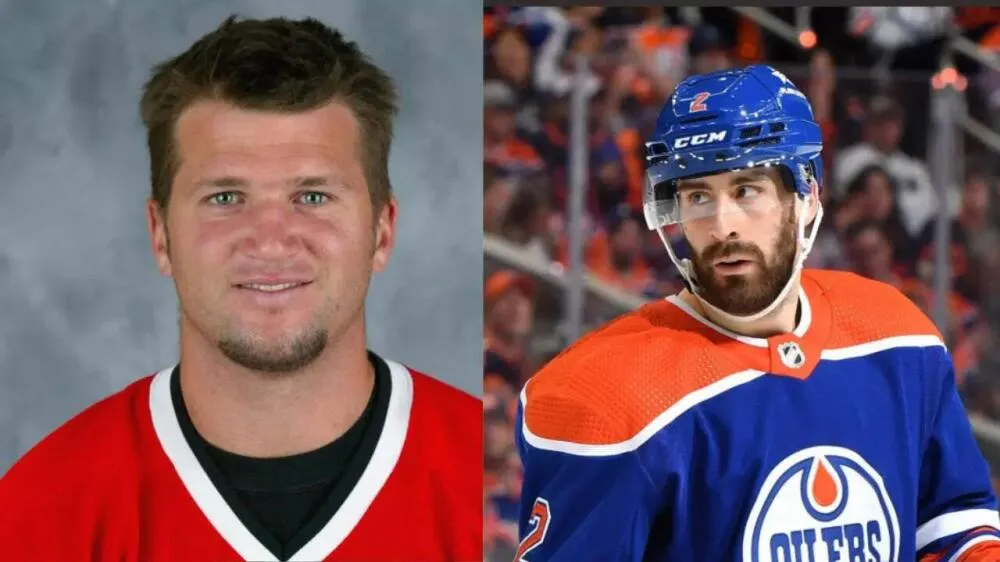
Understanding the Evan Bouchard omission from Team Canada 2026 Olympic roster
The latest roster projections from NHL.com make it official: Evan Bouchard is no longer among the eight defensemen expected to wear the Maple Leaf in February. This represents a stunning reversal from earlier predictions, when both TSN and NHL.com had confidently included Bouchard in their projected lineups. The shift occurred over just three weeks of regular season play, highlighting how dramatically his performance has deteriorated.
NHL.com’s Mike Zeisberger acknowledged the controversy surrounding Bouchard’s exclusion, writing, “the most debatable omission here could be Evan Bouchard of the Oilers and his signature Bouch Bomb slap shot from the point. Truth be told, he had a rough start to the season, when defensive deficiencies were magnified.” This measured assessment captures the complexity of the situation: Bouchard possesses elite offensive skills that few Canadian defensemen can match, yet his defensive lapses have become impossible to ignore.
The timing of Bouchard’s struggles couldn’t be worse. With the roster announcement expected around January 1, he has limited opportunities to change the narrative. The 2026 Winter Games mark the first Olympic tournament featuring NHL players since 2014, adding extra pressure to selection decisions. Every shift, every game, and every mistake is now being scrutinized through the lens of Olympic worthiness.
Bouchard’s absence from Canada’s 4 Nations Face-Off roster earlier in 2025 already raised questions about his standing with Hockey Canada management. That tournament, which Canada ultimately won, featured eight defensemen who have now become the core group expected to represent the nation in Italy. Breaking into that established unit would have been challenging under normal circumstances; doing so while playing poorly makes it nearly impossible.
Defensive breakdowns define the Evan Bouchard omission from Team Canada 2026 Olympic roster
The defensive catastrophes that have defined Bouchard’s early season play go far beyond ordinary mistakes. In one particularly egregious sequence against the New York Islanders, Bouchard committed three goal-costing errors in a single game. First, as the last man back while carrying the puck up ice, he attempted an ill-advised dangle at centre ice only to be stripped by a forechecking forward who converted the subsequent breakaway. Later in the same game, he abandoned his defensive assignment during an Edmonton power play, allowing a shorthanded breakaway that resulted in another goal against Stuart Skinner.
The third gaffe proved equally costly. With the Oilers pressing for a tying goal and Skinner pulled for an extra attacker, Bouchard lost his check, enabling the opposition to clear the puck and score into the empty net. These weren’t split-second mistakes or unfortunate bounces—they were fundamental breakdowns in positional awareness and decision-making that reflected poorly on a player hoping to compete at the Olympic level.
Defensive deficiencies have long been part of Bouchard’s scouting report, but previous seasons saw him compensate for these weaknesses with overwhelming offensive production. His ability to quarterback the power play, unleash his famous “Bouch Bomb” slap shot from the point, and generate offense at even strength made him virtually untouchable despite occasional defensive lapses. The current situation differs because his offensive game has simultaneously evaporated, leaving only the defensive warts visible.
The pattern of mistakes extends beyond individual games. Bouchard’s minus-9 rating through the first 10 games of the season represented one of the worst marks among NHL defensemen. While plus/minus statistics can be misleading in small samples, the eye test confirmed what the numbers suggested: Bouchard was consistently on the ice for opposition goals, often as a direct result of his errors. For Hockey Canada evaluators watching closely, these repeated breakdowns raised serious doubts about his ability to perform under the intense pressure of Olympic competition.
Analytics paint an equally troubling picture. According to advanced metrics available through The Hockey Writers, Bouchard’s defensive zone coverage has been among the league’s worst early in the season. His tendency to chase the play rather than maintain proper positioning creates odd-man rushes against the Oilers. In a best-on-best tournament like the Olympics, where opponents possess elite offensive talent, such defensive inadequacies would be ruthlessly exploited.
Offensive struggles compound the Evan Bouchard omission from Team Canada 2026 Olympic roster
During the 2023-24 and 2024-25 seasons, Bouchard established himself as one of the NHL’s premier offensive defensemen, averaging 0.91 points per game in regular season play and an astounding 1.17 points per game in the playoffs. These numbers placed him among the league’s elite in terms of production from the blue line. His power play prowess, in particular, made him invaluable to the Oilers’ offensive attack and seemingly indispensable to any Canadian team seeking goal-scoring depth.
The first three weeks of the 2025-26 season told a starkly different story. Bouchard opened the campaign completely pointless through six consecutive games, a drought that coincided with the Oilers’ sluggish start. Over his first 10 games, he managed just four points while posting that dreadful minus-9 rating. For a player whose offensive contributions had previously justified his roster spot despite defensive shortcomings, this production collapse proved devastating to his Olympic prospects.
A three-assist performance against Utah on October 28 offered a glimmer of hope, extending Bouchard’s point streak to five games. However, that breakout game represented his first multi-point performance of the season, and the competition level against expansion Utah hardly compares to what he’ll face from Olympic-caliber opponents. One strong game against a struggling team cannot erase weeks of poor play or rebuild the confidence that Hockey Canada management has lost.
The power play, traditionally Bouchard’s greatest strength, has also been inconsistent. His signature slap shot from the point—the “Bouch Bomb” that strikes fear into opposing penalty killers—has generated fewer dangerous scoring chances than in previous seasons. Whether this stems from predictability, mechanical issues, or simple bad luck remains unclear. What is clear is that Bouchard’s offensive weapons have not been firing with their usual consistency, removing his primary justification for roster inclusion.
Competition intensifies around the Evan Bouchard omission from Team Canada 2026 Olympic roster
The eight defensemen currently projected for Team Canada’s Olympic roster create a formidable group that will be difficult to crack. Cale Makar and Devon Toews form Colorado’s dynamic duo, combining elite skating, offensive creativity, and responsible defensive play. Josh Morrissey and Colton Parayko constitute Winnipeg’s shutdown pairing, having demonstrated tremendous chemistry during the 4 Nations Face-Off. These four players occupy spots that seem virtually untouchable barring injury.
Drew Doughty brings veteran leadership and two Stanley Cup championships to the roster, while Shea Theodore adds speed and transition ability from Las Vegas. Travis Sanheim’s strong two-way play for Philadelphia has earned recognition, and Dallas Stars defenseman Thomas Harley has emerged as one of the season’s most impressive breakout performers. Harley, in particular, represents the type of player whose strong start directly impacts Bouchard’s candidacy—every defenseman who elevates their game pushes Bouchard further down the depth chart.
The decision to stick with the 4 Nations Face-Off defensive core reflects Hockey Canada’s “if it ain’t broke, don’t fix it” philosophy. That tournament’s championship validated the defensive group’s chemistry and effectiveness. Breaking up winning combinations requires compelling justification, which Bouchard’s current play fails to provide. Even if his offensive ceiling exceeds that of players like Sanheim or Harley, his defensive floor has proven too low to risk at the Olympic level.
Beyond those eight projected players, Bouchard faces competition from other omitted candidates. Noah Dobson of the New York Islanders, Mackenzie Weegar of the Calgary Flames, and even Alex Pietrangelo if his hip injury heals in time all possess credentials comparable to Bouchard’s. The depth of Canadian defensive talent means that even a return to normal production levels might not guarantee Bouchard a roster spot—he may need to be truly exceptional over the coming weeks to force his way back into consideration.
The path forward for addressing the Evan Bouchard omission from Team Canada 2026 Olympic roster
Bouchard’s window for redemption remains open, but it’s closing rapidly. The Oilers face 13 games over the next 24 days, beginning with a home matchup against the New York Rangers. This stretch represents perhaps his final opportunity to showcase the elite play that made him an Olympic prospect in the first place. Every game now carries Olympic implications, with Hockey Canada management undoubtedly monitoring his performance closely.
What must Bouchard do to reclaim his Olympic aspirations? First and foremost, he needs to shore up his defensive game. The egregious mistakes must stop immediately—no more ill-advised rushes, no more blown coverages, no more mental lapses that lead directly to goals against. While he may never become a Selke Trophy candidate, demonstrating basic positional soundness and decision-making would go a long way toward rebuilding confidence in his overall game.
Offensively, Bouchard must rediscover the production that defined his previous two seasons. The power play needs to become a weapon again, with his point shot generating consistent quality chances. At even strength, his ability to transition the puck and join the rush must create offensive zone time and scoring opportunities. A return to his 0.91 points-per-game pace would remind evaluators of his unique offensive skill set that few Canadian defensemen can match.
Perhaps most importantly, Bouchard needs sustained excellence rather than isolated strong performances. A single three-point game against a weak opponent won’t suffice—he requires several weeks of consistently strong two-way play to overcome the damage done during his disastrous start. The margin for error has evaporated; every remaining game between now and roster announcement day matters immensely.
The competition with players like Thomas Harley adds urgency to Bouchard’s situation. Harley’s impressive start demonstrates that roster spots are fungible, earned through current performance rather than past accomplishments or perceived potential. If Bouchard continues struggling while competitors like Harley maintain their high level of play, Hockey Canada will have no choice but to reward current form over previous reputation.
The Evan Bouchard omission from Team Canada’s projected 2026 Olympic roster serves as a cautionary tale about the unforgiving nature of elite hockey evaluation. Three weeks of poor play have erased months of positive projections, placing his Olympic dreams in serious jeopardy. While the door hasn’t completely closed, it’s narrowing rapidly as competition intensifies and time runs short. Bouchard’s response to this adversity will define not only his Olympic prospects but also his legacy as a player who either rose to meet the moment or buckled under the pressure of heightened expectations. For Oilers fans and Canadian hockey observers alike, the coming weeks promise high-stakes drama as Bouchard battles to reclaim his place among the nation’s defensive elite.

Par Mike Jonderson
Mike Jonderson is a passionate hockey analyst and expert in advanced NHL statistics. A former college player and mathematics graduate, he combines his understanding of the game with technical expertise to develop innovative predictive models and contribute to the evolution of modern hockey analytics.