












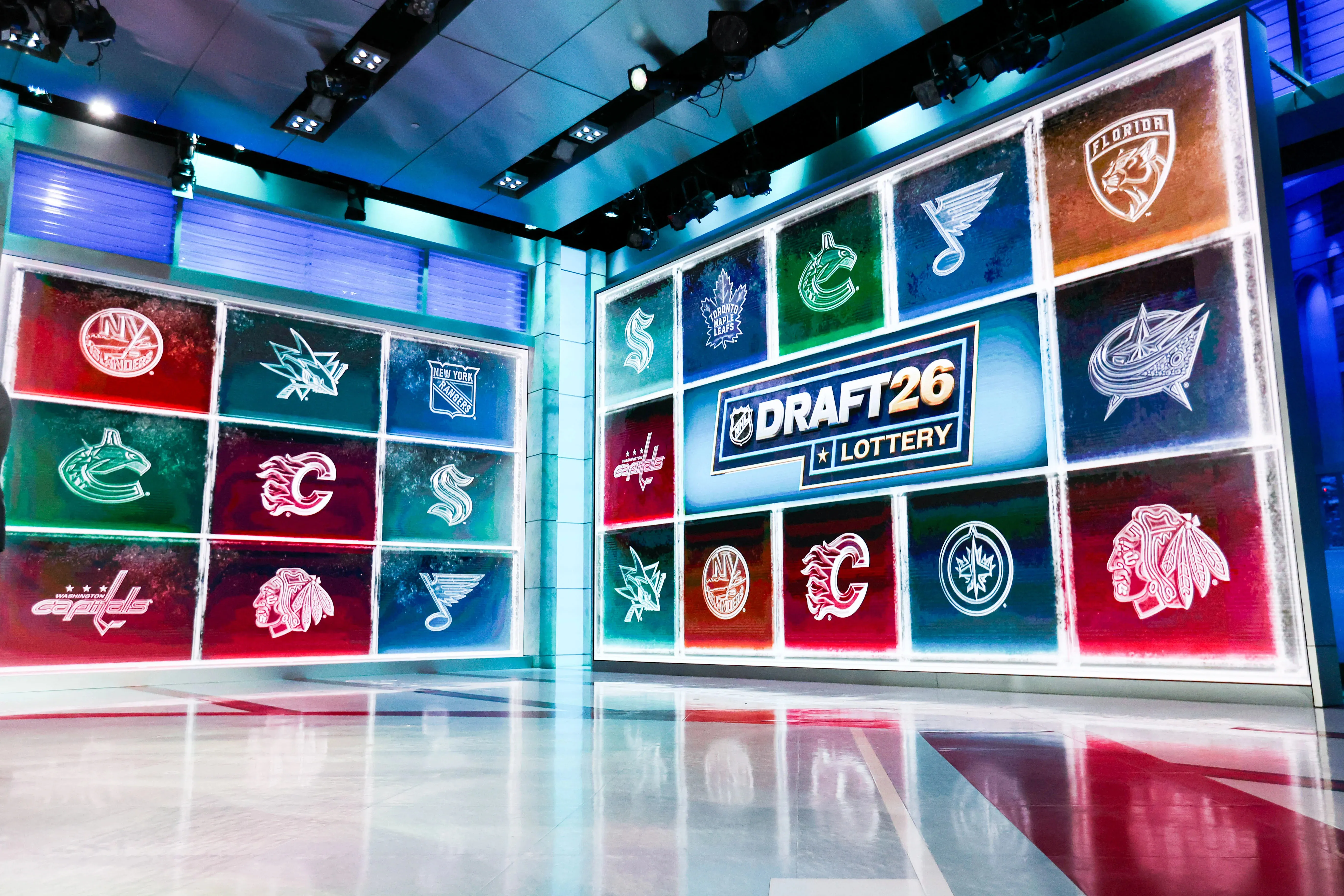
The 2026 NHL draft, set for June 26 and 27, will give the Toronto Maple Leafs a clearer picture of their top six forwards. Expect a lineup featuring either Gavin McKenna or Braeden Stenberg alongside Auston Matthews, William Nylander, Matthew Knies, John Tavares, and Easton Cowan. With that foundation in place, GM John Chayka’s focus shifts to bolstering the blue line with a puck-moving defenseman and securing a third-line center.[1][2]
This center needs to handle tough matchups, allowing stars like Matthews and Tavares to chase offense. Options range from battle-tested veterans to young talents who could grow into bigger roles as Tavares nears the end of his prime. Toronto’s strategy emphasizes youth and competitiveness, targeting players undervalued on their current teams.
Shane Wright from the Seattle Kraken
Shane Wright represents the perfect blend of youth and upside for the Maple Leafs. The former top prospect had a disappointing 2025-26 season after a strong rookie year with nearly 20 goals and 45 points. Under coach Lane Lambert, Wright saw limited ice time at 13:48 per game, often relegated behind Chandler Stephenson and Matty Beniers.[1]
Seattle’s prospect pipeline, including Berkly Catton, Jake O’Brien, Oscar Fisker Molgaard, and Julius Miettinen, crowds the center position. Wright could become the odd man out, especially with ongoing trade rumors. Reports indicate the Kraken are open to deals, potentially packaging him for a top-six forward.[3][4]
Wright dismissed the speculation coolly: “I don’t really care too much about that… I’m focused on the team here and winning hockey games.”[1] His two-way game and defensive reliability make him ideal for Toronto’s third line initially, with potential to slide up as he develops.
In Toronto, Wright could thrive with better deployment, starting in shutdown roles before transitioning to the second line. His value is at a low, allowing the Leafs to strike while Seattle rebuilds.
- Pros: Young (22), high ceiling, defensive floor, low trade cost.
- Cons: Recent production dip, needs consistent opportunity.
- Fit: Third-line starter evolving into Tavares successor.
Charlie Coyle from the Columbus Blue Jackets
Charlie Coyle has been a model of consistency as one of the NHL’s top two-way centers. At 34, he posted strong numbers in 2025-26, including 20 goals and around 40-50 points, excelling defensively and on special teams. Columbus views him as irreplaceable, urging a re-signing amid a thin free-agent center market.[2]
Since Ryan O’Reilly left Toronto in 2023, the Leafs have sought a matchup center for top lines. Coyle fits perfectly, with his penalty-kill prowess and timely scoring. Recent reports confirm Columbus locked him up with a six-year, $36 million extension ($6M AAV) through 2031-32, complicating any pursuit.[5]
Despite the deal, Coyle’s value to Toronto remains high for immediate impact. His reliability could stabilize the third line while veterans like Tavares focus on production.
Coyle’s physicality and faceoff wins would address Toronto’s needs in tough minutes. If any trade talks emerge post-extension, the Leafs should listen.
- Pros: Proven 20-50 point producer, elite defense, PK specialist.
- Cons: Age 34, recent long-term commitment to CBJ.
- Fit: Instant third-line anchor against top competition.
Mason McTavish from the Anaheim Ducks
Mason McTavish, the 2021 third-overall pick, mirrors Wright as a high-upside gamble. His 2025-26 season was rough, with just 34 points in 65 games and healthy scratches fueling trade talk. Still, at 23, his 6-foot-1 frame and two-way polish intrigue teams like Toronto.[6]
Anaheim’s rebuild might open doors, despite mixed contract reports including a potential long-term extension. McTavish could start as Toronto’s third center, growing into second-line duties.
His shot and physical edge suit the Leafs’ style. A change of scenery often reignites prospects like him.
- Pros: Elite pedigree, size, offensive tools.
- Cons: Inconsistent NHL translation, recent struggles.
- Fit: Developmental third-liner with star potential.
McTavish’s floor provides shutdown ability even if the ceiling isn’t reached immediately.
Boone Jenner from the Columbus Blue Jackets
Boone Jenner offers veteran grit akin to Coyle but at potentially lower cost. The 32-year-old captain hit 13 goals and 38 points in 67 games last season, down from prior 20-30 goal paces. His physicality and defensive push align with Toronto’s third-line vision.[7]
With his contract nearing UFA status, Columbus faces decisions amid roster changes. Jenner brings timely offense and a mean streak Toronto craves.
He’d excel in limited minutes, providing energy without demanding top billing. Less pricey than Coyle on the market.
- Pros: Leadership, physicality, faceoff strength.
- Cons: Recent production dip, age 32.
- Fit: Reliable shutdown pivot with edge.
Jenner’s Columbus ties run deep, but a Cup contender like Toronto could appeal.
Barrett Hayton from the Utah Mammoth
Barrett Hayton is the ultimate wild card at 25. Drafted fifth overall in 2018 by Chayka’s old Arizona regime, he flashed with 20 goals and 46 points previously but slumped to 10 goals and 25 points in 67 games. An upper-body injury limited him to one playoff game with minimal ice time.[8]
Neither fully young nor veteran, Hayton lacks elite defense but boasts a strong shot and playmaking. Utah’s depth questions his role.
High risk, as his value ties to offense without a safety net. Toronto could gamble on familiarity with Chayka.
- Pros: Chayka connection, scoring tools.
- Cons: Inconsistent, injury-prone, no defensive anchor.
- Fit: Boom-or-bust second/third-line option.
Hayton’s NHL struggles make him a pure upside play.
The Maple Leafs hold intriguing paths forward post-draft. Young bets like Wright and McTavish offer long-term growth, while veterans like Jenner provide stability. With cap space and Chayka’s vision, targeting undervalued centers could elevate Toronto’s contention window. Watch Seattle and Columbus closely as rumors heat up.[3]
Frequently Asked Questions

Par Mike Jonderson
Mike Jonderson is a passionate hockey analyst and expert in advanced NHL statistics. A former college player and mathematics graduate, he combines his understanding of the game with technical expertise to develop innovative predictive models and contribute to the evolution of modern hockey analytics.