













The Florida Panthers five-game road trip struggles during the 2025-26 season have exposed vulnerabilities that few expected from the defending Stanley Cup champions. After opening the campaign with three consecutive victories at home, the Panthers embarked on their first extended journey away from Amerant Bank Arena and returned with just one win in five contests. This disastrous stretch has raised serious questions about whether the team can sustain their championship pedigree as they pursue an unprecedented third consecutive Stanley Cup title.
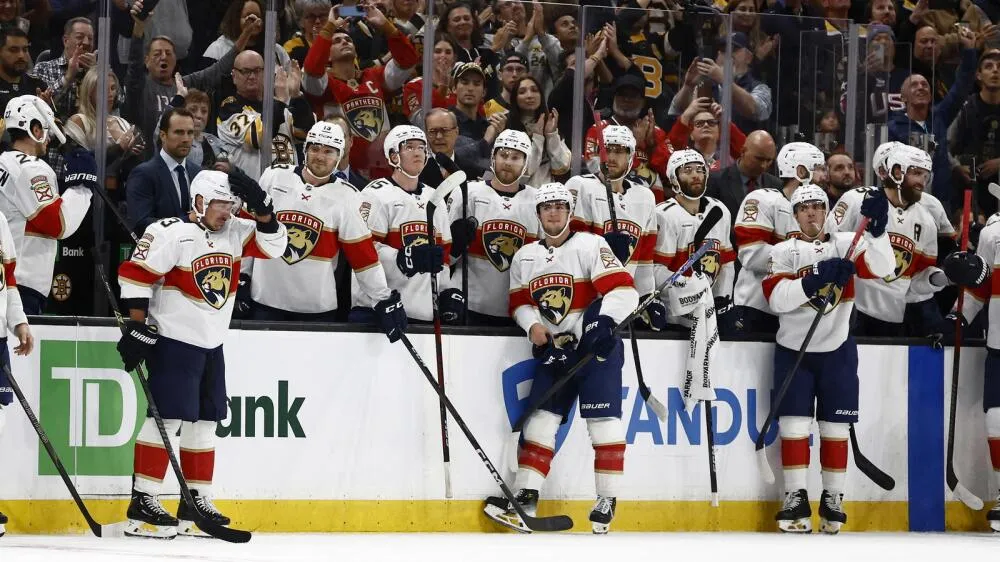
The road trip resulted in a 1-4-0 record, with defeats to Philadelphia, Detroit, New Jersey, and Buffalo before finally salvaging a victory against Boston in the final game. For a franchise that has dominated the league over the past three seasons, this extended slump represents more than just a rough patch—it signals potential systemic issues that could derail their historic championship quest if not addressed immediately.
Offensive drought defines the Florida Panthers five-game road trip struggles 2025-26 season
The most glaring issue during the Panthers’ disastrous road swing was an uncharacteristic inability to generate consistent offense. Florida managed just seven goals across the five-game stretch, averaging a meager 1.4 goals per game. For a team loaded with offensive weapons including Sam Reinhart, Carter Verhaeghe, and Brad Marchand, this production level is simply unacceptable.
Against the Buffalo Sabres, the Panthers were completely shut out in a 3-0 defeat. Against both the New Jersey Devils and Detroit Red Wings, Florida could only muster single goals in each contest. This offensive anemia has dropped the Panthers to third-last in the NHL in goals per game with just 2.38, a stunning statistic for a team that averaged over three goals per contest during their championship runs.
The struggles extend beyond just 5-on-5 play. According to Natural Stat Trick’s analysis, the Panthers held the advantage in expected goals percentage in only two of the five games and controlled high-danger scoring chances in just two contests. These advanced metrics reveal that Florida wasn’t simply suffering from bad luck—they were being comprehensively outplayed in the offensive zone.
Several key contributors have gone silent during this stretch. Sam Reinhart and Carter Verhaeghe, both capable of 30-goal seasons, managed just two goals and three points each during the road trip. Sam Bennett has been even quieter, notching only one goal and one assist. When your top-six forwards aren’t producing, winning hockey games becomes nearly impossible, regardless of how well your defense performs.
The power play has been equally impotent, converting on just two of 22 opportunities during the road trip. At 20.6% overall, the Panthers’ power play sits at a middling 15th in the league rankings. Against teams like Philadelphia, Buffalo, and Detroit—squads not expected to contend for playoff positions—the inability to capitalize on man-advantage situations proved particularly costly.
Perhaps most concerning is the lack of offensive contributions from the blue line. The Panthers have recorded just one goal from their defensemen all season, which came off Aaron Ekblad’s stick. In today’s NHL, where offensive defensemen can provide crucial secondary scoring, this drought from the back end places even more pressure on the forward group to generate offense.
Defensive breakdowns compound the Florida Panthers five-game road trip struggles 2025-26 season
While offense has been the primary concern, Florida’s defensive play has also deteriorated significantly compared to their championship standards. Over the five-game road trip, the Panthers were outscored 18-8 and outshot 142-124, alarming statistics for a team that has built its identity on defensive structure and goaltending excellence.
Every defenseman except Niko Mikkola finished the road trip with a minus rating, indicating that defensive breakdowns were a team-wide issue rather than isolated mistakes. The Panthers have allowed opponents far too many high-quality scoring chances, putting their goaltenders in difficult positions night after night. This represents a stark departure from the suffocating defensive system that carried them through two consecutive Cup runs.
The defensive struggles become even more pronounced when examining special teams play. Florida’s penalty kill, which should be a strength given their defensive personnel, has surrendered five power-play goals during the five-game stretch. That’s an average of one power-play goal against per game, contributing directly to four of their five losses. With a penalty kill percentage of 82.8%, ranking just 12th in the NHL, the Panthers are bleeding goals in situations where they should be gaining momentum.
The team’s lack of discipline has exacerbated these defensive issues. During the road trip, Florida gave opponents 22 power-play opportunities while accumulating 28 penalties and 59 penalty minutes. This undisciplined play forces the penalty kill onto the ice far too frequently, tiring out key defensive players and creating opportunities for opposing power plays to capitalize. Veterans on this roster should know better than to take unnecessary penalties, particularly during a challenging road stretch.
Zone coverage has become problematic, with forwards failing to support defensemen in the defensive zone and leaving gaps for opponents to exploit. The Panthers’ typically reliable system of cycling back and providing layers of defense has broken down, resulting in odd-man rushes and breakaway opportunities that were rare during their championship seasons. This systematic breakdown suggests coaching adjustments may be necessary to restore Florida’s defensive identity.
Goaltending has been adequate but not spectacular during this stretch. While the netminders haven’t stolen games, they also haven’t been the primary cause of losses. The real issue lies in front of them, where defensive zone coverage has become too porous and allowed far too many dangerous scoring opportunities.
Injury crisis fuels the Florida Panthers five-game road trip struggles 2025-26 season
A critical factor contributing to Florida’s struggles is the mounting injury list that has decimated their roster depth. The Panthers are far from playing at full strength, with multiple key contributors sidelined for extended periods. This attrition has exposed depth issues that championship teams typically need to overcome but can prove devastating when multiple injuries occur simultaneously.
Matthew Tkachuk, one of Florida’s most important players and emotional leaders, has missed significant time during this stretch. His absence removes not only offensive production but also the physical presence and agitation that makes the Panthers so difficult to play against. Tkachuk’s ability to draw penalties and create space for teammates is irreplaceable, and his absence has been felt throughout the lineup.
Aleksander Barkov, the Panthers’ captain and arguably their most complete player, has also been out of the lineup. Barkov’s two-way excellence anchors Florida’s defensive structure while providing offensive creativity and faceoff dominance. Without him, the Panthers lack a true number-one center, forcing depth players into roles they're not equipped to handle consistently at the NHL level.
Perhaps most devastating is the injury to Dmitry Kulikov, who suffered a torn labrum that required surgery. Kulikov won’t return for approximately five months, leaving a significant void on the blue line. His steady defensive presence and ability to eat minutes against top competition cannot be easily replaced, forcing other defensemen to play in more challenging situations than ideal.
Tomas Nosek, while not a star player, provides crucial depth and penalty-killing ability. His absence further strains the team’s already struggling special teams units. These cumulative injuries have forced Florida to rely heavily on players who would typically occupy bottom-six or bottom-pairing roles in more prominent positions throughout the lineup.
The injury crisis reflects the toll that deep playoff runs take on a roster. The Panthers have played an enormous amount of hockey over the past three seasons, including two full Stanley Cup Final series. The physical and mental fatigue from that sustained excellence is now manifesting in soft tissue injuries and overall wear and tear. Managing this reality will be crucial to Florida’s ability to contend for another championship.
Special teams failures define the Florida Panthers five-game road trip struggles 2025-26 season
Special teams performance often determines the outcome of closely contested NHL games, and the Panthers’ failures in this area directly contributed to their 1-4-0 road record. Both the power play and penalty kill have operated well below championship standards, costing Florida crucial points in games they should have won against inferior opponents.
The power play’s 2-for-22 performance during the road trip represents a catastrophic failure to capitalize on opportunities. Against teams like Buffalo and Detroit, which don’t possess elite penalty-killing units, Florida’s inability to score with the man advantage is simply inexcusable. The power play appears predictable and lacking in movement, allowing penalty killers to easily identify passing lanes and shooting locations.
Personnel deployment on the power play has also been questionable. Without consistent production from the top unit, the coaching staff needs to consider mixing lines and trying different combinations. Brad Marchand and Anton Lundell have been the most productive forwards, yet the power play structure doesn’t maximize their talents. Creative adjustments are necessary to jumpstart this critical aspect of the game.
The penalty kill’s struggles stem from both poor discipline leading to too many opportunities against and ineffective execution when shorthanded. Surrendering five power-play goals in five games puts tremendous pressure on the offense to overcome these deficits. In low-scoring games, allowing a power-play goal often proves to be the difference between winning and losing.
Shot blocking and aggressive penalty killing, hallmarks of Florida’s championship teams, have been absent during this road trip. The Panthers appear passive while shorthanded, allowing opposing power plays to establish clean zone entries and set up in the offensive zone without significant pressure. This conservative approach invites shots and chances rather than disrupting the flow of opposing power plays.
Faceoffs during special teams situations have also been problematic. Without Barkov winning crucial draws, Florida struggles to gain possession and clear the puck while shorthanded. On the power play, losing faceoffs means spending valuable seconds of the man advantage retrieving the puck rather than attacking. These seemingly small details accumulate into significant disadvantages over the course of a game.
The coaching staff must address these special teams deficiencies immediately. Adjustments to systems, personnel, and strategy are essential to prevent this weakness from undermining the entire season. Championship teams typically rank in the top ten in both power play and penalty kill—Florida currently falls short in both categories.
Road ahead requires immediate corrections for Florida Panthers five-game road trip struggles 2025-26 season recovery
The Panthers returned home following their disastrous road trip to face the Pittsburgh Penguins, presenting an opportunity to reset and rebuild confidence. Home ice provides comfort and familiarity, but Florida must demonstrate that they’ve learned from their road failures and made necessary adjustments. Simply returning to friendly confines won’t automatically solve the systemic issues exposed during this five-game stretch.
Upcoming opponents include challenging tests against the Vegas Golden Knights and Dallas Stars, teams with legitimate Stanley Cup aspirations. These games will reveal whether Florida’s struggles were merely a rough patch or indicative of deeper problems. The Panthers cannot afford to continue their pattern of poor offensive production and defensive breakdowns against elite competition.
The return of injured players will be crucial to Florida’s recovery. When Tkachuk and Barkov return to the lineup, they'll provide the offensive firepower and defensive responsibility that has been sorely missed. However, the team cannot rely solely on injury returns to solve their problems. The players currently in the lineup must elevate their performance regardless of who’s available.
Young players and depth contributors need to step up during this challenging period. This is when role players earn their contracts by providing consistent effort and occasional offensive contributions. The Panthers have demonstrated depth in previous seasons—now is the time for those depth players to prove they can carry the load when stars are unavailable.
Coaching adjustments will also be necessary. Paul Maurice and his staff must evaluate systems and strategies that aren’t working and implement changes. Whether that means altering line combinations, defensive pairings, or special teams units, the coaching staff cannot remain static when results demand evolution. Maurice’s experience and championship pedigree should provide the wisdom needed to guide Florida through this adversity.
The psychological aspect cannot be overlooked. Championship teams face adversity throughout the season, and how they respond defines their character. The Panthers have overcome obstacles before, including last season’s challenges and the previous year’s playoff battles. This veteran group knows what it takes to succeed at the highest level—they must rediscover that championship mentality and apply it consistently.
The Florida Panthers five-game road trip struggles during the 2025-26 season represent a significant setback for a team pursuing unprecedented championship glory. With a 1-4-0 record featuring anemic offensive production, defensive breakdowns, special teams failures, and mounting injuries, the Panthers face legitimate questions about their ability to three-peat. However, championship pedigree and veteran leadership provide reasons for optimism that this team can correct course.
The path forward requires immediate action on multiple fronts. Offensive consistency must return, particularly from star players like Reinhart, Verhaeghe, and Bennett. Defensive structure needs restoration to championship standards, with improved discipline and fewer penalties. Special teams must become a strength rather than a liability. As injured players return and the team settles into a rhythm at home, the Panthers have the talent and experience to overcome this early-season adversity and reclaim their position among the NHL’s elite contenders.

Par Mike Jonderson
Mike Jonderson is a passionate hockey analyst and expert in advanced NHL statistics. A former college player and mathematics graduate, he combines his understanding of the game with technical expertise to develop innovative predictive models and contribute to the evolution of modern hockey analytics.