







The Florida Panthers received encouraging news this week as star forward Matthew Tkachuk returned to the ice for the first time since his August surgery. However, the organization remains cautious about establishing a definitive timeline for his season debut. After undergoing procedures to repair a sports hernia and torn adductor muscle, Tkachuk’s recovery has entered a critical phase that could determine the Panthers’ fortunes in their quest for a third consecutive Stanley Cup championship.
While the sight of Tkachuk in skates energizes a team depleted by injuries, head coach Paul Maurice emphasized that significant hurdles remain before the All-Star winger can rejoin game action. The Panthers have navigated the first quarter of the season without their emotional leader, relying on depth and defensive structure to stay competitive in the Atlantic Division. Tkachuk’s eventual return promises to transform Florida’s offensive identity, but the medical staff insists on a methodical approach rather than rushing their $76 million investment back into the lineup.
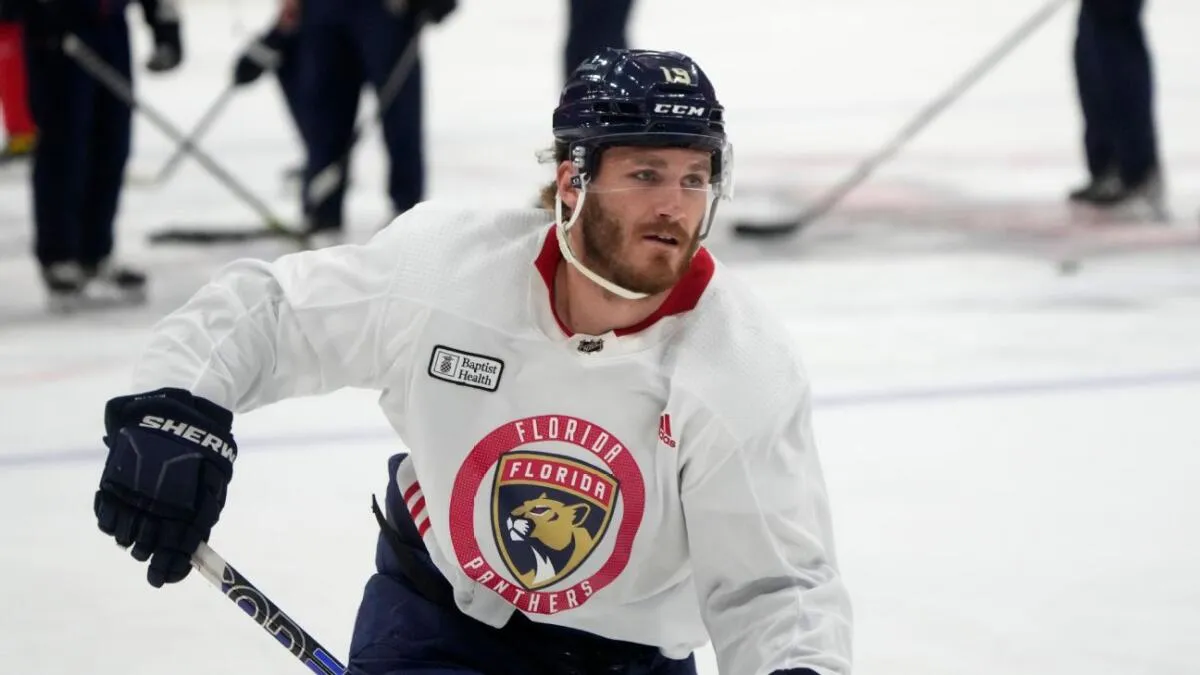
The injury timeline and surgery details
Matthew Tkachuk’s path to surgery began during the Panthers’ second consecutive Stanley Cup run last spring. The forward played through excruciating pain caused by a sports hernia and torn adductor muscle, injuries that would eventually require surgical intervention. Despite missing the final 25 games of the regular season, Tkachuk demonstrated remarkable resilience by accumulating 23 points (8 goals and 15 assists) across 23 playoff games, including a dominant seven-point performance in the Stanley Cup Final against Edmonton.
The offseason presented a difficult decision for Tkachuk and the Panthers’ medical team. Initial rehabilitation efforts during the summer months focused on avoiding surgery altogether. Tkachuk spent the first few weeks of his offseason attempting conservative treatment methods, hoping rest and therapy might resolve the issues without going under the knife. However, after his wedding and honeymoon in France, medical evaluations confirmed that surgery was inevitable. The procedure took place on August 22, immediately following his return from Europe, setting up a recovery timeline that would force him to miss the beginning of the 2025-26 season.
The dual nature of his injuries—a sports hernia combined with a torn adductor—complicated the recovery process. Sports hernias, which involve tears in the lower abdominal or groin muscles, typically require 6-12 weeks of recovery for professional athletes. When accompanied by an adductor muscle tear, the timeline extends further, particularly for a player whose game relies heavily on physicality, quick acceleration, and battles along the boards.
Return to skating and current status
On November 26, Tkachuk shared momentous news during his “Wingmen” podcast, which he co-hosts with his brother Brady Tkachuk of the Ottawa Senators. He revealed that he had completed two skating sessions the previous week, marking his first meaningful time on ice since Game 6 of the Stanley Cup Final. “The first time I’ve put on my skates, like legit, since Game 6,” Tkachuk told listeners, emphasizing the psychological milestone this represented in his recovery journey.
Panthers coach Paul Maurice confirmed the progress while managing expectations. “He’s still quite a way away, but he’s back on the ice and he wasn’t two weeks ago,” Maurice explained to reporters. “So we’re taking it.” The coach’s measured response reflects the organization’s commitment to long-term health over short-term gains. Skating represents just one component of a complex rehabilitation process that must address strength, conditioning, and the ability to withstand NHL-level contact.
Tkachuk himself struck an optimistic yet realistic tone when discussing his return. “I’m just excited to get out with the boys,” he said. “I don’t know when that’s going to be, but it’s obviously kind of getting over that hump and sooner rather than later. It’s starting to trend really, really well.” The forward acknowledged that while the skating sessions felt positive, numerous benchmarks remain before he can participate in full-contact practices or game situations.
Medical benchmarks and recovery process
The Panthers’ medical staff has established a comprehensive checklist of milestones Tkachuk must achieve before receiving clearance for game action. These benchmarks extend beyond simply skating without pain. The rehabilitation protocol includes progressive strength testing of the repaired adductor muscle, agility drills that simulate game conditions, and eventually contact drills that replicate the physical stress of NHL competition.
According to team sources, the recovery follows a month-to-month progression rather than a week-to-week timeline. This approach acknowledges the unpredictable nature of soft tissue healing and the high demands placed on a player who logged over 22 minutes per game during last year’s playoff run. The medical team monitors factors such as hip flexion strength, groin stability, and the absence of compensatory movements that could lead to secondary injuries.
Tkachuk’s injury history complicates the evaluation process. Having played through significant pain during the playoffs, the medical staff must ensure that his body has fully healed rather than simply adapted to discomfort. The surgical repair addressed the structural damage, but rebuilding the neuromuscular patterns and confidence in his movements represents a separate challenge. Each benchmark builds upon the previous one, creating a foundation for sustainable performance rather than a temporary return.
Panthers’ injury crisis extends beyond Tkachuk
The Florida Panthers face a broader injury crisis that has tested their organizational depth and resilience. Captain Aleksander Barkov’s torn ACL, suffered during his first training camp practice, created a massive void in Florida’s top-six forward group. The absence of both Tkachuk and Barkov simultaneously deprives the Panthers of their two most impactful offensive players and emotional leaders, a challenge no championship contender expects to navigate for an extended period.
Beyond the star forwards, the Panthers have sustained injuries throughout their lineup, forcing young players and depth acquisitions into larger roles. This adversity has revealed the organization’s strong developmental pipeline but has also exposed the razor-thin margin between success and failure in the salary cap era. When $19 million in combined cap hit occupies the injured reserve list, even the deepest rosters struggle to replicate that level of production and leadership.
The team’s ability to remain competitive during this stretch speaks to Paul Maurice’s coaching acumen and the veteran presence of players like Sam Reinhart, Sam Bennett, and defenseman Aaron Ekblad. However, the Panthers’ offensive efficiency has predictably declined, with power play production and high-danger chance generation suffering without Tkachuk’s net-front presence and playmaking ability. The organization has adopted a next-man-up mentality while anxiously awaiting the return of their catalyst.
Team performance without their star forward
Despite the significant absences, the Florida Panthers have managed to keep their playoff positioning relatively stable through the first two months of the season. The defensive structure, anchored by Sergei Bobrovsky’s goaltending and a commitment to limiting high-quality chances, has allowed the team to grind out wins in low-scoring affairs. This approach represents a stark contrast to last year’s high-octane offense but demonstrates the championship pedigree that runs through the roster.
The power play has experienced the most dramatic drop-off without Tkachuk’s net-front screening and elite hand-eye coordination. Last season, Florida converted at a 26.3 percent rate with the man advantage, ranking among the league’s best. Through November, that number has dipped below 20 percent, reflecting the absence of Tkachuk’s 62 power-play points from the previous campaign. Opposition penalty kills have adjusted their schemes, recognizing they no longer must account for Tkachuk’s positioning and tip-in ability.
Even-strength play has also felt the impact. Tkachuk’s 73 even-strength points last season ranked second on the team, and his ability to extend possessions through puck battles along the boards created secondary scoring chances that don’t appear in traditional statistics. The Panthers have struggled to maintain offensive zone pressure, leading to increased defensive zone starts and greater reliance on their goaltending. This imbalance, while manageable against weaker competition, could prove problematic during the tougher stretches of their schedule.
December target remains realistic
The “December-ish” timetable that circulated through training camp continues to serve as the most realistic target for Tkachuk’s return. Two weeks into November, this projection appears both ambitious and achievable, depending on how his body responds to the increased workload of skating and subsequent on-ice activities. The Panthers’ schedule includes several key divisional games in mid-to-late December, making that window particularly enticing for a potential comeback.
Medical experts suggest that returning to game action approximately four months post-surgery represents an aggressive but reasonable timeline for an elite athlete with access to world-class rehabilitation resources. The four-month mark would place Tkachuk’s potential return around mid-December, aligning perfectly with the organization’s internal projections. However, the forward must first complete several weeks of practice and contact drills before receiving medical clearance.
The Panthers’ medical staff faces a delicate balancing act. Rushing Tkachuk back before his adductor muscle can withstand the rigors of NHL play risks re-injury and could jeopardize his availability for the playoff push and potential Olympic participation. Conversely, an overly cautious approach might cost the team valuable points in the tightly contested Atlantic Division race. The month-to-month assessment framework provides flexibility while maintaining rigorous safety standards.
Olympic aspirations and long-term goals
Beyond his commitment to the Panthers, Matthew Tkachuk has expressed strong interest in representing the United States at the Milan-Cortina Olympics in February 2026. His participation in the Winter Games represents a career milestone that requires careful coordination with the Panthers’ medical and coaching staffs. A successful December return would give Tkachuk approximately six weeks to regain his form and prove his fitness to USA Hockey’s selection committee.
The Olympic timeline creates an additional incentive for Tkachuk to adhere strictly to his rehabilitation protocol. Rushing his recovery could not only jeopardize the Panthers’ season but also his Olympic dream. Conversely, a methodical approach that ensures full health by early February positions him as a key contributor for Team USA. The forward’s playoff pedigree and physical playing style make him an ideal candidate for international competition on the larger ice surface.
Panthers management must weigh the risks and rewards of Olympic participation. While the organization supports players representing their countries, the additional games and travel create further injury risk during a compressed NHL season. The team’s stance likely depends on Tkachuk’s health and the Panthers’ position in the standings by January. A playoff berth secured early might allow more flexibility, whereas a tight race could create tension between individual and team priorities.
What his return means for Panthers’ championship hopes
When Matthew Tkachuk ultimately returns to the Florida Panthers lineup, the impact will extend far beyond his individual statistics. His presence transforms the team’s identity, injecting a combination of skill, physicality, and emotional intensity that few players in the NHL can replicate. Tkachuk’s ability to elevate his game in crucial moments—evidenced by his playoff performances—gives the Panthers a dimension they currently lack in high-leverage situations.
The timing of his return could prove particularly fortuitous if it coincides with Aleksander Barkov’s recovery from ACL surgery. Barkov’s timeline suggests a potential mid-to-late season return, creating the possibility that Florida’s two superstars could re-enter the lineup within weeks of each other. Such a scenario would give the Panthers their full complement of elite talent for the final stretch run and playoff preparation, essentially turning the calendar to March with a fresh roster that has championship experience.
Tkachuk’s own ambitions reflect this championship mindset. “I’ve just got to get the jets on and start feeling good, and I think I’ll be hopefully picking up where I left off, if not hopefully better,” he stated on his podcast. “That’s the ideal plan.” This statement encapsulates the forward’s confidence and his understanding that regular season games represent merely a tune-up for the real season in April, May, and June.
The Florida Panthers have built their organization around a core group that has captured two consecutive Stanley Cups. Matthew Tkachuk’s journey from August surgery to November skating represents the latest chapter in a story defined by resilience and championship determination. While his exact return date remains uncertain, the progression from “a ways away” to skating regularly suggests that the “December-ish” timeline remains realistic and achievable. His eventual return will not simply add a star player to the lineup—it will restore the emotional and competitive engine that drives the Panthers’ pursuit of hockey immortality.
As Florida continues to navigate their injury challenges, the organization can take solace in knowing that their most dynamic forward is trending in the right direction. The combination of Tkachuk’s work ethic, the medical staff’s expertise, and the team’s championship pedigree creates optimism that the Panthers will enter the new year at full strength, poised to defend their title with the player who helped make their recent success possible. For the latest updates on Tkachuk’s recovery, fans can follow the ongoing coverage at NHL Insight, where the Panthers’ medical timeline continues to evolve with each passing week.
Frequently Asked Questions

Par Mike Jonderson
Mike Jonderson is a passionate hockey analyst and expert in advanced NHL statistics. A former college player and mathematics graduate, he combines his understanding of the game with technical expertise to develop innovative predictive models and contribute to the evolution of modern hockey analytics.