


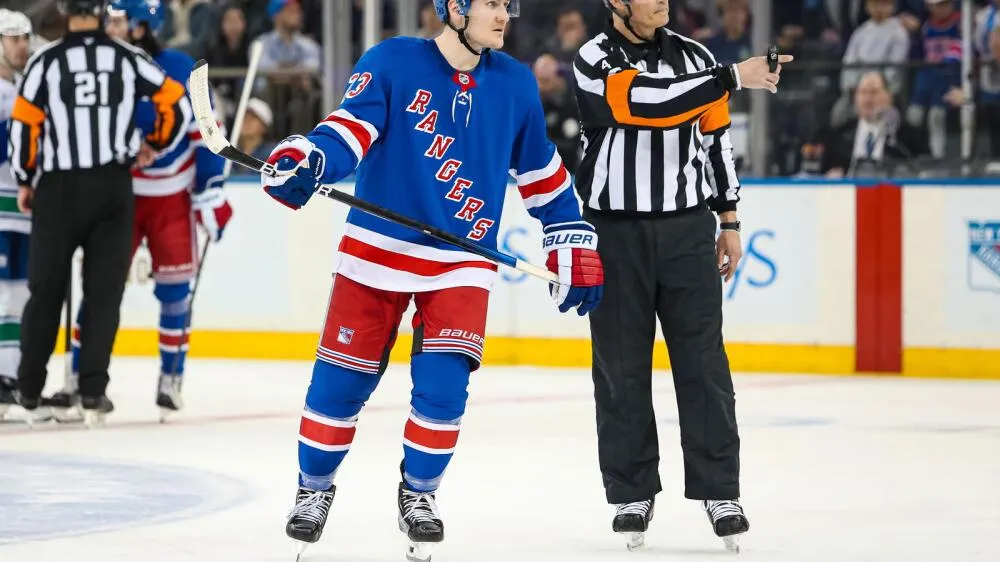
The New York Rangers made one of the most significant moves of their offseason when they signed Vladislav Gavrikov to a seven-year, $49 million contract. The intention was clear: pair him with Adam Fox to finally establish the elite top defense pairing that had eluded the franchise for years. After watching Fox cycle through multiple partners during a defensively turbulent 2024-25 campaign, management recognized that their Norris Trophy-winning defenseman needed a steady, reliable presence on his flank. The early returns on this partnership have shown both promise and growing pains, as the two elite blueliners work to establish the chemistry that could transform the Rangers’ defensive identity.
How the New York Rangers Fox Gavrikov top defense pair evolved through training camp
From the moment training camp opened, it became apparent that head coach Mike Sullivan had a vision for his defensive pairings. Fox and Gavrikov consistently skated together during drills, working on positioning, breakout patterns, and communication. The intentionality behind this pairing wasn’t lost on anyone in the organization, as Sullivan made his priorities clear from the outset.
“How do we find a way to help Fox capture his very best game?” Sullivan asked rhetorically during training camp. “I know we have the conversation, do we have the ideal partner for him? Because if we could find an ideal partner for him, where he could build and develop chemistry, that would suggest that it would set him up for success.” This statement encapsulated the Rangers’ strategic thinking—building around their best defenseman rather than spreading talent across multiple pairings.
Fox himself expressed enthusiasm about the opportunity to play alongside Gavrikov. “He’s an elite defenseman, and I think everyone wants to play with a guy like that,” Fox said. “He’s pretty similar to what I’m used to, playing with someone who is super reliable. You know what you’re getting when he’s out there and he’s a smart player too.” The mutual respect between the two players was evident from day one, even as they acknowledged the need to develop on-ice chemistry.
Gavrikov, for his part, understood the responsibility that came with being paired alongside one of the league’s premier offensive defensemen. “Foxy is a great player, a great play-maker,” Gavrikov noted. “Can do anything with the puck, skating very well as well. If I’m going to be with him, I’ll be happy to have him as a partner. I think we can create some offense on the other side, and play good defense.” His comments reflected an understanding of his role—provide defensive stability while complementing Fox’s playmaking abilities.
The decision to pair the team’s two best defensemen together wasn’t without debate. Some analysts argued that spreading elite talent across multiple pairings creates a more balanced defensive corps, allowing teams to match up effectively against opposing lines. However, Sullivan’s philosophy appeared to favor creating one dominant pairing capable of shutting down opponents’ top threats while driving offensive play. This approach has worked for other championship contenders, and the Rangers were betting it would elevate their defensive game.
Strong defensive foundation masks offensive chemistry challenges for New York Rangers Fox Gavrikov top defense pair
The early-season performance of the Fox-Gavrikov pairing revealed both strengths and areas requiring development. Defensively, the duo has been largely solid, contributing to the Rangers’ improved structural play under Sullivan’s system. The team’s transition from Peter Laviolette’s man-to-man defensive scheme to Sullivan’s zone coverage has suited both defensemen’s skill sets, allowing them to make smarter decisions with less risk.
Gavrikov’s defensive contributions have been immediately noticeable. Through the first 13 games, he accumulated 21 blocked shots, using his 6-foot-3 frame and long reach to disrupt passing and shooting lanes. His positioning has been sound, rarely caught out of place, and he’s been particularly effective on the penalty kill. The Rangers’ penalty kill unit has operated at 84.8 percent efficiency, with Gavrikov playing a central role in that success.
Fox has continued his pattern of excellent two-way play, posting three goals and eight assists through 13 games while handling matchups against opponents’ top forwards. His ability to make clean exits from the defensive zone has initiated countless rushes, and his cross-ice passes in the offensive zone continue to create high-danger scoring chances. The reduced penalty-kill deployment has allowed Fox to conserve energy for even-strength and power-play situations, where his impact is most significant.
However, according to The New York Post, the offensive chemistry between the two has been slower to develop. When asked about his individual performance early in the season, Gavrikov was refreshingly honest, admitting his start had been not great. This self-assessment, while harsh, demonstrated the high standards both players hold themselves to. The work-in-progress nature of their partnership means they’re still learning each other’s tendencies, particularly in transition situations where split-second decisions determine success or failure.
Sullivan acknowledged this reality, describing their chemistry as ongoing development rather than an immediate finished product. The feeling-out process is natural—Fox spent six seasons building an almost telepathic connection with Lindgren, while Gavrikov is adjusting to a new system, new teammates, and the expectations that come with a significant contract. The patience shown by coaching staff suggests confidence that time and repetition will smooth the rough edges.
Statistical excellence demonstrates New York Rangers Fox Gavrikov top defense pair potential
Despite the self-criticism and acknowledgment of growing pains, the underlying numbers tell a compelling story about the Fox-Gavrikov pairing’s effectiveness. Early-season data showed them ranking among the NHL’s elite defensive duos, with particularly impressive net-rating statistics that measure their overall impact on team performance when on the ice together.
The pairing’s territorial dominance has been noteworthy. When Fox and Gavrikov share the ice, the Rangers spend considerably more time in the offensive zone than the defensive zone, a key indicator of puck possession and control. This ability to dictate play keeps opposing forwards on their heels and limits the number of dangerous chances against. Their transition game, while still developing, has shown flashes of brilliance as they learn to read each other’s movements.
One of the most impressive aspects of their partnership has been clutch performance in critical moments. Late in close games, Sullivan has trusted them to protect leads and prevent opposing teams from generating sustained pressure. Their ability to make smart, simple plays under pressure has helped the Rangers close out victories, including a 3-2 overtime win against Seattle where the team allowed just 13 shots on goal.
The complementary nature of their skill sets becomes apparent when analyzing their individual contributions. Fox’s offensive instincts and playmaking vision pair well with Gavrikov’s defensive positioning and physical presence. When Fox jumps into the rush or activates from the point, Gavrikov provides reliable coverage, preventing odd-man rushes against. Conversely, when Gavrikov makes a strong defensive play to break up an attack, Fox is typically in position to quickly transition the puck up ice.
As detailed by The Hockey Writers, their possession metrics and defensive zone exits have contributed to the Rangers’ overall improvement defensively compared to last season. The team has reduced high-danger chances against and provided better support for goaltender Igor Shesterkin, who benefits enormously from having a reliable top pairing in front of him. Will Borgen has continued his strong play on the second pairing, while Carson Soucy and Braden Schneider have added depth, creating a more balanced defensive corps than the Rangers fielded last season.
Systems change under Sullivan enhances New York Rangers Fox Gavrikov top defense pair effectiveness
Mike Sullivan’s arrival brought significant tactical adjustments that have played to the strengths of the Fox-Gavrikov pairing. The shift from Laviolette’s man-to-man defensive coverage to Sullivan’s zone system has reduced individual accountability pressure, allowing both defensemen to make position-based decisions rather than chasing assignments across the ice. This change has been particularly beneficial for Gavrikov, whose skating, while effective, isn’t elite enough to recover from poor positioning in a man-coverage scheme.
The forechecking system also changed, moving from a 1-3-1 alignment to a more aggressive 1-2-2 structure. This adjustment has allowed the Rangers to establish offensive zone time more consistently, keeping play in the attacking end where Fox thrives. The increased possession time means fewer defensive zone shifts, and when the puck does come back, the structured zone coverage gives clear responsibility assignments that prevent confusion and breakdown plays.
Sullivan’s deployment of the defense has also been strategic. Rather than overloading Fox with penalty-kill minutes, he’s distributed that responsibility more evenly across the defensive corps, with Gavrikov taking on a larger share. This allocation recognizes Fox’s value at even strength and on the power play, where his vision and creativity produce offense. It also acknowledges Gavrikov’s defensive strengths, putting him in positions to succeed while managing Fox’s minutes for maximum effectiveness.
The Rangers’ overall defensive improvement under Sullivan extends beyond just the top pairing. The team has committed to playing a more structured defensive game, with forwards providing better backcheck support and middle-layer defense in the neutral zone. This systemic improvement has made life easier for all defensive pairings, including Fox and Gavrikov, who now face fewer odd-man rushes and broken plays requiring emergency defensive measures.
Veteran forwards who prioritize two-way play have been integrated into the lineup, creating a team-wide defensive identity rather than placing all responsibility on the defensemen. This philosophical approach mirrors successful championship teams that defend as a five-man unit rather than relying solely on their blueliners. The result has been a measurable decrease in high-danger chances allowed and slot shots against, key metrics for playoff success.
Developmental timeline and future outlook for the New York Rangers Fox Gavrikov top defense pair
The patience being shown with the Fox-Gavrikov pairing reflects organizational understanding that elite partnerships require time to fully develop. Looking at historically successful defensive tandems across the NHL, most required significant time to reach their peak effectiveness. The Rangers are betting that their investment in Gavrikov—both in term and salary—will pay long-term dividends as chemistry solidifies and communication becomes instinctive.
The seven-year commitment to Gavrikov signals that this isn’t a short-term experiment. Management clearly believes that this pairing represents the team’s best chance at sustained defensive excellence through their current competitive window. Fox is signed through the 2028-29 season with a $9.5 million cap hit, while Gavrikov’s contract runs through 2031-32 at $7 million annually. This overlap provides a five-year window where the Rangers can build around an established top pairing.
Early-season growing pains shouldn’t overshadow the underlying promise. Both players possess elite skill sets that should theoretically mesh well. Fox needs a reliable defensive presence who won’t create turnovers or force him into uncomfortable defensive situations. Gavrikov needs a partner who can quickly transition the puck and create offensive opportunities off defensive zone exits. On paper, it’s a match made in hockey heaven—execution just needs to catch up to theory.
The Rangers’ playoff aspirations depend heavily on this pairing reaching its potential. In postseason hockey, when checking tightens and offensive chances become scarce, having a dominant top pairing capable of shutting down opponents’ best players while generating offense becomes critical. Teams with shaky top pairings rarely advance deep into the playoffs, while those with elite tandems often find themselves competing for championships.
Looking ahead, the development of this partnership will likely follow a predictable trajectory. The defensive foundation is already solid, with both players showing reliability in their own end. The next phase will involve refining offensive zone entries, perfecting breakout timing, and developing the intuitive understanding that allows partners to anticipate each other’s movements. By mid-season, expect to see significant improvement in their transition game and offensive creativity. If all goes according to plan, the Fox-Gavrikov pairing should hit its stride entering the playoffs, providing the Rangers with the defensive anchor they’ve desperately needed for years.
The New York Rangers’ decision to invest heavily in establishing a true number-one defensive pairing represents a calculated bet on championship-caliber defense. While the early returns show both promise and areas for growth, the fundamental elements are in place for Fox and Gavrikov to develop into one of the NHL’s premier defensive tandems. Their success or failure will likely determine whether the Rangers emerge as legitimate Stanley Cup contenders or remain a team with unfulfilled potential. As the season progresses, all eyes will remain on this high-stakes partnership and its evolution toward elite status.

Par Mike Jonderson
Mike Jonderson is a passionate hockey analyst and expert in advanced NHL statistics. A former college player and mathematics graduate, he combines his understanding of the game with technical expertise to develop innovative predictive models and contribute to the evolution of modern hockey analytics.