






The Chicago Blackhawks find themselves navigating increasingly turbulent waters as another key contributor heads to the injured list. Rookie forward Frank Nazar is expected to miss approximately four weeks after taking a puck directly to the face during Saturday’s matchup against the Ottawa Senators, leaving the organization to yet again patch together a depleted lineup. The injury occurred just five minutes into the contest, with Nazar immediately departing for the locker room and not returning to what would become the Blackhawks’ fifth consecutive defeat.
This latest setback compounds what has already been a challenging stretch for Chicago, which now must soldier forward without one of its emerging young talents during a critical juncture in the season. The timing proves particularly difficult, as the Blackhawks were already managing significant injuries to cornerstone players, testing the organizational depth that general manager Kyle Davidson has worked diligently to build through the draft and strategic signings.
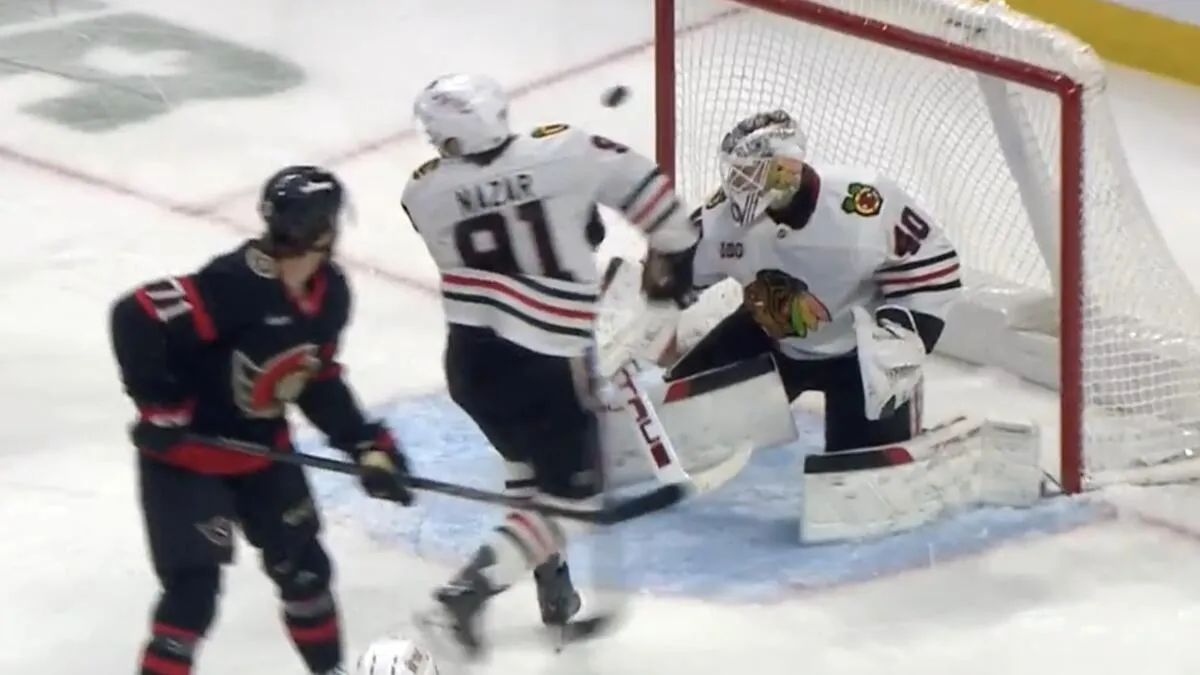
Frank Nazar suffers facial injury from puck impact in Ottawa
The incident itself was as abrupt as it was frightening. Senators defenseman Jordan Spence wound up for a shot that struck Nazar squarely in the face, sending the 21-year-old center straight to the dressing room with what would later be confirmed as a significant facial injury. Coach Jeff Blashill, when addressing media post-game, kept specifics private but didn’t mince words about the severity. “You saw the play,” Blashill stated. “He got hit right in the face.”
While the organization has declined to provide detailed medical specifics, the four-week timeline suggests a fracture or significant soft tissue damage requiring substantial healing time. Facial injuries from puck impacts can range from broken orbital bones to nasal fractures and dental damage, each presenting unique recovery challenges for a professional athlete. The Blackhawks medical staff will monitor Nazar’s progress closely, particularly his ability to resume contact without risk of re-injury upon his eventual return.
Jordan Spence’s shot changes the game dynamic
The play itself was a routine defensive zone clearance for the Senators that turned catastrophic for Chicago. Spence, positioned at the point, released a wrist shot that traveled approximately 30 feet before making contact with Nazar, who was positioned near the high slot area. At NHL speeds, even a moderately powered shot can exceed 80 miles per hour, turning a vulcanized rubber disk into a dangerous projectile. The incident serves as a stark reminder of how quickly hockey can shift from controlled chaos to medical emergency, despite modern protective equipment.
Chicago Blackhawks depth faces critical test without Nazar
Nazar’s absence creates another void in a lineup already missing its most dynamic offensive weapon. Connor Bedard, the 20-year-old phenom, missed his fourth consecutive game Saturday with a right shoulder injury that will sideline him until at least early January. The Blackhawks are proceeding cautiously with their franchise centerpiece, understanding that his long-term health outweighs any short-term gains. Bedard’s 19 goals and 25 assists currently lead the team, making his absence felt on both the scoresheet and in the locker room.
Captain Nick Foligno hasn’t suited up since November 15 due to a hand injury, though there remains optimism he could return soon. The veteran forward’s leadership and two-way play would provide a stabilizing presence during this turbulent stretch. His potential return can’t come quickly enough for a team struggling to find consistency and positive momentum. The combination of Nazar, Bedard, and Foligno representing nearly $15 million in salary cap value unavailable on game nights, forcing Chicago to rely heavily on its organizational depth.
Jeff Blashill addresses mounting injury challenges
Coach Blashill spoke candidly about the difficulty of maintaining competitive standards while key contributors watch from the press box. “One of the things that leads to consistency is depth, and so our depth is getting tested,” he acknowledged after the Ottawa loss. “So guys in those roles have to ultimately play at a higher level. As you play more minutes in more important roles, you’ve got to play that much better. And it’s a challenge. And it’s not easy.”
His assessment reflects the harsh reality facing Chicago: responsibility must be distributed across remaining roster players, many of whom are experiencing expanded roles for the first time in their NHL careers. The coaching staff has emphasized that increased opportunity brings heightened expectations, particularly for younger players who must accelerate their development timeline. Blashill’s message to the team remains consistent: “As a group, we need to get more out of more guys. We’ve talked about that, and we’ll continue to talk about that.”
Nazar’s promising season interrupted by unfortunate injury
Before Saturday’s incident, Frank Nazar had established himself as a reliable secondary scoring option and emerging two-way center. Through 33 games this season, the Michigan native accumulated six goals and 15 assists, demonstrating chemistry with various linemates and showing the hockey IQ that made him a first-round selection in the 2022 NHL Draft. His 21 points ranked fourth among Blackhawks forwards, trailing only Bedard, Taylor Hall, and Philipp Kurashev in offensive production.
The 2024-25 campaign represented Nazar’s first extended look at NHL action after playing primarily with the Rockford IceHogs during his rookie professional season. He had shown steady improvement in faceoff responsibilities, defensive zone coverage, and offensive creativity, earning increased trust from the coaching staff as the season progressed. His ability to transition from college hockey at Michigan to the professional ranks exemplified the patience and development plan Chicago has implemented for its young prospects.
Seven-year extension demonstrates long-term organizational belief
Chicago’s commitment to Nazar became crystal clear this past August when the two sides agreed to a seven-year contract extension, locking in the young center through the 2031-32 season. The deal, reportedly worth $31.5 million, represented a significant investment in a player who had yet to establish himself as a consistent NHL regular but showed tremendous upside. That faith in Nazar’s development trajectory now gets temporarily paused, though the organization maintains complete confidence in his long-term future.
The contract structure allows Chicago to manage its salary cap while securing a core piece at a reasonable annual average value. For Nazar, the security provides peace of mind during recovery, knowing his place in the organization’s future remains secure. This injury represents merely a detour in what both player and team expect to be a productive, lengthy partnership.
What four weeks on the sidelines means for Chicago’s trajectory
The Blackhawks now face an uphill battle through the holiday season and into mid-January without Nazar’s services. His projected return timeline would see him miss approximately 12-14 games, including crucial division matchups against Central opponents. Chicago currently sits near the bottom of the standings, making each point increasingly valuable as they attempt to avoid falling further behind in playoff positioning. While postseason aspirations remain a long shot, maintaining competitive integrity and continuing player development remain organizational priorities.
The team must now redistribute Nazar’s roughly 15 minutes of ice time per game across remaining forwards, likely seeing increased responsibilities for veterans like Hall, Ryan Donato, and Andreas Athanasiou. Younger players such as Lukas Reichel and Cole Guttman may receive opportunities in expanded roles, providing valuable experience that could pay dividends later in the season or in future years.
Short-term adjustments and long-term perspective
Chicago’s coaching staff will likely experiment with line combinations and special teams units to compensate for Nazar’s absence. His contribution to the penalty kill and second power-play unit creates additional opportunities for players like Jason Dickinson and Joey Anderson to showcase their versatility. The Blackhawks must balance the immediate need for competitive performance with the bigger picture of continuing their rebuild.
Management faces difficult decisions regarding potential call-ups from Rockford. The IceHogs feature several forwards who could step into NHL minutes, though none possess Nazar’s combination of skill and two-way responsibility. Alternatively, Chicago could explore the waiver wire or trade market for short-term reinforcements, though such moves might contradict the long-term build strategy that prioritizes internal development.
This stretch will test Chicago’s resolve and depth in ways they haven’t experienced this season. The four-week timeline for Frank Nazar’s recovery provides a clear target for his return, but the ripple effects of his absence will be felt across the organization. How the Blackhawks respond to this challenge may ultimately define their character and set the tone for the season’s second half.
The injury serves as a sobering reminder of hockey’s inherent unpredictability. Even as organizations meticulously plan development curves and roster construction, a single puck can alter the trajectory in an instant. For Frank Nazar, these next four weeks represent a detour, not a dead end. His future remains bright, his contract secure, and his place in Chicago’s plans unchanged. The Blackhawks simply must navigate this storm without one of their emerging young talents, hoping the depth they’ve built can withstand yet another significant test.
Frequently Asked Questions

Par Mike Jonderson
Mike Jonderson is a passionate hockey analyst and expert in advanced NHL statistics. A former college player and mathematics graduate, he combines his understanding of the game with technical expertise to develop innovative predictive models and contribute to the evolution of modern hockey analytics.