











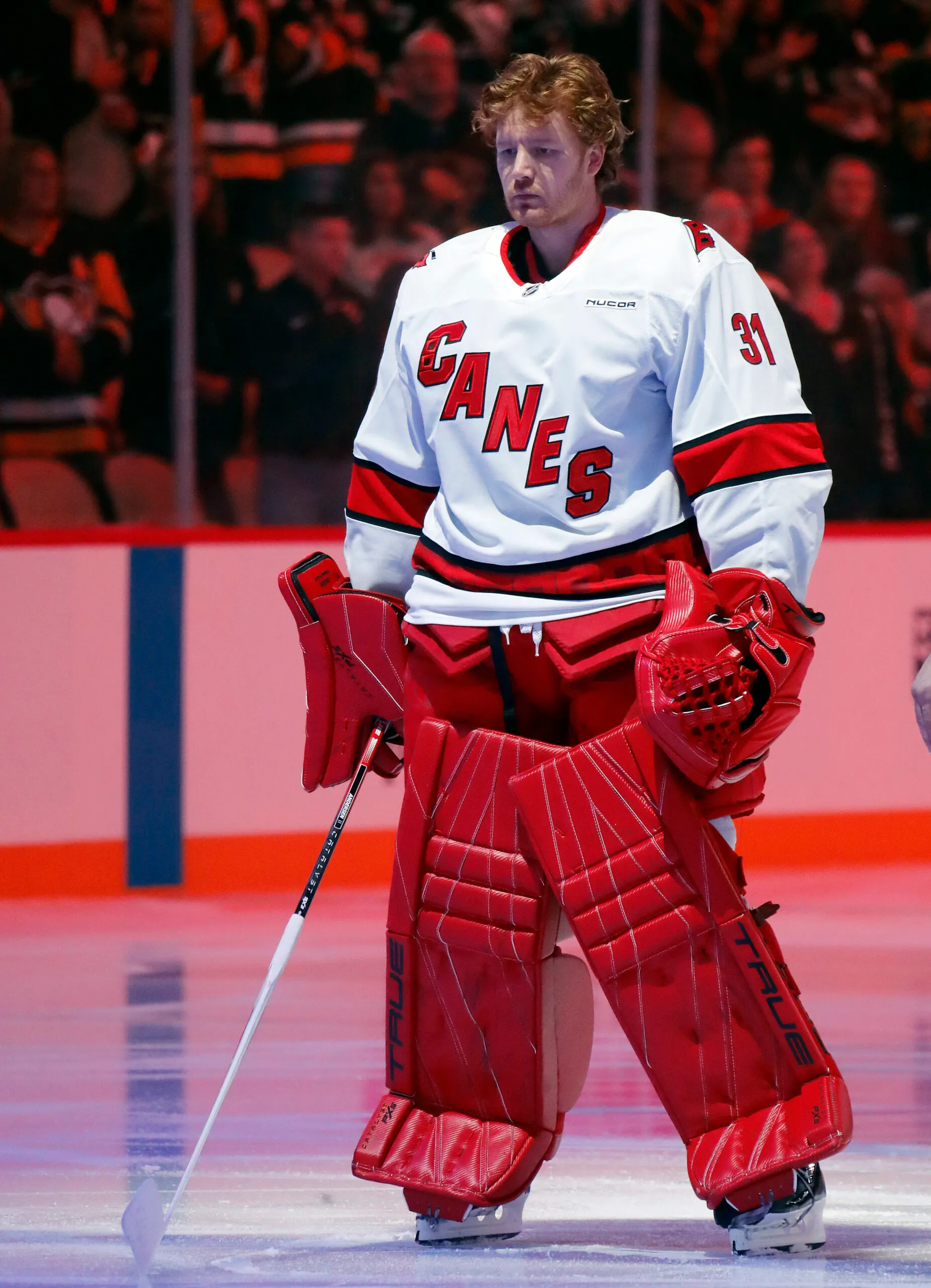
Frederik Andersen saved 12.8 goals above expected across 13 playoff games while leading the Carolina Hurricanes to the 2026 Stanley Cup.
Career peak meets edmonton opportunity
Andersen posted a .913 save percentage and 2.59 goals-against average over 634 regular-season games with Anaheim, Toronto and Carolina. The 6-foot-4, 229-pound Dane reached that career mark through consistent angle-cutting rather than highlight-reel athleticism. His wide stance limits high-corner openings, a trait Oilers management targeted after years of inconsistent net play.
Edmonton signed Andersen to a one-year, $2.8 million contract on July 1, 2026, immediately after he hoisted the Cup with Carolina. The low-risk deal contrasts with the multi-year commitments given to prior netminders who failed to deliver sustained results. New head coach Mike Babcock, hired June 23, 2026, inherits a three-goalie group that includes Andersen, Tristan Jarry and prospect Devon Levi.
Andersen’s calm demeanor provides a steady voice in a room that has cycled through multiple starters since Connor McDavid’s arrival. He appeared in every playoff game for the Hurricanes during their title run, logging 16 total postseason appearances before the final. That workload exceeded what any Oilers goaltender had sustained in recent postseasons.
Size and style versus prior netminders
Tristan Jarry owns a .907 save percentage and 2.80 GAA across 326 regular-season games, yet his aggressive puckhandling led to overcommitments that cost Edmonton in 2025-26. Andersen’s positioning-first approach contrasts with Jarry’s third-defenseman tendencies, offering Babcock a calmer default option during high-event stretches.
Stuart Skinner finished his Edmonton tenure with a .902 save percentage and 2.77 GAA in 224 games. His early butterfly drops left him exposed to screened shots, a vulnerability Andersen’s wider stance mitigates. Connor Ingram posted a .901 save percentage in 134 career games before departing as a UFA, leaving the door open for Levi’s internal push.
The Oilers traded Darnell Nurse to create cap flexibility for Andersen and additional depth pieces. That move reduced average annual value commitments while adding a proven champion who has appeared in 13 NHL seasons. Andersen’s 170-106-34 record with Pittsburgh and Edmonton for Jarry shows comparable volume, yet Andersen’s playoff track record remains the differentiator.
Durability questions and rotation upside
Andersen’s one-year pact allows Edmonton to evaluate his 35-year-old frame after injury-limited stretches in prior seasons. The three-goalie setup spreads workload across 82 games, reducing the risk that any single netminder faces the 60-plus starts that previously exposed durability gaps.
Devon Levi’s development gains immediate mentorship from a Cup winner, accelerating the prospect’s path to NHL minutes. If Andersen maintains his .910-or-better postseason form, the Oilers gain both present stability and future clarity. Should injuries surface, Jarry’s lateral quickness remains available without forcing over-reliance on any one option.
Andersen’s arrival raises the floor of a position that produced sub-.905 team save percentages in multiple McDavid-era playoffs. The combination of size, experience and recent championship validation gives Babcock concrete tools to manage rotations without repeating past overcommitments.
Frequently Asked Questions
Sources

Par Mike Jonderson
Mike Jonderson is a passionate hockey analyst and expert in advanced NHL statistics. A former college player and mathematics graduate, he combines his understanding of the game with technical expertise to develop innovative predictive models and contribute to the evolution of modern hockey analytics.