












With $5.3 million in salary cap space the Boston Bruins added J.J. Peterka and Will Borgen but still trail the Atlantic Division’s improved contenders.
Limited Summer Additions Leave Depth Concerns
The Bruins finished the 2025-26 season with the Atlantic Division’s fourth-best record after a bounce-back campaign. General manager Don Sweeney acquired winger J.J. Peterka from the Utah Mammoth and defenseman Will Borgen from the New York Rangers. These moves added experience yet left the forward group without high-end talent beyond David Pastrnak.
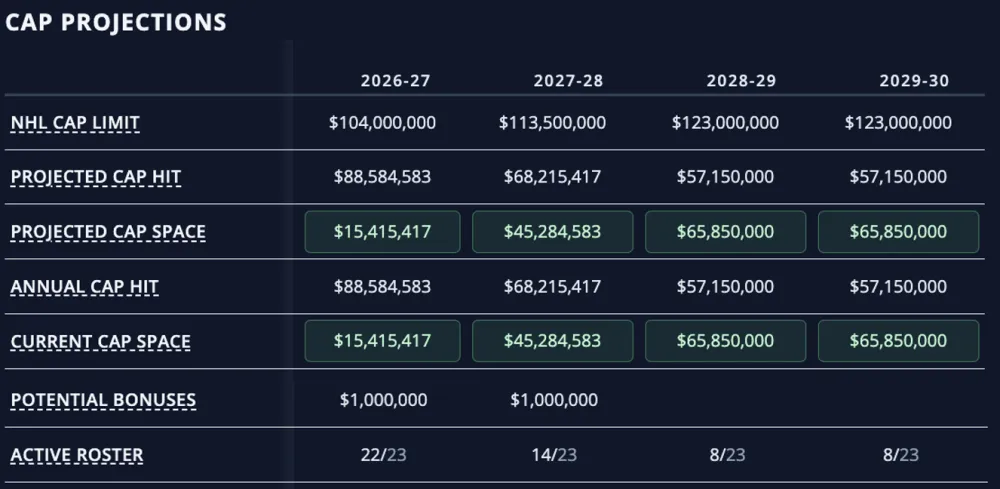
Ottawa Senators and Detroit Red Wings both targeted playoff spots this summer and increased division competition. Boston’s forward depth therefore ranks below several Atlantic rivals. The club now carries only $5.3 million in remaining cap space according to PuckPedia.
Michael DiPietro enters the season as Jeremy Swayman’s backup after strong AHL results. Any injury to Swayman would test whether DiPietro can sustain NHL performance over 82 games.
Sweeney chose to retain cap flexibility for in-season adjustments rather than pursue additional high-skill signings. That decision contrasts with division rivals who spent aggressively to close talent gaps.
The result is a roster that improved marginally but failed to keep pace with the Atlantic arms race. Boston therefore projects as a team fighting for a wild-card berth rather than a division title.
Internal Development Must Offset Roster Shortfalls
Pastrnak remains the lone Grade-A offensive driver. Without complementary top-six scoring the Bruins cannot generate consistent offense against tighter-checking opponents.
The defense corps gained Borgen’s physical presence yet still lacks a second-pair quarterback capable of driving play at five-on-five. This shortfall forces reliance on younger players who must accelerate their growth curves immediately.
Salary-cap constraints limit further external additions before training camp. Sweeney must therefore extract maximum value from internal candidates to avoid a half-step backward from the 2025-26 results.
Historical precedent shows teams in similar positions often slip outside the playoff picture when division rivals add multiple impact players. The Bruins face exactly that scenario in 2026-27.
Unless several prospects exceed expectations the margin for error narrows quickly once the schedule intensifies after Thanksgiving.
Playoff Odds Depend On Early-Season Stability
Boston is not projected to finish at the bottom of the standings. The club possesses enough structure and goaltending to remain competitive in most games.
Nevertheless the Atlantic standings now feature four teams with demonstrably deeper forward groups. The Bruins sit in the lower-middle tier of the league overall and lack the skill depth required to push into the top four.
Cap space of $5.3 million offers a buffer for mid-season trades but also signals that major upgrades were not prioritized this summer. Rivals in Ottawa and Detroit used similar windows to add multiple contributors.
A half-step regression would place Boston on the outside of the playoff race by the March trade deadline. That outcome would confirm the retool requires at least one additional offseason cycle.
The 2026-27 campaign therefore serves as a proving ground for whether internal growth can compensate for roster construction choices made in July.
Frequently Asked Questions
Sources

Par Mike Jonderson
Mike Jonderson is a passionate hockey analyst and expert in advanced NHL statistics. A former college player and mathematics graduate, he combines his understanding of the game with technical expertise to develop innovative predictive models and contribute to the evolution of modern hockey analytics.