









The Pittsburgh Penguins staved off elimination in their first-round playoff series against the Philadelphia Flyers with a crucial Game 4 victory, trimming the deficit to 3-1. Arturs Silovs delivered a standout performance in net, posting a .933 save percentage by stopping 19 of 21 shots despite the Flyers’ 30-21 shot advantage.[1][2] Stuart Skinner, who started the first three games, struggled with an .873 save percentage, contributing to Pittsburgh’s losses in each contest. This goaltending switch has sparked questions about Skinner’s future with the team, especially as he approaches unrestricted free agency (UFA) this summer.
With the Penguins facing an uphill battle to advance, coach Dan Muse’s bold decision to bench Skinner could signal the end of the 27-year-old’s tenure in Pittsburgh. Acquired from the Edmonton Oilers in December 2025, Skinner was expected to stabilize the crease, but his playoff shortcomings have put that in doubt.[3]
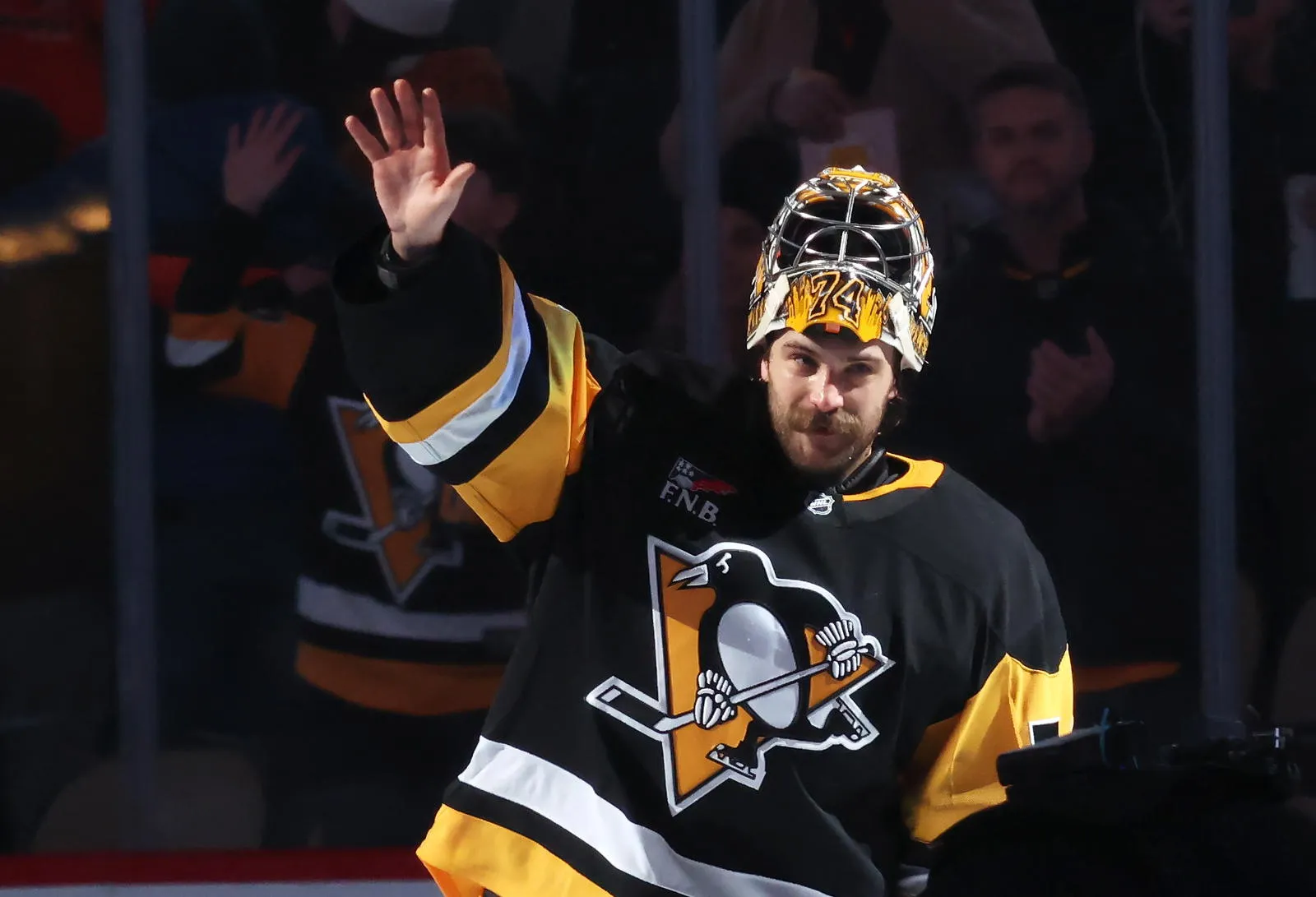
Skinner’s playoff struggles against the Flyers
Skinner entered the series as the presumptive starter, backed by his regular-season experience with both Edmonton and Pittsburgh. However, the Flyers exploited his vulnerabilities early. In Game 1, Philadelphia won 3-2, with Skinner unable to hold the fort in a tight contest.[4]
Game 2 saw a 3-0 shutout loss, underscoring defensive lapses in front of Skinner. By Game 3, a 5-2 defeat, his .873 save percentage across the three starts became unsustainable for a team clinging to faint playoff hopes.[5]
Post-game comments from Skinner reflected frustration but resolve. “No matter what way you go, you’re going to have a good team,” he said ahead of the series, yet the results painted a different picture.[6]
The benching in Game 4 wasn’t just tactical; it highlighted deeper concerns about Skinner’s consistency under pressure. Penguins fans, still smarting from recent postseason absences, watched as the goalie carousel spun once more.
Pittsburgh’s decision mirrors past goalie controversies, reminiscent of the Jarry-Skinner goalie swap analysis that brought him to the team.
Silovs emerges as the playoff hero
Arturs Silovs, acquired from the Vancouver Canucks in 2025 by GM Kyle Dubas, seized his opportunity. His calm demeanor and athleticism shone through, allowing just two goals on 30 shots—or 28 per some reports—in Game 4.[1][7]
At 25 years old and on a modest $850,000 salary, Silovs offers cost-effective upside. His regular-season .888 save percentage and 3.07 GAA were hampered by Pittsburgh’s bottom-five defense in goals allowed, yet he showed poise Saturday.[1]
Silovs’ prior postseason experience with Vancouver adds credibility. Muse praised the “high-impact performance,” suggesting Skinner may sit for the remainder of the series.[1]
This shift validates Dubas’ vision for the Latvian netminder. Even with flaws—like sub-.840 saves in three of his last four regular-season starts—Silovs’ potential aligns with Pittsburgh’s rebuild.
The Game 4 win, detailed in the Penguins avoid sweep coverage, breathed life into the series.
Reviewing Skinner’s 2025-26 season stats
Skinner’s split time between Edmonton and Pittsburgh yielded middling results. With the Oilers, he went 11-8-4 with a .891 SV% and 2.83 GAA in 23 games. In Pittsburgh, 12-9-5, .885 SV%, 2.99 GAA over 27 outings.[1]
These numbers position him as a reliable tandem option, not a 50-game workhorse. His $2.6 million cap hit over the past three seasons reflects that tandem role. PuckPedia details confirm his UFA status at age 27 this summer.[8]
Injuries, like an eye issue in April, disrupted rhythm, but Skinner returned steadily.[9]
Overall, his stats scream “depth netminder” in a market valuing steadiness.
- Wins-Losses-Overtime Losses: 23-17-9 across teams
- Goals Against Average: 2.92
- Save Percentage: .888
- Shutouts: 2[10]
Penguins’ goaltending pipeline beyond Skinner
Pittsburgh boasts promising youth in Joel Blomqvist and Sergei Murashov, currently starring for the Wilkes-Barre/Scranton Penguins. These prospects reduce urgency to re-sign Skinner long-term.
Silovs, at 25, fits the youth movement better. Dubas’ acquisition strategy prioritizes measured performers over high-cap veterans.
If the Penguins upset Philadelphia—needing three straight wins—Silovs likely cements the starter role. A quick exit accelerates Skinner’s UFA exit.
Blomqvist’s AHL exploits and Murashov’s potential signal a tandem refresh. Skinner’s trade gamble simply didn’t pan out.
Skinner’s outlook in the 2026 UFA market
As a UFA, Skinner should draw interest from teams seeking tandem depth. His proven NHL ability, without starter demands, keeps term and dollars reasonable—likely near $2.6-3 million AAV.
In a thin goalie market, clubs like those rebuilding around contenders will call. NHL.com profile highlights his Stanley Cup Final experience with Edmonton.[3]
Pittsburgh may let him walk, prioritizing cap flexibility amid Crosby-Malkin twilight.
Analysts debate re-signing risks versus alternatives. Penguins sit at a crossroads.[11]
Skinner won’t starve on the market, but Pittsburgh feels like a mismatch.
The Penguins’ creasemen, including Silovs and Skinner, vowed readiness pre-series, but actions speak louder.[12]
Unless Pittsburgh mounts a miracle comeback, Skinner’s Penguins chapter likely closes. For him, free agency offers tandem security elsewhere; for Pittsburgh, it clears space for the next wave. Watch Game 5 closely—it could be his swan song in black and gold.[1]
Frequently Asked Questions

Par Mike Jonderson
Mike Jonderson is a passionate hockey analyst and expert in advanced NHL statistics. A former college player and mathematics graduate, he combines his understanding of the game with technical expertise to develop innovative predictive models and contribute to the evolution of modern hockey analytics.