The NCAA’s decision to allow CHL players to compete at the Division I level has fundamentally altered the North American hockey development pathway. For years, CHL graduates were ineligible for NCAA programs, funneling many Canadian talents into USports as a bridge to professional hockey. Now, over a year since the rule took effect and following a full 2025-26 season, USports is adapting in unexpected ways.
This shift sparked an initial exodus from USports rosters, but it has also fostered greater parity and innovation across the league. Programs once dominant are facing stiffer challenges, while recruiting strategies have become more creative. The result is a more resilient USports landscape.
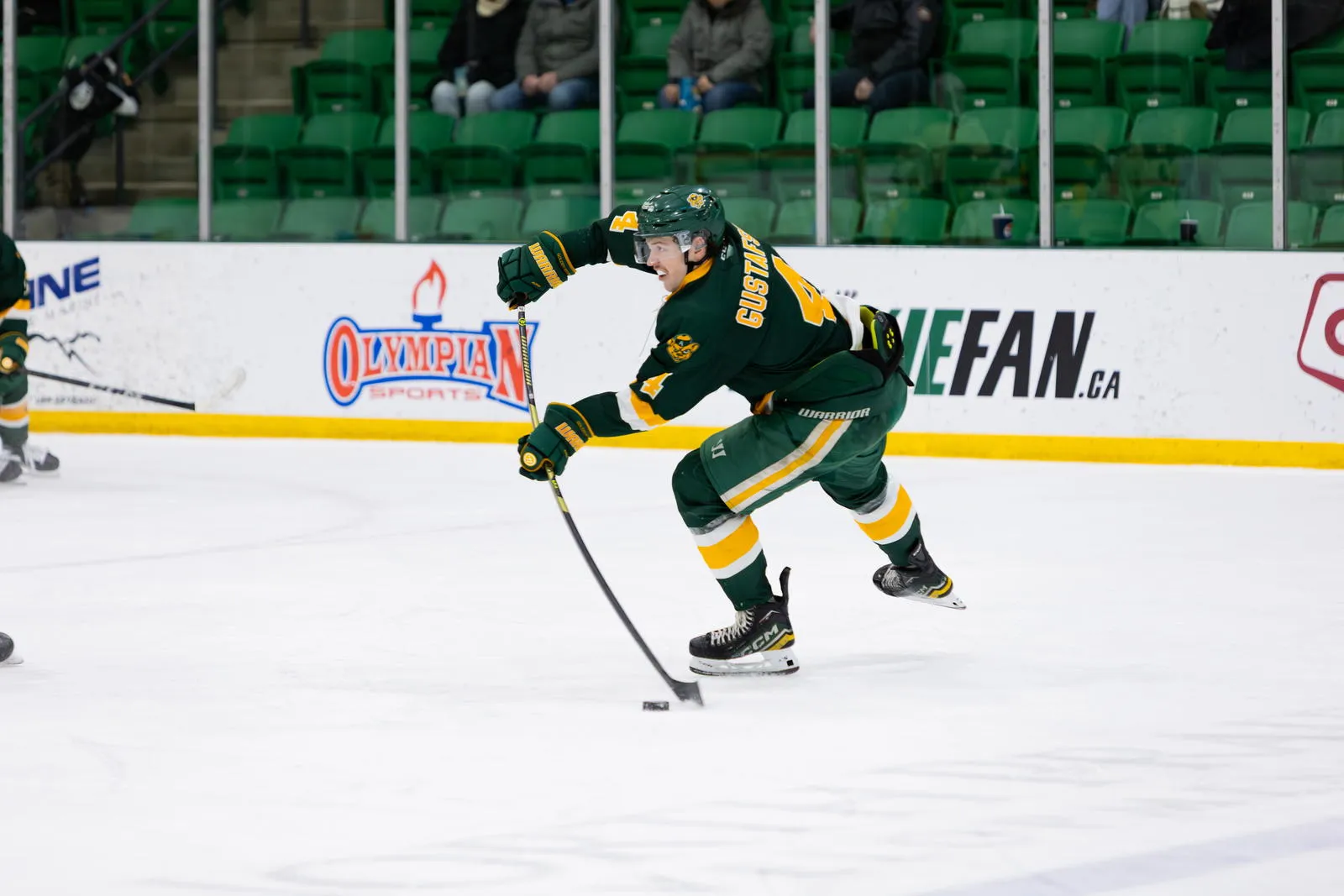
The immediate impact: A wave of transfers
In the rule change’s wake, numerous USports players bolted for NCAA opportunities, viewing them as a faster track to pro hockey. The University of Alberta Golden Bears lost seven players to NCAA teams, a stark example of the upheaval.
Defenseman Blake Gustafson of the Golden Bears wasn’t shocked by the departures. “The reason I wasn’t surprised is because we had a lot of guys that were here for hockey specifically, and not worried about their degrees,” he explained. “So I think when that opened up, those guys saw it as opportunity to have a different look at the sport.”
For many CHL veterans, the NCAA promised superior exposure and structure. Gustafson described it as a “grass is greener” mentality, where sudden eligibility prompted quick jumps despite potential mismatches.
Not every move panned out perfectly, but the trend highlighted players prioritizing hockey development over academics. This fluidity marked the early phase of the new era.
Programs like Alberta felt the pinch most acutely, but the transfers were widespread. For more on NCAA commitments, check The Hockey News’ latest updates.
Parity rises in USports competition
Far from weakening USports, the transfers have tightened competition league-wide. Traditional powerhouses such as the University of Alberta, UBC, Saskatchewan, and UNB no longer dominate effortlessly.
Gustafson noted the shift: “I don’t think these transfers take away from the competitiveness or the level of the league at all. You see, this league is getting closer and closer in how teams compete.” Every matchup now demands full effort, eliminating easy wins.
MacEwan University exemplified this resurgence, fielding its strongest squad in years. Coach Zack Dailey observed, “There’s a lot of parity in the league… it was a little bit more competitive, a little bit more parity, which I think is great for our league.”
This compression of talent has elevated the overall product. Mid-tier teams are thriving, making weekends grueling for all.
The change benefits fans and players alike, fostering unpredictability. For insights into broader college hockey shifts, see this analysis from The Hockey News.
Recruiting evolves amid fluid pipelines
USports coaches have pivoted to unconventional sources to rebuild. No longer reliant solely on CHL outflows, they’re tapping NCAA transfers, Jr. A leagues, and even pros returning for education.
Dailey praised the adaptability: “Coaches have done a really good job of being quite creative on where they’re finding players from, whether it’s the Div. I transfer portal, or getting guys back from pro.”
This dynamism has broadened talent pools. Programs now scout globally, emphasizing fit over pedigree.
The transfer portal has been key, allowing quick roster tweaks. Landon Kosior, for instance, moved from Saskatchewan to Nebraska-Omaha before returning home.
NCAA vs USports: Development philosophies clash
The leagues differ fundamentally in approach. NCAA often prioritizes hockey with structured practices, sometimes at academics’ expense.
Gustafson contrasted: “In the NCAA you might be on the ice two times a day… But in USports, the onus on the player.” USports demands self-motivation and balance.
Visibility isn’t an issue anymore, with streaming and data scouting ubiquitous. “If you’re good enough, you’ll have the opportunity,” Gustafson affirmed.
Players must weigh structure against independence.
Notable USports transfers to NCAA
The 2025-26 season saw significant movement. Here’s a reverse chronological list of key transfers:
- Ethan Burroughs (F) StFX → Vermont
- Dallon Melin (F) Calgary → Niagara University
- Jacob Maillet (F) Calgary → Niagara University
- Oliver Peer (F) UNB → Bemidji State University
- Connor McClennon (F) U of A → Bemidji State University
- Vincent Labelle (F) U of Ottawa → Bemidji State University
- Dylan Sydor (F) Calgary → University of Alaska-Fairbanks
- Samuel Richard (G) UNB → UMass-Lowell
- Charles Savoie (F) Concordia → Lindenwood University
- Maxime Pellerin (F) McGill → Nebraska-Omaha
- Trevor Wong (F) Saskatchewan → Nebraska-Omaha
- Sean Tschigerl (F) U of A → Nebraska-Omaha
- Samuel Huo (F) UBC → Nebraska-Omaha (now ECHL)
- Aidan De La Gorgendiere (D) U of A → Nebraska-Omaha
- Landon Kosior (D) Saskatchewan → Nebraska-Omaha (returned)
- Marc Lajoie (D) U of A → Nebraska-Omaha
- Brett Hyland (F) U of A → Nebraska-Omaha
- Carson Latimer (F) UBC → Michigan Tech
- And others including Tyler Palmer (G) U of A → Bowling Green State University.
Nebraska-Omaha emerged as a popular destination.
Future balance and USports resilience
Gustafson predicts a pendulum swing: “CHL guys go down, they’ll have not the best experience, and word travels back.” Some disillusionment could stem the flow.
USports’ evolution positions it strongly. More options benefit players, with choices driven by personal fit.
Ultimately, the rule change hasn’t eroded USports but propelled its growth into a balanced, competitive force. As development paths diversify, the league’s emphasis on holistic growth may attract a new generation of committed athletes.
Frequently Asked Questions

Par Mike Jonderson
Mike Jonderson is a passionate hockey analyst and expert in advanced NHL statistics. A former college player and mathematics graduate, he combines his understanding of the game with technical expertise to develop innovative predictive models and contribute to the evolution of modern hockey analytics.