On the last day of January, Penn State hosted a college hockey game in Beaver Stadium that drew nearly 75,000 fans, the second-largest crowd ever for the sport.[1][2] Deputy athletic director Vinnie James called the scene surreal, a movie-like moment made possible by heavy investments in the program long before NIL and revenue sharing became dominant forces. The Nittany Lions’ addition of star forward Gavin McKenna from Canada’s Western Hockey League accelerated their momentum, leading to this outdoor spectacle against No. 2 Michigan State.[3]
McKenna, the projected No. 1 pick in the upcoming NHL draft, contributed a goal and two assists in Penn State’s 5-4 overtime loss.[4] His July announcement to join Penn State for the 2025-26 season shook the college hockey landscape, especially after the NCAA cleared CHL players for eligibility in November 2024.[5][6] As the NCAA tournament kicks off this week with Michigan as the top seed, the sport grapples with how NIL deals and the House settlement’s revenue sharing—capped around $20.5 million per school—are reshaping rosters and competition.[7]
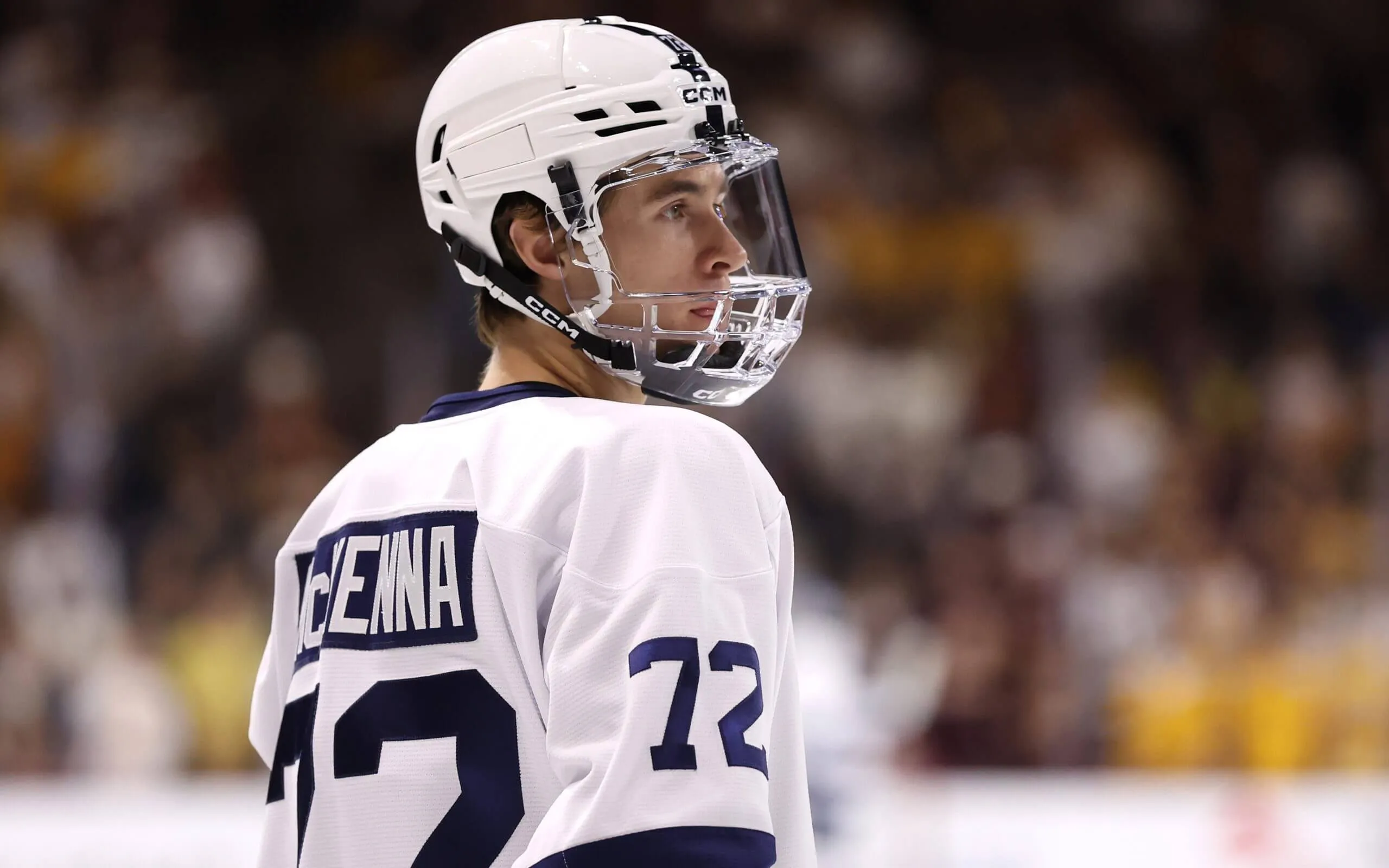
Penn State’s bold move with McKenna
Penn State’s hockey program transformed from a club sport before 2012 to hosting massive events in under 15 years. The addition of McKenna represented a calculated risk, blending financial incentives with top-tier resources like NHL-caliber strength training and nutrition. Vinnie James emphasized that elite players enable unique opportunities, such as filling Beaver Stadium.
James noted, “When you get to a certain level of player, they’re real investments for [an athletic] department, and the things that those players allow you to do are absolutely critical.”[8] Penn State pitched a competitive NIL package, betting that McKenna’s presence would generate revenue through heightened interest. The outdoor game announcement followed swiftly after his commitment, underscoring the marketing boost.
Quinnipiac coach Rand Pecknold hailed it as “a big moment in the NIL hockey world” and a smart long-term investment. With McKenna poised for NHL stardom, Penn State stands to recoup costs over time. The program reached its first Frozen Four in 2025, signaling their all-in approach.
This move highlights how Big Ten schools leverage football-driven budgets for hockey splashes. Yet, James stressed the personality fit to avoid locker room disruptions, given pay disparities.
Diverse programs navigate compensation
College hockey’s landscape spans Power 4 football powerhouses like Michigan to non-football schools like Denver, which boasts 10 NCAA titles. The NCHC has dominated recent championships, with seven of the last nine winners, including Western Michigan’s 2025 triumph.[7] Broncos coach Pat Ferschweiler predicted his team would be the last major-sport champ without NIL dollars.
Schools approach NIL variably. Quinnipiac, a private school without football, fundraises grassroots-style for its premier program. Coach Pecknold said, “We have to fundraise for our NIL money… If we want to stay and continue as a top 10 team, we need to adapt.”
Denver appointed Peter Mannino as NIL general manager, focusing on third-party deals vetted by the NCAA’s NIL Go. Without football, they empower revenue generators like hockey. Mannino described it as a “boutique” model, avoiding football’s shadow.
Boston College AD Blake James noted NHL draft status alters dynamics, as top players see college as a pro development step.
- Michigan: No. 1 overall seed, Big Ten regular-season champ.
- North Dakota: No. 2 seed, NCHC powerhouse.
- Michigan State: No. 3 seed, Big Ten contender.
- Western Michigan: No. 4 seed, defending champ.[9]
CHL eligibility opens new doors
The NCAA’s November 2024 ruling made CHL players eligible starting 2025-26, coinciding with NIL and revenue sharing explosions.[10] Penn State’s McKenna exemplifies this shift, reportedly netting around $700,000.[11]
Denver coach David Carle welcomed six CHL freshmen without pay queries, prioritizing team balance. “We’re not going to be a school that pays player X an exorbitant amount more than someone else,” he said. They opted into the House settlement for flexibility.
Western Michigan AD Dan Bartholomae acknowledged big-money pursuits but uncertainty below stars. Programs like Maine launched direct compensation via the Black Bear Student-Athlete Experience Fund, as AD Jude Killy detailed in a Bangor Daily News op-ed. Killy wrote, “While more resources won’t guarantee wins… we are keeping Maine in the game.”
Big Ten admins collaborate on strategies without specifics. James said, “The Big Ten is positioned really, really well… to hopefully separate ourselves.”
This diversity keeps parity, as upsets define tournaments—like Quinnipiac’s 2023 title or Western Michigan’s 2025 run.
Big Ten power vs. NCHC parity
Big Ten teams like Michigan, Michigan State, and Penn State earned top seeds, but no member has won since Michigan State’s 2007 title.[12] NCHC success persists despite varied football levels, from Western Michigan (Group of 6 FBS) to Denver (no football).
Mannino contrasted conferences: “There’s Big Ten versus NCHC… you can see the success and the results.” Yet, unpredictability reigns—Minnesota’s 2023 choke, Boston College and MSU as top seeds falling short last year.
Revenue sharing favors football schools for those sports, leaving hockey scraps. Non-football programs gain autonomy within caps. Carle noted Power schools may rely on collectives for football/basketball.
Western Michigan eyes sustained contention amid football ambitions and a new $515 million arena. Bartholomae aims to avoid fading post-glory.
Pecknold affirmed commitment overcomes size: “If a university is committed enough… they’ll find a way.” For deeper tournament insights, check our preview of the 2026 NCAA men’s hockey tournament.
Smaller schools innovate to compete
Quinnipiac’s 12th NCAA appearance underscores elite non-Power success. Fundraising and coach involvement sustain them amid rising costs. Pecknold views NIL like the portal: adapt or lag.
Maine’s fund stabilizes rosters against poaching, using no tuition funds. Killy called athlete pay “TBD” but essential: “If you sit idle… you’re not going to be in a good position.”
Denver’s 10 freshmen, including CHL transfers, enhance without disruption. Their skiing and lacrosse titles prove boutique viability.
Hockey East mixes FBS like Boston College with FCS and no-football like Providence, a No. 2 seed. James said positions vary: “When you look at some of the schools… that might be the premier program.”
Revenue sharing participation is widespread among contenders. Strategies diverge, but innovation unites them. See how CHL changes factor in our piece on Finnish prospects and the NIL NCAA pathway.
As the tournament unfolds—from regionals to a Las Vegas Frozen Four—NIL and revenue sharing promise evolution without eroding parity.[7] Big splashes like McKenna’s could tilt edges to resource-rich schools, but history favors the unpredictable. Programs committed to adaptation, regardless of profile, will thrive, keeping college hockey’s charm intact.[39] The real winners? Fans witnessing stars develop amid this new financial frontier.
Frequently Asked Questions

Par Mike Jonderson
Mike Jonderson is a passionate hockey analyst and expert in advanced NHL statistics. A former college player and mathematics graduate, he combines his understanding of the game with technical expertise to develop innovative predictive models and contribute to the evolution of modern hockey analytics.