











The Buffalo Sabres made a significant roster adjustment on Friday evening, recalling forward Isak Rosen from the AHL’s Rochester Americans while placing Zach Benson on injured reserve. The move comes after Benson left Thursday’s overtime loss to the Boston Bruins with an undisclosed injury late in the third period, dealing a blow to a team that had found its rhythm with the young forward in the lineup. Rosen, who has been lighting up the AHL with 12 points in eight games, earns another opportunity to prove he belongs at hockey’s highest level.
The roster shuffle highlights the delicate balance Buffalo must maintain between developing young talent and competing in the present. Benson’s absence removes one of the team’s most energetic players at a crucial juncture in the season, while Rosen’s recall offers the 2021 first-round pick a chance to finally establish himself as an NHL regular after years of development in Rochester.
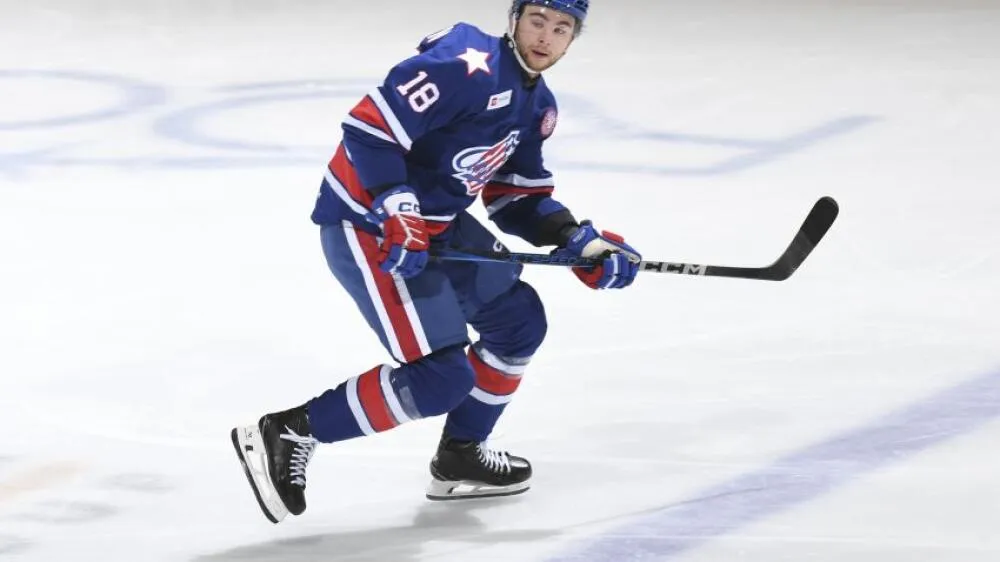
Zach Benson’s injury creates significant void for Buffalo Sabres
The placement of Benson on injured reserve deals a considerable blow to the Sabres’ forward group. The 20-year-old winger was forced to exit Thursday’s contest against Boston with 4:02 remaining in the third period, and the injury concern was significant enough to warrant an IR designation that will keep him out for at least the team’s next three games.
Benson has been instrumental in Buffalo’s improved play after a disastrous 0-3-0 start to the season. Since returning from his own earlier injury—a puck to the face during practice before the season opener—Benson has been a catalyst for the Sabres, recording eight assists in eight appearances. His four-assist performance in the 8-4 victory over Ottawa served as an emphatic announcement that he was ready to take on a larger role.
The Sabres’ record tells the story of Benson’s importance. Buffalo posted a 4-1-3 mark in games featuring the second-year forward, showcasing not just his offensive contributions but his ability to elevate the entire team’s performance. His 16:18 of ice time in the Boston game demonstrated the trust head coach Lindy Ruff has placed in him, and his departure clearly left a void the team couldn’t fill in the final minutes.
Beyond the point production, Benson brings an intangible element that Buffalo desperately needs. He’s one of the few true sparkplugs on the roster, capable of injecting energy when the team appears flat. According to advanced metrics from Evolving Hockey, his defensive impact ranks in the 92nd percentile with an expected goals above replacement of over nine—numbers that illustrate his value extends far beyond the assist column. His absence will test whether Buffalo’s improved work ethic and competitive fire can sustain itself without one of its primary catalysts on the ice.
The injury couldn’t come at a more challenging time. Buffalo faces a demanding stretch that includes matchups against Washington, Utah, St. Louis, Carolina, and another game against Utah. These contests will determine whether the Sabres can maintain momentum or slide backward during a critical period of the season.
Isak Rosen gets another chance with Buffalo Sabres recall
With Benson sidelined, the Sabres turned to Rosen, whose scorching start in Rochester has been impossible to ignore. The 22-year-old winger is currently leading the entire AHL in scoring with five goals, seven assists, and 12 points through just eight games—a performance that demands recognition and opportunity at the next level.
Rosen’s journey since being selected 14th overall in the 2021 NHL Draft has been one of steady, patient development. After arriving in North America in 2022, he posted a 14-23-37 line in 66 AHL games during his first season. His production climbed to 20-30-50 in 67 games the following year, then jumped again to 28-27-55 in 61 appearances last season. The consistent improvement suggested a player methodically building the complete game necessary for NHL success, even if the timeline stretched longer than initially anticipated.
What makes this recall particularly intriguing is that Rosen hasn’t exactly been given a fair shake during his previous call-ups. Across 15 career NHL appearances spanning the last two seasons, he’s averaged only 9:09 of ice time per game and managed just one assist. It’s difficult for any skilled forward to make an impact when relegated to fourth-line duty with minimal minutes—a reality that has likely frustrated both Rosen and the organization.
This time feels different. Rosen addressed his situation candidly during September’s rookie camp, acknowledging the pressure and opportunity ahead. “It’s my fourth year, so it’s time to show that I want a jersey in Buffalo,” Rosen stated. “And I’ve just got to take every opportunity I get here.” Those words carried the weight of a prospect who understands this might be his most important chance to prove he belongs.
The question facing Ruff is whether he’ll give Rosen legitimate top-nine minutes or once again bury him on the fourth line. Rosen’s skill set—elite puck skills, offensive creativity, and scoring touch—is wasted in a grind-line role. If Buffalo wants to see what they truly have in the Swedish forward, they need to deploy him in situations where he can showcase his offensive abilities. Success for Rosen won’t necessarily mean lighting the lamp every night; it will mean demonstrating responsible two-way play, working hard on the forecheck and backcheck, and making smart decisions with the puck.
For Rosen, the path forward is clear: embrace whatever role he’s given and make the most of every shift. Whether that means 10 minutes or 16 minutes per game, he needs to prove he can contribute at this level. Many AHL standouts struggle with the transition because they’re accustomed to being primary offensive weapons in the minors. NHL success often requires doing the dirty work—battling in corners, screening goaltenders, making the simple play instead of forcing highlight-reel passes. If Rosen can marry his offensive gifts with that blue-collar mentality, he might finally carve out the NHL career that seemed destined when Buffalo called his name in 2021.
What this roster move means for the Buffalo Sabres moving forward
The Sabres find themselves at a crossroads familiar to many developing teams. They’ve invested heavily in young talent through the draft, and now those investments must yield dividends at the NHL level. Benson has already proven his worth, making his absence all the more painful. Rosen represents the next wave—a prospect who must demonstrate whether years of development have prepared him for regular NHL duty.
Buffalo’s performance during this stretch without Benson will reveal much about the team’s depth and resilience. The improved energy and compete level that characterized their recent success cannot disappear simply because one player is sidelined. Other forwards must step up, whether that’s Rosen seizing his opportunity or established veterans raising their games to compensate for the loss of their young catalyst.
The medical timeline suggests Benson could return as early as November 8 against Carolina, giving Buffalo approximately one week to navigate without him. How the team performs during this span could influence decisions about Rosen’s future. If he excels and the Sabres maintain their competitive edge, management might face difficult roster decisions when Benson is healthy. If Buffalo struggles or Rosen fails to make an impact, the status quo will simply resume.
For now, the Sabres must focus on the immediate challenge: maintaining their improved play without one of their most important contributors. The recall of Isak Rosen isn’t just about filling a roster spot—it’s about providing opportunity to a prospect whose development timeline has finally reached a critical juncture. Whether he capitalizes on this chance could significantly impact both his career trajectory and Buffalo’s outlook for the remainder of the season. The next week will tell us whether the Sabres’ depth is genuine or illusory, and whether Rosen is ready to graduate from perennial prospect to NHL regular.

Par Mike Jonderson
Mike Jonderson is a passionate hockey analyst and expert in advanced NHL statistics. A former college player and mathematics graduate, he combines his understanding of the game with technical expertise to develop innovative predictive models and contribute to the evolution of modern hockey analytics.