






The 2025-26 season has brought unexpected challenges for Kent Johnson, the Columbus Blue Jackets’ talented young forward who entered the campaign hoping to build on a promising career year. Instead, Johnson has found himself navigating the most difficult stretch of his NHL career, culminating in a healthy scratch during the Blue Jackets’ road trip to Seattle in November. The decision by head coach Dean Evason to remove Johnson from the lineup has sparked conversations about development, accountability, and the team’s evolving identity under new leadership.
With just two goals and five points through his first 16 games while being shuffled throughout the lineup, Johnson’s struggles have become a focal point for a Blue Jackets organization seeking consistency and a competitive edge. The healthy scratch represents more than just a coaching decision—it signals a crucial juncture in Johnson’s development and the team’s expectations for its young core moving forward.
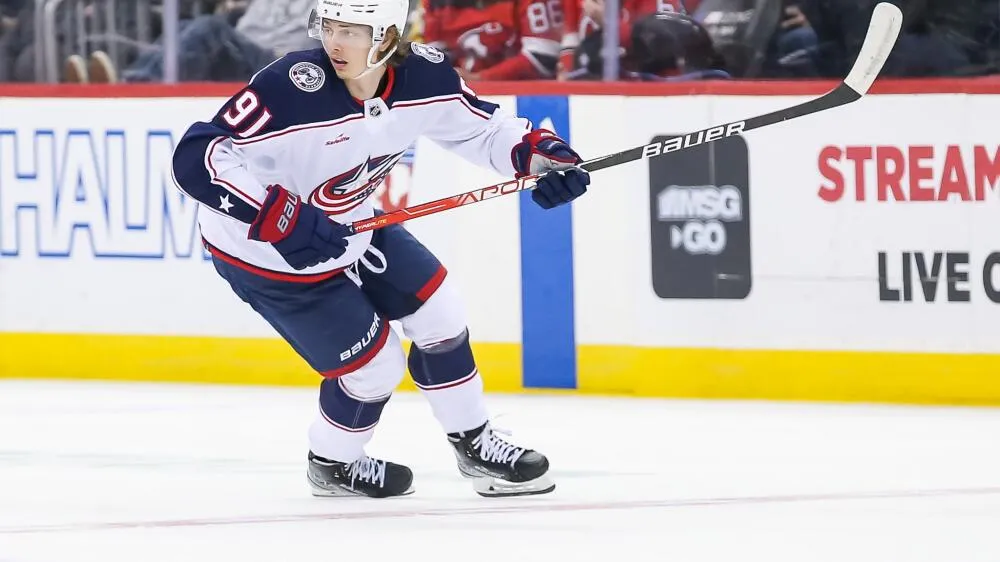
What led to Kent Johnson’s healthy scratch during the 2025-26 season
The circumstances surrounding Johnson’s healthy scratch on November 12th in Seattle initially created confusion among fans and media alike. With an illness sweeping through the Blue Jackets’ locker room during their western road trip, many wondered if Johnson’s absence was health-related. All 23 skaters participated in warmups that evening, leaving the door open for lineup changes based on player availability.
However, Evason cleared up any ambiguity the following morning before the team’s game against Edmonton. “He was not sick,” the head coach confirmed, eliminating any doubt that this was a performance-based decision. The choice to scratch Johnson came down to what Evason described as issues with consistency and compete level—areas where the coaching staff believed the 22-year-old needed to elevate his game.
The decision caught Johnson himself off guard. “Yeah it did to be honest,” Johnson admitted when speaking to reporters after practice. “But that’s all good. Just move forward and use it the best I can. (Coaches are) doing their job to get the best out of me. So just try to turn it into a good thing.” His response demonstrated maturity and an understanding that the organization’s expectations extended beyond offensive production alone.
Johnson acknowledged that communication between himself and the coaching staff had been consistent throughout the early season struggles. “Definitely. I think they’re trying to get the best out of me. Just move forward. We have conversations and I think it will make me better in the end,” he noted, suggesting that the healthy scratch didn’t come without warning or context.
Dean Evason’s expectations for Kent Johnson in the Columbus Blue Jackets system
Evason, in his first season leading the Blue Jackets, has established clear standards for how he wants his team to play. The emphasis on a “north and south” game—direct, physical hockey focused on getting pucks to the net—represents a departure from the more skill-based, east-west approach that talented players like Johnson naturally gravitate toward.
When asked what he needed to see from Johnson moving forward, Evason was direct and specific. “Just some compete. Some bite. Just sticking his nose in there,” the coach explained. “He knows exactly. We’ve had enough chats and as I think you guys know now, it’s that we talk and give the player the opportunity to do the things that we believe a player needs to do in order to help us win hockey games. And if it consistently doesn’t happen, then that’s the end result.”
The message wasn’t solely about scoring or offensive creativity. Evason wanted to see Johnson engage physically, win battles along the boards, and demonstrate the kind of determination that translates to earning the trust of coaching staff and increased ice time. For a player with Johnson’s skill set—creative playmaking ability and offensive vision—adapting to a more demanding two-way game represents a significant challenge.
The Blue Jackets coach made it clear that conversations about expectations had been ongoing, not reactionary. This wasn’t a surprise wake-up call but rather the culmination of multiple discussions where Johnson had been given opportunities to adjust his approach. The healthy scratch served as the final message that words alone wouldn’t be sufficient.
Understanding the context of why Kent Johnson’s healthy scratch sends a message to the Columbus Blue Jackets forward reveals deeper implications for the team’s development philosophy. Organizations often face difficult decisions when talented young players don’t immediately meet expectations, and the Blue Jackets chose accountability over patience in this instance.
Kent Johnson’s 2025-26 season statistics and power play struggles
The numbers tell a sobering story for a player who had shown significant promise in previous seasons. Through 16 games, Johnson’s two goals and five points represented a dramatic drop-off from the production the organization had anticipated. More concerning than the raw totals was the complete absence of power play points—an area where Johnson had previously excelled.
Johnson logged over 40 minutes of power play time without recording a single point, placing him among just three NHL players with that dubious distinction. According to Natural Stat Trick, only Jamie Drysdale and Sam Rinzel joined Johnson in failing to produce on the man advantage despite significant opportunities. For a player whose offensive creativity and vision had been considered assets on the power play, the drought raised questions about confidence, execution, and role clarity.
All five of Johnson’s points came at even strength, suggesting that the structured nature of power play situations—where defensive pressure is lighter and space theoretically more abundant—had become problematic. Johnson himself acknowledged the struggles. “I think I can create more and win more battles there and earn the trust of the coaches back more and get on the ice more too. I think any player feels good when they’re out there a lot. So I got to earn more ice time.”
The forward also admitted that his inability to finish scoring chances had compounded his frustrations. “I feel like I haven’t been burying my chances enough. Some of it’s luck and it will change. But I definitely feel like I need to be better,” Johnson said. The self-awareness demonstrated in these comments suggested a player capable of honest self-assessment, even if translating that awareness into on-ice results remained elusive.
Johnson’s movement throughout the lineup reflected the coaching staff’s attempts to find the right combination to spark his game. He skated with various linemates, including Sean Monahan and Luca Del Bel Belluz following his return from the healthy scratch. The constant shuffling, however, didn’t serve as an excuse in Johnson’s mind. “I’m not going to point the finger at any of that stuff,” he stated firmly. “Hockey, it’s an interesting sport with that stuff. But I feel like it’s all me. It’s definitely not on linemates.”
The broader context of the Columbus Blue Jackets’ 2025-26 challenges
Johnson’s healthy scratch occurred amid a challenging stretch for the Blue Jackets overall. The team returned home after a Columbus Blue Jackets road trip that yielded just three of a possible 10 points, leaving the organization searching for answers and consistency across the roster. The western swing had been complicated by the illness that swept through the locker room, adding another layer of difficulty to an already demanding schedule.
Compounding matters was the injury to captain Boone Jenner, whose upper-body issue would sideline him for what Evason described as “not short term.” Jenner’s absence removed a key leadership presence and one of the team’s most consistent competitors—exactly the type of player Evason wanted Johnson to emulate in terms of work ethic and engagement. “He drives our work ethic no question, but we have other guys that do that as well. We expect everybody to do that and lead as he has and does on a consistent basis,” Evason said of his captain.
With Jenner unavailable, the need for other players to step up became even more urgent. The coaching staff expected Johnson and other young players to fill the void not just in terms of production but in the intangible qualities that define winning hockey. The Blue Jackets were building an identity under Evason, and every player needed to commit to that vision.
The organization’s emphasis on accountability and team identity reflected a broader philosophy about player development. Rather than sheltering young players from consequences or lowering standards to protect confidence, the Blue Jackets chose to maintain high expectations and allow natural consequences to follow when those standards weren’t met. For Johnson, this meant sitting out a game and confronting uncomfortable truths about his play.
How Kent Johnson can rebound from his healthy scratch with the Blue Jackets
Johnson’s path forward requires balancing his natural offensive instincts with the more direct, competitive approach Evason demands. The challenge for any skilled player is maintaining creativity while adding layers of competitiveness and defensive responsibility—a delicate balance that separates good players from great ones at the NHL level.
The forward acknowledged that finding this balance involves both adaptation and staying true to his strengths. “I think a bit of both. I think there’s certain things. It’s a team sport so there’s certain stuff that coaches will ask. There’s a certain role you had or whatever. There’s definitely stuff like that you have to think about. It’s not just coming into the rink and don’t think and just be exactly what I’ve done my whole life. There’s definitely some of that. But also, you got to remember too what you’re here to do.”
Johnson’s belief that his situation could change quickly reflects the reality of NHL hockey, where momentum can shift dramatically from game to game. “I feel like it could change fast though in this league. There’s plenty of players that something happened quick. So hopefully, we get the ball moving quickly,” he said optimistically. History supports this perspective—young players often experience breakthrough moments after facing adversity, provided they respond with the right mindset and adjustments.
The immediate test came in Johnson’s return to the lineup against Edmonton, where he centered a line with Monahan and Del Bel Belluz. The combination offered offensive potential while also requiring Johnson to assume more defensive responsibility as the center on the line. How he performed in this role would signal whether the message of the healthy scratch had resonated.
Johnson’s willingness to take ownership of his struggles without making excuses provides a foundation for improvement. “I don’t think it’s been an ideal start to the year, obviously,” he admitted. “I want to earn more minutes (and) earn more trust. But yeah, I want to score too.” The acknowledgment that trust must be earned through consistent effort, not just offensive skill, represents the mental adjustment required for Johnson to maximize his potential.
The path forward also involves refining his approach to power play situations. With over 40 minutes of opportunity without a point, Johnson needs to simplify his game with the man advantage—getting to scoring areas, winning battles for loose pucks, and creating second opportunities rather than searching for the perfect creative play. These adjustments often seem simple in theory but require significant mental discipline to execute consistently.
The broader context of the Columbus Blue Jackets’ young core
Johnson’s healthy scratch occurred amid a challenging stretch for the Blue Jackets overall. The team returned home after a Columbus Blue Jackets road trip that yielded just three of a possible 10 points, leaving the organization searching for answers and consistency across the roster. The western swing had been complicated by the illness that swept through the locker room, adding another layer of difficulty to an already demanding schedule.
With Jenner unavailable, the need for other players to step up became even more urgent. The coaching staff expected Johnson and other young players to fill the void not just in terms of production but in the intangible qualities that define winning hockey. The Blue Jackets were building an identity under Evason, and every player needed to commit to that vision.
The organization’s emphasis on accountability and team identity reflected a broader philosophy about player development. Rather than sheltering young players from consequences or lowering standards to protect confidence, the Blue Jackets chose to maintain high expectations and allow natural consequences to follow when those standards weren’t met. For Johnson, this meant sitting out a game and confronting uncomfortable truths about his play.
Finally, the article concludes with a reflection on how Johnson and the organization handle adversity to shape the team’s rebuild and playoff pursuit.
Frequently Asked Questions

Par Mike Jonderson
Mike Jonderson is a passionate hockey analyst and expert in advanced NHL statistics. A former college player and mathematics graduate, he combines his understanding of the game with technical expertise to develop innovative predictive models and contribute to the evolution of modern hockey analytics.