












The New York Islanders announced devastating news on Saturday that veteran forward Kyle Palmieri will undergo surgery to repair a torn ACL in his left knee, sidelining him for six to eight months. The injury occurred during Friday night’s 4-3 shootout loss to the Philadelphia Flyers and immediately ends Palmieri’s impressive ironman streak of 223 consecutive games played. At 34 years old and in the first season of a two-year contract, this represents one of the most significant challenges of Palmieri’s 16-year NHL career.
The timing couldn’t be worse for the Islanders, who rely heavily on Palmieri’s veteran presence and offensive production. Through 25 games this season, Palmieri had already accumulated 18 points (6 goals, 12 assists), tying him for second on the team in scoring. His absence creates a substantial void in the lineup that will test the organization’s depth and potentially impact their playoff positioning in the competitive Metropolitan Division.
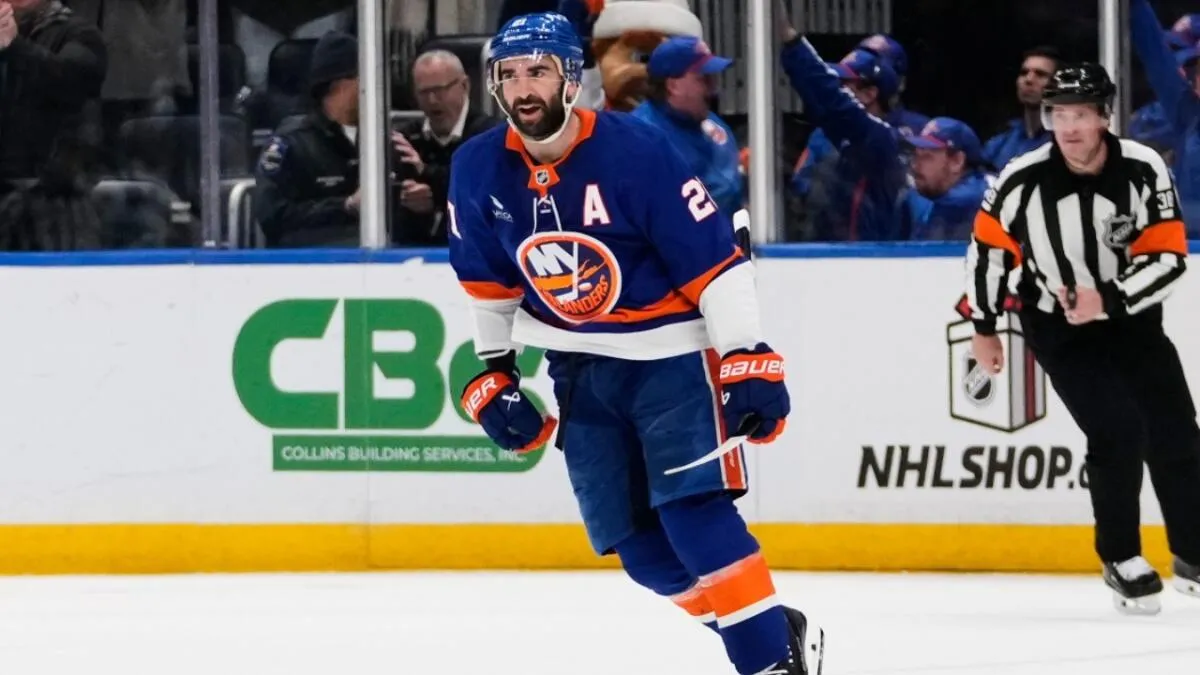
How the injury happened: A collision that changed everything
The incident unfolded in the second period when Palmieri battled for puck possession along the boards with Flyers defenseman Jamie Drysdale. The two players became tangled during the collision, and Palmieri fell awkwardly, immediately clutching his left knee in obvious pain. What happened next, however, epitomized the veteran’s competitive spirit and toughness.
Despite hobbling toward the bench, Palmieri never disengaged from the play. In a remarkable display of hockey IQ and determination, he managed to strip the puck from Flyers defenseman Emil Andrae and deliver a pass to Jonathan Drouin, who then set up Emil Heineman for a goal. Palmieri received credit for the secondary assist while trainers helped him to the locker room, a moment that left teammates in awe of his perseverance.
Islanders captain Anders Lee captured the sentiment perfectly in his post-game comments: “What a gutsy effort for him on that. Going through a lot of pain, he’s one of the toughest teammates that I know. Takes a lot for him to feel pain and get keeled over, but you can also see how strong he is to battle through and make a huge play.” The sequence became an instant testament to Palmieri’s dedication, even as it likely represented his final shift for the 2025 season.
Coach Patrick Roy told reporters after the game that the injury “did not look good,” and the team’s worst fears were confirmed the following day with the official diagnosis. Palmieri was placed on injured reserve retroactive to November 28, formally ending his availability for the foreseeable future.
Understanding Kyle Palmieri’s torn ACL recovery time 6-8 months
ACL injuries represent one of the most serious setbacks professional athletes can face, particularly in a sport as physically demanding as hockey. The anterior cruciate ligament is critical for knee stability, especially for movements requiring sudden changes in direction, pivots, and explosive acceleration—essentially every core movement in a hockey player’s arsenal.
The six to eight month timeline announced by the Islanders follows standard medical protocol for complete ACL reconstruction in high-performance athletes. This extensive recovery period includes:
- Initial surgical repair and post-operative healing (2-4 weeks)
- Progressive rehabilitation focusing on range of motion and strength building (2-4 months)
- Sport-specific training and conditioning (4-6 months)
- Medical clearance and gradual return to full-contact practice (6-8 months)
For a 34-year-old player like Palmieri, the recovery process may lean toward the longer end of that spectrum. While modern sports medicine has made remarkable advances, age remains a factor in tissue healing and muscle rebuilding. The Islanders medical staff will likely take a conservative approach to ensure Palmieri can return to his previous level of performance without risking re-injury.
The extended absence means Palmieri won’t just miss the remainder of the regular season—he’ll potentially miss the entire 2025 playoffs if the Islanders qualify, and could be unavailable for the start of the 2025-26 season depending on when his surgery occurs and how his rehabilitation progresses.
The end of an ironman streak and impact on team chemistry
Palmieri’s 223 consecutive games played established him as the Islanders’ reigning ironman, a testament to his durability and reliability throughout his tenure with the organization. That streak now joins the numerous personal accolades that define his career but also highlights what the team loses beyond just statistics.
Veteran presence matters significantly in NHL locker rooms, particularly during the grind of an 82-game season. Palmieri brought not only scoring ability but also mentorship for younger players, championship experience, and a consistent work ethic that set the tone for daily preparation. His absence forces others to step into leadership roles they may not be ready for, while creating ripple effects throughout the lineup.
The Islanders must now address several critical questions:
- Who fills Palmieri’s spot in the top-six forward group?
- How does the power play unit adjust without his right-handed shot and net-front presence?
- Which young prospects might earn opportunities, and can they handle increased responsibility?
- Does this injury accelerate trade deadline plans for general manager Lou Lamoriello?
The team’s forward depth faces its most significant test of the season, and the answers to these questions could determine whether the Islanders remain competitive in a division featuring powerhouses like the Carolina Hurricanes, New Jersey Devils, and New York Rangers.
Contract implications and career trajectory concerns
Palmieri is currently in year one of a two-year, $9.5 million contract he signed with the Islanders in May 2025. The deal reflected his importance to the franchise and his consistent production, but injuries of this magnitude naturally raise questions about future performance and value.
For players in their mid-30s, ACL tears represent more than just a temporary setback—they can accelerate physical decline and impact longevity. While many athletes have successfully returned from similar injuries, the rehabilitation process becomes more challenging with age. Palmieri will need to demonstrate not only physical recovery but also maintain the explosive skating and quick-release shooting that define his game.
The Islanders organization has invested significantly in Palmieri, both financially and emotionally. He grew up in New York and has embraced playing for his hometown team, making the injury particularly disappointing for fans who appreciate his local connection. The front office will monitor his rehabilitation closely, knowing that his successful return is crucial for both on-ice success and salary cap management.
From a roster construction perspective, the injury creates short-term salary cap relief through long-term injured reserve (LTIR), potentially giving Lamoriello flexibility to acquire a replacement. However, that relief disappears when Palmieri returns, requiring careful long-term planning. The situation mirrors challenges the Islanders have faced previously with veteran players, testing the organization’s ability to navigate adversity while maintaining competitive viability.
Historical context of ACL injuries in professional hockey
While ACL tears are more commonly associated with sports like football and basketball, they’ve impacted numerous NHL careers throughout history. Understanding this context helps frame Palmieri’s situation within broader league patterns and recovery benchmarks.
Recent examples of NHL players recovering from ACL injuries include:
- Mark Stone of the Vegas Golden Knights missed approximately seven months after his 2023 ACL tear
- Jaden Schwartz returned to the St. Louis Blues after a six-month absence following his 2022 injury
- Ryan Ellis faced multiple setbacks that extended his recovery beyond initial timelines
These cases illustrate that while six to eight months represents the standard recovery window, individual experiences vary significantly based on injury severity, surgical technique, rehabilitation protocols, and the player’s physical condition prior to surgery.
For wingers like Palmieri, the injury presents particular challenges related to skating stride mechanics and weight transfer during shooting. The ability to generate power from the legs while maintaining balance is fundamental to his playing style. Rehabilitation must address not just basic knee function but the sport-specific demands of professional hockey, including absorbing contact along the boards and executing tight turns at high speeds.
The Islanders can take some solace in knowing that modern ACL reconstruction techniques have improved dramatically over the past decade. Graft selection, surgical precision, and evidence-based rehabilitation programs give players better outcomes than previous generations enjoyed. However, the mental aspect of returning from such a serious injury remains equally important, requiring confidence to perform without hesitation.
Moving forward: Islanders’ options and Palmieri’s path back
With Palmieri officially sidelined, the Islanders must immediately adjust their forward rotations and strategic approach. The team has several internal candidates who could receive increased ice time, including younger prospects who may have started the season in the AHL. This situation also increases the likelihood that general manager Lou Lamoriello explores the trade market for reinforcements.
The coaching staff led by Patrick Roy will need to redistribute Palmieri’s responsibilities across multiple players rather than seeking one individual to replace his complete skill set. Some potential solutions include:
- Giving additional power play minutes to players like Oliver Wahlstrom or Simon Holmstrom
- Shifting Anders Lee into a more prominent scoring role alongside Mathew Barzal
- Promoting a two-way forward to handle defensive assignments that Palmieri managed
- Exploring the waiver wire or trade market for a veteran rental
For Palmieri personally, the focus shifts to surgery preparation and setting realistic rehabilitation goals. The veteran’s work ethic and professionalism suggest he’ll approach recovery with the same determination that defined his ironman streak. However, he must balance aggressive rehabilitation with patience, understanding that rushing the process risks long-term complications.
The Islanders community has already begun showing support for Palmieri through social media and fan forums, recognizing his contributions beyond statistics. How the team responds in his absence will significantly impact their season trajectory and potentially influence Palmieri’s eventual return to a club that demonstrates resilience in the face of adversity.
The road ahead is challenging for both player and organization, but Palmieri’s track record suggests he'll attack rehabilitation with characteristic toughness. While Islanders fans won't see number 21 on the ice for the foreseeable future, his influence on team culture and his eventual return will remain storylines worth following throughout 2025 and into the next season.
Frequently Asked Questions

Par Mike Jonderson
Mike Jonderson is a passionate hockey analyst and expert in advanced NHL statistics. A former college player and mathematics graduate, he combines his understanding of the game with technical expertise to develop innovative predictive models and contribute to the evolution of modern hockey analytics.