





The New York Islanders received crushing news on Saturday when the team announced that veteran forward Kyle Palmieri suffered a torn left ACL in Friday’s matchup against the Philadelphia Flyers. The injury will require surgery and sideline the 34-year-old winger for six to eight months, effectively ending his season and delivering a significant blow to the Islanders’ playoff aspirations. Palmieri, known for his durability and toughness, had his ironman streak snapped at 223 consecutive games—one of the longest active streaks in the NHL.
What makes the injury particularly gut-wrenching is that Palmieri managed to contribute a highlight-reel assist while clearly playing through excruciating pain. After colliding with Flyers defenseman Jamie Drysdale along the boards in the second period, Palmieri hobbled toward the bench but not before pickpocketing Philadelphia’s Emil Andrae and feeding Jonathan Drouin for a setup that resulted in an Emil Heineman goal. The sequence epitomized the veteran’s never-quit mentality that has made him indispensable to the Islanders organization over the past several seasons.
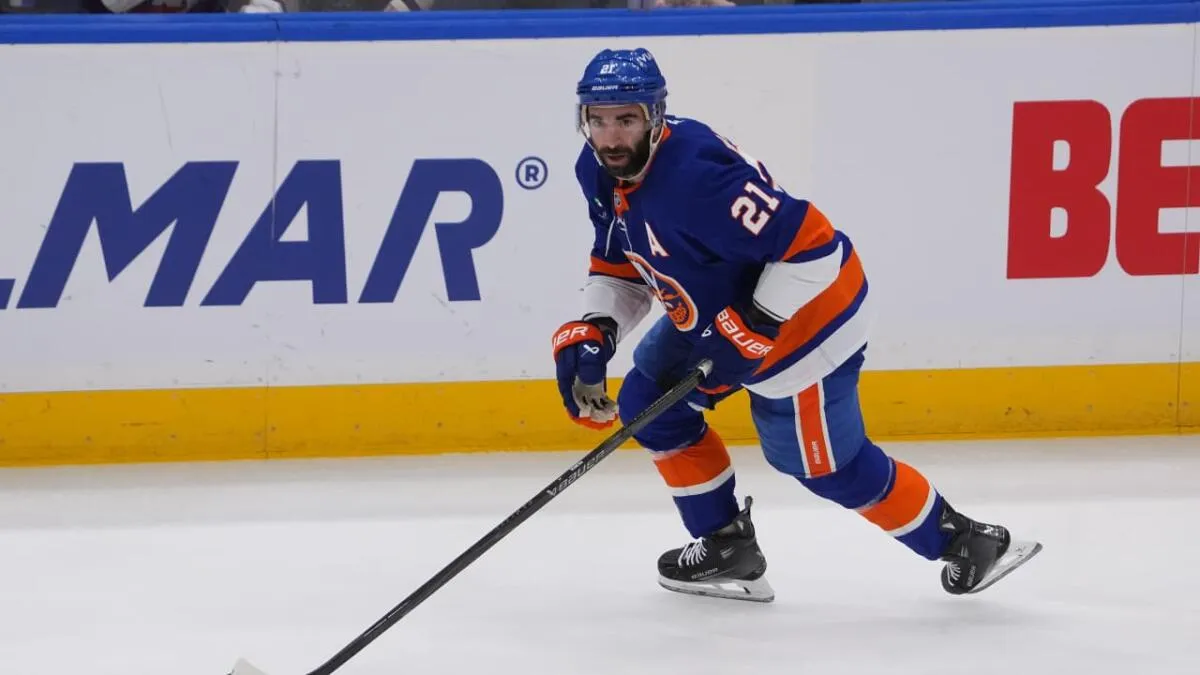
The injury that changed everything for Kyle Palmieri and the Islanders
The incident occurred early in the second period during a seemingly routine puck battle in the corner. As Palmieri engaged with Drysdale, his left leg twisted awkwardly underneath him, immediately sending him to the ice in visible discomfort. Cameras captured him grimacing as he struggled to get back on his feet, immediately signaling to the bench that something was seriously wrong.
Despite the obvious pain, Palmieri’s hockey instincts kicked in. While limping toward the exit, he noticed Andrae controlling the puck near the blue line. In a moment that demonstrated his incredible awareness and determination, Palmieri reached out with his stick, stripped the puck, and made a precise pass to Drouin before finally allowing trainers to escort him to the locker room. The play resulted in the Islanders’ first goal of the afternoon, providing a brief spark in what would become a 4-3 shootout loss.
Head coach Patrick Roy’s postgame comments suggested the team feared the worst immediately. “He’ll see the doctor tomorrow,” Roy told reporters. “But I think everybody knows it doesn’t look very good.” The veteran coach’s somber tone reflected the gravity of losing such a vital two-way contributor who touches every facet of the Islanders’ game plan.
The following day, medical imaging confirmed everyone’s worst fears: a complete tear of the anterior cruciate ligament in his left knee. The injury requires surgical intervention and an extensive rehabilitation process that will keep Palmieri off the ice for the remainder of the 2025 season and potentially impact his availability for the start of the 2026-2027 campaign.
Kyle Palmieri’s ironman streak ends at 223 consecutive games
Perhaps just as significant as the immediate on-ice impact is the symbolic weight of Palmieri’s consecutive games streak coming to an end at 223 games—the longest among all Islanders players by a considerable margin. In a sport as physically demanding as hockey, where players routinely block shots and absorb contact, maintaining such durability represents an extraordinary achievement that speaks to Palmieri’s conditioning, pain tolerance, and sheer love for the game.
His availability had become something the Islanders could bank on night after night. While other players cycled in and out of the lineup with various ailments, Palmieri remained a constant presence, providing stability to a roster that has undergone significant transition in recent years. That reliability extended beyond simply dressing for games; he consistently delivered quality minutes in all situations, whether skating on the top line, anchoring the power play, or killing penalties.
The streak’s conclusion marks the end of an era for a player who prided himself on answering the bell every game. Teammates and coaches had come to view his presence in the lineup as automatic as the sunrise, making his absence feel particularly jarring for an organization that values consistency and veteran leadership above almost everything else.
Palmieri’s productivity this season made the loss even more painful from a competitive standpoint. Through 25 games, he had amassed 18 points (6 goals, 12 assists), placing him tied for second on the team in scoring. He was on pace for one of the most productive seasons of his 16-year NHL career, demonstrating that age had not diminished his offensive capabilities or his ability to contribute in crucial moments.
How Kyle Palmieri torn ACL 6-8 months impacts Islanders roster construction
The timing of this injury creates a cascading set of challenges for Islanders general manager Mathieu Darche and the front office. Palmieri is currently in the first year of a two-year, $9.5 million contract extension signed in May, meaning his $4.75 million cap hit will remain on the books while he recovers. Unlike some long-term injury situations, this doesn’t provide immediate salary cap relief that could facilitate a replacement acquisition.
His absence creates a leadership vacuum in a locker room already navigating a delicate balance between veteran stalwarts and emerging younger talent. Palmieri served as a bridge between generations, having played with and learned from legendary Islanders like Anders Lee while mentoring newcomers including Oliver Wahlstrom and Simon Holmström. His voice in the room carried weight because his work ethic and toughness were never questioned.
On the ice, the Islanders lose a rare player who genuinely touched every aspect of the game. Consider his diverse responsibilities:
- Top-six forward minutes with responsibility for generating offense
- Power play net-front presence where his hand-eye coordination created deflections and rebounds
- Penalty kill specialist using his hockey IQ to break up opposing rushes
- Defensive zone starts in crucial late-game situations
- Stabilizing presence on any line when other players experienced slumps
This versatility made him irreplaceable in the truest sense. While the Islanders have depth pieces who can fill one or two of these roles, finding a single player who can replicate Palmieri’s complete game profile is virtually impossible. The team will likely need to adjust its entire tactical approach rather than simply plugging in a direct replacement.
Teammate reactions to Kyle Palmieri’s devastating injury
The respect Palmieri commands within the Islanders locker room became immediately apparent through the heartfelt reactions from teammates and coaches following Friday’s game. Captain Anders Lee, who has shared a dressing room with Palmieri for years, provided particularly poignant commentary on his teammate’s toughness and character.
“He’s one of the toughest teammates I know,” Lee told reporters. “It takes a lot for him to feel pain and get keeled over, but you can also see how strong he is to battle through and make a huge play. That gave us a spark.”
Defenseman Scott Mayfield, who knows firsthand the pain of blocking shots and playing through injuries, expressed admiration for Palmieri’s determination to contribute despite being severely compromised. “I’ve been on that end where you block a shot or whatever happens, you just want to get off,” Mayfield said. “For him to stay with it and make a really good play, that was good to see.”
Even opponents recognized the extraordinary nature of Palmieri’s assist. Social media erupted with clips of the play, with the popular hockey podcast Spittin’ Chiclets tweeting “ASSIST OF THE YEAR FROM KYLE PALMIERI” alongside video of the sequence. While the highlight provided momentary levity, the underlying concern about Palmieri’s health dominated postgame discussions across the hockey world.
Coach Roy’s assessment captured the organization’s sentiment perfectly. Having coached many tough players throughout his Hall of Fame career, Roy understood immediately that someone of Palmieri’s caliber wouldn’t stay down unless the injury was severe. His matter-of-fact acknowledgment that “it doesn’t look very good” resonated with fans who have seen this scenario play out too many times with key contributors.
What Kyle Palmieri torn ACL 6-8 months means for Islanders playoff hopes
The Islanders entered the season with aspirations of returning to the playoffs after narrowly missing the postseason last year. Palmieri’s strong start had been a driving force behind their competitive positioning in the Metropolitan Division. His 18 points in 25 games represented crucial production from a veteran expected to shoulder offensive responsibility, especially during stretches when the team’s younger scorers experienced inconsistency.
Losing him for the remainder of the regular season forces other players into elevated roles they may not be ready to handle. The 6-8 month recovery timeline means Palmieri won’t return even if the Islanders qualify for the playoffs, potentially extending through the entire postseason and into the summer months. This long-range absence fundamentally alters the team’s ceiling and forces a recalibration of expectations.
Several Islanders must elevate their performance to compensate for Palmieri’s absence:
- Oliver Wahlstrom needs to translate his potential into consistent top-six production
- Simon Holmstrom must continue his development trajectory while handling increased minutes
- Jean-Gabriel Pageau may need to assume more offensive responsibility despite his natural two-way center role
- Maxim Tsyplakov and Kyle MacLean could see their ice time expand significantly
- Max Shabanov has already been inserted into the top power-play unit, a role he’ll likely retain
The injury also impacts GM Darche’s approach to the trade deadline. While the Islanders might have been buyers looking to augment their roster for a playoff push, Palmieri’s absence could shift priorities. The team may need to acquire a middle-six forward just to maintain current competitive levels, potentially at the cost of prospects or draft capital that would have been preserved for future seasons.
The ripple effect extends to the upcoming NHL Draft as well. The Islanders’ blog network has been analyzing how this injury might influence the team’s long-term planning, with some suggesting it could accelerate the timeline for promoting prospects or change the calculus on which positions need reinforcement in the draft. Check out detailed analysis of how this impacts the Islanders season at Kyle Palmieri torn ACL left knee 6-8 months: Islanders veteran forward faces lengthy recovery.
The road ahead for Palmieri and the Islanders organization
At 34 years old and playing in his 16th NHL season, Palmieri faces a challenging rehabilitation process that will test both his physical resilience and mental fortitude. ACL recoveries for athletes of his age require meticulous attention to detail. While modern sports medicine has made tremendous advances, returning to elite-level hockey after such a significant knee injury represents a daunting challenge for any player, particularly one whose game relies on quick cuts, board battles, and net-front physicality.
The veteran forward has amassed an impressive career resume: 276 goals and 545 points across 925 games with the Anaheim Ducks, New Jersey Devils, and Islanders. He signed his current contract with the understanding that he could provide meaningful contributions through his mid-30s, and this injury obviously complicates that timeline. Where his future production fits into the Islanders’ long-term plans remains an open question.
For the organization, Palmieri’s absence reinforces the fragility of a team’s championship window. The Islanders have carefully constructed a roster balancing veteran experience with youthful upside, but losing a core piece like Palmieri exposes how quickly those plans can unravel. His injury serves as a reminder that durability is a skill in itself, one that Palmieri had demonstrated masterfully until this devastating moment.
The team’s medical staff will oversee his surgery and initial recovery, but the real work begins during the grueling months of rehabilitation that follow. Islanders fans have seen players like Cal Clutterbuck and Casey Cizikas bounce back from significant injuries, providing hope that Palmieri can make a successful return. However, each athlete’s body responds differently to trauma, and the mental aspect of trusting a reconstructed knee in high-speed NHL situations cannot be underestimated.
Conclusion
Kyle Palmieri’s torn ACL and subsequent 6-8 month absence represents more than just a season-ending injury for a valuable contributor. It signals a turning point for an Islanders team that must now navigate the remainder of the campaign without one of its most versatile and respected veterans. The remarkable assist he delivered while injured will be remembered as a testament to his character, but the void he leaves in the lineup will be felt across every line and special teams unit.
The organization’s response to this challenge will define their season. Whether through internal development, strategic acquisitions, or tactical adjustments, the Islanders must find a way to replace not just Palmieri’s 18 points, but his leadership, reliability, and two-way presence. For a team built on structure and veteran savvy, losing a player of Palmieri’s caliber tests the very identity that has made the Islanders competitive.
As the team moves forward, Palmieri’s journey through rehabilitation will be closely watched. His return timeline extends well beyond this season, creating uncertainty about his role when he eventually does come back. For now, the Islanders must channel the same resilience their teammate displayed while hobbling off the ice, stealing a puck and creating a goal. If they can embody even a fraction of Palmieri’s toughness, they might just survive this significant setback. The latest updates on his recovery and the team’s adjustments can be found in ongoing coverage at Kyle Palmieri torn ACL 6-8 months: Islanders forward out with ACL injury.
Frequently Asked Questions

Par Mike Jonderson
Mike Jonderson is a passionate hockey analyst and expert in advanced NHL statistics. A former college player and mathematics graduate, he combines his understanding of the game with technical expertise to develop innovative predictive models and contribute to the evolution of modern hockey analytics.