





The Washington Capitals duo of goaltender Logan Thompson and winger Tom Wilson find themselves in vastly different positions as Team Canada prepares its 2026 Olympic roster for Milano Cortina. With the December 31 roster submission deadline rapidly approaching, both players have been making compelling cases for inclusion on hockey’s biggest stage. Thompson leads all NHL goaltenders in goals-against average and save percentage through the early season, yet remains conspicuously absent from Hockey Canada’s inner circle. Wilson, meanwhile, has evolved into a legitimate two-way threat who’s leading his team in scoring while maintaining the physical edge that has defined his career.
The contrast between their situations highlights the complex dynamics at play in Olympic roster selection. Performance alone doesn’t always guarantee a spot when past relationships, playing styles, and behind-the-scenes considerations factor into decisions that could define careers. As Canada’s general manager Doug Armstrong navigates a wealth of talent across all positions, the Capitals’ two hopefuls represent fascinating case studies in what it takes—or doesn’t take—to wear the maple leaf.
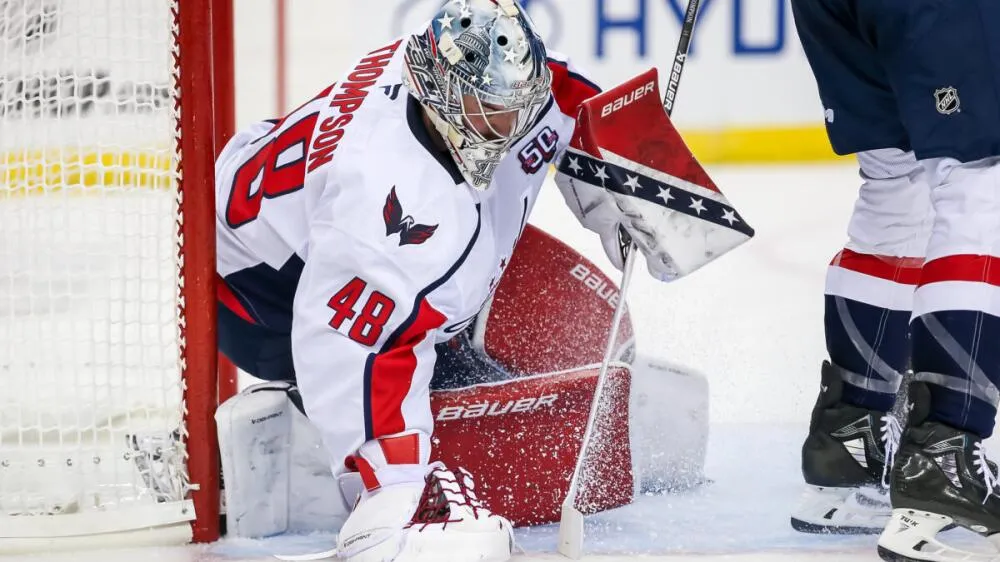
The Logan Thompson and Tom Wilson Team Canada 2026 Olympic roster debate intensifies
Team Canada’s goaltending situation remains one of the most contentious aspects of the 2026 Olympic roster construction. Thompson has put together an exceptional body of work over the past 13 months, yet he wasn’t invited to the summer orientation camp in Calgary while Jordan Binnington, Adin Hill, and Samuel Montembeault all received invitations. This snub came despite Thompson finishing fourth in Vezina Trophy voting last season with a 31-6-6 record and .910 save percentage for Washington.
Through the first eight games of the current season, Thompson has been nothing short of spectacular. His 1.51 goals-against average stands as the best in the NHL, and he’s maintained a save percentage that puts him at the top of the league’s netminding charts. Capitals head coach Spencer Carbery has been vocal in his support, stating that Thompson is “doing everything he can” to earn Olympic consideration.
The elephant in the room appears to be Thompson’s past relationship with his former coaches in Las Vegas. According to analyst Steve Valiquette, speaking on Sportsnet’s Real Kyper & Bourne, Bruce Cassidy and Peter DeBoer—both now involved with Team Canada’s coaching staff—“didn’t have a great experience with him in Vegas.” Valiquette suggested there were times the coaches wanted Thompson to play and he wasn’t available, adding cryptically that he knew details about the situation but couldn’t elaborate publicly.
Daily Faceoff’s Matt Larkin recently reported that Thompson “is not viewed as a good dressing room fit, particularly if his old Vegas teammate (Adin) Hill makes the team.” This persistent narrative has followed Thompson despite all evidence suggesting he’s integrated seamlessly into Washington’s locker room culture. The question becomes whether Hockey Canada will prioritize perceived chemistry concerns over undeniable on-ice performance.
Tom Wilson’s case for the Logan Thompson and Tom Wilson Team Canada 2026 Olympic roster conversation
Wilson’s path to Olympic consideration represents a different kind of uphill battle. Invited to the August orientation camp in Calgary, he wasn’t selected for the 4 Nations Face-Off roster despite Canada eventually embracing a physical, confrontational style in that tournament. The Toronto native has spent his career walking the line between effective power forward and disciplinary concern, and that reputation has likely cost him opportunities to represent his country.
The 31-year-old is currently leading the Capitals with six goals and seven assists through 12 games, while also ranking among the NHL’s top 25 hitters with 36 hits. He’s proven himself as more than just an enforcer, having scored a career-high 33 goals last season while adding 32 assists. Wilson’s game has evolved considerably from his early days as a one-dimensional physical presence, though questions persist about whether his style would translate to the typically penalty-happy IIHF officials at Olympic competition.
General manager Doug Armstrong has sent mixed signals about the type of roster he’s building. In comments to Sportsnet, Armstrong emphasized wanting “strong, hard defense that can play in front of our net” and “big, strong players that can play in hard areas.” He referenced Brian Burke’s famous “arrive with ill will” philosophy, suggesting Canada wants players who embrace physicality. On paper, that description fits Wilson perfectly.
The 4 Nations Face-Off proved that modern best-on-best hockey hasn’t lost its edge. The tournament featured line brawls, physical confrontations, and an intensity level that showcased why players like Wilson could be valuable assets. Team USA’s Brady and Matthew Tkachuk brothers set the tone with their aggressive approach, and one has to wonder if Wilson wouldn’t have thrived in that environment. If Hockey Canada expects similar intensity at the Olympics, Wilson’s omission would seem shortsighted.
International experience and the Logan Thompson and Tom Wilson Team Canada 2026 Olympic roster equation
Neither Thompson nor Wilson brings extensive international résumé credentials to their Olympic campaigns, which complicates their cases. Thompson’s only appearance in a Canadian jersey came at the 2022 World Championship, where he posted a 3-1 record with an .881 save percentage across four games, helping Canada earn a silver medal. It’s a small sample size that doesn’t particularly help or hurt his cause.
Wilson’s international experience is even more limited, confined entirely to junior competitions. He represented Canada at the 2011 World U17 Hockey Challenge and the 2011 Hlinka Gretzky Cup, contributing three points in five games during a gold medal run. However, he was cut from the final roster of the 2013 World Junior Championships and was prevented from participating in 2014 by the Capitals. At 31, he’s never worn the maple leaf in senior international competition.
This lack of international pedigree matters more for some players than others. Canada’s roster will be anchored by proven veterans like Sidney Crosby, Connor McDavid, and Nathan MacKinnon—players who’ve represented their country at multiple tournaments. The supporting cast often includes players who’ve built trust with Hockey Canada brass through repeated opportunities at World Championships and other events. Thompson and Wilson are largely unknown quantities in that ecosystem.
The irony is that both players have succeeded at the NHL’s highest level, with Thompson proving himself as an elite goaltender and Wilson establishing himself as a top-six forward capable of producing offense while maintaining his physical identity. Their NHL résumés should speak loudly, yet Hockey Canada appears to be weighing other factors just as heavily—if not more so—in its deliberations.
What the Logan Thompson and Tom Wilson Team Canada 2026 Olympic roster decisions reveal
The situations facing Thompson and Wilson illuminate the subjective nature of international roster selection. Thompson appears to be the victim of personal history with decision-makers, a circumstance that has nothing to do with his current performance level or his fit within his current team. If the reports about his Vegas relationships are accurate, he’s being punished for conflicts that occurred under a previous employer, in a different environment, years ago.
Wilson’s case highlights the tension between traditional hockey values and modern international game management. Canada wants toughness and physicality, yet seems hesitant to fully commit to a player who embodies those qualities because of concerns about how IIHF officials might officiate his style of play. It’s a conservative approach that prioritizes risk mitigation over potential reward, even as other countries—particularly the United States—seem willing to embrace players with similar profiles.
The December 31 deadline looms large for both players. Thompson needs to maintain his exceptional play while hoping Hockey Canada values performance over personal history. Wilson must continue producing offensively while demonstrating the discipline that suggests he can adapt his game to international standards. Neither player controls the narrative around their candidacies, which may be the most frustrating aspect of their situations.
What makes these cases particularly compelling is that both players are having career-defining seasons at exactly the right time. Thompson is playing the best hockey of his life when Olympic scouts are watching most closely. Wilson is proving he’s more than just a physical presence, showcasing offensive abilities that make him a legitimate top-six option. Whether Hockey Canada recognizes these contributions with roster spots remains uncertain.
The Logan Thompson and Tom Wilson Team Canada 2026 Olympic roster deliberations will ultimately reveal what Hockey Canada values most: pure performance, personal relationships, or perceived roster balance. Both Capitals have done everything within their control to earn consideration, yet both face obstacles that have little to do with their play on the ice. As the roster deadline approaches, hockey fans in Washington and across Canada will be watching closely to see if merit wins out over politics in the selection process. Thompson’s goaltending excellence deserves recognition on the world stage, while Wilson’s evolved game offers Canada a dimension few other players can provide. Whether Armstrong and his staff agree will become clear in the coming weeks, but the debate itself underscores the depth of talent Canada possesses—even among players who might not make the final cut.

Par Mike Jonderson
Mike Jonderson is a passionate hockey analyst and expert in advanced NHL statistics. A former college player and mathematics graduate, he combines his understanding of the game with technical expertise to develop innovative predictive models and contribute to the evolution of modern hockey analytics.