





The Calgary Flames entered the 2025-26 season with modest expectations, understanding that a full rebuild might still be a year or two away. However, even the most pessimistic projections couldn’t have predicted the struggles that would plague one of their most reliable performers. MacKenzie Weegar, the veteran defenseman who had established himself as arguably Calgary’s most complete player over the past two seasons, has experienced a dramatic decline that has left fans and analysts searching for answers. His early-season struggles have become emblematic of a team that sits dead last in the NHL standings, and the ripple effects extend far beyond simple box scores.
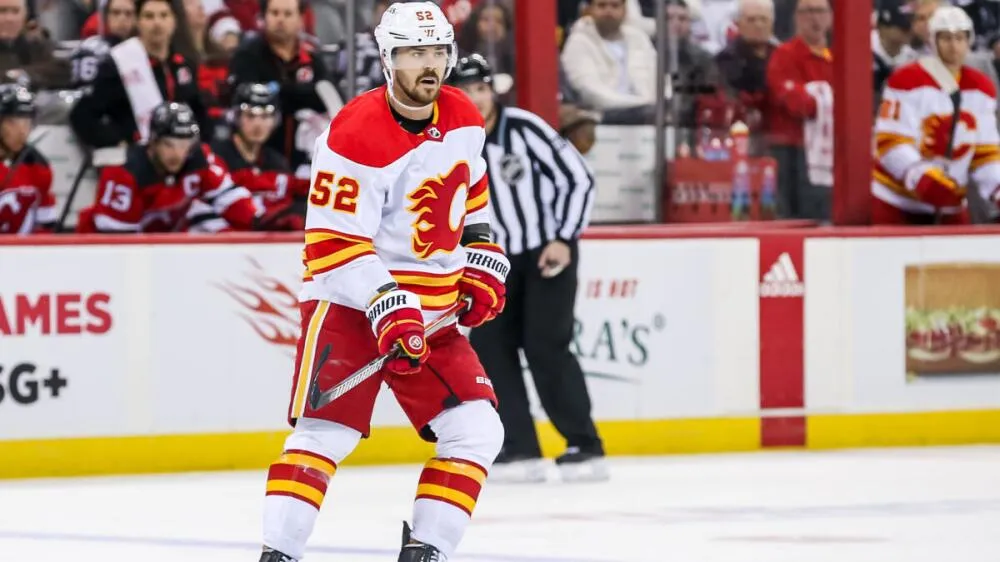
The numbers paint a grim picture for a player who built his reputation on defensive reliability. Through 15 games, Weegar posted a team-worst minus-11 rating, ranking third-worst in the entire NHL. For context, this represents a stunning reversal for a defenseman who has been a plus player for much of his career, including maintaining strong possession metrics throughout his tenure in Calgary. The advanced analytics tell an even more concerning story, as his giveaway total of 25 leads all Flames skaters and sits eighth among all NHL players.
These defensive miscues have manifested in various ways throughout the early season. Whether it’s mishandling the puck in the defensive zone, making poor decisions under pressure, or losing track of assignments, Weegar has looked uncharacteristically rattled. The confidence that defined his play during his career-best 2023-24 campaign—when he scored 20 goals and 52 points—seems to have evaporated. The mistakes aren’t isolated to one area either; they’ve occurred at even strength, on the penalty kill, and during crucial moments when Calgary needs veteran steadiness most.
What makes these struggles particularly puzzling is that Weegar isn’t dealing with reduced ice time or a diminished role. He continues to lead all Flames players with an average of 24:29 minutes per game, demonstrating that head coach Ryan Huska maintains faith in his veteran defender despite the poor results. This heavy workload, however, may be part of the problem rather than a vote of confidence. With limited depth on Calgary’s blue line beyond Weegar and Rasmus Andersson, there’s little room for rest or the ability to shelter struggling players.
The giveaway total deserves particular scrutiny when examining Weegar’s defensive breakdowns. Twenty-five turnovers in 15 games translates to more than 1.6 giveaways per game, a rate that’s simply unsustainable for a top-pairing defenseman. These aren’t always high-danger turnovers directly leading to goals, but they contribute to sustained defensive zone pressure and force Calgary’s goaltenders—primarily Dustin Wolf—to face more shots and more difficult situations than necessary. Each giveaway represents a lost opportunity to transition to offense and puts additional strain on a team already struggling to generate consistent scoring.
The physical toll of playing nearly 25 minutes per night cannot be understated either. At 30 years old, Weegar is entering the phase of his career where recovery becomes more challenging and cumulative fatigue can manifest in split-second decision-making errors. The Flames’ overall poor record means that many of those minutes come while defending leads that don’t exist or desperately trying to mount comebacks, which adds mental fatigue to the physical demands. It’s a vicious cycle: the team performs poorly, requiring more from their veterans, which in turn leads to diminished individual performance.
Offensive production dries up for Calgary Flames’ top defenseman
While defensive struggles represent the most alarming aspect of Weegar’s early-season performance, his offensive disappearance compounds the problem for a Flames team desperately seeking scoring from all sources. His four assists through 15 games represent a massive decline from his standard production rate, especially considering he averaged nearly a point every two games over the previous two seasons. More concerning is the complete absence of goals—Weegar has yet to find the back of the net after scoring 20 goals just two seasons ago and maintaining steady offensive contributions throughout his Calgary tenure.
The offensive drought extends beyond simple counting stats. Weegar’s role on Calgary’s power play has remained intact, yet he’s failed to generate the same dangerous chances that made him such a valuable weapon with the man advantage. His heavy shot from the point, once a reliable source of goals and rebounds, has either missed the net entirely or been blocked before reaching the goaltender. The passing vision that created opportunities for teammates has similarly vanished, with telegraphed plays and missed connections becoming far too common.
Zone entries and transitions represent another area where Weegar’s offensive impact has diminished significantly. In previous seasons, his ability to carry the puck out of the defensive zone or make quick, accurate outlet passes served as the catalyst for Calgary’s offensive rushes. This season, those attempts have resulted in turnovers or neutral zone dumps that sacrifice possession and momentum. Without that reliable first-pass option, the Flames’ offensive structure has suffered, creating a cascading effect throughout their forward lines.
The confidence factor plays a massive role in offensive production for defensemen. When shots aren’t going in and passes aren’t connecting, there’s a natural tendency to second-guess decisions or defer to teammates rather than asserting oneself. Weegar appears to be caught in this psychological trap, hesitating on opportunities where he previously would have attacked without thought. This hesitation not only reduces his personal production but also disrupts the timing and rhythm of Calgary’s offensive schemes, as teammates anticipate actions that never materialize.
Olympic dreams fade amid disappointing stretch for MacKenzie Weegar
The timing of Weegar’s struggles carries particularly cruel implications for his international aspirations. After being invited to Canada’s Olympic orientation camp this past summer, he appeared positioned for serious consideration for the 2026 Milan Olympics roster. That invitation represented validation of his elite status and suggested that Hockey Canada viewed him as a legitimate option for their deep defensive corps. However, the compressed scouting period before Olympic rosters are announced in early 2026 means that recent performance weighs heavily on selection committees.
The competition for Canadian defensive spots is fierce even in the best of circumstances. With established stars like Cale Makar, Quinn Hughes, and Shea Theodore virtual locks, and several other defensemen performing at high levels to start the season, Weegar needed to maintain his standard of play simply to remain in consideration. Instead, his poor start has likely removed him from the conversation entirely, barring a dramatic turnaround in the coming months. While there’s technically still time to salvage his Olympic hopes, every game of subpar performance makes the climb steeper.
The psychological pressure of chasing an Olympic dream may itself be contributing to Weegar’s struggles. Athletes often perform best when focused entirely on the present rather than future rewards or recognition. If Weegar is playing with Olympic selection weighing on his mind, that added pressure could manifest in the tentative play and uncharacteristic mistakes that have defined his season. It becomes a self-fulfilling prophecy: the desire to play well enough for Olympic consideration creates tension that leads to poor performance, which further damages those Olympic chances.
Beyond the individual disappointment, missing Olympic selection would represent a significant career milestone unreached. At 30 years old, Weegar may not have another realistic opportunity to represent Canada on hockey’s biggest stage. The 2030 Olympics remain a distant possibility, but projecting four years into the future for a defenseman who would then be 34 involves considerable uncertainty. For a player who has worked his way from undrafted free agent to NHL regular to genuine star, representing his country would have served as the ultimate validation of his journey.
What Calgary Flames need from Weegar moving forward this season
The Flames’ situation demands improvement from their veteran defenseman, regardless of Olympic considerations or individual accolades. Calgary’s coaching staff, already under pressure after a disastrous start, needs Weegar to rediscover the form that made him indispensable. This begins with simplifying his game and focusing on the fundamental aspects that created his success: strong positioning, smart first passes, and physical presence along the boards and in front of the net. The highlight-reel plays and offensive creativity can return naturally once the foundation is re-established.
One potential solution involves temporary adjustments to Weegar’s deployment. While he’ll continue logging heavy minutes given Calgary’s limited defensive depth, the coaching staff could consider sheltering him from the most difficult matchups for a brief period. Allowing Rasmus Andersson to handle the toughest assignments while Weegar focuses on rebuilding confidence against secondary lines might provide the breathing room necessary for a reset. This approach carries risks—Andersson can’t carry the entire defensive burden alone—but desperate times may call for creative solutions.
The power play represents perhaps the best opportunity for Weegar to rebuild his confidence through offensive production. A goal or even a primary assist could serve as the spark that reignites his season, and the man-advantage provides more time and space to execute plays. The coaching staff should ensure Weegar receives quality opportunities in the offensive zone during power plays, positioning him for one-timer chances and encouraging him to shoot more frequently. Sometimes the simplest solution—just getting pucks to the net—can break through mental barriers.
Communication and support from teammates and coaching staff will prove crucial during this challenging stretch. Veteran leaders like Jonathan Huberdeau and Nazem Kadri, who have experienced their own early-season struggles before finding their games, can provide perspective and encouragement. The coaching staff must balance accountability with support, holding Weegar to high standards while also providing the tools and adjustments necessary for improvement. Public criticism or benching might satisfy frustrated fans but could further damage a player’s confidence when the goal should be restoration, not punishment.
Mental preparation and routine evaluation deserve attention as well. Working with sports psychologists or mental performance coaches could help Weegar identify whether external pressures or internal expectations are contributing to his poor play. Sometimes struggles stem from technical issues that video study and practice can address, but other times the problems are purely mental—between the ears rather than in the hands or feet. There’s no shame in seeking that assistance; the best athletes in any sport utilize mental performance resources to maintain their edge.
The remainder of the season offers Weegar approximately 65 games to salvage both his campaign and potentially his Olympic dreams, though the latter grows more distant with each passing week. For the Calgary Flames, however, the equation is simpler: they need their best defenseman playing like one. The team’s slim playoff hopes depend on multiple factors aligning, but none of those factors matter if their highest-paid defenseman continues performing below replacement-level standards. Whether motivated by Olympic aspirations, professional pride, or loyalty to teammates, Weegar must find answers soon. The early struggles of the 2025-26 season have created a hole that deepens with each game, and climbing out requires immediate, sustained improvement rather than hoping the problem resolves itself. Calgary’s season may already be slipping away, but Weegar still has the opportunity to ensure his personal campaign doesn’t follow the same trajectory.

Par Mike Jonderson
Mike Jonderson is a passionate hockey analyst and expert in advanced NHL statistics. A former college player and mathematics graduate, he combines his understanding of the game with technical expertise to develop innovative predictive models and contribute to the evolution of modern hockey analytics.