











The Toronto Maple Leafs’ October and November stretch has left fans and analysts scratching their heads. The team started sluggish, briefly showed flashes of brilliance in early November, then suddenly cratered into a slump so severe it threatened to derail their entire season. But here’s what makes this different from typical losing streaks: the avalanche of injuries was announced after the poor play began, not before.
Veteran hockey observers know something doesn’t add up. Teams usually struggle because key players get hurt. The Maple Leafs were struggling first, then the injury reports started flowing. This reversal suggests something deeper was happening behind closed doors at Scotiabank Arena—something the organization wasn’t ready to acknowledge until the losses forced their hand.
The seven regulars who vanished without warning
By mid-November, Toronto found itself without seven regular contributors. Auston Matthews, Matthew Knies, Nicolas Roy, Scott Laughton, Chris Tanev, Brandon Carlo, and Anthony Stolarz all disappeared from the lineup within a compressed timeframe. What made this unusual wasn’t just the volume—it was the manner of their departures.
Most hockey injuries come with highlight-reel collisions or obvious moments of distress. A player crumples after blocking a shot, grabs his knee after an awkward fall, or slowly skates to the bench holding his wrist. These Maple Leafs injuries? They materialized as lines on a morning skate report. No clear inciting incidents. No dramatic exits. Just names suddenly appearing on the injury list with vague designations like “lower body” or “upper body.”
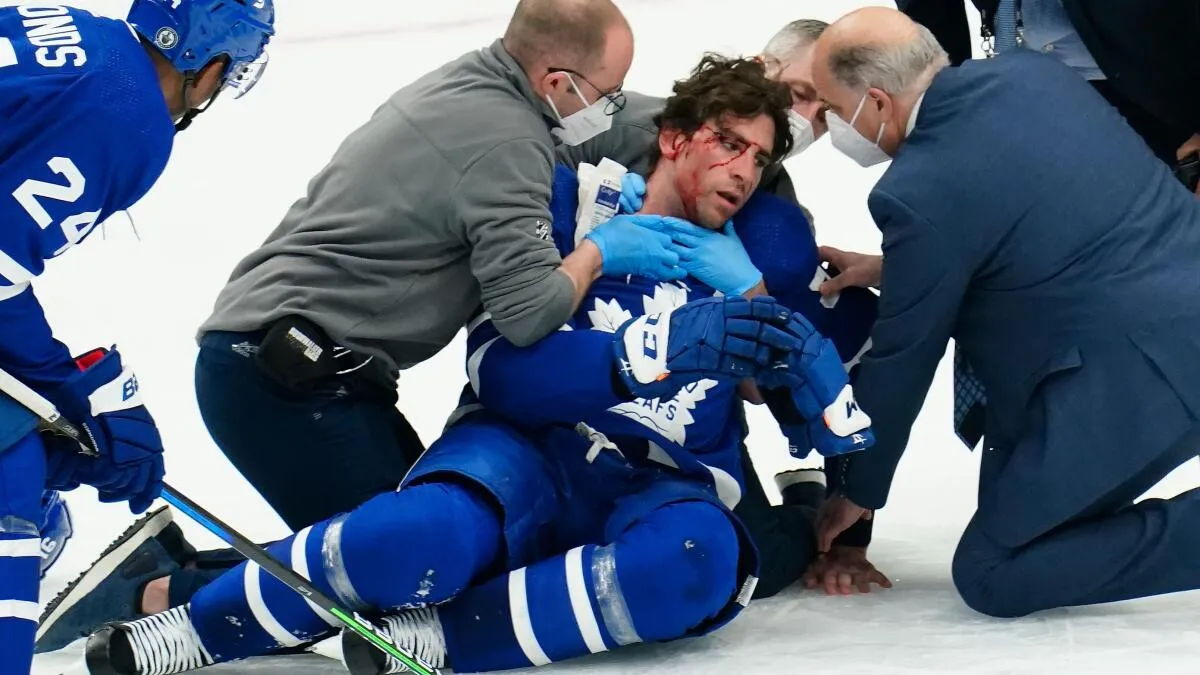
The mystery deepened with each absence. Matthew Knies became a late scratch before a game against St. Louis, his first missed action despite showing no obvious distress in previous contests. Anthony Stolarz left the Boston game in the first period, but the severity only became clear days later when coach Craig Berube admitted the injury was “worse than we thought.” Chris Tanev’s situation was perhaps most alarming—stretchered off after an awkward hit from Philadelphia’s Matvei Michkov on November 1, then placed on long-term injured reserve without any concrete timeline for return.
Understanding hockey’s hidden injury timeline
What fans saw publicly told only part of the story. The on-ice product in October suggested a team skating through mud—slow reads, loose coverage, and an unusual generosity with odd-man rushes against. They looked tired despite no scheduling excuse for fatigue. The standard explanation would be poor chemistry or systems issues, but the subsequent injury revelations opened another possibility: they were playing hurt all along.
The sequence matters more than most realize. Poor performance typically triggers lineup changes, not medical disclosures. But in Toronto’s case, the losing seemed to affect the injury admissions. This suggests a culture where players were attempting to push through manageable discomfort until the team’s slide made their diminished effectiveness impossible to hide any longer.
Why hockey players hide their pain
NHL culture treats playing through injury as a badge of honor. It’s not just tolerated—it’s expected. By November, most locker rooms resemble triage units, with half the roster held together by tape, painkillers, and stubborn pride. Ankles, wrists, groins, and backs become daily negotiations between player, trainer, and coach.
This mentality creates a dangerous feedback loop. A player nursing a minor issue tries to play through it, his performance dips slightly, the team struggles, and suddenly what was manageable becomes a legitimate problem. The Maple Leafs’ situation appears to be a textbook example of this phenomenon played out across multiple bodies simultaneously.
The psychology is complex. During a winning streak, pain gets dismissed as part of the job. The team is succeeding, so individual sacrifice feels noble and necessary. But when losses pile up, that same pain becomes a potential excuse—a reason you’re letting teammates down. Players who would never admit weakness during good times suddenly find themselves having conversations with trainers they should have had weeks earlier.
The Maple Leafs’ specific injury culture
Toronto has developed a reputation for secrecy around injuries. The organization rarely provides detailed timelines or specific diagnoses, preferring vague updates that leave fans and media guessing. While this approach theoretically protects players from targeted attacks on known weaknesses, it also creates an information vacuum that breeds speculation.
Coach Craig Berube’s coaching style likely amplifies this dynamic. His demanding, accountability-first approach could make players hesitant to admit limitations, fearing they’ll be seen as making excuses or letting the team down. The result is a roster where injuries fester until they become impossible to conceal with normal performance levels.
The Matthews question: A captain’s burden
Auston Matthews’ situation crystallizes the entire mystery. The captain sustained a lower-body injury from a Nikita Zadorov hit on November 11 in Boston—a clear, documentable event. But his subsequent absence, and the team’s struggles before and after, raises questions about his condition leading up to that moment.
Matthews is skating again, participating in team practices while wearing a grey non-contact jersey. Yet coach Berube lists him as “doubtful” for upcoming games. This careful, deliberate recovery process suggests the organization has learned its lesson about pushing star players before they’re ready. The question remains: was Matthews already managing discomfort before the Zadorov hit, and did that make him more susceptible to a serious injury?
The math is sobering. Toronto’s offense was already sputtering before losing their best goal-scorer. Their power play looked disjointed. Defensive coverage was spotty. These systemic issues don’t typically spring from one player’s absence—they’re team-wide problems that suggest multiple players operating below 100 percent.
The goaltending mystery deepens
Anthony Stolarz’s injury timeline reveals the organization itself might not have understood the severity initially. He “stretched out” something upper-body against Boston on November 11, but Berube’s subsequent admission that the injury was “obviously worse than we thought” indicates a possible misdiagnosis or underreporting of symptoms.
Goaltenders face unique pressure to hide injuries. With only two netminders on a roster, admitting weakness means immediately increasing your partner’s workload and forcing management to call up an unproven AHL player. This dynamic might explain why Stolarz attempted to play through discomfort until his body simply couldn’t continue.
The victory that proved the theory
In perhaps the most ironic twist, Toronto delivered one of its most complete performances of the season with seven regulars missing from the lineup. The call-ups played with desperation, the veterans simplified their games, and everyone bought into a basic, structured approach. The result was a win that shouldn’t have been possible by traditional roster-strength analysis.
This paradox supports the “playing hurt before anyone knew it” theory. The remaining healthy players, combined with fresh, eager reinforcements from the AHL, created a roster that was actually more effective than the one struggling at full strength (or what appeared to be full strength). The game plan became straightforward: play simple, hard hockey without the complications of managing multiple nagging injuries across the lineup.
Sometimes clarity only comes after catastrophe. When the injured players finally admitted their limitations and stepped aside, the remaining team could stop guessing about line combinations and ice time distribution. The lineup was what it was, and everyone understood their role. That simplicity produced better hockey than the complicated calculus of trying to integrate partially-injured stars.
What this means for the playoff push
Toronto’s injury situation has created both challenges and opportunities. On one hand, losing seven regulars strains the organization’s depth and tests the durability of the remaining players. The team enters a crucial five-game road trip with a depleted roster, relying heavily on Joseph Woll in net and hoping for continued contributions from young players like Easton Cowan.
On the other hand, the crisis has forced the Maple Leafs to discover what they truly have in their system. Players who might never have received NHL opportunities are gaining valuable experience. The coaching staff is learning which combinations work when egos and salary considerations are removed from the equation. This knowledge becomes invaluable later in the season when tough lineup decisions inevitably arise.
The cap implications are significant as well. Multiple players on long-term injured reserve creates flexibility for roster moves, but also means the team will face difficult decisions when those players become healthy again. Toronto’s front office must balance short-term survival against long-term roster construction.
The hidden truth behind Toronto’s struggles
The Maple Leafs’ early-season slump might fundamentally change how we evaluate teams during mysterious downturns. Bad hockey doesn’t always mean bad systems, poor coaching, or lack of effort. Sometimes it means a roster full of warriors hiding pain that would send ordinary people to bed for a week.
This isn’t an excuse—every NHL team deals with injuries. But the concentration and timing of Toronto’s injury wave suggests a unique scenario where multiple players crossed the threshold from “playable hurt” to “unable to contribute” simultaneously. The losing streak likely accelerated this process, as players who could justify playing through pain during wins found it harder to make the same case during losses.
The real lesson is about transparency. Teams that create cultures where players can admit limitations early might prevent the cascading failures Toronto experienced. A player who sits out two games in late October with a minor issue might prevent a four-week absence in November. The Maple Leafs learned this lesson the hard way, and their season’s fate depends on how well they apply it going forward.
Toronto’s challenge now is maintaining the simple, honest hockey they played with their depleted roster while reintegrating stars who must resist the temptation to overcompensate upon returning. The playoff race in the Atlantic Division waits for no one, and the Maple Leafs have already burned much of their margin for error. Whether they can turn this mystery into momentum will determine their fate in the 2025-26 season.
Frequently Asked Questions

Par Mike Jonderson
Mike Jonderson is a passionate hockey analyst and expert in advanced NHL statistics. A former college player and mathematics graduate, he combines his understanding of the game with technical expertise to develop innovative predictive models and contribute to the evolution of modern hockey analytics.