










The Mason Marchment trade to Columbus Blue Jackets for two draft picks represents a significant midseason roster shakeup for two struggling franchises. Just hours before the NHL’s holiday roster freeze took effect on December 20, the Seattle Kraken dealt the veteran forward to Columbus, recouping valuable draft capital while freeing up salary cap space. The move ends Marchment’s brief tenure in Seattle after just 29 games, sending him to his fifth NHL organization in a career marked by perseverance and offensive production.
This transaction underscores the divergent paths both teams are navigating early in the season. Columbus sits tied for last in the ultra-competitive Eastern Conference despite being in playoff contention, while Seattle finds itself tied for last in the Western Conference after a brutal stretch that has seen them lose 10 of their last 11 games. The trade provides each club with different tools to address their respective challenges moving forward.
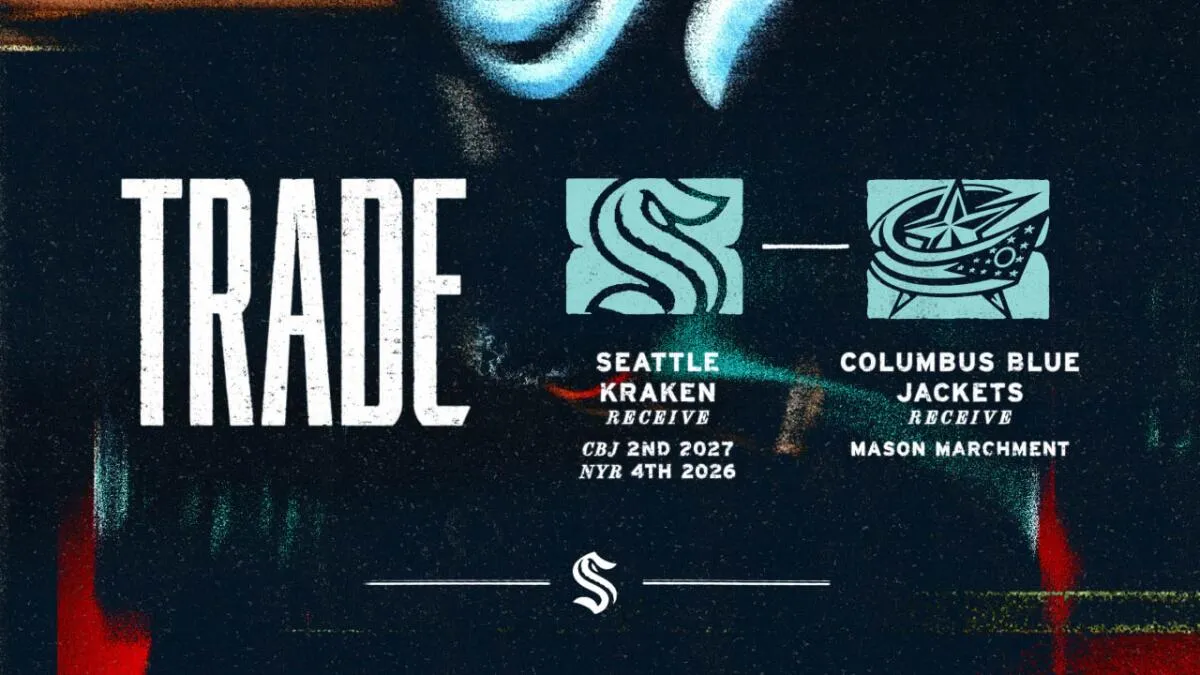
Details of the Mason Marchment trade to Columbus Blue Jackets for two draft picks
The Blue Jackets acquired Mason Marchment from the Kraken in exchange for two future draft selections. Columbus sent a second-round pick in the 2027 NHL Draft and a fourth-round pick in the 2026 NHL Draft to Seattle, with the latter selection originally belonging to the New York Rangers. No salary was retained in the transaction, meaning Columbus assumes the full remaining value of Marchment’s contract.
The timing proved crucial, as the deal materialized on the final day available for player movement before the league’s holiday roster freeze. Starting at midnight on December 20, teams cannot make trades until December 28, forcing both front offices to finalize terms quickly. The compressed timeline makes this agreement particularly notable for its efficiency and the clear motivations driving both sides.
Marchment, 30, finds himself on the move less than six months after the Kraken acquired him from the Dallas Stars. Seattle had given up a 2025 fourth-round pick (Brandon Gorzynski) and a 2026 third-round pick to bring the Ontario native to the Pacific Northwest in June. This latest trade represents a net gain in draft capital for Seattle, turning those earlier assets into higher-value selections while shedding a contract that no longer fit their plans.
Mason Marchment’s journey through the NHL
The undrafted forward’s path to Columbus exemplifies persistence in professional hockey. Mason Marchment didn’t break into the NHL until age 24, debuting with the Toronto Maple Leafs during the 2019-20 season. His career trajectory includes stops with the Florida Panthers, where he enjoyed his most productive offensive season with 47 points in 54 games during the 2021-22 campaign, and the Dallas Stars, who signed him to a four-year, $18 million contract in July 2022.
Marchment’s pedigree includes being the son of longtime NHL defenseman Bryan Marchment, giving him an insider’s understanding of league culture and expectations. His physical tools stand out at 6-foot-4 and 220 pounds, making him an imposing presence on the wing. Throughout his 331 career games, he’s demonstrated consistent scoring ability with 80 goals and 202 points while racking up 284 penalty minutes that reflect his hard-nosed playing style.
The forward’s time in Seattle proved disappointing statistically. Through 29 games, Marchment managed just 13 points (4 goals, 9 assists), a significant drop from the 22 goals he scored in each of his final two seasons with Dallas. His ice time averaged just under 17 minutes per game, and he struggled to find chemistry within the Kraken’s system despite showing occasional flashes like his two-goal performance against Utah last week.
Columbus Blue Jackets’ perspective on the Mason Marchment trade
Blue Jackets general manager Don Waddell expressed strong enthusiasm for adding Marchment to his roster. “Mason is a player I know very well, and I think he will add a great deal to our team,” Waddell stated following the trade. “He is a physical, hard-nosed competitor with proven offensive ability and we are very excited to have him join the Blue Jackets.”
Waddell’s familiarity with Marchment dates back to his tenure as general manager in Carolina, where he tracked the forward’s development and reportedly maintained interest over several seasons. The Blue Jackets currently rank 21st in NHL scoring at 2.88 goals per game, making Marchment’s potential offensive contribution particularly valuable for a team fighting to climb the Eastern Conference standings.
Columbus enters the holiday break with a 14-14-6 record, sitting at .500 but still searching for consistency. The team has battled through injuries and roster adjustments throughout the early season, and Marchment’s experience could provide stability in the middle-six forward group. His two-way capabilities and physical presence address multiple needs for a franchise aiming to return to playoff relevance after several seasons of rebuilding.
The acquisition cost reflects minimal risk for Columbus. While second-round picks carry value, the Blue Jackets prioritized immediate roster improvement over future assets. Marchment’s expiring contract also provides flexibility—if he excels, they can negotiate a new deal; if he doesn’t fit, they gain salary cap space for other moves.
Seattle Kraken’s motivation for moving Mason Marchment
The Kraken’s decision to trade Marchment stems from multiple factors. General manager Jason Botterill acknowledged the organization’s need for flexibility, stating, “This trade gives us more draft capital and flexibility as we look to improve our team moving forward.” Seattle’s disappointing season—featuring a 1-9-1 record over their last 11 games and no regulation wins since November 20—forced management to reevaluate roster construction.
Financial considerations played a significant role in the decision. Marchment carries a $4.5 million cap hit in the final season of his contract, a substantial commitment for a non-playoff team underperforming offensively. By shedding his salary without retention, Seattle creates immediate cap space for potential future acquisitions or internal contract extensions.
The Kraken’s slide to 12-14-6 places them seven points out of a Western Conference playoff spot, prompting organizational change. Moving Marchment opens opportunities for younger players to assume larger roles in the top-six and on the power play. Seattle’s prospect pipeline needs evaluation at the NHL level, and creating roster spots facilitates that development process.
From an asset management perspective, Botterill flipped a player acquired for mid-round picks into higher-value selections within months. While the on-ice results didn’t meet expectations, the front office demonstrated an ability to efficiently manage their roster and maintain future flexibility. The additional draft capital strengthens Seattle’s position for upcoming drafts, where they can target prospects or use selections as trade chips.
Strategic implications of the Mason Marchment trade to Columbus Blue Jackets for two draft picks
This transaction highlights how NHL teams approach midseason roster management differently based on their circumstances. Columbus, despite struggling, believes it remains within striking distance of a playoff berth. Adding a veteran with Marchment’s track record represents a low-risk, potentially high-reward move that could provide the offensive spark needed for a second-half surge.
The trade also reflects the premium NHL teams place on size and physicality without sacrificing skill. Marchment’s combination of 6-foot-4 frame, scoring touch, and competitive edge made him attractive to a Blue Jackets team seeking to balance its roster composition. His ability to play multiple forward positions gives coach Dean Evason lineup flexibility during crucial stretch games.
For Seattle, the deal signals a pragmatic acceptance of their current position while maintaining long-term vision. Rather than forcing an ill-fitting piece to work, Botterill cut losses and recouped assets. The Kraken’s expansion franchise status requires patience and asset accumulation, making draft picks particularly valuable for sustained success.
The timing before the holiday roster freeze created artificial urgency that likely influenced both teams’ negotiating positions. Columbus needed to add a piece before the break, while Seattle faced limited options for moving a struggling asset. This dynamic may have accelerated discussions that ultimately benefited both organizations.
What Mason Marchment brings to Columbus
Beyond his statistical profile, Marchment injects veteran perspective into a relatively young Blue Jackets locker room. Having participated in deep playoff runs with Dallas and experienced multiple organizations, he understands the intensity required for postseason pushes. His father’s NHL career provided additional insight into professional preparation and consistency.
Marchment’s playing style fits the Blue Jackets’ identity under Evason. He attacks the net aggressively, wins puck battles along the boards, and stands up for teammates when necessary. His 47-point season with Florida demonstrated top-six capability, while his defensive responsibility earned trust in Dallas’s structured system.
The forward’s versatility allows deployment across multiple line combinations. He can complement skilled playmakers by creating space and retrieving pucks, or he can drive offense on a checking line with his north-south skating and shooting ability. This adaptability proves invaluable during injury situations or when searching for chemistry.
Waddell specifically mentioned Marchment’s “proven offensive ability,” suggesting expectations for immediate production. The Blue Jackets rank among the league’s lowest-scoring teams, and Marchment’s history suggests he can contribute 15-20 goals over a full season if given appropriate opportunities and linemates.
Contract situation and future outlook
Marchment enters Columbus on an expiring contract, creating an intriguing dynamic for the remainder of the season. The $4.5 million cap hit represents significant investment but carries no long-term commitment. This arrangement essentially provides a high-end rental without sacrificing core assets, as Columbus gave up only future draft picks.
For Marchment personally, the trade offers a reset opportunity and a platform to showcase his value before unrestricted free agency. A strong second half could position him for another substantial contract, whether with Columbus or another team. He’ll be motivated to prove his Seattle struggles resulted from fit rather than declining ability.
The Blue Jackets maintain flexibility regarding his future. If Marchment excels and fits their culture, extension talks could begin as early as March. If not, they acquired a useful player for a playoff push without sacrificing long-term flexibility. This approach aligns with Waddell’s measured team-building philosophy.
Seattle’s decision not to retain salary highlights their confidence in finding better uses for that cap space. The Kraken face upcoming decisions on several young players requiring new contracts, making every dollar of cap room valuable for roster planning.
The Mason Marchment trade to Columbus Blue Jackets for two draft picks delivers immediate benefits to both franchises while carrying minimal long-term consequences. Columbus adds a proven, motivated veteran to a roster seeking offensive improvement and playoff positioning. Seattle gains valuable draft capital and salary flexibility as they retool during a disappointing season. For Marchment, the move provides fresh opportunity to demonstrate his value before hitting unrestricted free agency. The deal’s timing and structure reflect smart asset management from both front offices, addressing short-term needs without compromising future flexibility. As the NHL season resumes after the holiday break, all eyes will be on how quickly Marchment can integrate into the Blue Jackets’ system and whether this trade proves to be the catalyst Columbus needs for a second-half surge.
Frequently Asked Questions

Par Mike Jonderson
Mike Jonderson is a passionate hockey analyst and expert in advanced NHL statistics. A former college player and mathematics graduate, he combines his understanding of the game with technical expertise to develop innovative predictive models and contribute to the evolution of modern hockey analytics.