






Mathew Barzal fined $5,000 for two-handed slash on Mason Marchment
New York Islanders star forward Mathew Barzal will be $5,000 lighter after the NHL’s Department of Player Safety handed down the maximum allowable fine for his two-handed slash on Columbus Blue Jackets forward Mason Marchment. The incident, which occurred during Sunday’s game at Nationwide Arena, has sparked conversations about player protection, retaliation, and the consistency of NHL disciplinary actions.
The fine, announced Monday, came just hours after the Islanders fell 4-2 to the Blue Jackets in a game where emotions boiled over in the second period. While Barzal avoided suspension for his actions, the maximum financial penalty raises questions about where the line sits between defending a teammate and crossing into dangerous territory.
The incident: a knee-on-knee collision ignites tension
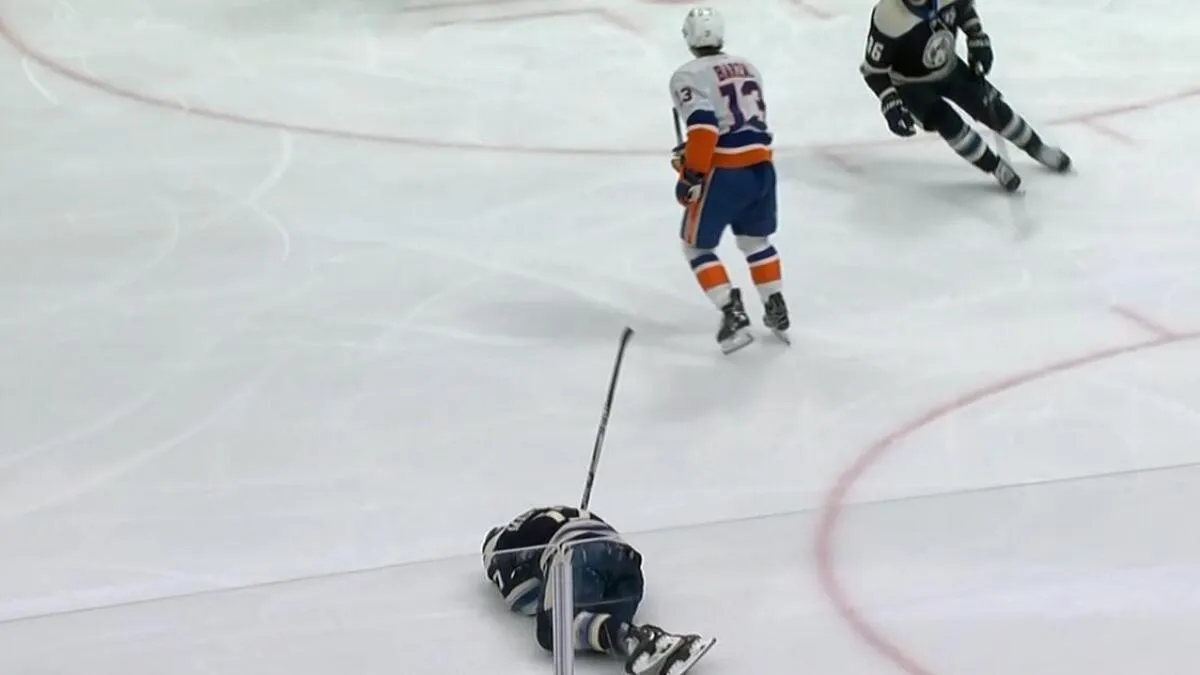
The sequence began innocently enough, with Islanders rookie sensation Matthew Schaefer skating through the neutral zone with the puck. The 18-year-old defenseman, this year’s number one overall pick and early Calder Trophy favorite, was looking to create offensive opportunities when Mason Marchment stuck out his leg in what appeared to be a knee-on-knee collision.
Marchment received a two-minute tripping penalty for the hit, which Islanders players and coaching staff immediately viewed as a deliberate attempt to injure their prized rookie. Schaefer, who averages nearly 24 minutes of ice time per game and has already accumulated 24 points in 39 games, remained on the bench and later returned to the game, seemingly no worse for wear.
The play represented a growing pattern around the league. Opponents have targeted Schaefer physically throughout his rookie campaign, testing the teenager’s ability to handle the NHL’s rougher elements. The Islanders have become increasingly protective of their young star, who represents the franchise’s future and has quickly become their most important defenseman.
Barzal, as one of the Islanders’ veteran leaders and alternate captains, took it upon himself to send a message. His response, however, would prove costly for both his wallet and his team’s chances of winning the game.
The retaliation: a two-handed slash draws major penalty
Less than two minutes after the Marchment penalty, Barzal delivered his own form of justice. As Marchment skated near the Islanders bench, Barzal delivered a forceful two-handed chop to Marchment’s leg, a clear act of retaliation that referees immediately flagged.
The officials wasted no time in assessing the appropriate punishment. Barzal received a five-minute major penalty for slashing and an automatic game misconduct, ending his night early. Under NHL rules, any major penalty for slashing carries an automatic game misconduct, meaning Barzal would watch the remainder of the contest from the locker room.
“We thought it was a knee,” Islanders head coach Patrick Roy said after the game, defending his player’s actions. “And then, we’re never going to blame a teammate for going to try and defend a teammate.”
Marchment, for his part, seemed to understand the nature of the exchange. “It’s part of my game to kind of get in the other team’s head a little bit,” he told reporters. “I was never trying to hurt him there in the middle, kind of just get in his way. Probably not smart by me.”
The slash itself didn’t injure Marchment, who returned for the third period after serving his tripping penalty. However, the extended power play proved to be a turning point in the game. Columbus scored during the major penalty and rode the momentum swing to three unanswered goals in the final period, turning a 2-1 deficit into a 4-2 victory.
NHL Player Safety ruling: maximum fine but no suspension
The NHL’s Department of Player Safety announced Monday that Barzal would be fined $5,000, the maximum allowable under the Collective Bargaining Agreement, for his slash on Marchment. The money will go to the Players’ Emergency Assistance Fund, a fund that helps former players facing financial hardship.
In their official release, the league stated: “The incident occurred at 1:34 of the second period. Barzal was assessed a major penalty and game misconduct for slashing.”
The decision to issue only a fine, rather than a suspension, raises eyebrows given the clear intent behind Barzal’s actions. The two-handed chop was undeniably a retaliatory strike meant to send a message, yet the league determined that financial punishment was sufficient discipline.
Several factors likely influenced the decision. First, Marchment was not injured on the play, which typically weighs heavily in NHL disciplinary decisions. Second, the play was clearly retaliatory, which sometimes earns players more leniency than predatory hits. Third, Barzal’s clean record in terms of suspensions may have worked in his favor, though his history of fines tells a different story.
The maximum fine amount represents the league’s acknowledgment that the act crossed a line, even if it didn’t warrant missing game time. For a player earning Barzal’s salary, $5,000 represents a significant but not devastating financial hit.
Pattern of behavior: Barzal’s growing disciplinary history
What makes this fine particularly noteworthy is Barzal’s established history of run-ins with NHL Player Safety. The Islanders forward has accumulated multiple fines over his career for various infractions, suggesting a pattern of pushing the boundaries of acceptable play.
Earlier in his career, Barzal received a $2,000 fine for diving and embellishment in April 2021, followed by a $5,000 fine for cross-checking Tampa Bay defenseman Jan Rutta just two months later. He has also been cited for unsportsmanlike conduct, adding to his reputation as a player who occasionally lets his emotions get the better of him.
His most significant previous fine came in the 2021 playoffs when he was ejected from Game 5 against the Lightning for a cross-check. That incident, which also resulted in a $5,000 fine, shares similarities with the Marchment slash—an emotional response that crossed the line into dangerous territory.
Barzal’s supporters argue that his actions, while undisciplined, stem from his competitive nature and desire to protect teammates. Critics point to the pattern as evidence that fines alone aren’t deterring the behavior. The fact that his latest fine matches his previous highest penalty suggests the league views this incident as one of his most serious transgressions.
The Islanders’ loss to Columbus demonstrated how these emotional responses can cost teams dearly. A five-minute major penalty in a close game is a significant disadvantage, and the timing couldn’t have been worse for New York.
Protecting the franchise’s future
The underlying context for this entire incident is the Islanders’ fierce protectiveness of Matthew Schaefer. The rookie defenseman has exceeded all expectations in his first NHL season, immediately stepping into a top-pairing role and delivering at both ends of the ice.
With nine goals and 24 points in 39 games while averaging 23:47 of ice time, Schaefer has established himself as the Calder Trophy favorite and the potential cornerstone of the Islanders defense for the next decade. His presence has revitalized a franchise that has struggled to develop elite homegrown talent.
This isn’t the first time the Islanders have shown their willingness to go to bat for their young star. During the preseason, veteran players positioned themselves as human shields to prevent Rangers forward Matt Rempe from engaging Schaefer physically. The message was clear: opponents would have to go through the entire roster to get to their prized rookie.
Coach Roy’s postgame comments reinforced this mentality. “Teams seem to be physical on (Schaefer),” he noted. “I like the response by (Barzal).” While Roy certainly didn’t endorse the two-handed slash specifically, his support for the principle of teammate protection was evident.
The challenge for the Islanders is balancing that protective instinct with the discipline required to win games. Barzal’s intentions may have aligned with team unity, but the execution and resulting penalty actively hurt his team’s chances of victory.
Inconsistency in NHL discipline: the comparison debate
Perhaps the most controversial aspect of the Barzal ruling is its apparent inconsistency with recent NHL disciplinary decisions. Just weeks earlier, Toronto Maple Leafs forward Bobby McMann received a one-game suspension for a retaliatory slash on Tampa Bay’s Oliver Bjorkstrand.
The McMann incident, which occurred during a Maple Leafs-Lightning game, involved a similar act of retaliation after Bjorkstrand made contact with a Maple Leafs player. Yet McMann’s punishment included both a fine and a suspension, while Barzal’s did not.
This disparity has led many to question the consistency of NHL Player Safety’s decision-making process. Both plays involved retaliatory slashes. Both were clear violations of the rules. Yet the outcomes differed significantly.
The league might argue that each incident must be judged on its own merits, considering factors like injury, intent, and game situation. However, the optics of such seemingly similar plays receiving vastly different punishments undermine confidence in the system.
Critics suggest that star power may have influenced the decision. Barzal is a higher-profile player than McMann, and the Islanders are in a tight playoff race. A suspension would have been a significant blow to New York’s postseason hopes. The Bobby McMann suspension case provides an interesting parallel that highlights these concerns.
The NHL has long faced criticism for inconsistent disciplinary rulings, and this latest pair of decisions does little to silence those concerns. Players, coaches, and fans are left wondering where the line truly sits between a fine and a suspension.
Takeaway: defending teammates comes at a cost
Mathew Barzal’s $5,000 fine for his two-handed slash on Mason Marchment serves as a reminder that the NHL has clear boundaries, even when emotions run high and teammates need protection. While Barzal’s instinct to defend Matthew Schaefer aligns with hockey’s unwritten code, his method crossed into unacceptable territory.
The Islanders lost more than just $5,000 from Barzal’s paycheck. They lost a key player for most of Sunday’s game, surrendered a critical five-minute penalty kill, and ultimately dropped two points in the standings. The protective mentality that bonds teams can also burn them when discipline fails.
For Barzal personally, this represents another mark on a disciplinary record that continues to grow. While he has yet to be suspended, the pattern of fines suggests a player who occasionally allows emotion to override better judgment. At 27 years old and in his prime, Barzal must find a way to channel his competitive fire more constructively.
The NHL’s decision not to suspend him keeps the Islanders’ playoff hopes intact, but the maximum fine signals that the league views this as a serious infraction. As the season progresses and physical play intensifies, all eyes will be on how players like Barzal balance the instinct to protect teammates with the discipline required to stay on the right side of the rulebook.
Protecting a rookie sensation like Matthew Schaefer is commendable. Doing so in a way that hurts your team’s chances of winning is not. Barzal and the Islanders must learn from this costly lesson as they navigate the physical and emotional challenges of a playoff push.
Frequently Asked Questions

Par Mike Jonderson
Mike Jonderson is a passionate hockey analyst and expert in advanced NHL statistics. A former college player and mathematics graduate, he combines his understanding of the game with technical expertise to develop innovative predictive models and contribute to the evolution of modern hockey analytics.