



Matthew Tkachuk skating return date remains TBD for Panthers despite progress
The Florida Panthers are navigating the 2025-26 season without one of their most dynamic players, as Matthew Tkachuk continues his recovery from offseason surgery. While the star forward has taken a significant step by returning to the ice, the organization maintains a cautious approach regarding his comeback timeline. Tkachuk underwent surgery on August 22 to repair a torn adductor muscle and sports hernia, injuries that plagued him throughout last season’s championship run. His absence has created a notable void in Florida’s lineup, though the team is prioritizing his long-term health over a rushed return.
Recent updates from both Tkachuk and Panthers head coach Paul Maurice reveal a player making steady progress but still facing considerable hurdles before he can rejoin his teammates for practice, let alone game action. The situation exemplifies the delicate balance between medical clearance, physical readiness, and competitive urgency that defines NHL injury recoveries. With the Panthers defending their second consecutive Stanley Cup title, every development in Tkachuk’s rehabilitation carries significant implications for the franchise’s ambitions.
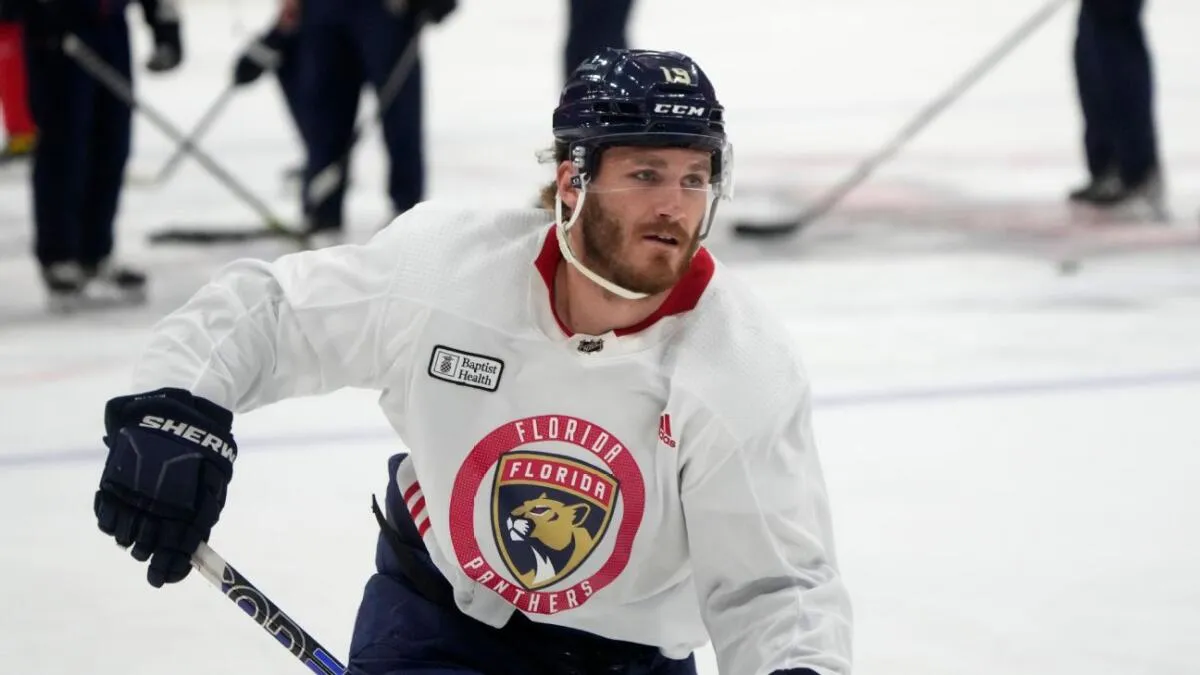
The injury timeline that led to Tkachuk’s surgery
The foundation of Matthew Tkachuk’s current absence traces back to February’s 4 Nations Face-Off tournament, where he initially sustained the injury representing Team USA. Rather than immediately seeking surgical intervention, Tkachuk opted to manage the problem through rehabilitation, a decision that allowed him to participate in Florida’s historic pursuit of back-to-back championships. The forward missed the final 25 games of the regular season as he dealt with the torn adductor muscle and sports hernia, focusing his energy on returning for the postseason.
What transpired next became one of the remarkable stories of the 2025 playoffs. Tkachuk rejoined the Panthers lineup and delivered an exceptional performance despite obvious physical limitations, accumulating 23 points (8 goals, 15 assists) across 23 postseason games. His contributions proved instrumental in Florida’s victory over the Edmonton Oilers in the Stanley Cup Final, where he posted seven points in six games. The image of Tkachuk battling through pain to secure another championship cemented his status as a warrior in the eyes of Panthers fans.
The decision to delay surgery until late August came after Tkachuk and the team’s medical staff exhausted conservative treatment options. As he explained on his “Wingmen” podcast, the turning point occurred during a video shoot for EA Sports’ NHL 26 cover, where he joined his brother Brady and father Keith for the deluxe edition artwork. “This was really the first time I legit put on my skates since Game 6,” Tkachuk admitted, noting that the activity revealed the injury hadn’t healed sufficiently. The subsequent procedure meant he would miss the start of the 2025-26 season, with an initial recovery window estimated between December and January.
Tkachuk’s return to skating and recovery protocol
Matthew Tkachuk’s rehabilitation reached a meaningful milestone when he stepped onto the ice in Fort Lauderdale last week, marking his first legitimate skating session since the Panthers clinched the Stanley Cup on June 18. According to coach Paul Maurice, Tkachuk skated twice during that initial week before consulting with doctors to evaluate his progress and establish the next phase of his recovery plan. This development represents a crucial psychological boost for both the player and organization, signaling the transition from off-ice conditioning to on-ice activity.
The Panthers have implemented a deliberately conservative approach to Tkachuk’s skating progression. Maurice confirmed that the star forward is following an alternating day schedule—skating one day, training the next—to manage soreness and prevent setbacks. “He is on an on-off schedule; he skates one, then trains one just to keep the soreness out,” Maurice detailed in his recent press conference. This methodology reflects the organization’s commitment to monitoring Tkachuk’s health closely rather than adhering to an arbitrary calendar date.
On his podcast, Tkachuk shared his personal perspective about those first strides back on the ice. “It was a weird feeling,” he acknowledged, while also expressing optimism about his trajectory. “The docs and the trainers and the rehab schedule that I am on is really good, really easy to just continue to ramp up like any other injury. It did feel so weird, but I felt better than I did in my first skate in the playoffs.” His comments reveal both the physical and mental challenges of returning from significant surgery, even for an elite athlete accustomed to pushing through discomfort.
Medical milestones and the uncertain timeline
Despite the positive development of Tkachuk returning to the ice, the Panthers organization is carefully managing expectations about the timeline. Coach Maurice was explicit in his assessment: “He’s still a ways away.” This candid evaluation underscores the complex nature of recovering from both a torn adductor muscle and sports hernia, injuries that require complete healing before a player can safely resume the explosive movements and physical contact inherent to NHL play.
The medical staff has established specific benchmarks Tkachuk must achieve before advancing to the next stage of his rehabilitation. These markers include demonstrating sufficient power and strength in the affected areas, which will allow him to progress from the current one-day-on, one-day-off skating schedule to a more demanding two-days-on, one-day-off routine. Only after clearing these physical thresholds will the team consider integrating him into full practice sessions with teammates.
General manager Bill Zito had previously indicated hopes that Tkachuk would be skating with the team again by mid-December. While that target remains theoretically possible, Maurice’s recent comments suggest flexibility is paramount. “It was December, January, is what we were told,” the coach recalled. “It’s an eight-week window, but that’s where these injuries are. He just has to hit a bunch of milestones before he can be pushed.” This uncertainty explains why the Panthers officially list Tkachuk’s return date as “to be determined” rather than committing to a specific timeframe.
Impact on Panthers’ lineup and championship defense
Florida’s ability to remain competitive without Tkachuk reflects the organization’s depth and resilience, though his absence is certainly felt. The Panthers currently sit sixth in the Atlantic Division with a 12-9-1 record, navigating not only Tkachuk’s absence but also a series of significant injuries to other key players. Captain Aleksander Barkov’s knee surgery, which will sideline him for 7-9 months, compounds the challenge, leaving the team without its top two forwards.
The extended absences have created opportunities for other roster members to assume larger roles. Young players and depth forwards have received increased ice time and responsibility, which could benefit the team long-term as it builds experience and chemistry. However, the offensive production and physical presence that Tkachuk provides—his ability to agitate opponents, create space for linemates, and contribute in all situations—represents an irreplaceable element that the Panthers are carefully conserving for the stretch run.
Looking ahead, Tkachuk’s recovery timeline also intersects with international hockey commitments. Both Matthew and his brother Brady were named to the United States’ preliminary roster for the Olympic Winter Games Milano Cortina 2026, scheduled for February. While his NHL return remains the priority, the potential to represent his country on such a prestigious stage provides additional motivation for Tkachuk to complete his rehabilitation properly. A healthy, fully recovered Tkachuk joining the Panthers lineup in December or January would position Florida as a formidable contender entering the playoff push, potentially peaking at the right time to defend their title.
What Tkachuk’s return means for Florida’s Cup chances
The significance of Matthew Tkachuk’s eventual return extends beyond simply adding another elite player to the lineup. His presence transforms the Panthers’ identity, bringing a combination of skill, grit, and emotional leadership that elevates everyone around him. During last season’s playoff run, Tkachuk’s willingness to sacrifice his body despite injury set a tone for the entire organization, creating a culture where players embrace discomfort for collective success.
From a tactical perspective, Tkachuk’s return allows coach Maurice to reconfigure his forward combinations in ways that maximize matchups against opponents. His versatility enables him to play various roles, whether driving a scoring line with elite playmakers or providing a physical edge alongside the team’s energetic bottom-six forwards. The psychological boost to teammates cannot be overstated—seeing Tkachuk back in uniform signals that the Panthers are whole again and ready for the championship defense to truly begin.
The organization’s methodical approach to his recovery, while frustrating for fans eager to see him back on the ice, demonstrates a championship-caliber understanding of what matters most. General manager Bill Zito and the medical staff have earned the benefit of the doubt after successfully managing injuries throughout last season’s title run. Their patience with Tkachuk reflects confidence in the team’s current ability to stay afloat in the standings and a belief that a fully healthy Tkachuk in April and May is infinitely more valuable than a compromised version in November and December.
Matthew Tkachuk’s journey from August surgery to his recent return to the ice represents another chapter in his evolving legacy with the Florida Panthers. While his exact return date remains uncertain, the progress he’s made suggests the wait won’t extend much longer. For a franchise simultaneously defending a championship and managing an unprecedented injury list, having their passionate superstar back in the lineup—when he’s truly ready—might be the catalyst for another deep playoff run. The Panthers have proven they can win without him in the short term; with him, they become a different, more dangerous team entirely.
Frequently Asked Questions

Par Mike Jonderson
Mike Jonderson is a passionate hockey analyst and expert in advanced NHL statistics. A former college player and mathematics graduate, he combines his understanding of the game with technical expertise to develop innovative predictive models and contribute to the evolution of modern hockey analytics.