
The Miami RedHawks have burst onto the college hockey scene with their best start in nearly two decades. For a program that endured a challenging 3-28-3 campaign just last season, the transformation has been nothing short of remarkable. The RedHawks’ 4-0-0 record to open the 2025-26 season marks their first time starting undefeated through four games since the memorable 2007-08 campaign, when they finished with a program-best 33-8-1 record.
This hot start has already earned Miami recognition in the national polls, receiving votes for the first time in two years. The RedHawks have demonstrated resilience and versatility by sweeping both Ferris State and RPI in different styles of play, showcasing their ability to win offensive shootouts and defensive battles alike. What makes this start even more impressive is that Miami has achieved it without highly touted freshman goaltender Shika Gadzhiev, who remains sidelined with eligibility issues, and dynamic forward David Deputy, who has been out since the opening period of the season opener with an injury.
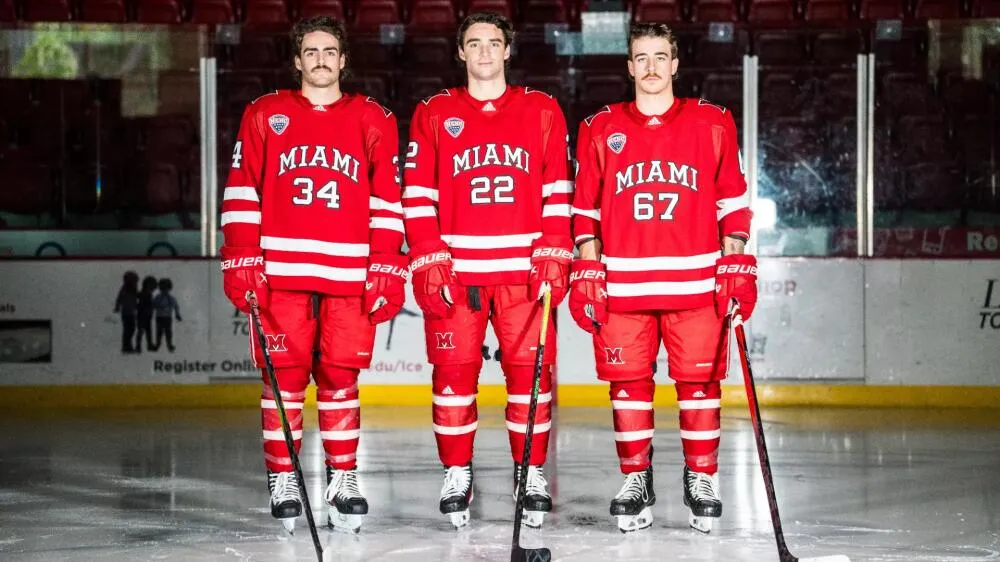
Miami RedHawks’ top line chemistry drives offensive success
The most significant takeaway from the Miami RedHawks 4-0-0 start is the exceptional chemistry developed by the top line of Kocha Delic, Ilia Morozov, and Matteo Giampa. This trio has been the catalyst for Miami’s offensive explosion, combining for 19 points through the first four games. Giampa leads the team with eight points on three goals and five assists, while Delic has emerged as the team’s top goal scorer with four tallies.
Head coach Anthony Noreen identified the unique blend of skills that makes this line so effective. Giampa brings size, elite skating ability, and impressive puck-handling skills that create sustained offensive zone time. His presence on the top power-play unit has been instrumental in the RedHawks’ 25% success rate with the man advantage. The junior forward has also contributed two game-winning goals, demonstrating his ability to deliver in crucial moments.
Delic has been an absolute workhorse, averaging a team-leading 20:06 of ice time per game among forwards. His relentless energy and speed have drawn comparisons to an “Energizer Bunny” from his coaching staff. The improvement in his defensive game, particularly his active stick work and backchecking, has made him a complete two-way threat. His quick-release wrist shot might be the most dangerous weapon in Miami’s arsenal, and he’s been equally effective on both special teams units.
The revelation of this line has been 17-year-old Ilia Morozov, who is not only the youngest player on the Miami roster but the youngest player in all of college hockey. Despite his age, Morozov has compiled seven points on three goals and four assists, including a six-point weekend against RPI where he recorded his first two collegiate goals. His patience with the puck and advanced playmaking ability have scouts taking notice, as evidenced by his “B” grade on the preliminary NHL Central Scouting Rankings, projecting him as a potential second or third-round pick in the 2026 NHL Draft.
Morozov’s maturity extends beyond his offensive production. While he’s still adjusting to the college faceoff circle with a 42% win rate, his willingness to engage physically despite his youth and his defensive awareness have exceeded all expectations. The decision to accelerate his academic schedule to arrive early has paid immediate dividends for the RedHawks.
Matteo Drobac’s stellar goaltending anchors defensive success
One of the most critical Miami RedHawks 4-0-0 start takeaways centers on the outstanding performance of goaltender Matteo Drobac. The junior netminder has been a wall between the pipes, posting a perfect 4-0-0 record with a 2.00 goals-against average and an impressive .928 save percentage. Through four games, Drobac has faced 111 shots and turned aside 103 of them, providing the consistency and confidence Miami needed after last season’s struggles.
Drobac’s ability to maintain composure under pressure was on full display during the RPI series. After allowing two early goals in Friday’s opener, he settled down and stopped 24 of the final 27 shots he faced, even adding an assist to his stat line. His short-term memory and ability to reset mentally after each period proved crucial as Miami mounted a comeback victory.
The highlight of Drobac’s early season came Saturday night when he recorded his first collegiate shutout, stopping all 26 shots in a dominant 5-0 victory over RPI. His improved rebound control throughout the weekend demonstrated his attention to detail and willingness to refine his game. This performance earned him NCHC Goaltender of the Week honors, adding to Miami’s historic week where three RedHawks players captured conference awards simultaneously.
Coming from the high-octane Ontario Hockey League, where he played approximately 50 games in his overage season, Drobac has embraced the college schedule. The two-game weekend format followed by a week of practice, film study, and skill development has allowed him to maintain peak performance while addressing areas for improvement. His experience facing heavy shot volumes in junior hockey has prepared him well for the workload, and he appears comfortable carrying the starting duties with Gadzhiev unavailable.
Depth scoring and special teams improvement emerging
Beyond the top line’s dominance, the Miami RedHawks have demonstrated impressive depth throughout their lineup, a crucial factor in their perfect start. The ability to roll four lines effectively has kept Miami fresh while wearing down opponents over 60 minutes. The fourth line has embraced its checking role, providing energy and defensive responsibility, while the third line featuring Doug Grimes, Casper Nassen, and Justin Stupka has contributed timely depth scoring.
Max Helgeson exemplifies the value of Miami’s depth and versatility. Playing on the second line, Helgeson has delivered 100% effort on every shift, contributing two goals including the game-winner in Friday’s matchup at RPI. His ability to move up and down the lineup as needed has been invaluable, especially with Deputy sidelined. This kind of adaptability gives coach Noreen flexibility in matching lines and managing different game situations.
Special teams have shown marked improvement, though there remains room for growth. According to The Hockey Writers, Miami’s power play is operating at 25% efficiency with four conversions on 16 opportunities. Giampa, Morozov, Delic, and Michael Quinn have all found the back of the net with the man advantage, spreading the threat across multiple units. The RedHawks’ ability to generate quality chances and finish on the power play represents a significant improvement from recent seasons.
The penalty kill has been solid at 80% success rate, though it will face tougher tests as the season progresses. Freshman Ethan Hay has emerged as a valuable shorthanded asset, winning crucial defensive zone faceoffs to alleviate pressure. His 73.7% faceoff performance in the RPI finale, including four shorthanded wins, demonstrated poise beyond his years.
Faceoffs overall remain an area requiring continued focus. Miami’s 40.3% success rate through four games shows improvement from early season struggles but needs to climb closer to 50% for sustained success. Hay leads the team with 33 faceoff wins at a 44.6% clip, establishing himself as Miami’s most reliable center in the circle. This is particularly important given that faceoff struggles have plagued the program in recent campaigns.
Defensive core providing stability and puck movement
The Miami defensive corps has been instrumental in the team’s early success, providing both shutdown defense and offensive contributions. Vladislav Lukashevich anchors the blue line, leading all defensemen with an average of 21:32 ice time per game. His two-way capabilities have made him indispensable, seeing time on both power play and penalty kill units while generating offense from the back end.
Ryder Thompson has been a shot-blocking machine, leading the team with 11 blocked shots through four games. His willingness to sacrifice his body and commitment to team defense has set the tone for Miami’s defensive identity. Thompson’s physical presence and gap control have limited opponents’ clean zone entries and disrupted offensive cycles.
The defensive group’s ability to move the puck efficiently has been another key component of Miami’s success. Quick breakouts have allowed the RedHawks to transition from defense to offense seamlessly, feeding their speedy forwards in stride and creating odd-man rushes. This aggressive yet controlled style has helped Miami maintain possession and dictate the pace of play.
Miami’s defensive structure has also benefited from improved team defense throughout the lineup. Forwards are backchecking with purpose, providing support in the defensive zone and eliminating odd-man rushes against. The RedHawks are averaging 30.3 shots per game while limiting opponents’ quality chances, a balance that reflects both offensive aggression and defensive responsibility.
Recognition and momentum building for program resurgence
The early season accolades for Miami players signal a changing perception of the program nationally. Four different RedHawks have earned NCHC weekly honors in the season’s first three weeks, with Justin Stupka winning Rookie of the Week after the opening weekend, followed by Morozov (Forward of the Week), Drobac (Goaltender of the Week), and Delic (Rookie of the Week) all earning recognition in the same week. According to Miami RedHawks official coverage, this marked the first time in program history that three Miami players captured NCHC weekly awards simultaneously, a testament to the team-wide excellence being displayed.
The presence of NHL scouts at Miami games represents another significant development. At least one NHL scout was spotted in Oxford for the Ferris State series, with interest likely centered on Morozov but potentially evaluating other RedHawks as well. This attention benefits the entire program, raising Miami’s profile in recruiting circles and validating the development work being done by the coaching staff.
Miami’s victory over Ferris State carries additional weight given the Bulldogs’ subsequent road upset of then-No. 1 Western Michigan. The RedHawks didn’t just beat Ferris State—they swept a team capable of taking down the nation’s top-ranked squad. This transitive property doesn’t always hold in sports, but it suggests Miami handled a higher caliber opponent than some initially realized.
The RedHawks now face Lindenwood, a team that just split a series with then-No. 5 Denver, presenting another opportunity to prove this start is legitimate. As Miami prepares to enter full NCHC conference play, maintaining this momentum will be crucial. The return of Gadzhiev and Deputy would provide even more depth and options, though the team has clearly adapted well to their absences.
For a program that won just three games all of last season, this 4-0-0 start represents more than a hot streak—it’s evidence of a fundamental shift in culture, execution, and expectations. Miami has rediscovered the winning formula that made them a national contender in the past. The blend of veteran leadership from players like Giampa and Drobac with the youthful energy of Morozov, Stupka, and other freshmen has created a balanced roster capable of competing with anyone. If the RedHawks can maintain their defensive structure, continue developing their special teams, and stay healthy, this season could mark the beginning of Miami’s return to national prominence in college hockey. The 2025-26 campaign is still young, but the foundation being built in Oxford suggests these RedHawks are ready to soar far beyond anyone’s preseason expectations.

Par Mike Jonderson
Mike Jonderson is a passionate hockey analyst and expert in advanced NHL statistics. A former college player and mathematics graduate, he combines his understanding of the game with technical expertise to develop innovative predictive models and contribute to the evolution of modern hockey analytics.