



The Miami RedHawks hockey team delivered a statement performance on Saturday night, defeating the Arizona State Sun Devils 5-2 at Goggin Ice Center in Oxford, Ohio. The victory was more than just another win in the standings—it represented a breakthrough moment for a program that had endured 658 days without an NCHC conference victory. In a season already filled with promise, this triumph over Arizona State marked head coach Anthony Noreen’s first conference win and validated the dramatic transformation taking place within the RedHawks’ locker room.
The game showcased everything Miami has been building toward this season: resilience in the face of adversity, depth throughout the lineup, and an unwavering commitment to playing the right way for a full 60 minutes. After dropping Friday’s series opener 4-1 to the Sun Devils, the RedHawks responded with perhaps their most complete performance of the young season, erasing a 41-game NCHC winless streak that had haunted the program since January 2024.
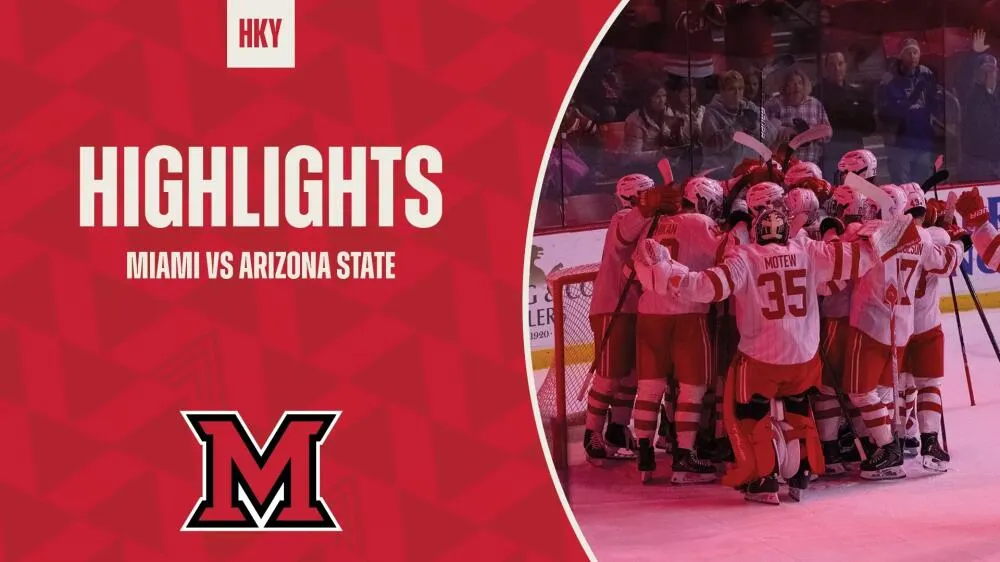
Miami’s offensive explosion breaks through conference drought
Max Helgeson and Ryan Smith led the offensive charge for the Miami RedHawks, each finding the back of the net twice in the commanding victory. Helgeson opened the scoring just 2:02 into the game, winning a 1-on-2 battle along the boards before carrying the puck to the net and roofing a wrist shot past Arizona State goaltender Connor Hasley. The early goal set the tone for a RedHawks squad determined to avenge the previous night’s defeat.
Smith’s performance was particularly noteworthy, as the sophomore transfer from Quinnipiac has now scored in Miami’s last four Saturday games, tallying five goals during that span. After managing just two goals and three assists in 33 games with the Bobcats last season, Smith has found new life in Oxford with six goals already this year. His second goal of the night came late in the third period on an empty-netter, playing give-and-go with Blake Mesenburg to seal the 5-2 victory with 1:12 remaining in regulation.
Freshman Ethan Hay provided the game-winning goal in spectacular fashion, scoring shorthanded late in the second period. Taking a drop pass from Justin Stupka on a 3-on-2 rush, Hay fired a laser one-timer past Hasley with just two seconds remaining on the Miami penalty. The goal was Hay’s first collegiate tally and Miami’s first shorthanded marker in 34 games, dating back to October 2024. According to The Hockey Writers’ coverage of the game, the momentum-swinging strike proved to be a critical turning point.
Kocha Delic extended his points streak to eight games with two assists, matching the longest streak to open a season since Carter Camper’s nine-game run in 2010. The consistent production from Delic, combined with contributions from Doug Grimes (who extended his points streak to six games) and Stupka (five points in five games), demonstrated the depth and balance that has defined Miami’s successful start to the season.
Adversity strikes as depth answers the call
The complexion of the game changed dramatically at the 11:37 mark of the first period when 17-year-old phenom Ilia Morozov received a five-minute major penalty and game misconduct for cross-checking. The incident occurred just over a minute after Arizona State had tied the game, and the loss of one of Miami’s top forwards—not to mention the extended penalty kill—could have derailed the RedHawks’ chances.
Instead, Miami’s penalty kill unit rose to the occasion, successfully navigating the five-minute major without allowing a goal. Despite entering the weekend with a concerning 71.4% penalty kill percentage, the RedHawks’ short-handed unit found its stride when it mattered most. The team finished the game killing four of five Arizona State power plays, blocking 12 shots in the process while keeping the Sun Devils from establishing any sustained offensive rhythm.
Coach Noreen praised his team’s response to losing Morozov, highlighting how the adversity galvanized the entire roster. “You’re in a situation where the five-minute kill is the turning point of the game,” Noreen explained after the victory. “With that power play, and those guys going against first-rounders all over the place, that could very easily go the other way, and you get through it, and there was a really good feeling from that point on.”
David Deputy emerged as the unlikely hero in Morozov’s absence. Playing just his second game back from injury, Deputy started on the fourth line but quickly earned promotion to the top unit alongside Delic and Matteo Giampa. He finished with a career-high 17:28 of ice time, tied for the team lead with seven shots on goal, and notched his first collegiate point with a primary assist on Helgeson’s second goal. Deputy’s explosive speed and two-way play showcased why the coaching staff had been so high on him during the offseason, and Noreen’s postgame comments suggested there’s much more to come from the freshman forward.
Penalty kill excellence swings momentum
Miami’s special teams performance, particularly on the penalty kill, proved decisive in securing the 5-2 win over Arizona State. After struggling through much of the early season with their short-handed units, the RedHawks found their identity when facing extended pressure. Beyond the crucial five-minute major kill in the first period, Miami continued to frustrate Arizona State’s power play throughout the contest.
Ryder Thompson led the defensive effort with three blocked shots while logging a team-high 22:42 of ice time and finishing plus-3 on the night. His quiet but effective performance anchored a defensive corps that limited Arizona State to just 23 shots on goal, including a mere five attempts in the final period. The entire defensive unit played with discipline and structure, helping goaltender Matteo Drobac maintain clear sightlines and limiting second-chance opportunities.
The game-winning shorthanded goal by Hay in the second period exemplified Miami’s aggressive, confident approach to penalty killing. Rather than simply clearing pucks and playing conservative hockey, the RedHawks looked for opportunities to counter-attack. The rush that produced Hay’s goal featured quick puck movement and smart positioning, with Stupka making an excellent read to drop the pass at precisely the right moment.
Noreen identified the shorthanded tally as perhaps the biggest goal of Miami’s season to date. “What Ethan does doesn’t always show up on the scoresheet,” the coach noted. “That kid is every single thing we want this program to be about. That was probably the biggest goal we’ve scored as a team all year. So that was a huge moment, and I thought our kill was excellent.”
The penalty kill success continued even after Miami took a bench minor midway through the second period, reportedly for comments from Noreen directed at the officials. The RedHawks killed that penalty as well, maintaining their defensive integrity and refusing to let Arizona State build any sustained momentum despite the numerous power play opportunities.
Goaltending and defensive structure seal the victory
Matteo Drobac continued his impressive start to the season, stopping 21 of 23 shots and improving his record to 7-1. The sophomore netminder has played every minute in net for Miami this season and has been particularly stellar on odd-man rushes and breakaways. Both goals he allowed came on excellent plays by Arizona State—Cruz Lucius’ wrist shot from the right faceoff circle and Benjamin Kevan’s backdoor finish on a perfectly threaded pass from former Miamian Johnny Waldron—giving Drobac little chance on either.
What has impressed observers most about Drobac’s play is his consistency and poise. He hasn’t allowed a soft goal all season, maintaining a 2.61 goals-against average and a .911 save percentage through eight games. His ability to remain calm under pressure has provided Miami with the stable goaltending that championship teams require. According to View from the Glass’s detailed game coverage, Drobac shut down yet another breakaway in this contest, continuing his excellent play in high-danger situations.
The defensive structure in front of Drobac improved markedly from Friday’s loss. Miami held Arizona State to just 23 shots while outshooting the Sun Devils 31-23, a significant improvement from the previous night’s 20-shot performance. More importantly, the RedHawks limited high-quality scoring chances, forcing Arizona State to shoot from the perimeter or through traffic.
Michael Quinn earned the lone point among defensemen, his fourth of the season, but the entire blue line contributed with strong positional play and active sticks in passing lanes. The defense helped Miami control the third period completely, allowing just five shots on goal while protecting the lead. This defensive commitment in the final 20 minutes—refusing to sit back and instead continuing to play aggressive, proactive hockey—demonstrated the maturity and confidence this young team has developed.
Response to adversity defines new Miami identity
Following Friday’s disappointing 4-1 loss to Arizona State, Coach Noreen delivered a pointed message to his team: the previous night’s performance was not up to standard, regardless of the 2-1 scoreline and missed opportunities. The RedHawks’ response on Saturday validated everything the first-year head coach has been preaching since taking over the program.
“I think it was evident from the drop of the puck,” Noreen said after the game. “I think it’s very easy to look at last night’s game and say, oh, it’s a 2-1 game, we had our chances, but no, that was not to our standard. It’s really easy for us as a staff to put those clips together, and it’s really easy for us to be hard on the guys during the day and deliver a message. The hard part is them taking it and actually doing the work on the ice, and I thought we were as physical as we’ve been all year.”
The physicality and compete level were evident from the opening faceoff. Miami won crucial battles along the boards, finished checks consistently, and never allowed Arizona State to establish the same transition game that had been so effective on Friday. The RedHawks blocked 12 shots compared to Arizona State’s eight, throwing their bodies in front of pucks and making life difficult for the Sun Devils’ skilled forwards.
Miami’s willingness to play a complete 60-minute game marked a significant departure from the patterns that plagued previous seasons. Rather than protecting a lead in the third period, the RedHawks continued to attack, generating quality chances and maintaining offensive pressure. They outshot Arizona State 10-5 in the final frame, refusing to give the Sun Devils any momentum or belief they could mount a comeback.
The transformation from last season’s struggles—when Miami went winless in 41 consecutive NCHC games—to this year’s 7-1 start represents one of college hockey’s most remarkable turnarounds. While the 41-game conference winless streak was technically a separate entity from this year’s team, exorcising that demon represented an important psychological milestone for the program. The players may not have lived through all those losses, but the weight of the drought hung over Goggin Ice Center nonetheless.
What the win means for Miami’s season trajectory
The 5-2 victory over Arizona State and the subsequent series split provided several crucial takeaways for Miami moving forward. First, the RedHawks demonstrated they can compete with quality NCHC competition when executing their game plan. Arizona State entered the weekend ranked and had won three straight games against Miami dating back to 2024, but the RedHawks’ response after Friday’s setback showed this is a program with championship aspirations, not one satisfied with merely being competitive.
Second, Miami’s depth has proven to be a significant strength. When Morozov was ejected, multiple players stepped up seamlessly. Deputy’s emergence, Hay’s game-winning goal, and contributions from role players throughout the lineup demonstrated that this team doesn’t rely solely on its top-line forwards. That depth will be crucial as the season progresses and injuries inevitably mount.
Third, the power play, while still not converting on Saturday (0-for-5), generated quality chances and maintained strong puck movement even without Morozov. At 17.2% on the season, Miami’s power play ranks tied for 36th nationally—respectable but with room for improvement. Noreen praised the unit’s performance despite the lack of goals, noting it was their best effort of the season and generated momentum each time they took the ice.
Fourth, special teams competence can elevate Miami from a good team to a great one. The penalty kill’s performance against Arizona State showed what this unit is capable of when playing with structure and confidence. If the RedHawks can maintain an 80% or better kill rate moving forward, they’ll be difficult to beat in tight conference games.
The victory moves Miami to 7-1 overall and 1-1 in NCHC play, tied for third place in the conference standings with three points. With a bye week ahead before traveling to face defending national champion Western Michigan on November 14-15, the RedHawks have time to rest, heal, and build on Saturday’s breakthrough performance.
The test against Western Michigan will provide another measuring stick for how far this program has come. The Broncos remain one of the elite teams in college hockey, and earning a split or better in Kalamazoo would send a clear message that Miami belongs in the conversation among the NCHC’s upper echelon. For now, though, the RedHawks can savor ending the longest conference winless streak in program history and embrace the identity they’re forging under Noreen’s demanding leadership—a team that refuses to accept anything less than maximum effort and playing the right way for 60 minutes, regardless of the opponent or circumstances.

Par Mike Jonderson
Mike Jonderson is a passionate hockey analyst and expert in advanced NHL statistics. A former college player and mathematics graduate, he combines his understanding of the game with technical expertise to develop innovative predictive models and contribute to the evolution of modern hockey analytics.