












Dallas Stars forward Mikko Rantanen received an automatic one-game suspension after accumulating two game misconduct penalties for boarding incidents within an eight-day span. The suspension, mandated by NHL Rule 23.6, kept Rantanen out of Tuesday night’s matchup against the Edmonton Oilers, a critical early-season test for the Stars.
The league’s Department of Player Safety elected not to hold a formal hearing for the latest incident, instead allowing the automatic suspension mechanism to take effect. This little-known rule has now put the Star’s marquee offseason acquisition under scrutiny, raising questions about how the team will manage his physical style of play moving forward. Rantanen, who leads the entire NHL with 57 penalty minutes, must now navigate a 41-game period without another physical infraction game misconduct or face increasingly severe automatic penalties.
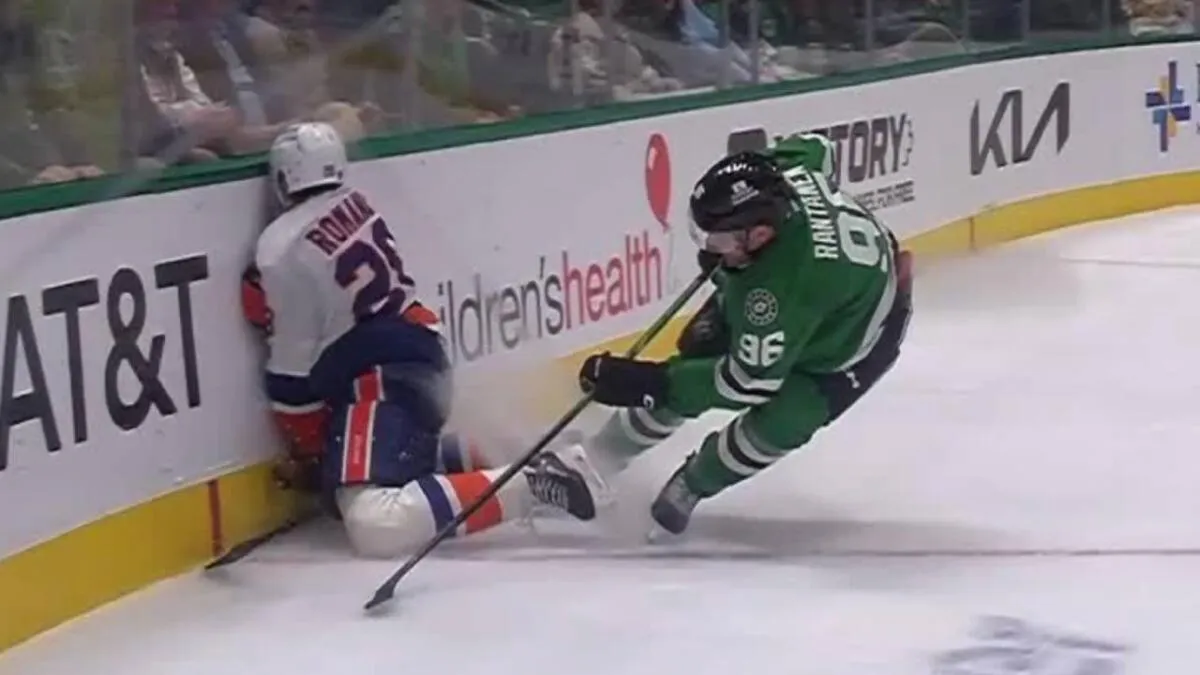
Understanding Mikko Rantanen’s automatic one-game suspension after two game misconducts for Dallas Stars
The NHL’s collective bargaining agreement and rulebook contain numerous provisions designed to curb repeat offender behavior, but Rule 23.6 remains one of the less discussed automatic suspension mechanisms. Unlike supplemental discipline that requires Department of Player Safety intervention, this rule triggers automatically when a player crosses a specific threshold.
The rule behind the suspension: NHL Rule 23.6 explained
Rule 23.6 states that any player who receives two game misconduct penalties in the “Physical Infractions Category” before playing 41 consecutive regular-season games without such a penalty faces an automatic one-game suspension. The rule explicitly lists boarding, charging, elbowing, interference, and kneeing as qualifying infractions. For each subsequent violation, the suspension increases by one additional game.
The mechanism serves as a parallel disciplinary track to the Department of Player Safety’s review process. While Player Safety officials reviewed both Rantanen incidents, they determined neither warranted additional supplemental discipline beyond the automatic penalty. The rule essentially acts as a cumulative deterrent for players who frequently cross the line physically, even if individual incidents don’t rise to the level of independent suspension.
The two incidents that triggered the NHL penalty
Rantanen’s first game misconduct came on November 18 against the New York Islanders, when he boarded defenseman Alexander Romanov with 28 seconds remaining in a 3-2 loss. The hit, which occurred at 19:32 of the third period, drew immediate condemnation from Islanders head coach Patrick Roy, who delivered a profanity-laced tirade as Rantanen left the ice.
The second incident happened four days later in Calgary, when Rantanen boarded Flames forward Matt Coronato from behind at 16:47 of the second period. While Coronato was able to finish the game, Flames coach Ryan Huska called it “a terrible hit.” The five-minute major penalty proved costly for Dallas, which eventually lost 3-2 in a shootout.
Impact on the Dallas Stars lineup and forward depth
Losing Rantanen for even a single game represents a significant blow to the Stars’ offensive arsenal. Acquired in a blockbuster trade with Carolina, Rantanen has quickly become Dallas’s most productive forward, tying with Jason Robertson for the team lead with 28 points in 22 games (10 goals, 18 assists). His combination of size, skill, and physical presence created mismatches for opponents.
The suspension forced head coach Peter DeBoer to reshuffle his top six forwards for the Edmonton matchup. Without Rantanen on the right side of the top line, the Stars had to rely on secondary scoring options in a game against Western Conference heavyweight Oilers. The timing proved particularly frustrating, coming during a stretch where Dallas needed every available point in the competitive Central Division.
How the NHL’s automatic suspension system works under Rule 23.6 for physical infractions
The NHL employs a multi-layered disciplinary system designed to address both individual incidents and patterns of behavior. While high-profile suspensions dominate headlines, the automatic suspension rule quietly manages repeat physical offenders through a structured, non-discretionary process.
The 41-game clock mechanism and penalty reset
The 41-game provision creates a pathway for players to clear their record through sustained good behavior. Once a player completes 41 consecutive regular-season games without receiving a game misconduct for a physical infraction, previous violations are removed from their current record for Rule 23.6 purposes. These incidents remain part of the player’s historical record for other disciplinary considerations but no longer count toward automatic suspension triggers.
For Rantanen, this means he must now play 41 straight games without another boarding or similar physical infraction game misconduct to reset his counter. Given his current pace of 57 penalty minutes through 22 games, maintaining clean play represents a significant adjustment. The Stars forward has accumulated 39 penalty minutes in his last three games alone, indicating an increasingly physical approach that now must be tempered.
Escalating penalties for repeat offenders
The progressive nature of Rule 23.6 creates a dangerous escalation pattern. While Rantanen’s first threshold crossing resulted in a one-game ban, a third qualifying game misconduct before his 41-game clock resets would trigger an automatic two-game suspension. A fourth would bring three games, and so on.
This structure explains why teams and players must take the first automatic suspension seriously. What begins as a one-game inconvenience can quickly spiral into extended absences if playing style doesn’t adapt. For a player of Rantanen’s caliber, missing multiple games could significantly impact Dallas’s playoff positioning and his own statistics.
Inside the two plays that cost Mikko Rantanen a game suspension
Both boarding incidents that triggered Rantanen’s suspension shared common elements: hits from behind near the boards, late in periods, with the opposing player in vulnerable positions. Understanding the specifics helps explain why they qualified for game misconducts while not rising to independent suspension standards.
The Alexander Romanov boarding that started the sequence
The November 18 incident against the Islanders proved particularly costly for the victim. With less than 30 seconds remaining and the Stars trailing, Rantanen drilled Romanov from behind into the end boards. The hit drew a five-minute major and game misconduct, though the game’s ending made the penalty largely symbolic at the time.
Romanov sustained an upper-body injury and was placed on injured reserve the following day. The Islanders later announced he requires shoulder surgery and will miss five to six months, making the incident far more serious than initially apparent. Patrick Roy’s post-game comments reflected this severity.
“I’m going to say is [that] when you see the number, you have to lay off. Everybody knows that. You don’t go through the guy,” Roy said after the game. “I was in Colorado when [Rantanen] was drafted there. It’s not his style. But at the same time, that should not be part of our game.”
The Matt Coronato hit and immediate game misconduct
The Calgary incident followed a similar pattern. As Coronato retrieved the puck along the boards, Rantanen delivered a hit from behind, driving the Flames rookie into the wall. Officials immediately assessed a major penalty and game misconduct, recognizing the boarding violation.
What made this second incident trigger the automatic suspension wasn’t necessarily increased severity, but rather the proximity in time to the first offense. Coronato’s ability to continue playing likely factored into the Department of Player Safety’s decision not to pursue additional discipline, but the pattern of behavior concerned league officials enough to let the automatic rule stand.
What Mikko Rantanen’s suspension means for Dallas Stars going forward
The automatic suspension serves as an early-season wake-up call for both Rantanen and the Stars organization. While the team can absorb a one-game absence, the underlying pattern raises questions about how to deploy their star forward effectively while keeping him on the ice.
Rantanen’s penalty minute explosion and playing style adjustment
Rantanen’s 57 penalty minutes lead the entire NHL through the first quarter of the season. To put this in perspective, his previous career-high was 54 penalty minutes in a full season. At his current pace, he would finish with approximately 212 penalty minutes, a staggering total for a skill player who also leads his team in scoring.
This dramatic increase suggests either an intentional shift toward more physical play or a series of ill-timed decisions. The Stars coaching staff must now work with Rantanen to find the right balance between using his 6-foot-4, 215-pound frame effectively and avoiding further disciplinary action. His value to the team diminishes significantly if he’s spending time in the penalty box or serving automatic suspensions.
Managing physical play while staying on the ice
The challenge for Rantanen involves maintaining his competitive edge while eliminating the specific type of hit that triggers Rule 23.6. Boarding calls typically involve hitting a player from behind or when they’re in a vulnerable position near the boards. For a power forward like Rantanen, this means adjusting approach angles and timing on forechecks.
The coaching staff may need to spend extra video sessions reviewing Rantanen’s hit selection and positioning. While they certainly don’t want to remove the physical element that makes him effective, they must ensure he understands the precise boundaries that separate clean hits from game misconducts. The automatic suspension system leaves no room for discretion or debate.
Dallas Stars fans and management must hope this early-season lesson prevents more costly absences later in the year. With the Western Conference playoff race expected to be tight, every point matters, and Dallas needs its best players available for all 82 games. The situation bears monitoring, and you can find more analysis about how the Stars are handling this disciplinary challenge on our Mikko Rantanen suspension breakdown page.
As the season progresses, Rantanen’s ability to adapt his physical play will significantly impact Dallas’s success. The automatic suspension system worked exactly as designed in this case, catching a pattern before it escalated into more serious incidents. For more details on the specific NHL rule mechanism, check our comprehensive Rule 23.6 explainer.
The Stars continue their road trip with renewed focus on disciplined physical play, hoping their star forward has learned to walk the fine line between intimidation and infraction. Rantanen’s response to this setback will define not only his season but potentially Dallas’s playoff trajectory in an increasingly competitive Western Conference.
Frequently Asked Questions

Par Mike Jonderson
Mike Jonderson is a passionate hockey analyst and expert in advanced NHL statistics. A former college player and mathematics graduate, he combines his understanding of the game with technical expertise to develop innovative predictive models and contribute to the evolution of modern hockey analytics.